Introduction
A customer enters a hypermarket with a shopping list. They walk through the grocery section, explore personal care products, and move toward electronics. Along the way, several promotional posters and digital screens display offers, but many go unnoticed.
This creates a familiar challenge for retailers. How can stores communicate relevant promotions to customers who are constantly moving between departments?
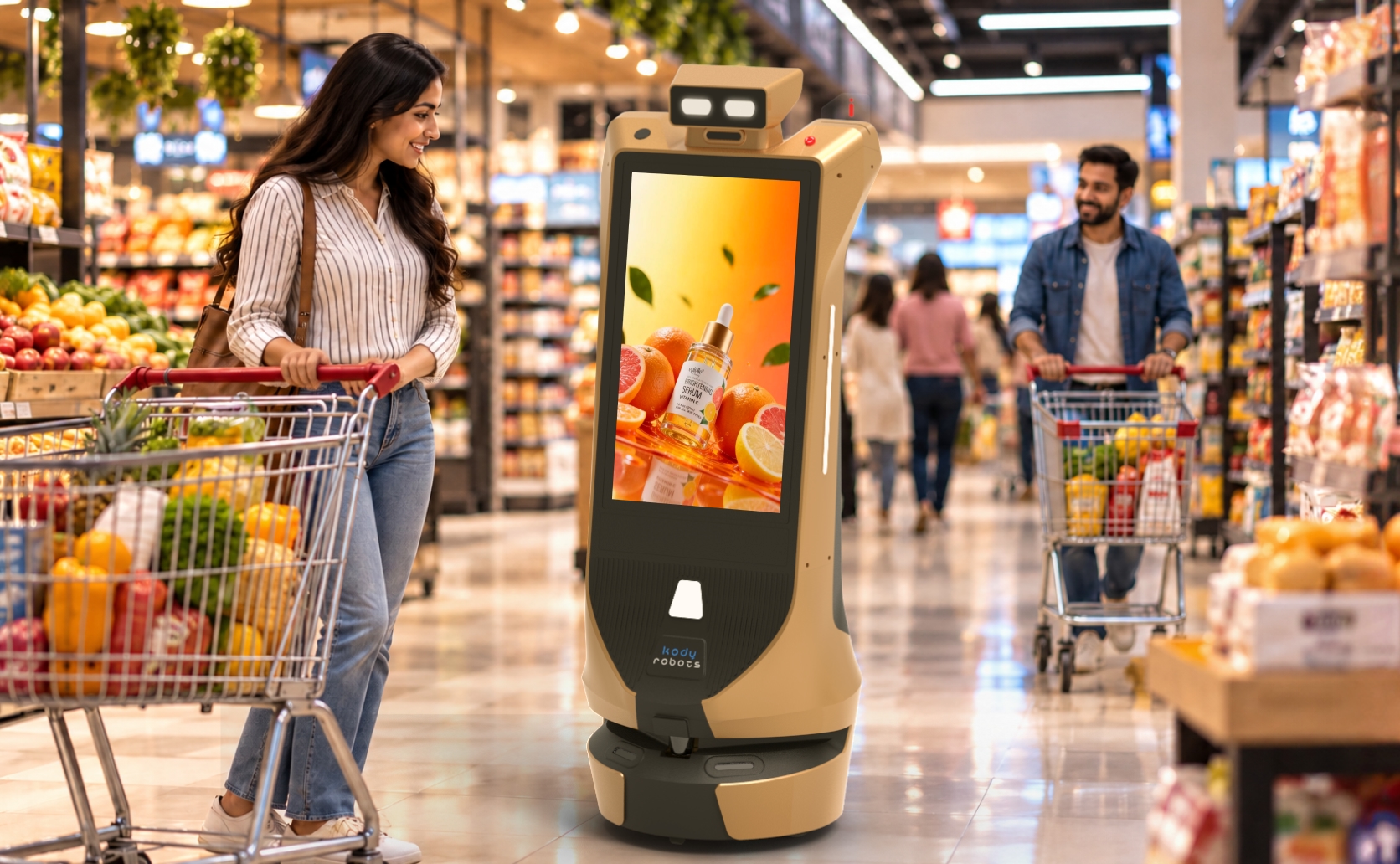
Advertising robots for retail introduce a different approach to in-store marketing. Instead of keeping promotional messages in one location, these autonomous machines can travel through designated areas while displaying advertisements and providing useful shopping information.
For hypermarket operators, this creates opportunities beyond improving brand visibility. Mobile advertising platforms can support product discovery, customer assistance, promotional campaigns, and retail media activities within the same environment.
As stores explore intelligent automation, collaborating with a robotics company in India can help operators evaluate solutions that fit their business requirements.
Understanding how these robots function, what they offer, and where they provide value is the first step toward making an informed investment decision.
Key Takeaways
Advertising robots combine mobility and digital marketing, allowing hypermarkets to display promotional campaigns across different store departments.
Autonomous navigation enables flexible advertising, helping retailers reach shoppers beyond fixed advertising locations.
Interactive features improve customer engagement through touchscreen information, product searches, promotional offers, and navigation assistance.
Centralized campaign management simplifies advertising operations, allowing retailers to update promotional content without manually replacing displays.
Advertising performance analytics provide useful insights into campaign delivery, customer interactions, and engagement patterns.
Mobile advertising creates additional retail media opportunities by allowing hypermarkets to offer brands new promotional placements.
Successful deployment requires proper planning, including store mapping, pedestrian traffic assessment, connectivity, and campaign objectives.
What Is an Advertising Robot?
An advertising robot is a self-navigating robotic platform equipped with digital screens that displays promotional content while moving through commercial environments. It can also offer interactive services such as product information, customer assistance, and location guidance.
In a hypermarket, these robots operate as mobile communication platforms.
Rather than relying entirely on posters, shelf displays, and stationary screens, retailers can introduce promotional messages across multiple departments.
For example, a robot displaying a household cleaning product advertisement could operate near the home care section. Later, the same robot could promote a personal care brand in another designated area.
Some advanced models also include interactive touchscreens, voice assistance, and navigation systems.
The purpose is not simply to introduce automation into advertising. It is to make promotional communication more accessible, flexible, and relevant to customers moving throughout the store.
How Do Advertising Robots Work Inside Hypermarkets?
A hypermarket advertising robot uses navigation technology, digital displays, and advertising management software to perform its functions.
Before operation, the store environment is mapped to identify accessible pathways, operating areas, and restricted locations.
The robot uses this information to navigate its surroundings while detecting obstacles such as shoppers, carts, and temporary displays.
Its advertising system operates alongside the navigation technology.
Retail managers can upload promotional creatives, establish campaign schedules, and assign advertising content to appropriate operating zones.
For instance, a retailer could configure campaigns for different shopping periods:
Morning: Breakfast cereals, dairy products, and grocery promotions.
Afternoon: Household essentials, personal care, and seasonal products.
Evening: Ready-to-eat meals, beverages, and family shopping offers.
Weekends: Special discounts, loyalty campaigns, and sponsored promotions.
The exact scheduling and location-based capabilities depend on the robot's software.
Solutions such as the Odigo advertising robot combine autonomous movement, interactive digital advertising, and shopper assistance for commercial environments.
Why Should Hypermarkets Consider Advertising Robots?
Hypermarkets contain numerous product categories, promotional displays, and shopping routes.
However, reaching customers with relevant advertising remains challenging because their attention changes as they move through the store.
A customer visiting the electronics department may never see a promotional screen positioned near the grocery entrance.
Mobile advertising offers an additional opportunity to address this limitation.
1. Expand Advertising Coverage
A fixed display serves customers passing through one location.
An autonomous advertising robot can operate across multiple designated zones, giving retailers greater flexibility in distributing campaigns.
2. Make Promotions More Relevant
Product promotions become more useful when displayed near related categories.
For example, an advertisement for skincare products may have greater contextual relevance near beauty and personal care aisles than near the billing counter.
3. Simplify Campaign Updates
Traditional promotional materials often require printing, installation, and physical replacement.
Digital campaigns can be modified through a software interface, reducing the manual work involved in updating promotional content.
4. Introduce Interactive Brand Experiences
Shoppers can explore product details, access promotional offers, or request assistance through compatible interactive systems.
This creates opportunities for meaningful customer engagement beyond passive advertisement viewing.
How Do Smart Advertising Robots Improve Customer Engagement?
A smart advertising robot can turn advertising into a two-way interaction.
Traditional promotional displays primarily communicate information. Interactive robots can also allow customers to respond to what they see.
Depending on the system, customers may be able to:
Browse information about advertised products.
Use touchscreen menus to explore available services.
Scan QR codes to access promotional campaigns.
Search for stores, departments, or facilities.
Request directions to a particular location.
Interact with a voice-enabled assistant.
Consider a shopper looking for a particular brand of coffee.
While walking through the store, they encounter a robot displaying a coffee promotion.
Instead of continuing to search independently, the shopper could use the robot's interface to identify the relevant shopping area, provided the required navigation functionality is available.
This connects promotional communication with practical shopping assistance.
Can Advertising Robots Help Customers Find Products?
Yes. Advertising robots equipped with wayfinding technology can help customers locate departments, facilities, and other mapped destinations.
Large hypermarkets often have extensive layouts that can be unfamiliar to first-time visitors.
A customer looking for the electronics section may need to ask an employee or consult store directories.
A compatible autonomous robot can provide another assistance option.
The process typically involves three activities:
1. Customer Search
The customer enters a department, destination, or supported product category through the robot's interface.
2. Location Identification
The system identifies the destination using its available store mapping and location information.
3. Navigation Assistance
The robot provides directions or guides the customer toward the destination, depending on its capabilities.
However, product-level guidance requires accurate integration with store inventory and location information.
Without these systems, navigation may be limited to departments and predefined destinations.
How Can Hypermarkets Measure Advertising Robot Performance?
Measuring campaign performance helps retailers understand whether their advertising strategy is meeting its objectives.
An advertising robot with reporting capabilities may provide information about advertising delivery, device activity, and customer interactions.
Important metrics include:
Advertisement plays: Number of times promotional content is displayed.
Campaign duration: Time allocated to individual advertisements.
Customer interactions: Number of touchscreen or supported voice interactions.
QR code engagement: Scans associated with specific promotional campaigns.
Navigation requests: Customer requests for directions or location assistance.
Operating coverage: Store zones visited during advertising activity.
Robot availability: Operating time, charging periods, and interruptions.
These metrics can help marketing teams compare campaigns and refine promotional schedules.
However, advertisement plays should not automatically be interpreted as actual customer views.
Similarly, an interaction does not necessarily indicate a completed purchase.
For a stronger understanding of commercial outcomes, retailers may need to combine advertising data with point-of-sale information, promotional redemptions, and other relevant business metrics.
Can Advertising Robots Generate Additional Retail Media Revenue?
Advertising robots can provide hypermarkets with another opportunity to offer promotional inventory to brands.
Retail media involves retailers providing advertising opportunities within channels and environments they operate.
In physical stores, these opportunities commonly include shelf placements, promotional displays, and digital screens.
Mobile advertising can expand the available options.
For example, hypermarket operators could develop sponsored packages based on:
Advertising duration.
Selected departments.
Operating zones.
Campaign frequency.
Seasonal shopping events.
Product category sponsorships.
A beverage manufacturer might sponsor advertising activity near grocery and refrigerated product sections.
Similarly, a personal care brand might promote a campaign in areas relevant to its target customers.
The commercial value depends on store traffic, advertising demand, campaign delivery, and the retailer's ability to demonstrate results.
What Should Hypermarkets Consider Before Deploying Advertising Robots?
Introducing an autonomous robot requires planning beyond purchasing the hardware.
Each hypermarket has different aisle configurations, customer traffic patterns, and operational requirements.
A structured deployment approach can help identify potential problems before wider implementation.
Evaluate Store Infrastructure
Review aisle widths, floor conditions, loading areas, and locations where shopping carts frequently accumulate.
The selected robot must be suitable for the store's physical environment.
Identify Suitable Operating Zones
Determine where mobile advertising will be most useful without interrupting normal shopping activities.
Busy intersections, emergency exits, and operationally restricted areas should receive particular attention.
Establish Advertising Objectives
Decide whether the primary goal is brand promotion, customer interaction, product discovery, or additional retail media revenue.
Clear objectives make performance evaluation more meaningful.
Plan Charging and Connectivity
Confirm that the robot has access to suitable charging arrangements and the connectivity required for its management features.
Begin With a Pilot Deployment
Start with a limited operating area and a defined set of campaigns.
Evaluate navigation reliability, campaign delivery, customer interactions, and staff feedback before expanding.
This approach allows retailers to identify practical improvements while limiting the complexity of the initial deployment.
Is an Advertising Robot a Good Investment for Hypermarkets?
An advertising robot may be a worthwhile investment for hypermarkets that regularly manage promotional campaigns, serve large numbers of shoppers, and want to introduce more interactive advertising experiences.
However, its value should be evaluated against measurable business objectives.
A retailer focused on advertising revenue should assess sponsor demand, campaign delivery capacity, and operating expenses.
A retailer prioritizing customer experience should examine shopper interactions, navigation requests, and the usefulness of assistance features.
Before investing, operators should answer three important questions:
What specific store or marketing problem will the robot address?
How will the robot complement existing advertising and customer service systems?
Which performance indicators will determine whether the deployment is successful?
Answering these questions helps establish realistic expectations and supports better purchasing decisions.
Conclusion
Advertising robots offer hypermarkets a flexible way to connect promotional communication with autonomous movement and customer assistance.
Their value extends beyond displaying advertisements. Depending on the platform, they can support customer engagement, store navigation, campaign management, and measurable retail media activities.
However, successful adoption depends on choosing appropriate technology, identifying practical use cases, and evaluating performance under real store conditions.
For hypermarket operators, the objective should be to introduce advertising technology that supports both commercial goals and a convenient shopping experience.




