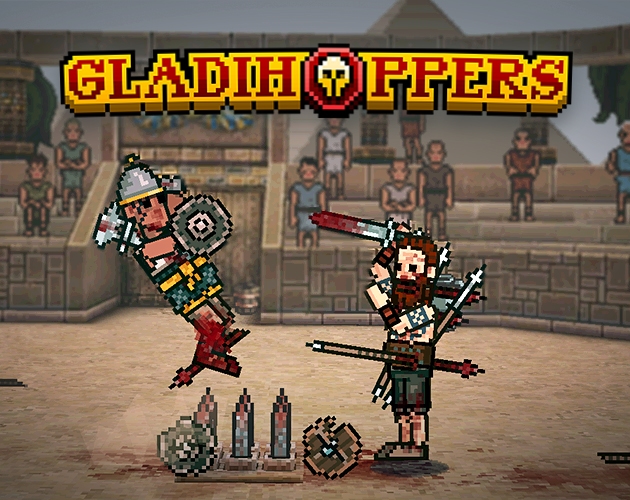
What actually happens when your gladiator's javelin throw misses and you are already out of backup ranged options halfway through a Career mode fight against someone with higher Strength than you? The answer to that question contains more of what Gladihoppers is about as a game than any description of its physics system or equipment count. The moment the javelin is gone, you are committed entirely to melee reads, stance management, and whatever advantage your armor gives you on incoming hits — and whether you trained for that scenario or avoided it defines how far your Career mode run actually goes.
Genre | 2D Physics Fighting / Arena Combat Simulator |
Platforms | iOS, Android, PC, Browser |
Modes | Career, Spartacus War, Save the Emperor, Quick Fight, Practice |
Arenas | The Colosseum, Aegyptus, Macedonia, Gallia, Hispania, The Ludus, The Palace |
Equipment Pool | 100+ items: swords, axes, maces, war hammers, shields, helmets, armor, shin guards, gloves, boots |
Character Populations | Romans, Gauls, Nubians, Egyptians — 16 face options |
Support Roles | Trainer, Surgeon, Priest, Spy |
The Physics Engine That Defines Gladihoppers Combat
Gladihoppers is built on an inverted pendulum physics model combined with 2D sprite animation — a pairing that makes every fighter behave as if their center of gravity is slightly unpredictable at all times. When you swing a war hammer, your gladiator's momentum carries the body forward even if you did not intend to close distance. When you take a clean torso hit, the ragdoll response can spin you sideways and expose the back of your helmet to a follow-up. This is not incidental chaos added for comedy, even though the results are frequently funny. The physics are the combat system. Every decision you make — when to swing, which direction, whether to press forward or hold ground — is simultaneously a balance decision, because your gladiator's physical state after each action determines what options you have immediately afterward.
The damage calculation in this game is a genuine system rather than a flat number lookup. The formula takes weapon type, armor coverage on the specific body part struck, the attacker's Strength stat, and critically, the velocity of the weapon at the moment of contact. A mace swung while your fighter is already moving forward hits harder than the same mace from a standing position, because the momentum adds to the contact velocity. Head and torso hits deal substantially more health damage than arm or leg hits, which shapes the entire strategic logic of fighting — exposed heads are priority targets, and equipment choices that leave the head uncovered are gambles that experienced players avoid against high-Strength opponents. Players who understand this calculation start making different equipment choices: a helmet may be worth more denarii value per fight than a more expensive sword, because it removes the most punishing damage multiplier from the opponent's options.
The two battle stances at the center of Gladihoppers combat are not just speed-versus-power toggles. Each stance has its own set of directional attack animations with specific hitbox timings, recovery frames, and momentum properties. The heavy stance delivers attacks that are harder to interrupt mid-swing but carry longer recovery periods on a miss. The fast stance produces attacks that can be chained more quickly and leave smaller openings, but do not carry the same per-hit damage. What the game teaches slowly — and what players in the Discord community identify as the biggest skill gap — is that stance-switching mid-fight is an active tool. Shifting to the fast stance immediately after an opponent's heavy swing misses means your attacks land during their recovery window. Holding the heavy stance when your Strength stat is meaningfully higher than the opponent's makes every exchange a coin flip they are likely to lose. The community term "stance-dancing" refers to this intentional switching and is the vocabulary that separates players who have genuinely engaged with the combat from those still relying on timing luck.
Career Mode Structure and the Gladihoppers Fame System
Career mode runs on two parallel economies: denarii for gear and upgrades, and Fame as the legacy metric that both reflects your gladiator's achievements and gates which arenas and opponents they face. Fame accumulates through wins, through completing objectives that the game sets between fights, and through the simple act of surviving — a gladiator who wins thirty fights at The Ludus level before falling carries a different Fame score than one who rushed to The Colosseum on weak equipment and got eliminated in five bouts. The final Fame score when your gladiator is defeated is the Career mode high score, which is why the community talks about "running" in Career mode the same way roguelike players talk about a run — it has a beginning, a peak, and an end, and the goal is to push that peak higher each time.
Early in Career mode, fights in The Ludus are forgiving enough that aggression works. Opponents have modest Strength, basic armor, and limited equipment coverage. A Roman with a straightforward sword loadout and leather armor can win consistently through pressure alone at this stage. The shift happens gradually. As Fame grows and arenas progress from The Ludus through Macedonia, Gallia, and Hispania toward The Colosseum and The Palace, opponent stats scale significantly. By the time your fights are staged in The Palace, every opponent your gladiator faces has equipment quality and Strength values that punish the rush-down habits formed in The Ludus. Players who never adjusted their tactics during the easy early fights hit this wall hard and often assume the game became unfair, when what actually changed is that their tactics stopped scaling.
The Trainer, Surgeon, Priest, and Spy are support figures available between Career mode fights. The Trainer improves your stats temporarily ahead of a difficult bout. The Surgeon recovers health that would otherwise carry forward as a disadvantage into the next fight. The Priest provides a morale-based benefit. The Spy is the one players flag most specifically in community discussions: using the Spy before a fight against an opponent with Strength or Endurance values above your current gladiator's numbers gives you a clear read on the mismatch, which changes whether you enter that fight conservatively or aggressively. New players skip all four of these roles habitually, treating them as optional flavor, and the community consensus is that this is the single most correctable mistake in Career mode. The Spy in particular becomes nearly mandatory once you are deep enough that opponent stat advantages are routine.
Equipment Depth and Build Identity in Gladihoppers
Weapon category: Each weapon type in Gladihoppers has a distinct combat identity. Swords offer balanced speed and damage with reliable recovery times, making them the most forgiving choice for players still developing stance-switching timing. Axes produce wider swing arcs and heavier damage but carry longer recovery on a miss. Maces and war hammers hit with the most raw force and can visibly stagger opponents on clean contact, but the slower animation timing makes them punishing to use against fast-stance fighters who dodge consistently. Shields add a defensive hitbox layer that reduces damage on covered body parts; the Egyptian Shield in particular comes up frequently in community posts about Career mode endgame builds.
The 100-plus equipment items divide across weapons, chest armor, helmets, wrist guards, gloves, pants, shin guards, boots, and sandals — each protecting or exposing specific hitbox zones on your gladiator's body. Building a gladiator in Career mode is a layered decision: weapon first for offensive style, then armor pieces prioritized by which body parts you most commonly lose health from. Players who get hit in the head consistently need a helmet before a better weapon. Players who are losing health on leg hits against sweep-style fighters need shin guards before upgraded chest armor. This is the part of the game's depth that most players do not consciously engage with until mid-Career mode, when the equipment gaps between fights become too costly to ignore.
One of the more debated topics in the Gladihoppers community is how heavily Strength skews the damage economy compared to weapon type. A gladiator with 18 Strength swinging a basic sword will frequently outperform a gladiator with 8 Strength holding an expensive war hammer, because the velocity multiplier in the damage formula amplifies the Strength stat more than raw weapon base damage compensates. Some players find this satisfying — it rewards stat investment and creates clear Career mode goals. Others find it frustrating because it makes expensive weapon unlocks feel less meaningful than another point of Strength. This tension has been discussed extensively on the Discord server and remains the most consistent mechanical criticism the game receives from engaged players who are past the casual phase.
Gladihoppers Game Modes Beyond Career
Spartacus War is the mode that gets the least attention from new players and the most appreciation from veterans. Built on the same combat engine as Career mode and Quick Fight, it adds a faction-based strategy map where individual arena duels determine territorial control over towns and regions. Winning a fight in Spartacus War is not just a Fame or denarii transaction — it changes the map. Players who find Career mode too repetitive after several runs return to Spartacus War specifically because the strategic stakes make each individual fight meaningful in a different way. The same stance-dancing and javelin timing that matters in Career mode matters here, but the consequences extend beyond the duel itself.
Save the Emperor is the arcade mode — a theoretically endless chain of fights against progressively tougher opponents where health does not fully reset between bouts. The mode is a sustained execution test. Players who have genuinely internalized stance transitions and javelin conservation find Save the Emperor comfortable to chain for long streaks. Players who are still relying on timing luck or single-stance aggression find their run ends before it feels like it should. The useful thing about this mode for developing players is that it reveals which specific habits break down under pressure — a habit that barely costs you anything in a single Quick Fight becomes a consistent losing pattern across ten consecutive fights without recovery time between them.
Practice mode is the least glamorous part of Gladihoppers and the one most underused by players who are struggling. It does not offer denarii, Fame, or map progress. What it offers is repetition without consequence, which is where javelin throw timing, stance-switch windows, and the specific moment to trade against a heavy opponent are actually learned. Players who wonder why blocking feels inconsistent or why their javelin throws keep missing are almost always players who went straight to Career mode without spending time in Practice reading opponent recovery frames.
Quick Fight serves a different function: fast, customized or randomized duels against the CPU or a friend on the same screen. Local multiplayer in Quick Fight is where the game's absurdist physics are most visible and most celebrated — two players on one device, both fighting the pendulum momentum as much as they are fighting each other, creates exactly the chaotic and funny scenarios that make Gladihoppers easy to share with someone who has never played it. It is also the fastest testing ground for a new equipment setup, without committing a full Career run to the experiment.
Advanced Techniques Most Gladihoppers Players Miss
The first advanced technique that separates experienced players is deliberate javelin conservation paired with guard-read throws. Instead of throwing in the opening seconds of a fight, practiced players watch for the moment an opponent's shield visibly rotates away from a critical hitbox — usually during their own attack recovery — and release the javelin into the exposed zone. Against blocking opponents, this means targeting leg or side hitboxes that the shield does not cover rather than throwing at the center mass where the guard is strongest. This approach requires patience that feels counterintuitive when holding a ranged weapon, which is why most players abandon it before it becomes a habit.
Stance-switching timing is the second technique that takes longest to develop deliberately. Most players switch stances reactively — when they feel like they need more speed or more power. Advanced players switch at specific mechanical moments: immediately after an opponent's heavy swing misses (shift to fast stance, punish the recovery), or when entering the final phase of a fight against a low-health opponent (shift to heavy stance, end the fight quickly rather than extending it with lighter hits). The audio cue for a missed heavy swing — the whiff sound of a war hammer or mace cutting air — is one of those specific game details that experienced players immediately recognize as the signal to switch stances and counter.
The Looting skill is the most commonly underprioritized Career mode upgrade and the one that compounds most over a long run. Raising Looting increases denarii earned per fight. A gladiator who invested in Looting early reaches the equipment tier needed for The Colosseum substantially faster than one who put all denarii into Strength and Endurance from the start. The compounding effect is not dramatic fight-to-fight but becomes visible over fifteen or twenty Career mode bouts. Players who wonder why their gladiator is still using basic gear by mid-Fame progression are almost always players who ignored Looting in favor of direct stat boosts. Charisma is a similarly overlooked stat that affects crowd response and certain career event outcomes, though its mechanical impact is less immediately visible than Looting's economic effect.
What the Gladihoppers Community Debates
The Strength-versus-equipment debate is the most persistent discussion. Players who have built high-Strength gladiators with basic weapons and outperformed players running expensive war hammers at lower Strength make the argument that stat investment is the real game. Players who spent significant denarii unlocking higher-tier weapons and found the damage difference smaller than expected push back on this and argue the game undersells its own equipment variety by making Strength too dominant in the damage formula. Both sides are drawing from real experiences — the formula does amplify Strength substantially — but the debate tends to ignore that high-Strength builds also require more Career mode time to develop, which means the players making that argument have usually already survived long enough to benefit from compounding upgrades.
Blocking consistency is the second major community discussion point, and it is a legitimate one. The inverted pendulum physics mean that your gladiator's body position shifts constantly during combat, which means shield coverage is not static. New players who expect a dedicated block input with guaranteed protection find the system frustrating. Veterans who understand that the shield covers a hitbox zone rather than activating a block state find it manageable, but acknowledge that the game does a poor job explaining this distinction. The itch.io comment sections for Gladihoppers contain multiple requests for a clearer blocking tutorial, which the game has not added in any version to date.
The monetization pacing in Career mode — specifically the rate at which meaningful equipment unlocks require denarii relative to how quickly fights get harder — is a third ongoing discussion. Players who push into The Colosseum and The Palace arenas on equipment funded only through Career fights find the gear gaps uncomfortable. Players who engaged with the Looting upgrade early find the pacing manageable. The tension between these two experiences is a design question the game has not definitively resolved, and it comes up reliably whenever new players share their first Career mode experience on community forums.
Questions Players Search Most About Gladihoppers
The question of how blocking actually works in Gladihoppers comes up more than almost any other mechanical question. Blocking in this game is not a button state — it is the result of your shield's hitbox overlapping with an incoming attack's hitbox at the moment of contact. Because your gladiator's body position is governed by physics rather than locked stances, the shield can rotate away from optimal coverage during your own attack animations or while recovering from a missed swing. Understanding this means that players who equip the Egyptian Shield and swing aggressively are not actually blocking during those swings; they are attacking with an unguarded torso and relying on damage reduction from chest armor instead. Effective shield use means controlling your fighter's body position to keep the shield between you and the opponent, which is a posture decision rather than an input decision.
Whether Roman, Gaul, Nubian, or Egyptian character choices affect stats is another question searched consistently. In the current version of Gladihoppers, the four population options are cosmetic in terms of available face designs — the 16 faces are distributed across the four groups — and do not assign different base stat values. Your starting Strength, Endurance, and Health are determined by career progression and upgrades, not by population selection. The only meaningful choice at character creation is the face aesthetic, which players in Career mode become genuinely attached to over time because it becomes the visual identity of their specific run.
How to unlock The Palace arena is a question that reflects how Fame gating works. The Palace does not unlock through a single milestone fight — it becomes accessible as your Fame score rises through accumulated wins and objectives across multiple Career mode bouts. Players who try to force their way to The Palace through a few decisive wins in earlier arenas find the progression does not work that way. Fame is a long-term accumulation, which means the path to The Palace runs through consistent performance in The Colosseum and the regional arenas, not through a single breakout match.
Gladihoppers does not deliver its depth upfront, which is both its appeal and its most honest limitation. The first few fights in The Ludus feel simple enough that players underestimate what is coming; the first loss in The Colosseum to a high-Strength opponent who reads your javelin timing and punishes your stance hesitation feels jarring by comparison. That gap is where the real game begins — where stance-dancing, Spy consultations before mismatched fights, and the carefully saved Egyptian Shield all stop being optional refinements and start being the difference between a Career run that reaches The Palace and one that ends somewhere in Macedonia.