
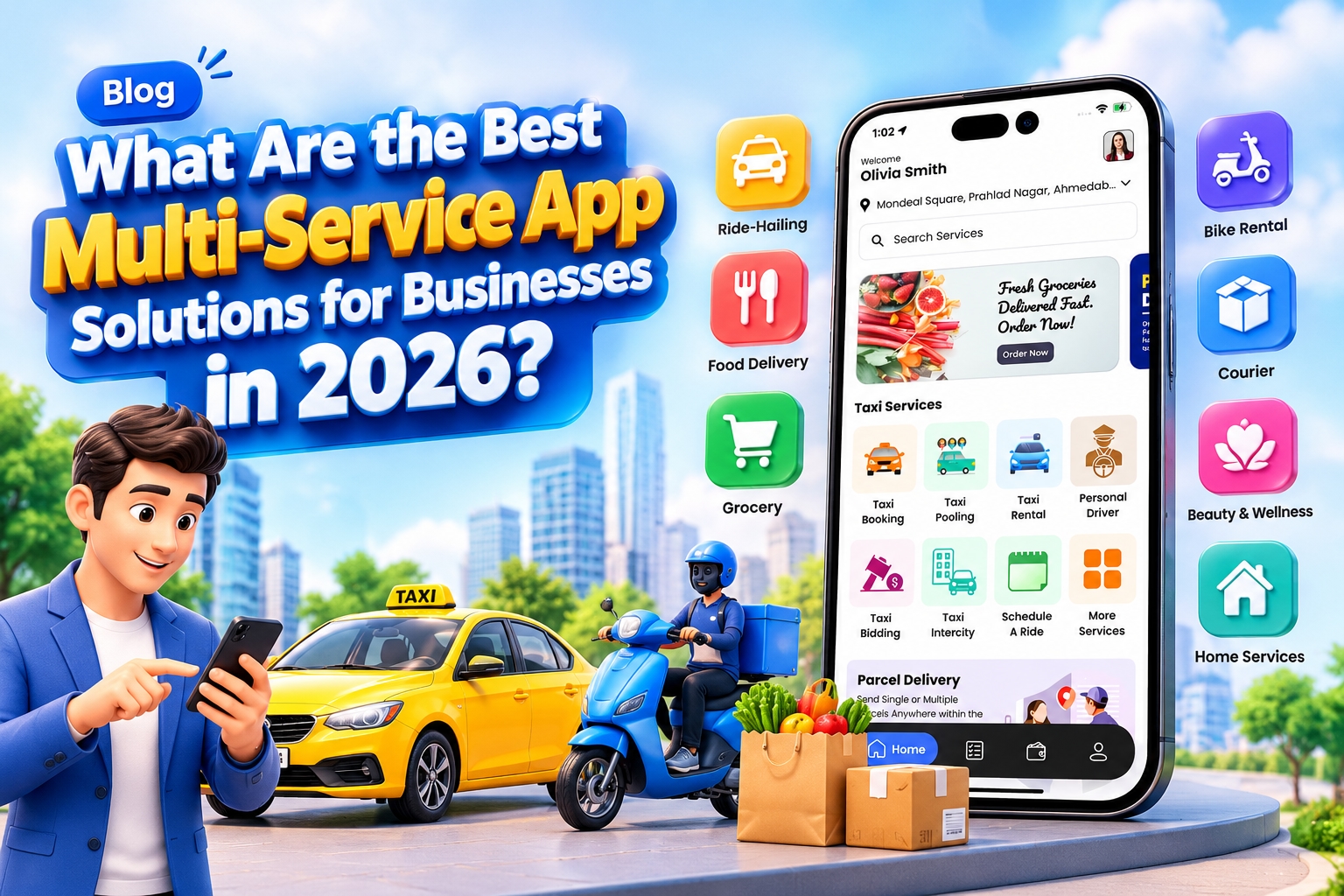
Multi-service app solutions enable businesses to offer multiple services through a single digital platform. From taxi booking and food delivery to grocery shopping, courier services, and home maintenance, these applications help companies connect customers with different services through one convenient interface.
The best multi-service app solution depends on a company's budget, target audience, required features, operational needs, and long-term growth plans. Startups may prioritize faster deployment and manageable initial investment, while established businesses often require advanced integrations, customized workflows, and scalable infrastructure.
This guide explores the best types of multi-service app solutions, essential features, development approaches, and practical factors businesses should consider before choosing a platform.
What Is a Multi-Service App Solution?
A multi-service app solution is a software platform that allows businesses to provide multiple services through one application or connected digital ecosystem. Instead of developing separate applications for every service category, businesses can manage different offerings through a shared platform.
For example, a single application might support taxi booking, food delivery, grocery ordering, parcel delivery, and home services. Customers can access available services from one interface, while administrators manage service providers, transactions, commissions, and operations through a centralized dashboard.
A typical multi-service platform includes:
Customer app: Allows users to browse services, place orders, book rides, make payments, and track requests.
Service-provider app: Enables providers to accept requests, manage availability, update service status, and monitor earnings.
Driver or delivery-partner app: Supports transportation and delivery workflows where applicable.
Admin dashboard: Provides tools to manage users, service categories, commissions, payments, promotions, and business reports.
The exact components depend on the services being offered and the business's operating model.
Why Are Multi-Service App Solutions Valuable for Businesses?
Multi-service platforms can help companies diversify their offerings without requiring customers to navigate multiple disconnected applications. Their business value depends on customer demand, service quality, and effective operations.
1. Expand Business Opportunities
Businesses can introduce complementary services to address different customer needs. For example, a company initially offering taxi booking might later introduce parcel delivery, grocery shopping, or home services.
This approach allows businesses to explore additional markets while building on existing customer relationships.
2. Create Multiple Revenue Streams
A multi-service platform can support different revenue models, including service commissions, booking fees, delivery charges, subscriptions, and promotional placements.
Businesses should evaluate the profitability of each service independently. Adding more categories does not automatically increase revenue if operating costs or customer acquisition expenses are too high.
3. Improve Customer Convenience
Customers can access multiple services through a unified interface rather than installing separate applications for every requirement. Consistent navigation, payment experiences, notifications, and account management can make the platform easier to use.
4. Centralize Business Operations
A shared administration system can help businesses monitor transactions, manage providers, review service performance, and generate reports. This can reduce fragmented workflows when the platform supports the company's operational requirements.
5. Support Business Expansion
A scalable platform may allow businesses to add service categories, introduce new locations, and adapt pricing or commission structures as demand changes. The ability to expand depends on the software architecture and customization capabilities.
What Are the Best Multi-Service App Solutions for Startups and Established Businesses?
There is no single solution that fits every business. The most suitable option depends on the company's stage, technical requirements, available resources, and expansion strategy.
1. Ready-Made Multi-Service App Software
Ready-made multi-service software provides a pre-developed foundation that businesses can configure for their requirements. It may include customer applications, provider applications, administrative tools, and common on-demand service workflows.
Best suited for: Startups and businesses that want to launch a platform without developing every component from scratch.
Advantages:
Existing functionality can reduce development work.
Common workflows may already be implemented.
Businesses can focus on branding, provider onboarding, and market entry.
Initial requirements are often easier to define.
Limitations:
Some workflows may require customization.
Integrations can vary by provider.
Licensing, source-code access, updates, and ongoing support must be reviewed.
Before selecting a ready-made solution, confirm which features are included, what requires additional development, and whether the software meets your security and performance requirements.
2. White-Label Super App Solutions
A white-label super app solution allows a business to launch software under its own brand. Depending on the provider, businesses may be able to customize the logo, colors, application interface, service categories, and selected business rules.
Best suited for: Entrepreneurs, local service businesses, and companies that want branded software without commissioning a completely new platform.
White-label software can provide a useful starting point when the business model aligns with the available functionality. However, businesses should verify whether customization is limited to visual branding or also covers operational workflows, integrations, and source-code access.
Before purchasing, review the available applications, supported services, licensing terms, maintenance arrangements, and customization costs.
3. Custom Multi-Service App Development
Custom development involves building a platform around specific business requirements rather than relying primarily on an existing product.
Best suited for: Established companies, businesses with specialized workflows, and organizations that need extensive integration with existing systems.
Potential advantages include greater control over user experiences, business rules, third-party integrations, and future development priorities.
However, custom development may involve a longer implementation process, higher initial investment, and greater responsibility for maintenance and technical management. Businesses should define requirements carefully before committing to a development plan.
4. Industry-Specific On-Demand App Solutions
Some businesses need a platform focused on a particular industry rather than a broad super app. Examples include taxi booking, food delivery, grocery delivery, and home service management.
Best suited for: Businesses entering a specific market with clearly defined customer needs.
An industry-focused platform may provide deeper functionality for its primary use case. For example, taxi booking software may need driver allocation, fare calculation, trip tracking, and driver earnings management.
This option can be more appropriate when a business wants to establish one service category first and consider additional services later.
5. Modular Multi-Service Platforms
A modular platform is organized into components that can be introduced, customized, or expanded according to business needs. Depending on its architecture, a company might begin with two service categories and introduce additional modules after validating demand.
Best suited for: Startups planning phased expansion and established businesses with evolving requirements.
Modular development can help businesses prioritize essential capabilities and avoid implementing unnecessary features at launch. However, the ability to add modules independently depends on the platform's architecture, integration requirements, and licensing terms.
What Features Should Businesses Look for in a Multi-Service App?
Feature selection should reflect the business model rather than simply maximizing the number of available features.
Feature | Business purpose |
|---|---|
Customer application | Makes service discovery, booking, and ordering accessible |
Provider application | Helps service providers manage requests and availability |
Admin dashboard | Centralizes users, services, transactions, and operational controls |
Payment integration | Supports suitable payment methods and transaction workflows |
Real-time tracking | Helps customers monitor eligible rides or deliveries |
Service management | Allows administrators to configure categories and offerings |
Commission management | Supports different earning structures across services |
Notifications | Communicates booking updates and important alerts |
Analytics and reports | Helps evaluate demand, performance, and revenue |
Localization | Supports relevant languages, currencies, and regional settings |
Security controls | Helps protect accounts, transactions, and business information |
Businesses should also evaluate application performance, backup procedures, access permissions, maintenance arrangements, and compliance requirements relevant to their markets.
Which Multi-Service App Solution Is Best for Startups?
For startups, a ready-made or white-label solution may be a practical choice when it meets the intended business requirements and offers acceptable customization.
Before making a decision, startups should:
Identify the target market and validate customer demand.
Select the initial service categories based on local needs.
Define a realistic budget for software, operations, marketing, and support.
Compare ready-made software with custom development.
Confirm ownership, licensing, integrations, and maintenance terms.
Test the customer and provider experiences before launching.
Track customer acquisition, repeat usage, service quality, and profitability.
A startup does not necessarily need to launch every possible service on day one. Beginning with a focused selection can simplify provider onboarding and help the business understand which categories deserve further investment.
What Should Established Businesses Consider?
Established businesses generally need to evaluate a wider set of operational and technical requirements.
Integration capabilities: Determine whether the platform can connect with existing payment systems, customer databases, accounting software, or enterprise tools.
Scalability: Ask how the software handles increases in users, transactions, providers, and geographic coverage. Request technical documentation and relevant performance evidence.
Customization: Verify whether the platform can support company-specific workflows, pricing rules, commission structures, and approval processes.
Data security: Review access controls, data handling, backup arrangements, security testing, and applicable privacy obligations.
Ongoing support: Establish expectations for maintenance, updates, issue resolution, and future development.
Total cost of ownership: Consider implementation, licensing, integrations, hosting, maintenance, support, and future customization rather than comparing only initial prices.
A solution that is inexpensive to acquire may not be the most cost-effective option if it requires substantial modifications or ongoing operational work.
Ready-Made vs. Custom Multi-Service App Development
Choosing between ready-made software and custom development is an important decision.
Evaluation factor | Ready-made solution | Custom development |
|---|---|---|
Initial development work | Generally lower | Generally higher |
Launch timeline | Potentially shorter | Depends on project scope |
Customization | Depends on the product | Can be tailored to requirements |
Existing functionality | Often available | Must be developed or integrated |
Technical control | Depends on licensing and access | Depends on the agreed ownership and architecture |
Maintenance | Provider-dependent | Requires an agreed support model |
Best fit | Standardized business requirements | Specialized or complex requirements |
Neither approach is universally superior. A ready-made solution can suit businesses whose requirements align with existing functionality, while custom development may be more appropriate when specialized workflows are central to the business model.
How to Choose the Right Multi-Service App Development Company
Selecting the right provider requires more than comparing marketing claims.
Evaluate these factors before signing a contract:
Relevant experience: Ask for examples of comparable projects and the provider's specific role in delivering them.
Product demonstration: Test actual booking, ordering, payment, and administration workflows.
Feature transparency: Request a written list of included features, exclusions, and customization costs.
Technical documentation: Review supported platforms, integrations, architecture, and deployment arrangements.
Ownership and licensing: Clarify source-code access, intellectual property, third-party components, and usage rights.
Security and compliance: Understand how the provider addresses relevant security and privacy requirements.
Support and maintenance: Confirm update policies, service expectations, and support responsibilities.
Scalability: Ask for evidence that the platform can accommodate your expected operating conditions.
Request a detailed proposal that separates software licensing, customization, third-party services, implementation, and ongoing support. This makes comparisons more meaningful and helps prevent unexpected costs.
How Can Businesses Launch a Multi-Service App Successfully?
A successful launch involves more than selecting software.
Step 1: Research the market. Identify customer needs, competing services, target locations, and potential demand.
Step 2: Define the business model. Decide how customers will use the platform, how providers will participate, and how the business intends to generate revenue.
Step 3: Select the software. Compare relevant platforms using documented requirements, demonstrations, and realistic budgets.
Step 4: Configure the platform. Set up branding, service categories, payment methods, pricing rules, and administrative permissions.
Step 5: Onboard service providers. Establish provider verification procedures, service standards, and operational processes.
Step 6: Test the complete experience. Validate account registration, bookings, payments, cancellations, notifications, and reporting.
Step 7: Launch and measure results. Start in a manageable market, gather customer feedback, and monitor performance before expanding.
Useful metrics include booking conversion, repeat usage, order completion, provider activity, customer retention, complaint rates, and contribution margin.
Frequently Asked Questions
1. What is the best multi-service app solution for a new business?
The best solution is one that matches the business's target market, budget, required services, and technical needs. Ready-made or white-label software may suit standard requirements, while custom development can be appropriate for specialized operations.
2. Can a multi-service app support different business categories?
Yes. Depending on the software, a multi-service app can support categories such as taxi booking, food delivery, grocery ordering, courier services, and home services through a shared platform.
3. How much does multi-service app development cost?
Costs vary according to the development approach, number of service categories, customization, integrations, supported platforms, and maintenance requirements. Businesses should request itemized proposals based on their actual requirements instead of relying on a universal price estimate.
4. Is white-label software suitable for established businesses?
It can be suitable when the available functionality, customization options, integrations, security controls, and licensing terms meet the company's requirements. Businesses with complex operational needs should evaluate these factors carefully before choosing a white-label product.
5. Can businesses add new services after launching?
Some platforms support adding service categories or modules after launch. Businesses should confirm whether new categories require additional licensing, development, integrations, or changes to existing workflows.
6. How can a business earn revenue from a multi-service app?
Potential revenue sources include commissions, booking fees, delivery charges, subscriptions, and promotional placements. The appropriate model depends on the services offered, customer expectations, provider agreements, and operating costs.
Conclusion
The best multi-service app solution for startups and established businesses is the one that supports their current requirements while providing a realistic path for future growth. Ready-made platforms, white-label super apps, custom development, industry-specific software, and modular solutions each serve different business needs.
Before investing, compare functionality, customization, integration capabilities, licensing, security, support, and total ownership costs. Start with clearly defined customer needs and a manageable service offering, then expand according to measurable demand.
A careful evaluation of software capabilities and provider requirements can help businesses establish a stronger foundation for launching and growing an on-demand service platform.






