
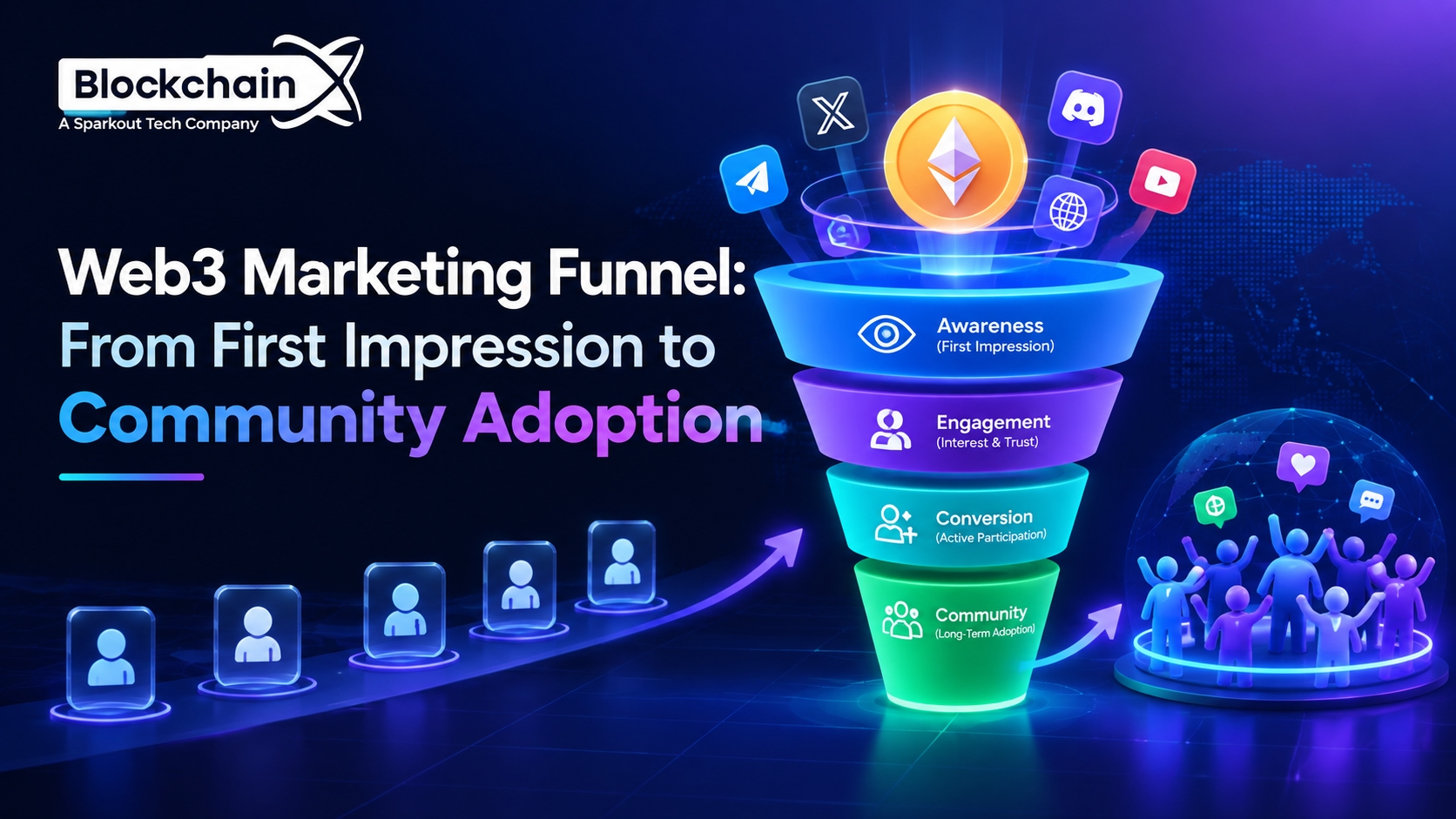
Launching a Web3 product is only one part of building a successful digital ecosystem. A project can have a strong technical foundation and still struggle to attract the right audience if people do not understand its purpose or know how to get involved.
This is why marketing for Web3 projects needs to go beyond publishing social posts or building a large follower base. Potential users move through several stages before they decide to interact with a product. They first discover it, look for more information, evaluate its credibility, and then decide whether joining the ecosystem is worth their time.
A well-planned Web3 marketing funnel helps organize this journey and gives projects a practical way to turn initial attention into meaningful participation.
Start With the Problem, Not the Technology
One of the easiest ways for a Web3 project to lose a potential user is to introduce the technology before explaining the problem.
Terms such as smart contracts, decentralized infrastructure, tokenization, wallets, and protocols may be familiar to experienced blockchain users, but they can make a product difficult to understand for newcomers.
The first stage of the funnel should therefore focus on the problem the product addresses.
A project's homepage, social profile, or campaign should make it possible for a visitor to understand:
What the product does
Who can use it
What problem it addresses
How it works at a high level
What the visitor can do next
For example, a tokenization platform could first explain how businesses can represent certain real-world assets digitally instead of opening with a detailed explanation of blockchain architecture.
The technology supports the proposition. It does not necessarily need to be the proposition.
Give Curious Visitors a Reason to Stay
Once someone notices a project, curiosity needs to become understanding.
This is where educational content becomes valuable. People researching a Web3 product may have questions that cannot be answered in a short social media post or advertisement.
A project can address those questions through different formats, including:
Educational articles
Product explainers
Tutorials
Videos
Case studies
Technical documentation
Frequently asked questions
Industry commentary
The content should correspond to what people actually want to know.
Someone researching a blockchain wallet, for instance, may want to understand security features, supported networks, transaction management, and user experience before considering the product. A generic article about the history of blockchain may not move that person closer to a decision.
Good funnel content reduces uncertainty one question at a time.
Make Credibility Visible
Interest does not automatically produce trust.
Web3 users often evaluate projects carefully because they may be interacting with digital assets, decentralized applications, smart contracts, or unfamiliar platforms. Marketing therefore needs to work alongside transparency.
A project can demonstrate credibility by making important information easy to find.
Depending on the business, this could include:
Company and team information
Product documentation
Security practices
Audit reports where applicable
Technical architecture
Development updates
Partnerships and integrations
Clear explanations of product functionality
Accessible support channels
Consistency also matters. If a project communicates frequently but provides little useful information, increased visibility may not translate into stronger confidence.
Trust is better supported by evidence than by exaggerated claims.
Move From Audience to Community
The next challenge is creating a relationship beyond a website visit.
Web3 projects often use communities on platforms such as X, Discord, Telegram, newsletters, and other digital channels. These spaces can become important sources of feedback, education, announcements, and discussion.
However, community building should not be treated simply as a race for member numbers.
A new member should have a clear reason to remain involved.
For example, a community might provide access to:
Product announcements
Industry discussions
Developer resources
Live Q&A sessions
Educational events
Product demonstrations
Feedback opportunities
Early access to selected features
A simple onboarding process can make a major difference. New members should quickly understand where to find important information and how they can participate.
The objective is to transform passive followers into people who have a reason to return.
Connect Community Activity With the Product
This is where many marketing programs encounter a gap.
A project may generate strong engagement on social platforms without seeing equivalent growth in product usage. Likes, reposts, and community membership can indicate interest, but they do not necessarily demonstrate adoption.
Marketing and product teams should therefore create a bridge between community activity and actual product experiences.
That bridge might involve:
Education → Demonstration → Trial → Onboarding → Usage
Suppose a decentralized application introduces a new feature. Instead of announcing the feature with a short promotional post, the project could publish an explainer, demonstrate the feature through a video, provide a walkthrough, and direct interested users toward the product.
Each step removes another barrier.
The same approach can be used for developer-focused projects. Documentation, sample implementations, tutorials, and technical discussions can help developers move from learning about a protocol to experimenting with it.
Keep Users Engaged After Adoption
Acquisition is only one part of the funnel.
If users try a product once and never return, marketing has not created a sustainable relationship. Retention requires continued value from both the product and the surrounding ecosystem.
Projects can maintain engagement by communicating meaningful updates rather than filling channels with constant promotional messages.
Useful activities may include:
Feature announcements
Product education
Community sessions
User feedback programs
Technical updates
Industry research
Developer initiatives
Community recognition
Feedback should also travel in both directions. Communities can reveal problems that analytics alone may not show, while product teams can use community discussions to identify recurring questions and content gaps.
This creates a feedback loop:
User activity → Feedback → Product improvement → Better experience → Continued engagement
Measure the Journey, Not Just the Reach
A Web3 marketing funnel strategy becomes more useful when every stage has measurable objectives.
A project can track different indicators depending on its goals.
Funnel Stage | Possible Indicators |
Discovery | Search visibility, impressions, website visitors |
Exploration | Content engagement, returning visitors, documentation views |
Consideration | Product inquiries, demo requests, sign-ups |
Community | New members, active participants, event attendance |
Adoption | Product registrations, active users, feature usage |
Retention | Returning users, repeat usage, contributor activity |
The important point is to connect these metrics.
For example, an increase in website traffic may initially appear successful. But if visitors leave quickly and few explore the product, the project may need to improve its messaging or landing-page experience.
Likewise, a growing community may have limited business value if members rarely interact with the product.
Looking at the complete journey provides more useful insight than focusing on one impressive number.
Why the Funnel Should Evolve With the Project
A Web3 marketing funnel is not something that needs to remain unchanged after launch.
Early-stage projects may need to prioritize awareness and education. A product approaching wider adoption may instead need stronger onboarding and retention programs. Developer-focused platforms may require a completely different content journey from consumer applications.
The funnel should therefore change as audience behavior, product features, and business objectives evolve.
Analytics, community feedback, search behavior, and user questions can all reveal where potential users are dropping out.
If people visit but do not explore, the messaging may need work. If they join the community but never try the product, onboarding could be the issue. If users try the product but do not return, the problem may extend beyond marketing.
Conclusion
A Web3 project does not build a lasting audience simply by generating attention. People need a clear reason to discover the project, enough information to understand it, credible evidence to evaluate it, and an easy path toward participation.
A strong Web3 marketing funnel connects these stages instead of treating them as separate campaigns.
The most useful approach is to think of marketing as a continuous journey: introduce the problem, educate the audience, establish credibility, create meaningful community participation, simplify product adoption, and keep listening after users arrive.
When marketing and product experiences work together, community growth can become part of a broader path toward genuine Web3 adoption.