Almost everyone has stood in a line that felt longer than it should have: a clinic waiting room, a bank branch on a Monday morning, a government office before a deadline. Waiting is not only boring for customers; it also costs businesses money, staff energy and reputation. The good news is that the line itself no longer has to be physical. Virtual queuing lets people hold their place without standing in one spot, and it is quietly changing how service-heavy organisations work.
In this article I'll explain how virtual queues work, where they make the biggest difference, and what to look for if you are thinking about introducing one.
Why traditional queues fail
A physical queue has a few built-in problems:
Uncertainty. People don't know how long they will wait, so even a short wait feels long.
Crowding. Waiting areas fill up, which is uncomfortable for visitors and stressful for staff.
Walk-aways. When a line looks too long, many customers simply leave, and the business never knows how many it lost.
No data. A row of people in a hallway tells managers very little about peak hours, service times or staffing needs.
How a virtual queue works
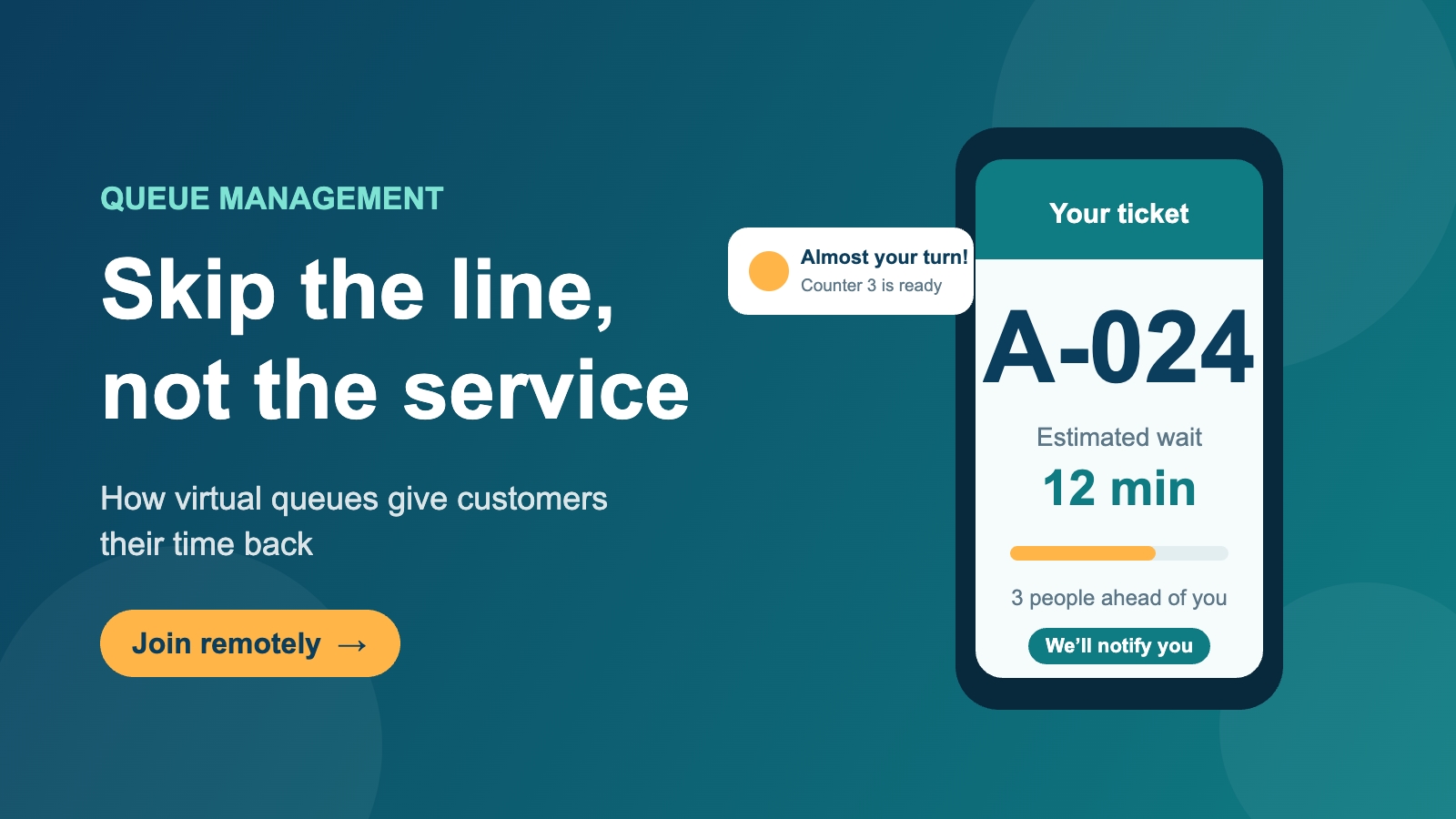
The idea is simple. Instead of standing in line, a visitor joins the queue digitally — by scanning a QR code, using a kiosk, booking online or sending a message. They receive a ticket number and an estimated wait time, and they get a notification by SMS, app or display screen when it is almost their turn. In the meantime they can sit down, grab a coffee or finish errands nearby.
Behind the scenes, staff see the whole queue on a dashboard. They can call the next person, transfer a visitor to another counter or service, and see how long each step takes. Managers get reports on wait times, service times and busy periods, which makes staffing decisions much easier.
Where virtual queuing makes the biggest difference
Healthcare. Clinics and hospitals can reduce crowded waiting rooms and give patients realistic wait estimates.
Banks and financial services. Customers can be routed to the right desk before they even reach it.
Government and public services. Offices with high daily footfall can spread visits more evenly across the day.
Retail and service centres. Stores can manage pickups, returns and repair desks without long lines at the door.
Universities. Admissions, finance and student-service offices can handle seasonal peaks more calmly.
What to look for in a queue management tool
If you are comparing options, these features matter most in day-to-day use:
Several ways to join — QR code, web link, kiosk and walk-in tickets, so nobody is left out.
Clear notifications by SMS, email or display screens, ideally in more than one language.
Appointment support, so booked visits and walk-ins can be handled in one flow.
Analytics on waiting and service times, broken down by branch, service and staff member.
Feedback collection right after the service, while the experience is still fresh.
Easy setup and integrations with your existing CRM or booking tools.
For example, a virtual queue management solution such as Qwaiting combines remote check-in, live notifications and reporting in one system, which is a useful reference point when you are building your own list of requirements.
Tips for a smooth rollout
Start with one location or one service and measure the current average wait before you switch.
Keep a fallback for visitors without smartphones — a kiosk or a receptionist who can add them to the queue.
Train staff first. The system only helps if the people calling the next visitor trust it.
Tell customers clearly how to join, with signs at the entrance and a line on your website.
Review the data monthly and adjust opening hours or staffing to match real demand.
Final thoughts
Waiting will never disappear completely, but it doesn't have to mean standing in a crowded room with no idea when your turn will come. A well-planned virtual queue gives visitors back their time, gives staff a calmer working day and gives managers the data they need to improve service. For any organisation that serves people face to face, it is worth exploring.
Disclosure: this article mentions Qwaiting, a product I work with on its marketing.