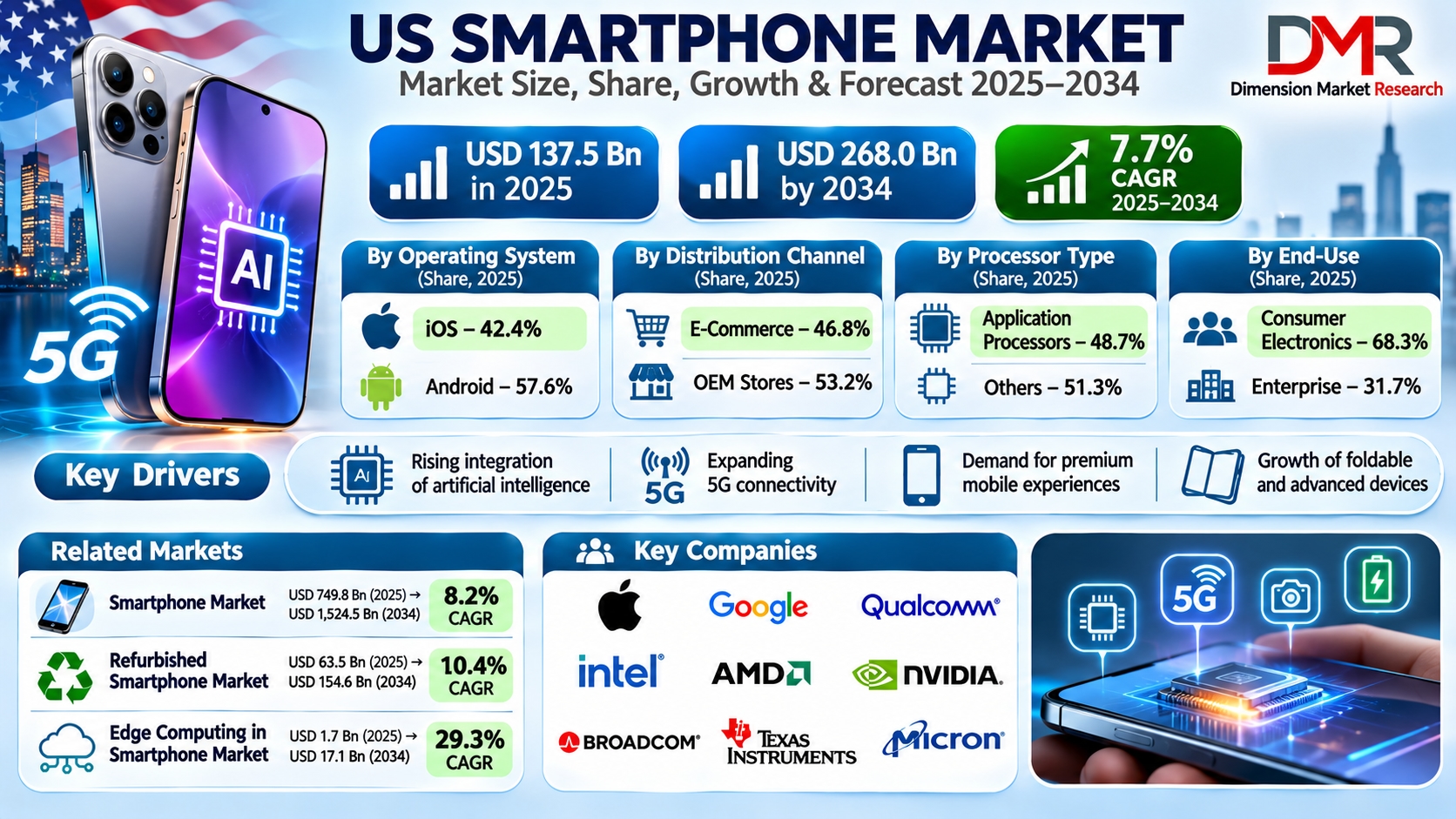
The US Smartphone Market is undergoing significant transformation as artificial intelligence, advanced mobile processors, and high-speed connectivity reshape consumer expectations and mobile technology development. According to Dimension Market Research, the market is projected to increase from USD 137.5 billion in 2025 to USD 268.0 billion by 2034, registering a CAGR of 7.7% during the 2025–2034 forecast period.
Demand for AI-powered smartphones, 5G-enabled devices, advanced cameras, and premium mobile experiences is supporting market expansion. Manufacturers are increasingly integrating neural processing units, energy-efficient chipsets, and on-device intelligence to differentiate their products.
The growing importance of mobile productivity, connected ecosystems, gaming, and digital services is also transforming smartphones into sophisticated computing platforms.
What Is the US Smartphone Market?
The US Smartphone Market encompasses smartphones, their operating systems, distribution channels, processor technologies, and applications across consumer and industrial environments.
Smartphones combine mobile communication, internet connectivity, application processing, cameras, navigation, and multimedia functionality in portable devices.
Modern smartphones increasingly feature advanced application processors, graphics processing units, AI accelerators, 5G modems, and biometric security technologies.
The market includes operating systems such as iOS and Android, supported by manufacturers, semiconductor developers, telecommunications providers, and distribution networks.
As smartphones become integrated with wearables, smart homes, cloud platforms, and enterprise applications, their role continues to expand beyond traditional communication.
Get a Free Sample of the US Smartphone Market Report
Evaluating opportunities in AI smartphones, mobile processors, 5G connectivity, or US consumer electronics? Request a free sample to review the research scope, market segmentation, competitive environment, and industry outlook.
https://dimensionmarketresearch.com/request-sample/us-smartphone-market/
Why Is the US Smartphone Market Growing?
Increasing Integration of Artificial Intelligence
Artificial intelligence is becoming an important differentiator across premium and mainstream smartphones.
Manufacturers are incorporating neural processing units and advanced AI algorithms to support voice recognition, intelligent photography, adaptive battery management, predictive typing, and personalized user experiences.
On-device AI processing enables selected functions to operate locally rather than relying entirely on cloud infrastructure.
This development can improve response times, reduce network dependence, and strengthen privacy for certain applications.
For smartphone manufacturers, AI integration creates opportunities to differentiate devices through processing performance, software capabilities, and ecosystem compatibility.
Expanding 5G Connectivity and Edge Computing
The expansion of 5G networks is supporting demand for smartphones capable of delivering faster connectivity and responsive digital experiences.
Consumers increasingly use smartphones for high-definition video streaming, mobile gaming, cloud applications, and real-time communication.
Advanced modems and application processors help devices manage demanding workloads while maintaining power efficiency.
Edge computing is also gaining importance as smartphones process more information directly on the device, supporting applications that require low latency.
Growing Demand for Premium Mobile Experiences
US consumers continue to demonstrate interest in improved camera capabilities, high-performance processors, advanced displays, and integrated digital ecosystems.
Foldable smartphones, computational photography, mobile gaming, and sophisticated security features are influencing product development.
Manufacturers are combining hardware innovation with software updates and connected services to strengthen customer engagement.
US Smartphone Market Size, Share and Growth Statistics
● Market Size (2025): USD 137.5 Billion
● Forecast Market Value (2034): USD 268.0 Billion
● Forecast CAGR (2025–2034): 7.7%
● Leading Operating System: iOS, 42.4% Share
● Leading Distribution Channel: E-Commerce, 46.8% Share
● Leading Processor Type: Application Processors, 48.7% Share
● Leading Processor Architecture: ARM-Based Processors, 80.5% Share
● Leading End-Use Industry: Consumer Electronics, 68.3% Share
All reported segment shares refer to the 2025 market outlook.
US Smartphone Market Segmentation Analysis
iOS Leads the Operating System Segment
iOS is projected to capture approximately 42.4% of the US Smartphone Market in 2025.
Its position reflects Apple's integrated ecosystem, software optimization, privacy features, and customer loyalty.
Features such as Face ID, synchronized device services, regular software updates, and on-device intelligence contribute to the platform's value proposition.
Android remains an important competitive platform, offering devices across different price categories and supporting innovation in foldable displays, gaming, and enterprise applications.
E-Commerce Dominates Smartphone Distribution
E-commerce is expected to account for 46.8% of the market in 2025.
Online platforms enable consumers to compare specifications, evaluate prices, access promotional offers, and purchase devices directly from manufacturers or retailers.
OEM stores remain important for product demonstrations, customer assistance, financing options, and trade-in programs.
For manufacturers, combining digital distribution with physical retail services can support customer acquisition and aftermarket engagement.
Application Processors Lead Semiconductor Demand
Application processors are anticipated to account for 48.7% of the processor type segment in 2025.
These components manage operating systems, mobile applications, AI workloads, camera processing, and gaming performance.
Increasing demand for intelligent smartphones is encouraging manufacturers to integrate dedicated AI acceleration and improved graphics capabilities.
ARM-based processors are projected to dominate processor architecture with an 80.5% share, reflecting their power efficiency and suitability for battery-powered devices.
How AI and Edge Computing Are Transforming Smartphones
AI-enabled smartphones are increasingly performing tasks that previously required substantial cloud processing.
These capabilities include image enhancement, speech recognition, predictive assistance, and selected productivity applications.
Edge computing supports local data processing, reducing dependence on continuous network connectivity for compatible workloads.
For enterprises, AI-enabled smartphones create opportunities in logistics, healthcare, field services, and mobile workforce management.
Businesses can use smartphones for document processing, biometric authentication, communication, and connected operational applications.
This transition strengthens the importance of efficient processors, secure operating systems, and specialized mobile software.
Emerging Trends and Market Opportunities
Foldable and Flexible Display Technologies
Foldable smartphones are gaining attention as manufacturers explore larger display experiences without sacrificing portability.
Advanced OLED displays and adaptive user interfaces support multitasking, entertainment, and mobile productivity.
Sustainable and Repairable Smartphone Designs
Sustainability is becoming increasingly important in smartphone development.
Longer software support, repair-friendly components, recyclable materials, and energy-efficient processors are influencing product strategies.
Extended device lifecycles and refurbishment programs may also affect replacement cycles and aftermarket opportunities.
Integration With Wearables and IoT Devices
Smartphones increasingly function as central interfaces for smartwatches, fitness trackers, home automation systems, and connected devices.
For manufacturers, integrated ecosystems can strengthen customer retention and create additional opportunities through services and accessories.
Challenges Affecting the US Smartphone Market
High device prices and extended replacement cycles remain important market constraints.
Premium smartphones incorporating advanced processors, foldable displays, and sophisticated cameras often require substantial consumer spending.
This encourages some buyers to retain existing devices longer or consider refurbished alternatives.
Data privacy and cybersecurity represent additional challenges as smartphones process increasing amounts of personal information.
Manufacturers must balance AI personalization with secure data handling, software reliability, and consumer trust.
Competitive Landscape and Industry Developments
The US Smartphone Market includes smartphone manufacturers, operating system providers, semiconductor developers, and connectivity technology suppliers.
Prominent companies identified in the report include Apple, Google, Qualcomm, Intel, AMD, NVIDIA, Broadcom, Texas Instruments, Micron Technology, Skyworks Solutions, Marvell Technology, Qorvo, and Motorola.
Competition increasingly focuses on processor efficiency, AI acceleration, premium device features, software integration, and connectivity performance.
The report also highlights telecommunications industry developments, including T-Mobile US announcing its agreement to acquire UScellular's wireless operations and selected spectrum assets in May 2024.
Such infrastructure and distribution developments illustrate the importance of connectivity investment to the broader smartphone ecosystem.
Future Outlook for the US Smartphone Market Through 2034
The US Smartphone Market is expected to benefit from advances in AI computing, 5G connectivity, mobile processors, and integrated digital experiences.
Manufacturers are likely to continue emphasizing personalized software capabilities, improved energy efficiency, sophisticated cameras, and device ecosystem integration.
For technology providers and investors, important considerations include processor innovation, consumer replacement behavior, distribution strategies, and expanding enterprise applications.
Explore the Complete US Smartphone Market Analysis
Explore the complete US Smartphone Market report to assess forecasts, operating system trends, processor technologies, distribution channels, competitive developments, and strategic opportunities through 2034.
View the report and available purchase options:
https://dimensionmarketresearch.com/checkout/us-smartphone-market/
Frequently Asked Questions About the US Smartphone Market
1. What is the US Smartphone Market size?
The US Smartphone Market is projected to increase from USD 137.5 billion in 2025 to USD 268.0 billion by 2034.
2. What is the expected CAGR of the US Smartphone Market?
The market is forecast to expand at a CAGR of 7.7% during the 2025–2034 forecast period.
3. Which operating system leads the US Smartphone Market?
iOS is projected to lead the operating system segment with approximately 42.4% market share in 2025.
4. Which distribution channel dominates the US Smartphone Market?
E-commerce leads the market, with an expected 46.8% share in 2025, supported by online purchasing convenience and access to competitive offers.
5. What factors are driving US Smartphone Market growth?
Major growth factors include AI integration, 5G connectivity, advanced mobile processors, demand for premium devices, and expanding smartphone applications.
Conclusion
The US Smartphone Market is positioned for sustained expansion through 2034 as artificial intelligence, improved connectivity, and advanced semiconductor technologies influence smartphone development.
iOS, e-commerce, application processors, and ARM-based architectures represent important components of the market's competitive structure.
AI-enabled experiences, foldable displays, connected ecosystems, and enterprise applications create opportunities, while pricing pressures and replacement cycles remain important challenges.
Related Smartphone and Mobile Technology Market Insights
Smartphone Market
The global Smartphone Market Size is projected to increase from USD 749.8 billion in 2025 to USD 1,524.5 billion by 2034, registering a CAGR of 8.2%. Growth is supported by 5G adoption, improvements in mobile processors, AI-enabled functionality, advanced cameras, and increasing smartphone penetration across emerging economies.
Refurbished Smartphone Market
The Refurbished Smartphone Market Share outlook highlights increasing consumer interest in certified pre-owned devices, affordability, and sustainable electronics. The global market is projected to grow from USD 63.5 billion in 2025 to USD 154.6 billion by 2034, registering a CAGR of 10.4%. Trade-in programs, online sales platforms, and professional refurbishment services are supporting industry development.
Edge Computing in Smartphone Market
The Edge Computing in Smartphone Market Growth outlook projects an increase from USD 1.7 billion in 2025 to USD 17.1 billion by 2034, at a CAGR of 29.3%. Increasing demand for on-device AI processing, low-latency applications, 5G connectivity, and advanced mobile chipsets is supporting market development.