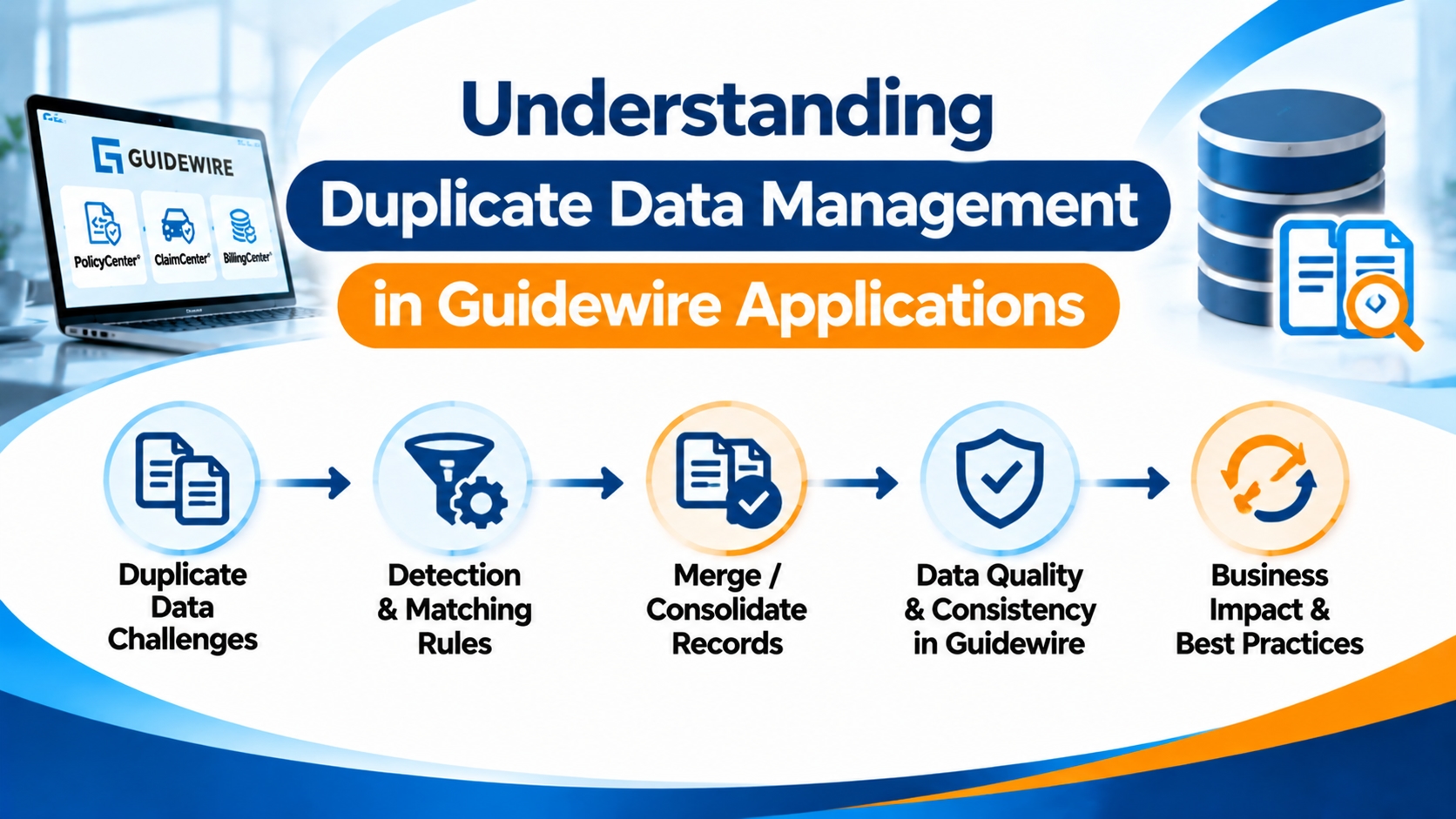
Property and casualty insurers process millions of transactions every week across underwriting, billing, and claims operations, creating an environment where redundant records can easily multiply. When customer profiles, vendor details, or policy entries are duplicated across core systems, operational bottlenecks quickly emerge. Adjusters waste valuable hours verifying which profile contains the accurate address, underwriters miscalculate risk exposure across fragmented accounts, and billing teams risk issuing conflicting invoices. Effective duplicate data management in Guidewire applications addresses this challenge at the architectural level. By establishing a single source of truth across the InsuranceSuite ecosystem, carriers safeguard data integrity, streamline automated workflows, and deliver consistent omnichannel experiences to policyholders without manual cleanup delays.
Mastering these enterprise data governance workflows requires deep familiarity with how Guidewire entities interact under the hood, making structured learning essential for aspiring developers and business analysts. Professionals looking to build hands-on expertise in configuring entity matching rules and database constraints often enroll in specialized programs like Guidewire Training in Pune to gain practical exposure to real-world InsuranceSuite environments. Understanding how Guidewire prevents redundant entries from entering the database—and how it reconciles conflicting records when external integrations push updates—separates functional implementations from fragile ones, empowering technical teams to maintain clean, high-performing insurance platforms at scale.
The Root Causes of Duplicate Records in InsuranceSuite
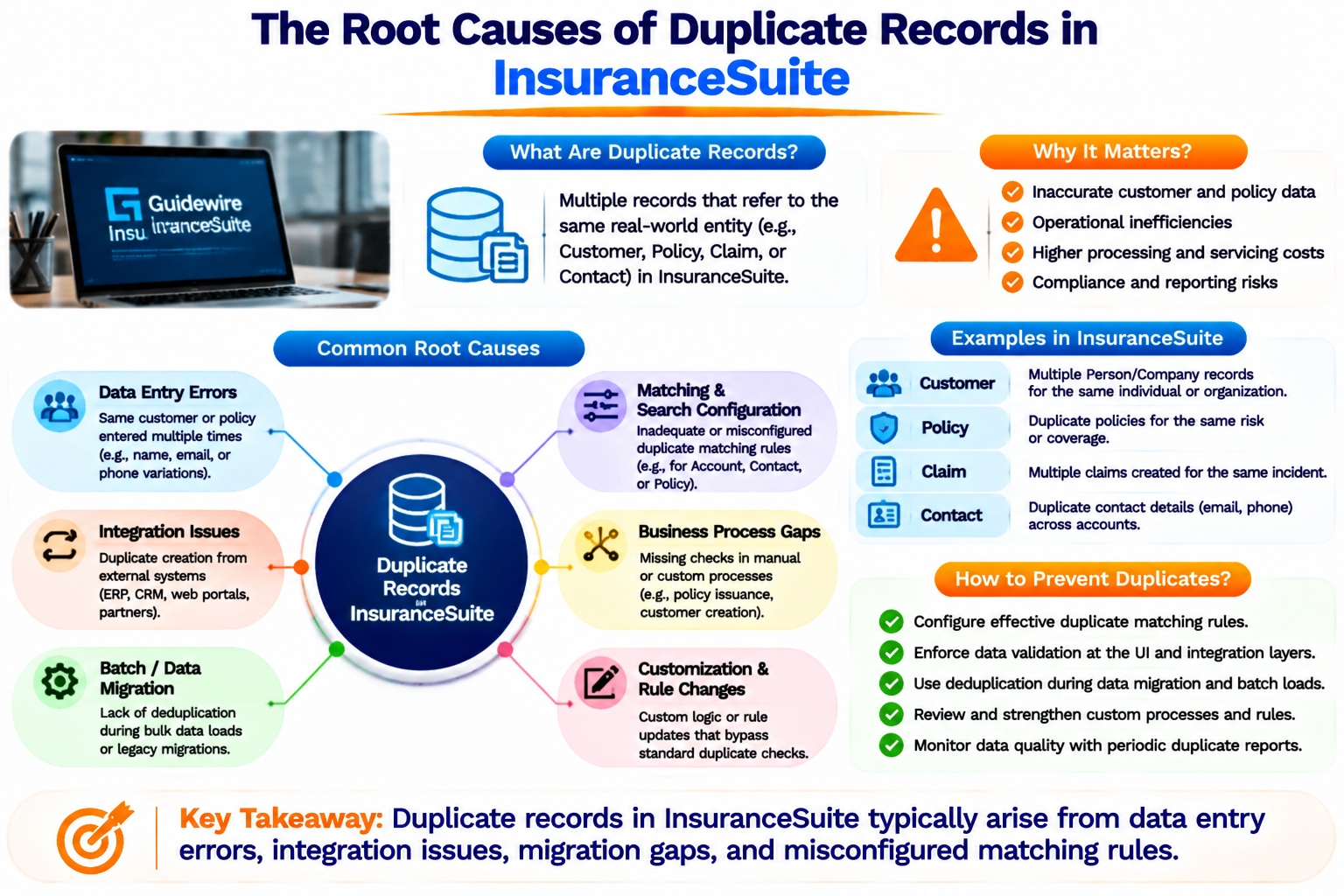
Duplicate records rarely stem from a single point of failure; instead, they arise from the complex interplay between human data entry, legacy system migrations, and high-velocity third-party integrations. During a First Notice of Loss (FNOL) call, a claims representative working under time pressure might create a new contact record for a claimant rather than searching thoroughly for an existing policyholder profile. Minor typographical variations—such as entering "Jon Smith" instead of "Jonathan Smith," abbreviating "Street" as "St.," or omitting a middle initial—can bypass basic exact-match lookups and generate a brand-new database entry.
Beyond manual entry, automated external feeds introduce significant duplication risks. Modern insurers rely on external portals, agency management systems, medical billing networks, and repair shop integrations that continuously push data into PolicyCenter, ClaimCenter, and BillingCenter. If an upstream broker portal transmits a policy submission without an established external identifier, or if network latency triggers a retry on an API payload, the receiving Guidewire application may inadvertently commit identical records twice unless strict transactional safeguards and matching algorithms are actively enforced.
Centralized Architecture with Guidewire ContactManager
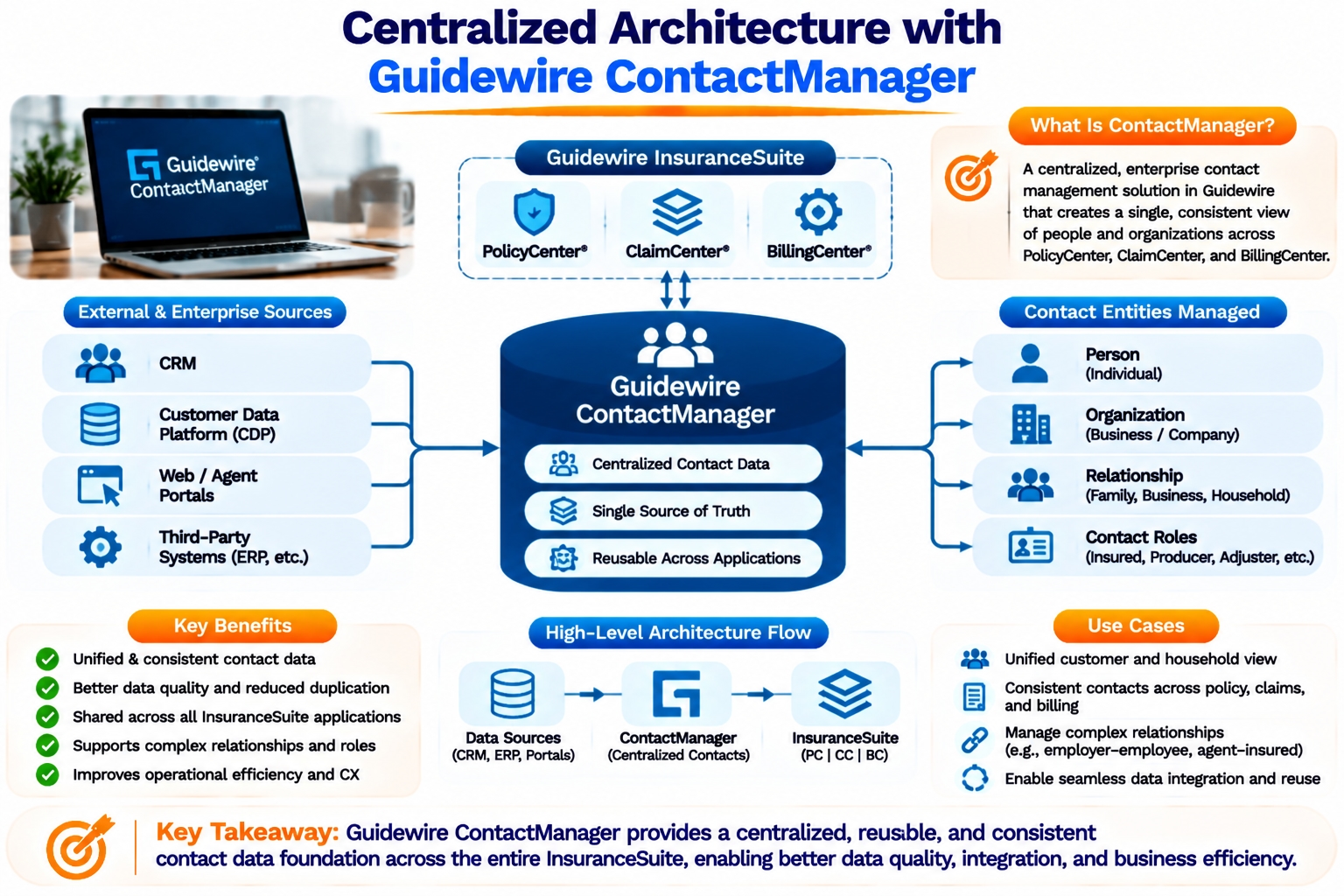
Guidewire ContactManager serves as the central hub designed specifically to eliminate fragmented customer and vendor profiles across the entire InsuranceSuite platform. Rather than allowing PolicyCenter, ClaimCenter, and BillingCenter to maintain isolated, disconnected address books, ContactManager acts as the authoritative system of record for all shared parties—including insureds, claimants, lienholders, attorneys, and auto repair vendors. When a user creates or updates a contact in any connected core application, ContactManager synchronizes that information across the ecosystem using unique AddressBookUID identifiers, ensuring every module references the exact same underlying entity.
Configuring this bidirectional synchronization and customizing contact subtypes requires a solid grasp of Guidewire's metadata-driven data model and Gosu programming rules. Technical specialists who complete comprehensive Guidewire Training in Pune learn how to map custom contact extensions and fine-tune search criteria so ContactManager flags potential overlaps before a new profile is saved. By forcing every core module to validate party details against a unified repository, insurers prevent redundant profiles from proliferating across separate policy and claims databases, dramatically reducing downstream reconciliation efforts.
Fuzzy Matching Algorithms and Potential Duplicate Detection
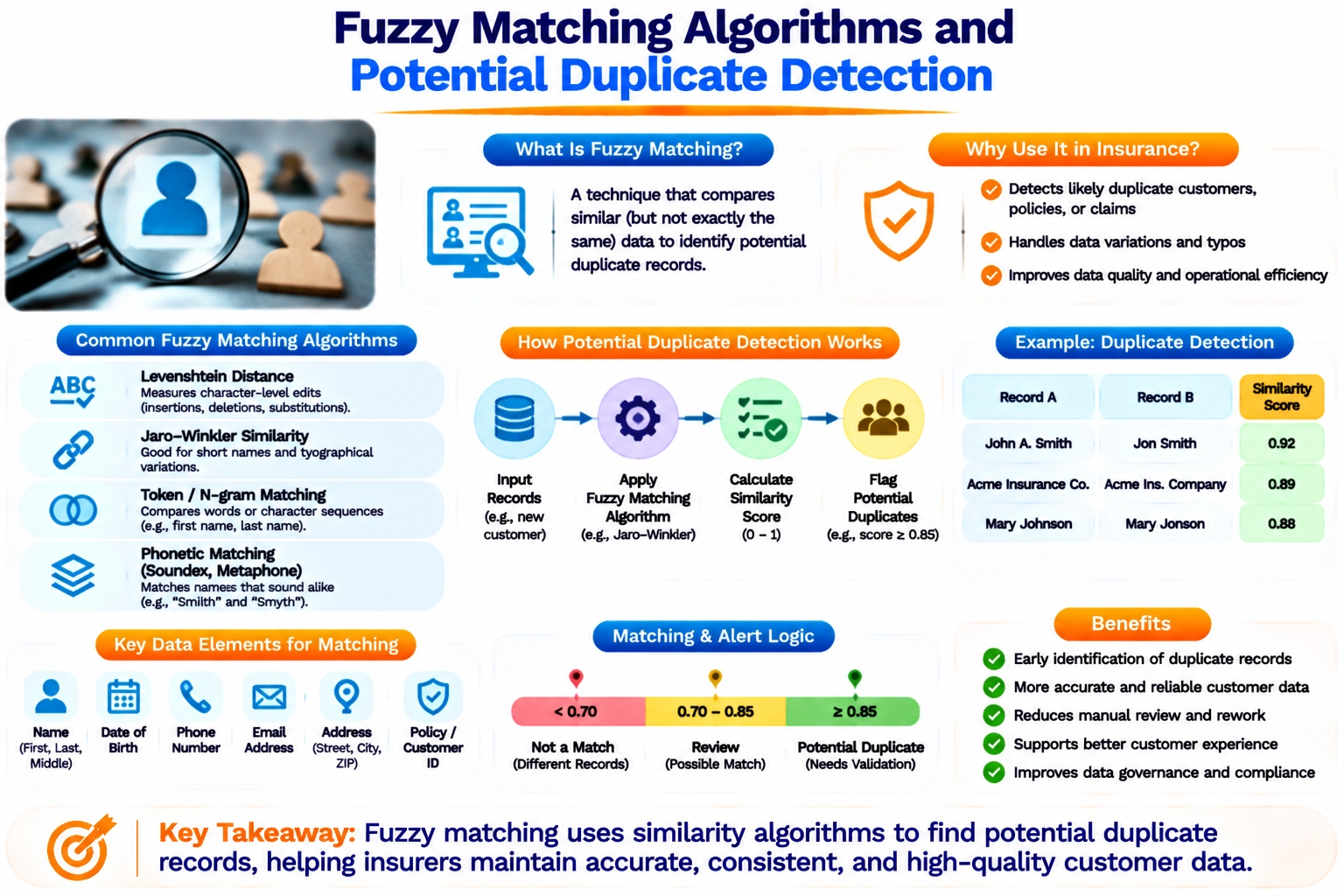
Exact-match database queries fail whenever real-world inconsistencies enter the picture, which is why Guidewire relies on configurable fuzzy matching rules and weighted scoring engines to detect potential duplicates. Instead of requiring 100% character-for-character alignment, ContactManager evaluates multiple attributes simultaneously—such as first name, last name, tax identification number (TIN), date of birth, phone number, and postal address—assigning specific point values to partial and exact matches across each field.
When a user or external system attempts to add a new contact, the matching engine calculates a composite similarity score against existing database entries. Administrators configure two critical thresholds within the system rules:
Potential Match Threshold: If a candidate record scores above this baseline, Guidewire alerts the user via the interface, displaying a side-by-side comparison of existing profiles so the operator can select the right person instead of creating a duplicate.
Definitive Match Threshold: If a score exceeds this upper ceiling—such as an exact match on a Social Security Number or Federal Employer Identification Number alongside a matching surname—the system automatically blocks duplicate creation or links the transaction directly to the existing master record.
Preventing Duplicate API Transactions and Integration Payloads
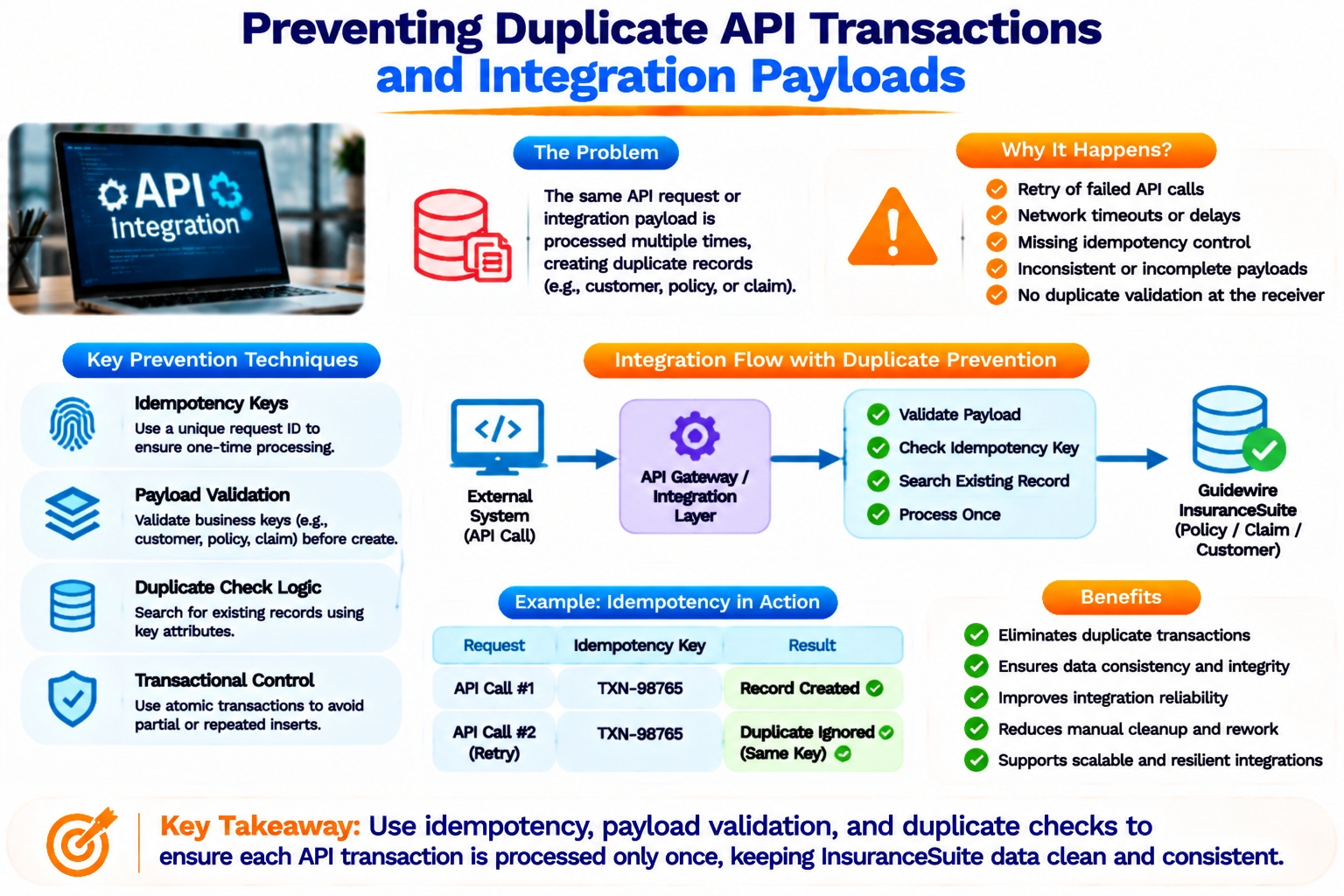
In cloud-native Guidewire deployments, RESTful Cloud APIs handle massive volumes of asynchronous traffic from digital portals, mobile apps, and partner ecosystems. Network timeouts or client-side retry logic frequently cause external callers to resubmit the exact same POST request within milliseconds. Without idempotency controls, a single customer payment, policy endorsement, or claim creation request could execute multiple times, corrupting financial ledgers and spawning duplicate business entities.
To neutralize this risk at the transport layer, Guidewire Cloud API utilizes the GW-DBTransaction-ID request header. When an integrating application sends a unique transaction identifier inside this header, Guidewire attempts to record that ID in its internal TransactionID database table alongside the commit operation. If the identifier does not exist, the database insert succeeds and the API processes the payload normally. If a duplicate retry arrives carrying the same header value, the insert fails immediately and Guidewire rejects the redundant call with an AlreadyExecutedException (HTTP 400 status), guaranteeing transactional idempotency without requiring complex custom deduplication code.
Contact Merging, Linking, and Master Data Governance
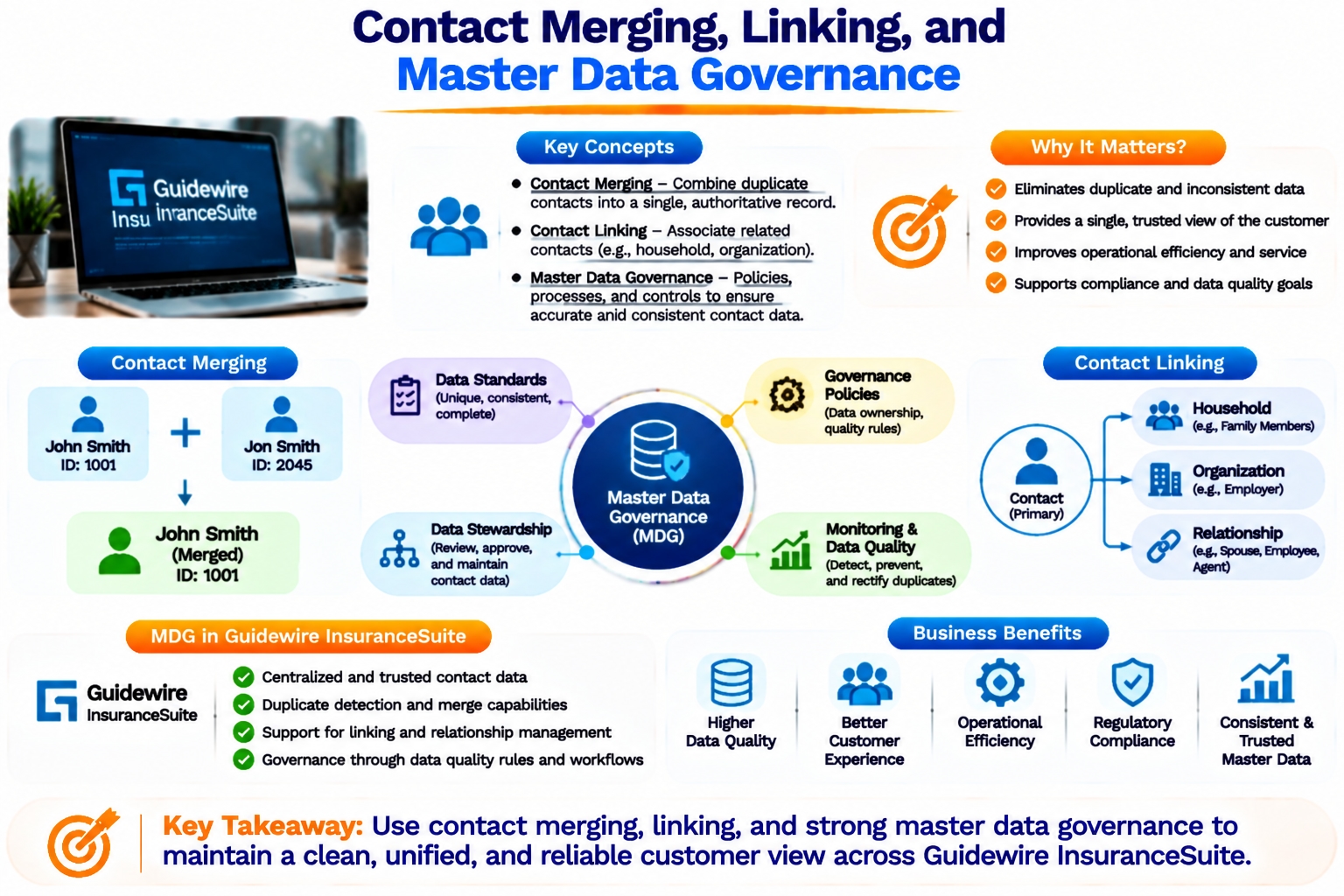
Even with robust preventative filters, duplicate records occasionally slip into production environments—particularly following legacy data migrations or corporate acquisitions. Guidewire addresses post-entry cleanup through structured linking and merging workflows managed primarily within ContactManager. Authorized data stewards use dedicated administrative screens to review flagged duplicate pairs, inspect associated policies or open claims, and execute a controlled merge operation.
During a merge, the steward designates one profile as the kept (surviving) contact and the other as the retired contact. Guidewire automatically repoints all foreign key references—spanning active policies, historical claims, billing accounts, and contact roles—from the retired record to the surviving master record before marking the duplicate inactive. This non-destructive retirement approach preserves full audit trails and regulatory compliance while presenting a clean, consolidated single view to everyday end users.
Best Practices for Maintaining Long-Term Data Hygiene
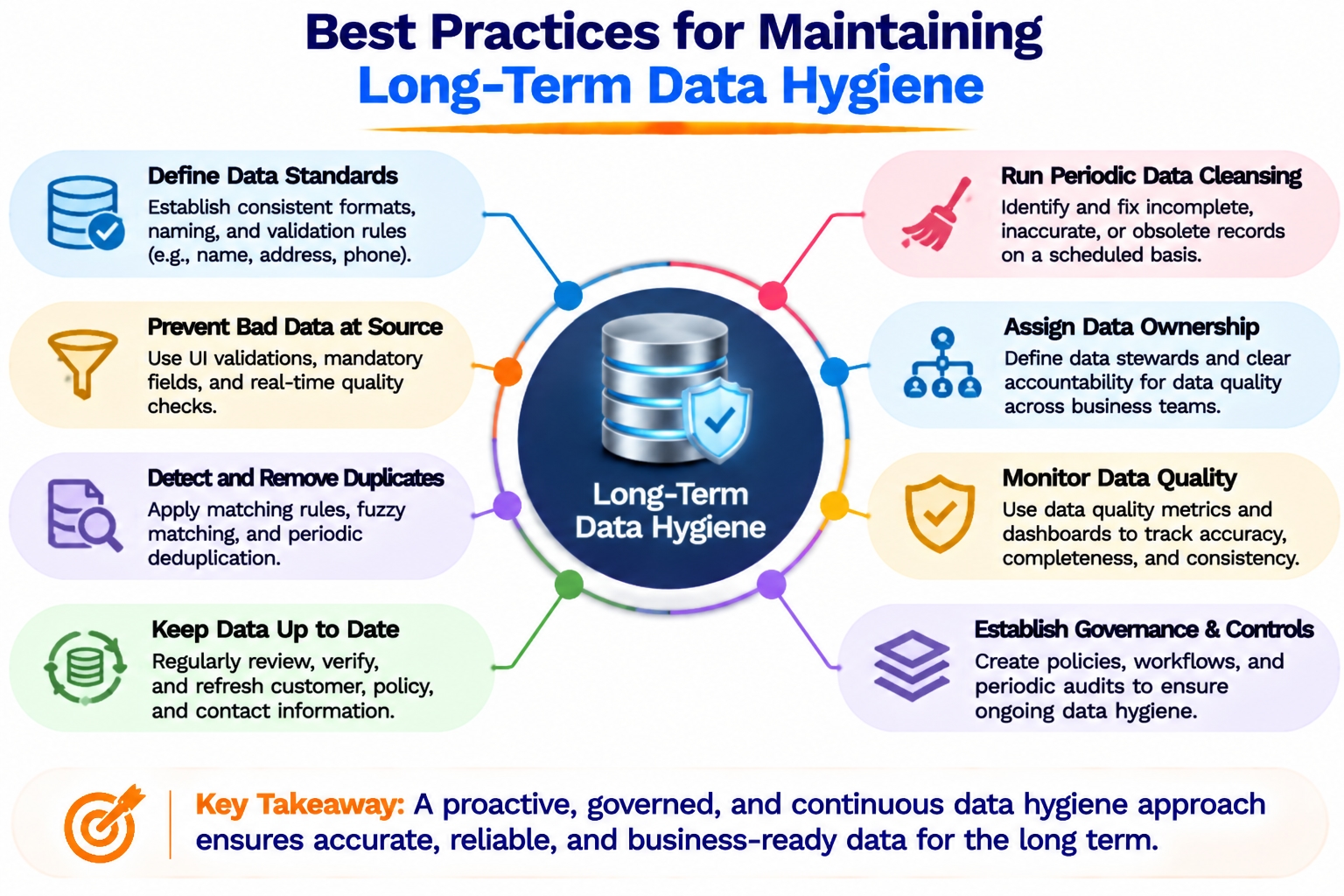
Sustaining a duplicate-free Guidewire environment requires ongoing governance rather than a one-time configuration effort during initial implementation. Technical architects and business analysts must establish clear operational standards across data ingestion, testing, and periodic maintenance cycles:
Standardize Input Formats Early: Enforce strict validation rules and address standardization services (such as USPS or international postal verification APIs) at the point of entry so street names, phone numbers, and tax IDs follow uniform structures before matching rules execute.
Audit Legacy Migration Datasets: Before loading historical records into PolicyCenter or ContactManager, run comprehensive data profiling and cleansing scripts to deduplicate legacy tables rather than importing decades of dirty data into a modern cloud architecture.
Tune Scoring Weights Periodically: Review false-positive and false-negative match logs quarterly. If adjusters routinely bypass duplicate warnings because the threshold is too loose, recalibrate field weights to improve precision.
Preserve Referential Integrity in Lower Environments: When cloning or masking production data for QA and staging sandboxes, utilize Guidewire-aware data management tools that preserve foreign key relationships and
AddressBookUIDlinks so test environments accurately mirror production behavior.
Comparison of Duplicate Management Mechanisms in Guidewire
Mechanism / Layer | Primary Guidewire Component | Detection Timing | Core Technique Used | Primary Business Benefit |
Centralized Contact Hub | ContactManager | Real-time (Create/Update) | Master | Eliminates siloed customer and vendor profiles across InsuranceSuite |
Fuzzy Search & Scoring | ContactManager & Core UI | Pre-save / User Entry | Weighted multi-field similarity scoring and thresholds | Alerts users to near-matches caused by typos or abbreviations |
API Idempotency Control | Guidewire Cloud API | In-flight API Request |
| Prevents duplicate database commits from network retries |
Administrative Merge | ContactManager Admin UI | Post-creation / Audit | Surviving vs. retired record consolidation & key repointing | Cleans up historical duplicates while preserving full audit trails |
Migration & Integration Staging | Integration Data Manager / ETL | Pre-ingestion / Batch | Schema normalization, data cleansing, and staging validation | Protects core data models from external data corruption |
Conclusion
Duplicate data management is far more than a routine database maintenance task—it is a foundational pillar of operational accuracy across every Guidewire implementation. When redundant customer profiles, vendor entries, or API transactions infiltrate PolicyCenter, ClaimCenter, and BillingCenter, insurers face delayed claims settlements, inaccurate underwriting risk assessments, and fractured customer experiences. By combining centralized governance through Guidewire ContactManager, intelligent fuzzy matching thresholds, idempotent Cloud API transaction headers, and disciplined administrative merge workflows, organizations can stop duplicates at the point of entry and resolve legacy overlaps cleanly. As insurance ecosystems continue expanding through digital portals and third-party integrations, investing in sound data hygiene ensures your Guidewire platform remains agile, compliant, and dependable for years to come.