
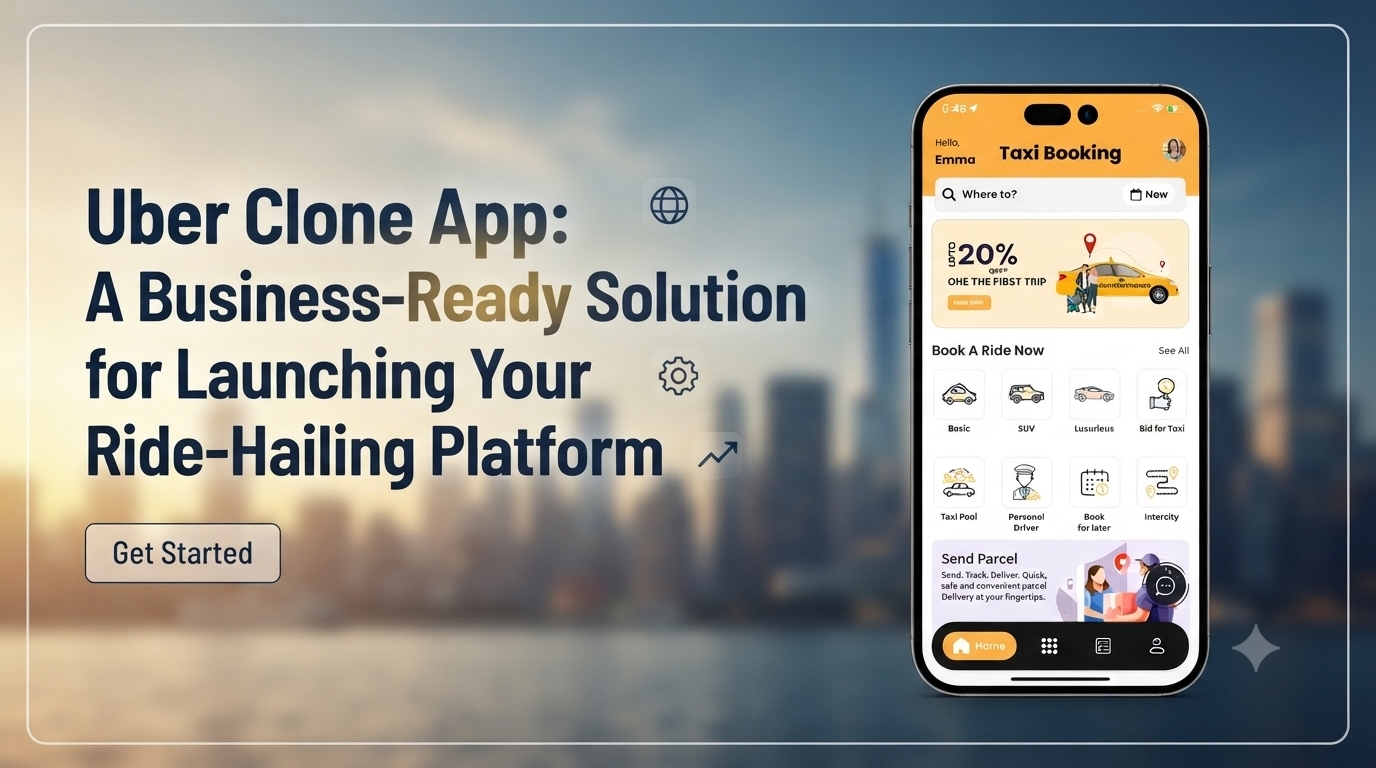
The ride-hailing industry has evolved into a technology-driven business ecosystem where customers expect quick bookings, transparent pricing, real-time tracking, convenient payments, and reliable service. For entrepreneurs and transportation companies, building a digital platform can create opportunities to serve local markets, manage fleets, connect independent drivers, and expand into new locations.
An Uber Clone App provides a business-ready foundation for launching such a platform under your own brand. Instead of starting every component from scratch, businesses can use a pre-built ride-hailing solution and customize its branding, features, pricing structure, service areas, and business model according to their requirements.
Uber Clone App: A Business-Ready Solution
An Uber Clone App is a ready-to-customize ride-hailing platform that enables businesses to launch their own transportation marketplace. It typically connects passengers with drivers through dedicated applications while providing administrators with centralized tools to manage the entire operation.
The platform can include a customer app, driver app, and admin panel, creating an integrated ecosystem for managing bookings and daily operations.
From a business perspective, the key advantage is flexibility. A company can define its service categories, operating areas, commission structure, pricing rules, and payment options rather than following another platform's business model.
Core capabilities may include:
On-demand and scheduled ride booking
Real-time GPS and trip tracking
Driver discovery and matching
Fare calculation and estimation
Multiple payment options
Driver and passenger profiles
Ratings and reviews
Push notifications
Ride history and booking management
Promotional offers and referral programs
Driver earnings and payout management
Admin reporting and operational controls
A business can also adapt the platform for different transportation models, including city taxis, private vehicles, corporate transportation, fleet services, airport transfers, and other mobility solutions.
Inside Our Uber Clone Script: What Businesses Get
For a transportation startup or established operator, launching an app involves more than creating a customer-facing interface. The underlying platform needs to support drivers, administrators, payments, bookings, communication, and operational management.
A comprehensive Uber Clone Script can provide the foundation for these requirements through multiple components.
Passenger App
The passenger application allows customers to search for rides, enter pickup and destination locations, select available ride options, view estimated fares, and confirm bookings.
Features such as live driver tracking, digital payments, ride history, ratings, reviews, notifications, and in-app communication can make the booking experience convenient.
Driver App
The driver application provides tools for accepting or rejecting ride requests, navigating to pickup locations, managing trips, viewing earnings, checking completed rides, and communicating with customers.
Businesses can configure driver-related rules according to their operational model, including commissions, availability, service areas, and payout processes.
Admin Panel
The admin dashboard gives business owners centralized control over their platform. Administrators can manage users, drivers, bookings, payments, service categories, commissions, promotions, reports, and other operational settings from one place.
This centralized approach helps businesses monitor activity and make data-informed decisions as their platform grows.
Customization and Branding
A white-label approach allows businesses to launch the platform under their own identity. Branding elements such as the logo, colors, application name, and selected features can be customized to match the company's market positioning.
The platform can also be adapted to specific locations, currencies, languages, payment methods, and service requirements.
How to Monetize an Uber-Like Ride-Hailing App
Launching a ride-hailing platform is only one part of the business strategy. Entrepreneurs also need to determine how the platform will generate sustainable revenue.
Different markets may require different monetization approaches, so businesses can combine multiple revenue streams depending on their customer base and operational model.
Commission From Drivers
A platform can charge a percentage or fixed fee from completed rides. The commission model allows the business to generate revenue as booking volume increases.
Booking or Service Fees
Businesses can apply a platform fee, convenience fee, or booking charge to eligible rides. The amount and structure can be configured according to the market and service category.
Surge or Dynamic Pricing
During periods of high demand, businesses can use dynamic pricing mechanisms to adjust fares based on demand, availability, distance, time, or other configured parameters.
Corporate Transportation
A ride-hailing platform can also serve companies that need transportation for employees, clients, events, or business travel. Corporate accounts can create an additional B2B revenue channel.
Premium Ride Categories
Businesses can introduce multiple vehicle categories, such as economy, premium, luxury, larger vehicles, or specialized transportation. Each category can have its own pricing structure.
Advertising and Promotional Partnerships
Once the platform develops a substantial customer base, businesses may explore promotional placements, brand partnerships, and sponsored offers as additional revenue opportunities.
The right model depends on the target market, customer expectations, operating costs, driver structure, and competitive environment.
Uber Clone App Development Cost: What to Know
The cost of developing a ride-hailing platform varies significantly because there is no single development scope that fits every business.
Several factors influence the overall investment.
Feature Requirements
A platform with basic booking, GPS tracking, payments, and driver management will generally have a different development scope from a solution that includes advanced automation, corporate accounts, multiple ride categories, AI capabilities, and complex reporting.
Platform Selection
Businesses may require Android, iOS, web applications, or a combination of platforms. Supporting multiple platforms can affect development and testing requirements.
Customization
The level of customization also influences the development effort. Businesses may want unique workflows, custom pricing rules, specialized booking processes, or integrations designed around their operational model.
Third-Party Integrations
Maps, payment gateways, SMS providers, authentication services, analytics tools, and other third-party systems can affect the overall project scope and ongoing operating expenses.
Design and User Experience
A highly customized interface with tailored user journeys requires additional design and development work compared with a standard implementation.
Scalability Requirements
Businesses planning to operate across multiple cities or countries may require an architecture designed for larger volumes of users, bookings, drivers, and transactions.
For this reason, businesses should evaluate the complete solution scope rather than selecting a development option based only on an initial price.
Advanced Features for Modern Taxi Booking Apps
Today's transportation platforms need more than basic ride booking. Advanced capabilities can help businesses improve operational efficiency, provide greater visibility, and create a smoother experience for customers and drivers.
Real-Time GPS Tracking
GPS-based tracking allows passengers and administrators to monitor vehicle locations during active trips while helping drivers navigate efficiently.
Smart Driver Matching
Automated driver assignment can consider factors such as location, availability, vehicle category, and configured business rules when matching drivers with passengers.
Scheduled Rides
Customers can book trips for a future date and time, making the platform suitable for airport transfers, business travel, appointments, and planned transportation.
Multiple Ride Categories
Businesses can offer different vehicle types and pricing tiers from the same platform, allowing them to serve a wider range of customers.
Digital Payments
Integration with payment gateways enables customers to pay electronically while allowing businesses to manage transaction records and driver payouts.
Ratings and Reviews
Two-way ratings can provide feedback about completed trips and help businesses monitor service quality.
Promotions and Referral Programs
Discount codes, referral incentives, and promotional campaigns can help businesses attract new users and encourage repeat bookings.
Analytics and Reporting
Business dashboards can provide information about bookings, revenue, driver activity, customer activity, cancellations, and other operational metrics.
AI-Powered Features for Smarter Ride-Hailing Apps
Artificial intelligence is creating new possibilities for transportation businesses by helping automate decisions, analyze operational data, and improve user experiences.
AI capabilities can be introduced according to a company's specific requirements rather than treating them as mandatory components of every platform.
AI-Based Booking Assistance
AI-powered assistants can help customers with common booking questions, ride information, and basic support interactions, reducing the workload on customer service teams.
Intelligent Driver Matching
AI and data-driven algorithms can analyze multiple variables to improve driver-passenger matching and support more efficient dispatching.
Demand Prediction
Historical booking patterns and operational data can be analyzed to identify potential periods of higher demand. Businesses can use these insights to plan driver availability and operational resources.
Dynamic Pricing Intelligence
AI-driven analysis can support pricing decisions by evaluating factors such as demand patterns, location, time, and vehicle availability.
Fraud and Risk Detection
Automated systems can identify unusual booking or payment patterns and flag potentially suspicious activity for further review.
Driver Earnings Optimization
Data-driven recommendations can help drivers identify demand patterns and potentially improve how they plan their availability.
Building a Scalable Ride-Hailing Business
An Uber Clone App should be viewed as more than a mobile application. For businesses, it can serve as the technology infrastructure connecting customers, drivers, administrators, payments, and transportation operations.
The right solution can provide a starting point while allowing the business to customize its platform around a specific market and growth strategy. From branding and monetization to advanced features and AI-powered capabilities, each component can be selected based on actual business requirements.
Before launching, businesses should clearly define their target audience, service area, vehicle categories, pricing model, driver onboarding process, revenue strategy, technology requirements, and expansion plans.
With a business-focused approach, a customizable ride-hailing platform can provide the foundation needed to establish a branded transportation service and adapt as customer expectations and market opportunities evolve.
FAQs
1. Is an Uber Clone App suitable for startups?
Yes. A customizable ride-hailing solution can provide startups with a structured technology foundation while allowing them to configure features, branding, pricing, and services according to their business model.
2. Can businesses customize an Uber Clone Script?
Yes. Businesses can customize branding, workflows, service categories, pricing rules, payment options, integrations, and other platform components based on their requirements.
3. Can an Uber Clone App support multiple cities?
A scalable platform can be configured to support expansion into multiple service areas, cities, or regions, depending on its technical architecture and business requirements.
4. Can AI features be added to a ride-hailing platform?
Yes. AI capabilities such as booking assistance, demand analysis, intelligent matching, fraud detection, and automated support can be incorporated based on the platform's requirements.