
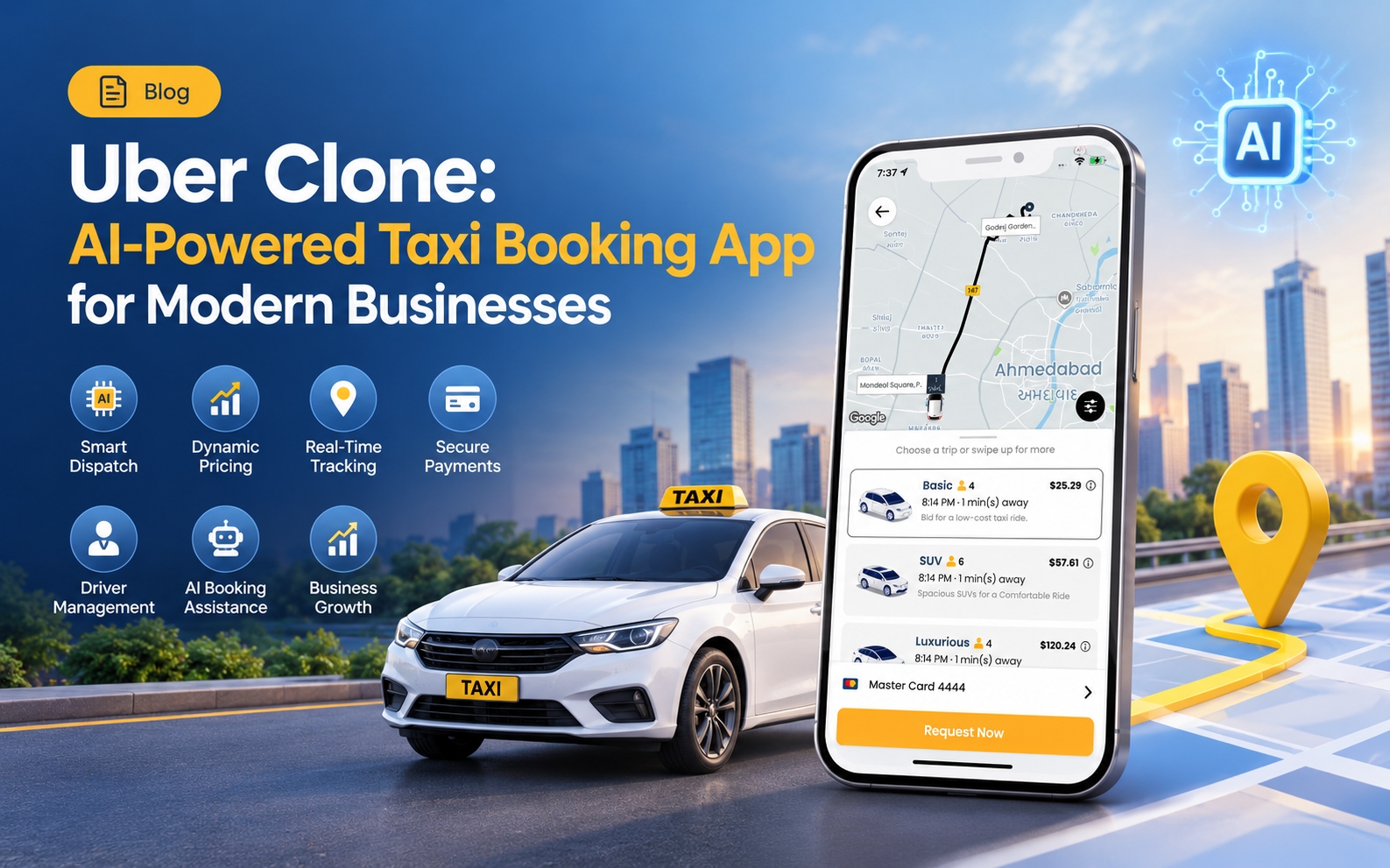
The taxi and ride-hailing industry is becoming increasingly technology-driven, with businesses looking for smarter ways to connect passengers with drivers, automate operations, and create sustainable revenue. An Uber Clone provides a ready-to-customize foundation for launching a branded taxi booking platform with modern mobility features.
Instead of developing every component from the ground up, businesses can use a customizable taxi booking solution that brings passenger booking, driver management, dispatch, payments, tracking, analytics, and business administration together in one ecosystem.
With AI-powered capabilities added to the platform, businesses can go beyond basic ride booking. Intelligent dispatching, booking assistance, dynamic pricing, fraud detection, driver earnings optimization, and operational insights can help create a more responsive ride-hailing experience.
What Is an Uber Clone?
An Uber Clone is a customizable taxi booking app solution designed to help businesses launch their own branded ride-hailing platform. It typically includes dedicated applications and management interfaces for passengers, drivers, and administrators.
The concept is not about duplicating another company's branding or proprietary technology. Instead, it provides a technology framework inspired by the functionality users expect from modern ride-hailing platforms.
Businesses can customize the solution with their own:
Brand name and logo
Colors, fonts, and visual identity
Pricing and commission structure
Service areas
Payment methods
Driver onboarding policies
Business rules
Languages and currencies
Promotional campaigns
A complete platform can support the entire ride lifecycle—from booking and driver matching to trip completion, payment processing, ratings, and business reporting.
Advanced Features of a Taxi Booking App
A modern taxi booking platform needs more than a simple pickup-and-drop interface. Businesses require tools that help them manage customers, drivers, trips, finances, and day-to-day operations efficiently.
1. Real-Time Ride Booking
Passengers can enter pickup and destination locations, view available ride options, receive estimated fares, and request a ride directly from the application.
2. Smart Driver Dispatch
The platform can automatically identify suitable drivers based on factors such as proximity, availability, vehicle type, and operational rules. This helps reduce manual dispatching and unnecessary waiting time.
3. Real-Time GPS Tracking
Passengers can track their assigned driver and monitor the trip in real time. Drivers can also use navigation support to reach pickup and destination locations efficiently.
4. Dynamic Pricing
Businesses can configure pricing rules based on demand, distance, time, location, or other business conditions. This gives operators greater flexibility when managing changing market conditions.
5. Multiple Payment Options
A taxi booking platform can support different payment methods, including cards, digital wallets, cash, and integrated payment gateways, depending on the target market.
6. Scheduled Rides
Customers can reserve rides in advance instead of requesting them immediately. This can be useful for airport transfers, business transportation, appointments, and planned journeys.
7. Driver Earnings Management
Drivers can access information about completed trips, commissions, earnings, incentives, and payouts through their dedicated application.
8. Ratings and Reviews
Passengers and drivers can provide ratings and feedback after completing trips, helping businesses monitor service quality and identify operational issues.
9. Admin Dashboard
The administrator can manage users, drivers, vehicles, trips, pricing, commissions, payments, service areas, promotions, and other operational settings from a centralized dashboard.
10. Analytics and Reports
Business owners can analyze booking volume, revenue, driver performance, customer activity, cancellations, payment activity, and other operational metrics.
AI-Powered Features of an Uber Clone App
Artificial intelligence can make a taxi booking platform more intelligent by helping businesses automate decisions and improve the experience for passengers and drivers.
AI Taxi Booking Assistance
An AI-powered booking assistant can help passengers with common booking-related questions, ride information, and booking assistance. This can reduce the need for manual customer support for routine requests.
Intelligent Ride Dispatch
AI can analyze available drivers, location data, ride demand, and operational conditions to support more intelligent driver assignment and dispatch decisions.
AI-Powered Dynamic Surge Pricing
AI-driven pricing mechanisms can analyze demand patterns and other operational signals to help businesses adjust fares during periods of increased demand while maintaining configurable business rules.
Risk and Fraud Detection
AI-based monitoring can identify unusual booking, payment, account, or trip patterns that may require additional review. This can help businesses strengthen platform security and reduce potentially fraudulent activity.
AI Driver Earnings Optimizer
AI-powered insights can help drivers understand earning opportunities and identify patterns around demand, trip activity, and working periods. Businesses can use these insights to improve driver engagement and platform efficiency.
Intelligent Operational Insights
AI can analyze historical and real-time platform information to identify trends in bookings, cancellations, demand, driver availability, and revenue. These insights can support better operational decisions.
About Uber Clone Script
An Uber Clone Script is the underlying software framework used to create a taxi booking platform with pre-developed functionality. Rather than starting with an empty development environment, businesses can begin with an existing architecture containing essential ride-hailing components.
A customizable script can include:
Passenger app
Driver app
Admin panel
Booking management
Driver management
Vehicle management
GPS tracking
Payment integration
Fare management
Commission management
Ratings and reviews
Notifications
Analytics and reporting
AI-powered capabilities
The major advantage is flexibility. Businesses can customize the platform according to their operational requirements instead of being restricted to a generic taxi booking model.
Revenue Streams of an Uber Clone Taxi Booking App
A taxi booking platform can generate revenue through multiple channels rather than depending on a single source.
Revenue Stream | How It Works |
|---|---|
Trip Commission | The platform retains a percentage or fixed amount from completed rides. |
Driver Subscription | Drivers can pay a recurring fee to access platform services under a selected plan. |
Surge Pricing | Higher fares can be applied during high-demand periods according to business rules. |
Booking Fees | A fixed service or convenience fee can be added to eligible bookings. |
Cancellation Fees | Businesses can charge applicable fees for certain late cancellations. |
Corporate Accounts | Businesses can offer dedicated transportation services to corporate customers. |
Advertising | Relevant businesses can promote offers or services through available advertising placements. |
Premium Services | Higher-value ride categories can generate additional revenue through premium pricing. |
Using multiple revenue models can help businesses build a more diversified commercial strategy while adapting monetization to their market.
Readymade Uber Clone vs. Building From Scratch
Choosing between a ready-made solution and completely custom development depends on budget, timeline, technical requirements, and long-term objectives.
Factor | Readymade Uber Clone | Build From Scratch |
|---|---|---|
Development Time | Faster launch | Usually takes longer |
Initial Cost | Generally lower | Generally higher |
Core Features | Pre-developed | Developed from zero |
Customization | Customizable | Fully custom |
Testing | Existing modules can reduce development effort | Requires extensive development and testing |
Scalability | Can be configured for business growth | Designed according to requirements |
Technology Investment | Lower initial development effort | Higher engineering investment |
Launch Speed | Faster market entry | Longer time to market |
Maintenance | Updates and customization required | Full ongoing development responsibility |
Business Validation | Faster way to test a business model | Requires larger initial commitment |
For businesses that want to enter the market faster while retaining customization capabilities, a ready-made solution can provide a practical starting point.
Why Choose Our Uber Clone App?
Launching a ride-hailing platform requires more than simply purchasing software. The technology needs to support business operations, customer experience, driver management, and future expansion.
Our Uber Clone App is designed around the requirements of modern taxi and mobility businesses.
AI-Powered Capabilities
The platform can incorporate intelligent features such as booking assistance, smart dispatch, dynamic pricing support, fraud and risk detection, and driver earnings insights.
Complete Ride-Hailing Ecosystem
Businesses can manage passengers, drivers, bookings, vehicles, payments, pricing, commissions, and operations through connected applications and administrative tools.
Customizable Branding
The platform can be adapted to match your business identity, including your brand name, logo, colors, fonts, and other visual elements.
Scalable Business Model
Whether you are launching a local taxi service or planning a larger mobility operation, the platform can be configured around your business requirements and expansion strategy.
Multiple Business Opportunities
From standard taxi rides to premium transportation, scheduled journeys, corporate transportation, and additional service categories, businesses can develop different commercial models around the platform.
Data-Driven Management
Reports and analytics can help business owners understand bookings, revenue, driver activity, customer behavior, cancellations, and other important performance indicators.
Development and Launch Process of an Uber Clone
A structured development process can make the transition from business idea to live taxi booking platform more efficient.
Step 1: Business Requirement Analysis
The first stage is understanding your target market, service area, customer segments, vehicle categories, pricing model, payment methods, and operational requirements.
Step 2: Feature Planning
The required passenger, driver, and admin features are finalized. AI-powered functionality, integrations, revenue models, and customization requirements are also identified.
Step 3: UI/UX Customization
The application's interface is customized according to the business brand. User journeys are designed to keep booking, navigation, payments, and account management straightforward.
Step 4: Platform Configuration & Development
The core taxi booking system is configured and customized according to the approved requirements. APIs, payment gateways, maps, notifications, and other required integrations can be connected.
Step 5: AI Feature Integration
Selected AI capabilities can be configured or integrated based on the business model, such as intelligent dispatch, booking assistance, risk detection, pricing intelligence, or driver insights.
Step 6: Testing & Quality Assurance
The platform is tested across major workflows, including registration, booking, driver assignment, tracking, payments, cancellations, notifications, and administrative operations.
Step 7: Deployment
Once testing is completed, the applications and backend infrastructure can be prepared for deployment. Business accounts, configurations, service locations, and operational settings are finalized.
Step 8: Launch & Optimization
After launch, businesses can monitor platform performance, customer behavior, driver activity, and revenue metrics. Continuous improvements can then be made based on real-world data.
Frequently Asked Questions
1. What is an Uber Clone app?
An Uber Clone app is a customizable taxi booking software solution that enables businesses to launch their own branded ride-hailing platform with passenger, driver, and administrative functionalities.
2. Can an Uber Clone app include AI features?
Yes. Depending on the solution, AI capabilities can include intelligent ride dispatch, booking assistance, risk and fraud detection, dynamic pricing support, driver earnings optimization, and operational insights.
3. Can I customize the Uber Clone app for my business?
Yes. Businesses can customize branding, pricing models, service areas, payment methods, ride categories, commissions, languages, currencies, and other platform components according to their requirements.
4. How does an Uber Clone taxi app generate revenue?
Revenue can come from ride commissions, booking fees, driver subscriptions, surge pricing, cancellation fees, corporate accounts, advertising, and premium transportation services.
5. Is a ready-made Uber Clone better than developing an app from scratch?
It depends on the business requirements. A ready-made solution can reduce development time and initial effort while still allowing customization. Building from scratch offers greater control but generally requires more development resources, time, and investment.
6. How long does it take to launch an Uber Clone app?
The timeline depends on the required features, integrations, customization, AI functionality, platform configuration, testing, and deployment requirements. A ready-made foundation can generally accelerate the process compared with developing the entire platform from scratch.
Build Your AI-Powered Taxi Booking Business
The next generation of ride-hailing is moving beyond basic booking applications. Businesses need platforms that can connect passengers and drivers while also supporting intelligent dispatch, dynamic pricing, secure payments, operational analytics, and AI-powered decision-making.
An Uber Clone App can provide the technology foundation needed to enter the taxi booking market with a customizable and scalable business platform. By combining advanced ride-hailing functionality with AI-powered capabilities and flexible revenue models, businesses can create a transportation service designed for modern customer expectations and long-term growth.
Whether your goal is to launch a local taxi service, expand an existing transportation company, or build a larger ride-hailing marketplace, the right technology platform can turn the concept into a practical digital business.



