
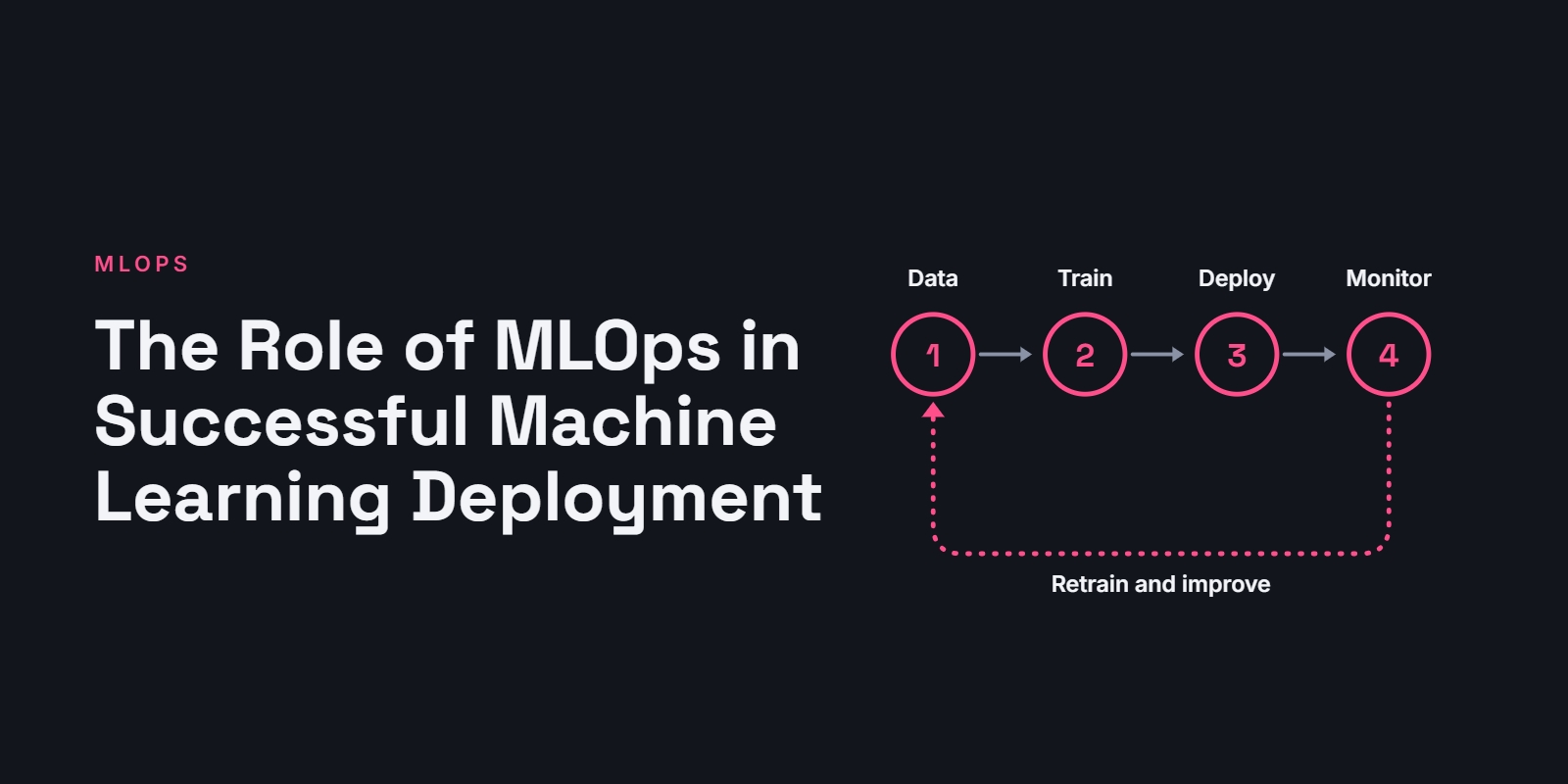
Machine learning can be very beneficial in modern businesses. It can allow for more efficient decision-making, pattern recognition, predictions, and improved customer experience. Once a model has been built and is ready for deployment, however, it can be difficult to ensure a successful deployment.
If models are not consistently performing as expected in deployment, this could be caused by a variety of factors such as changes to data, inconsistent environments, or unexpected user activity. MLOps, in conjunction with machine learning, software engineering, and operations, allows businesses to successfully implement, monitor, and manage machine learning models within their business.
What Is MLOps?
MLOps (Machine Learning Operations) allows standardised and automated processes within machine learning. It enables collaboration between data scientists, machine learning engineers and IT operations to create consistent models.
Without MLOps, traditional machine learning may cause issues. The phases of development, testing, and deployment may be separated, causing communication issues. This means that models may be difficult to maintain and may cause slower deployment.
With MLOps, automation and collaboration are applied. Key benefits from implementing MLOps include:
Automated model training and deployment.
Consistency between development and deployment.
Monitoring model performance and data quality.
Allowing models to be continuously improved.
Reducing human error and manual effort.
Improving Machine Learning Deployment With MLOps
When deploying machine learning models, many processes need to occur. These include managing data pipelines, dependencies, infrastructure, testing, and monitoring performance.
MLOps provides structure to machine learning deployment. For example, in an e-commerce application, models may be used to make product recommendations. As user interaction may change over time, models must be updated regularly. MLOps can be implemented to automate data collection, model retraining, validation, and deployment. This ensures that product recommendations stay relevant as user preferences change.
MLOps allows businesses to turn experimental ML models into reliable applications. Teams leveraging professional AI development solutions often find the transition from prototype to production smoother, as experienced partners bring established pipelines and deployment frameworks that reduce time-to-value significantly.
Key Aspects of Effective MLOps
To successfully implement MLOps within a business, there are key aspects to consider.
Data Management and Versioning
The quality of data used in training models affects the performance of models. Therefore, if there are changes to data sources, format, or distribution, this can impact model performance.
MLOps allows consistent data processing by validating the data, versioning, and managing the data pipeline. As a result, teams can easily see which data sets have been used to train a model, and understand what data changes may impact model performance.
Automated Model Training
Manually training models can be inefficient if many machine learning applications are present in an organisation.
By implementing automated model training pipelines, models can be retrained with updated datasets within a set configuration. This reduces repetitive tasks. It also makes it easy to experiment with models. Businesses investing in AI app development services often benefit from ready-built automation frameworks that accelerate this process without requiring teams to build pipelines from scratch.
Continuous Integration and Deployment
Implementing CI/CD within machine learning applications can streamline testing and deployment. Before deploying models, automated checks can be carried out to understand model performance and ensure compatibility of dependencies and deployment environments.
This allows for controlled deployment of model updates, meaning that human error in live models is minimised.
Model Monitoring
Once models are deployed, they may perform differently. In real-world settings, data will usually be constantly changing. This is known as data drift or concept drift.
Monitoring model performance can be useful to understand if any significant changes have occurred in the data, the quality of predictions, speed, and resource usage. Insights from monitoring can help teams investigate problems and understand when models must be retrained.
Benefits of MLOps
Along with increasing speed of deployment, MLOps can help businesses manage, scale, and sustain their machine learning projects. Sound machine learning development practices become far more consistent and repeatable when MLOps principles are embedded from the start of a project.
Benefits include:
Faster deployment – Repetitive manual tasks are reduced, and models can be deployed efficiently.
More reliable deployments – Consistent testing and validation processes reduce inconsistencies.
Better collaboration – Data scientists, developers, and operations teams can collaborate.
Easier Scaling – Multiple models and deployment environments can be managed efficiently.
Lower cost of operations – Automated processes mean fewer manual tasks. Models can be more easily maintained.
MLOps is therefore very beneficial to businesses that require continual decisions to be made using machine learning.
Common Issues
Despite benefits, care must be taken to implement MLOps correctly. If new tools are being integrated into current infrastructure, or complex data pipelines are being managed, there may be difficulties.
Common issues faced when implementing MLOps include ensuring good quality data, choosing appropriate technologies, managing costs of infrastructure, and finding people with the right mix of knowledge in both machine learning and DevOps.
Good governance can also be challenging. Businesses must document models appropriately, understand and prevent bias within models, protect sensitive data, and ensure models in production are compliant with requirements.
However, starting with a small number of valuable ML projects may allow businesses to create effective processes. Working alongside providers of artificial intelligence development services can help organisations navigate these early-stage challenges, particularly around governance, infrastructure choices, and building the right internal capabilities.
Best Practice
MLOps should be considered as an ongoing process within business operations.
Some best practices to follow:
Understand goals for ML deployment.
Ensure efficient data pipelines. Validate, store, and version data.
Automate repetitive processes. Automate model training, testing, and deployment.
Monitor deployed models. This includes model performance, data drift, system status, and prediction quality.
Document models. Document the model versions, configurations, dependencies, and changes in deployment.
Check processes regularly to improve them.
Conclusion
MLOps is very important to allow reliable, consistent, and scalable machine learning deployment. It enables efficient deployment by providing automation, monitoring, version control, and improvements.
As more businesses rely on machine learning applications, it is very important that models are managed appropriately throughout their life cycle. With MLOps, businesses can overcome deployment issues, maintain model performance, and turn experimental models into valuable applications.






