
We encounter the electrostatic properties of plastics every day. Synthetic fabrics cling. Dust settles on plastic surfaces. In industrial settings, accumulated charge can damage electronics or ignite flammable vapors. Familiar annoyances, occasionally hazards.
What is less familiar is what happens when plastics break down. Micro- and nanoplastics (MNPs) have been found from Antarctica to the human brain. As particles shrink, their electrical properties do not disappear. The question: what determines where these particles go and how they interact with living organisms?
The electrical state of MNPs, the file argues, may be an underappreciated factor in their behavior.
The arithmetic of fragmentation
A tenfold reduction in particle diameter produces roughly a thousand times more particles and about ten times more total surface area. A 1 mm particle fragmented into 100 nm particles could yield approximately a trillion particles, with total surface area increasing by roughly 10,000 times.
That expanded surface is where contact happens — with water, other particles, biomolecules, cells. At the micro- and nanoscale, electrostatic charge may not be just a familiar quirk of plastic. It may be a factor in how MNPs behave.
How plastics acquire charge
Plastics are good electrical insulators. Excess charge does not dissipate quickly. Charge can accumulate through contact electrification — contact followed by separation. Mechanical breakdown can also generate surface charge. Fragmentation itself may alter the electrical state of newly formed particles.
Contact with water offers another pathway. Electron transfer and ion adsorption both contribute to electrification at the liquid-solid interface. In experiments with deionized water and PTFE, contact electrification produced surface charge densities on the order of 1 nC·cm⁻², roughly ten times more than calculated for ion transfer alone, suggesting a substantial contribution from electron transfer.
Charge does not sit still
In insulating plastics, excess charge can localize in energy traps associated with molecular structure, disorder, defects, impurities, and internal interfaces. The depth and density of these traps affect how long charge persists.
Charge can also distribute unevenly. Experiments with contact-electrified polymers have revealed a random mosaic of oppositely charged domains with characteristic length scales of approximately 44 and 450 nm. Those scales overlap with the size range of nanoplastic particles themselves.
What zeta potential does and does not measure
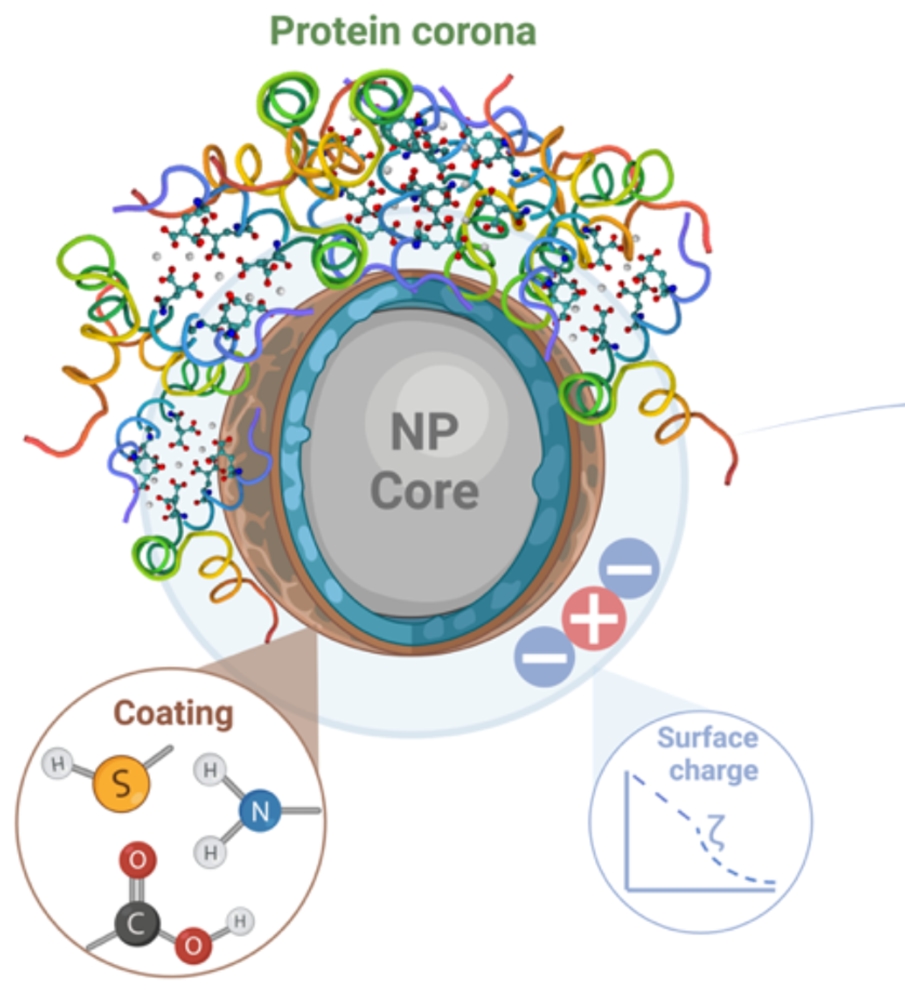
Surface charge of MNPs is typically characterized using zeta potential, but this is not a direct measurement of charge on the plastic surface. It represents an effective electrokinetic potential at the slipping plane and does not reveal local charge heterogeneity. It also depends on the surrounding medium. For example, 50-nm polystyrene nanoparticles with zeta potentials of -8, -21, and +20 mV in water showed negative values (-8 to -14 mV) in culture medium, attributed to formation of a negatively charged protein corona.
Charge changes over time
The electrical state of MNPs can change as sunlight, heat, oxidation, and mechanical stress alter their shape, surface chemistry, and molecular structure. Degradation can produce free radicals, polymer chain scission, changes in crystallinity, and structural defects. In a recent study of PET, higher recycled content was associated with greater charge retention and changes in dielectric behavior, consistent with polymer chain scission and defect-induced polarization.
Electrical state can also change in biological environments, where proteins can form a corona that alters the particle surface and its electrostatic interactions.
Why electrical state may matter
Electrostatic forces can influence whether particles remain dispersed or aggregated, whether they attach to minerals or organic matter, and whether they interact with biomolecules and biological surfaces. These interactions depend not only on how much charge a particle carries but on how that charge is distributed and on its polarizability.
Electrical state may be especially important in living systems, where electrical and electrochemical gradients play central roles. Cell membranes maintain potential differences and ion gradients. Proteins, lipids, nucleic acids carry charged groups. An MNP entering this environment encounters a complex electrical landscape.
Experiments with polystyrene nanoplastics have shown substantial but system-dependent differences in biological effects. In one study using 50-60 nm particles on *Caenorhabditis elegans*, positively charged nanoplastics were more than 60 times more toxic than negatively charged particles. Experiments with 50 nm particles on mouse lymphocytes revealed charge-related differences in oxidative stress, mitochondrial dysfunction, and apoptosis, with positively charged particles showing the strongest toxicity. However, other experiments showed lower acute toxicity of positively charged polystyrene nanoplastics on *Daphnia magna* under certain conditions.
Charge sign alone does not always predict effects.
Water deserves particular attention
Water is often the medium in which MNPs interact with other particles, surfaces, and molecules. At the MNP-water interface, electron transfer and ion adsorption can alter the local electrical environment, which may influence the orientation and organization of hydrogen bonds in nearby water molecules. For plastics specifically, molecular modeling of polystyrene-water interfaces shows that water organization is sensitive to polymer surface chemistry: more extensive surface oxidation is associated with increased water density at the interface, altered molecular ordering, and enhanced hydrogen bonding.
Whether persistent or spatially heterogeneous electrostatic charge on MNPs causes additional changes in water structure remains largely unexplored. Recent experiments have recorded changes in thermal conductivity and thermal diffusivity of water and seawater containing microplastics — though whether electrical effects contribute is unknown.
Not the same as current
Electrostatic charge can accumulate and remain localized, especially on or within an electrical insulator such as plastic. Even without discharge, localized charge generates electric fields and electrostatic forces that can influence nearby particles and surfaces. Experiments relevant to early stages of planet formation show that collisions can electrically charge dust particles, and electrostatic attraction can contribute to their aggregation even when gravity between individual particles is extremely weak.
The question is not whether, but what state
The question is not simply whether MNPs can carry electrostatic charge, but what electrical state they actually exhibit when interacting with another particle, surface, biomolecule, or cell. As a particle moves through different environments, charge can be acquired, retained, lost, or redistributed. Environmental conditions such as pH and ionic strength can alter surface ionization and electrostatic screening. Adsorbed proteins and other coatings can further modify the effective contact surface.
For a specific interaction, what likely matters most is the electrical state of the particle at that moment. That state may not be captured by a single descriptor such as zeta potential, especially when charge is spatially heterogeneous. Artificially created, laboratory-aged, and environmentally exposed particles with comparable zeta potentials have been reported to show different aggregation behavior and biological responses.
Assessing the significance of electrical state will require studies of particles aged and processed under conditions representative of the environments in which these interactions occur.
What might follow
MNPs are already widespread in the environment and in living organisms. Understanding not only where these particles are but what determines their behavior after they arrive becomes increasingly important. The file argues that electrical state deserves greater attention. If its importance is demonstrated, finding ways to modify charge generation, retention, or dissipation could eventually offer means to alter MNP interactions, movement, or accumulation.
What begins with something as familiar as static electricity may ultimately reveal an overlooked aspect of the MNP problem — and perhaps new opportunities to address it.



