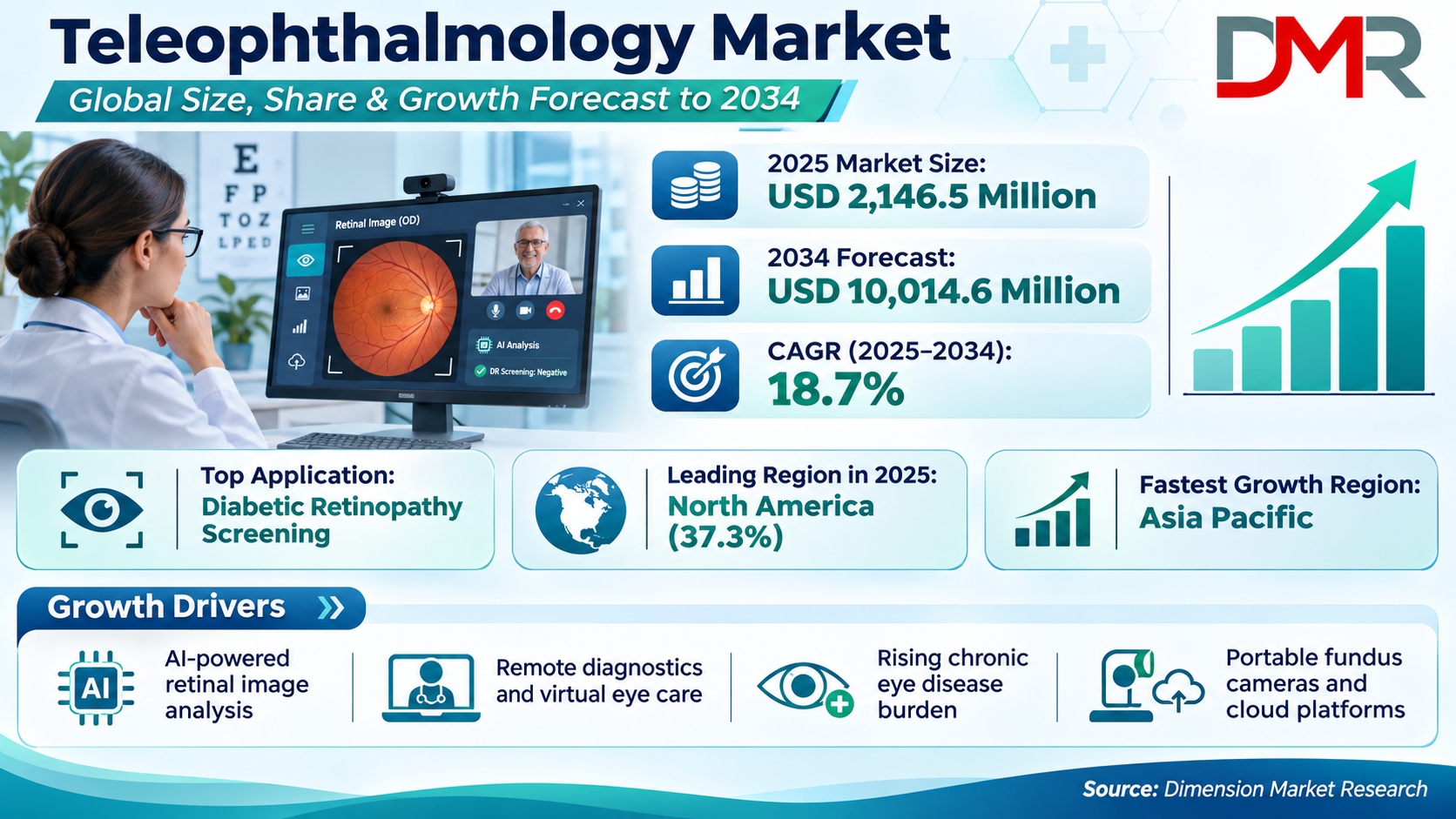
The global Teleophthalmology Market is experiencing significant transformation as healthcare providers adopt artificial intelligence, connected retinal imaging, and remote eye screening technologies to improve early disease detection. According to Dimension Market Research, the market is projected to reach USD 2,146.5 million in 2025 and expand to USD 10,014.6 million by 2034, registering a CAGR of 18.7% from 2025 to 2034.
Increasing cases of diabetic retinopathy, glaucoma, age-related macular degeneration, and other vision disorders are encouraging hospitals, ophthalmology clinics, and public health organizations to expand digital eye care services.
The integration of AI-assisted diagnostics, portable fundus cameras, cloud-based imaging platforms, and remote specialist consultations is also improving access to ophthalmic services in underserved communities.
What Is the Teleophthalmology Market?
Teleophthalmology refers to the delivery of ophthalmic screening, diagnosis, consultation, and disease monitoring through telecommunications and digital healthcare technologies.
It allows medical professionals to capture retinal images, optical coherence tomography (OCT) scans, and other diagnostic information at one location and transmit the results to ophthalmologists for remote interpretation.
The market encompasses asynchronous store-and-forward systems, real-time teleconsultations, AI-enabled diagnostic solutions, and connected ophthalmic devices.
These technologies support early detection of diabetic retinopathy, glaucoma, retinal disorders, and pediatric eye conditions while reducing the need for patients to travel to specialist facilities.
Why Is the Teleophthalmology Market Growing?
The rising prevalence of chronic eye diseases is one of the primary factors supporting market expansion. Aging populations and increasing diabetes rates are creating demand for routine retinal examinations and long-term ophthalmic monitoring.
Healthcare systems are adopting remote screening programs to identify vision-threatening conditions before irreversible damage occurs.
Artificial intelligence is another important growth factor. Automated retinal image analysis can help healthcare professionals identify abnormalities, classify disease severity, and prioritize patients requiring specialist attention.
The expansion of cloud-based healthcare platforms also enables hospitals and community clinics to share diagnostic images, manage referrals, and coordinate treatment decisions.
Government-supported digital health initiatives and remote screening programs further contribute to adoption, particularly in regions experiencing shortages of ophthalmologists.
Get a Free Sample of the Teleophthalmology Market Report
Evaluating opportunities in remote ophthalmic diagnostics, AI-powered retinal screening, or connected eye care technologies? Request a sample to explore the research scope and assess its relevance to healthcare investment, product development, and market expansion strategies.
https://dimensionmarketresearch.com/request-sample/teleophthalmology-market/
Key Technologies Transforming Remote Eye Care
AI-Powered Retinal Image Analysis
Artificial intelligence supports automated diabetic retinopathy screening, glaucoma risk assessment, OCT image interpretation, and clinical triage. These capabilities help healthcare organizations process diagnostic images and identify patients requiring additional evaluation.
Portable and Smartphone-Based Imaging
Compact fundus cameras and smartphone-compatible retinal imaging devices enable healthcare workers to conduct screening outside traditional ophthalmology departments.
Their portability makes them particularly useful for mobile healthcare units, rural clinics, and community screening programs.
Cloud-Based Ophthalmic Platforms
Cloud-connected imaging systems allow diagnostic information to move between primary care facilities, specialist hospitals, and remote consultation centers.
Integration with electronic health records also supports coordinated patient management and longitudinal monitoring.
Teleophthalmology Market Segmentation Analysis
Asynchronous Teleophthalmology Leads by Type
Asynchronous or store-and-forward teleophthalmology is identified as the leading technology type.
This approach enables healthcare professionals to capture diagnostic images and securely transmit them for later specialist interpretation without requiring simultaneous patient and ophthalmologist participation.
Its scalability, operational flexibility, and suitability for high-volume screening programs support adoption across healthcare networks.
Diabetic Retinopathy Screening Dominates Applications
Diabetic retinopathy screening represents the largest application segment.
The increasing global diabetes burden is encouraging healthcare providers to introduce routine retinal screening within primary care settings.
Remote imaging combined with automated diagnostic analysis enables screening programs to reach larger patient populations.
Hospitals and Eye Clinics Lead End-User Adoption
Hospitals and eye clinics represent the leading end-user category because they provide specialist interpretation, treatment planning, and advanced ophthalmic diagnostic services.
Primary care centers also play an important role by collecting retinal images and referring patients requiring further evaluation.
Regional Teleophthalmology Market Outlook
North America Holds the Largest Market Share
North America is projected to account for approximately 37.3% of global market revenue in 2025.
The region benefits from established digital healthcare infrastructure, telemedicine adoption, ophthalmic screening programs, and integration of AI-enabled diagnostic technologies.
The United States teleophthalmology market is estimated at USD 673.3 million in 2025 and projected to reach USD 2,883.3 million by 2034.
Asia-Pacific Offers Strong Growth Potential
Asia-Pacific is identified as the fastest-growing regional market.
Increasing diabetes prevalence, substantial rural populations, limited specialist availability, and government-supported healthcare digitization are encouraging investment in remote ophthalmic services.
India, China, Japan, and other regional economies present opportunities for portable diagnostic devices and AI-supported screening infrastructure.
Competitive Landscape and Industry Developments
The teleophthalmology market includes ophthalmic equipment manufacturers, AI diagnostic technology developers, and digital healthcare platform providers.
Companies discussed in the report include Topcon Healthcare, Carl Zeiss Meditec, NIDEK, Heidelberg Engineering, Haag-Streit, Eyenuk, Remidio Innovative Solutions, Forus Health, Teladoc Health, and Amwell.
Competition increasingly involves diagnostic accuracy, cloud connectivity, interoperability, portable device capabilities, and integration with existing clinical workflows.
The report also highlights developments during 2025, including Topcon's expansion of connected ophthalmic technologies and Remidio's introduction of the Neubo-130 neonatal retinal imaging system.
Challenges and Future Growth Opportunities
Despite strong expansion prospects, teleophthalmology faces barriers involving digital infrastructure, diagnostic equipment costs, patient data privacy, and differences in healthcare regulations.
The implementation of remote diagnostic systems also requires reliable connectivity, trained personnel, and appropriate clinical oversight.
However, growing investments in AI-enabled imaging, mobile screening programs, and integrated healthcare platforms create opportunities for technology providers and healthcare organizations.
For suppliers, this suggests increasing importance for affordable diagnostic equipment, interoperable software, and scalable screening solutions.
View the Teleophthalmology Market Report and Purchase Options
Explore the complete report to assess market forecasts, technology segmentation, regional opportunities, competitive developments, and factors influencing investment in digital ophthalmic healthcare.
https://dimensionmarketresearch.com/checkout/teleophthalmology-market/
Frequently Asked Questions
1. What is the size of the global Teleophthalmology Market?
The market is estimated at USD 2,146.5 million in 2025 and projected to reach USD 10,014.6 million by 2034.
2. What is the expected CAGR of the Teleophthalmology Market?
The market is forecast to expand at a CAGR of 18.7% from 2025 to 2034.
3. Which application dominates the Teleophthalmology Market?
Diabetic retinopathy screening is the leading application, supported by increasing diabetes prevalence and demand for routine retinal examinations.
4. Which region leads the Teleophthalmology Market?
North America leads with an estimated 37.3% market share in 2025.
5. What factors are driving teleophthalmology adoption?
Growth is supported by chronic eye disease prevalence, AI-enabled diagnostics, portable imaging devices, digital healthcare infrastructure, and demand for accessible specialist services.
Conclusion
The Teleophthalmology Market is progressing toward a more connected, technology-driven model of ophthalmic care.
Artificial intelligence, cloud-based imaging, remote consultations, and portable diagnostic devices are reshaping how healthcare providers screen and monitor eye diseases.
As healthcare systems prioritize early detection and broader specialist accessibility, teleophthalmology is expected to remain an important component of digital healthcare development through 2034.
Related Healthcare Market Insights
The AI in Telemedicine Market Size is closely connected to the adoption of intelligent remote diagnostics. This market was forecast at USD 19.4 billion in 2024 and is projected to reach USD 156.7 billion by 2033, expanding at a CAGR of 26.1%. AI-enabled clinical decision support and medical image analysis are important areas of technological development.
The Ophthalmic Disease Therapeutics Market Share provides additional perspective on treatment demand for glaucoma, retinal disorders, and other ophthalmic conditions. The market is projected to grow from USD 46.0 billion in 2026 to USD 84.6 billion by 2035, with North America accounting for 41.8% of the market in 2026.
The Ophthalmic Microscopes Market Growth reflects developments in precision ophthalmic equipment. The market was estimated at USD 685.9 million in 2024 and is forecast to reach USD 1,519.6 million by 2033, registering a CAGR of 9.2%, supported by demand for advanced ophthalmic visualization and surgical technologies.




