
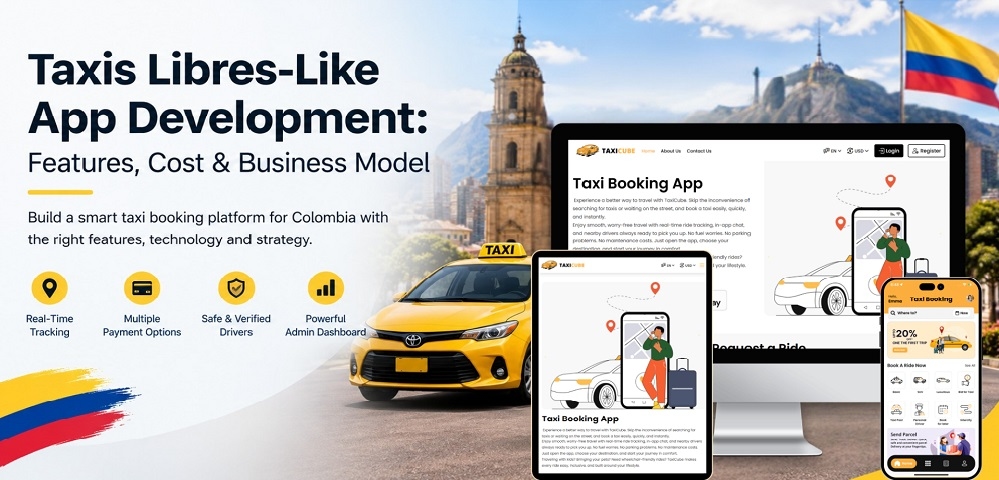
Colombia's taxi industry offers a strong opportunity for businesses looking to combine established transportation services with digital booking. Passengers increasingly expect convenient ways to request rides, track vehicles, receive fare information, and manage payments from their smartphones. For taxi operators, this shift creates an opportunity to move beyond traditional dispatching and build a connected platform for managing passengers, drivers, and daily operations.
Taxis Libres provides a useful reference for understanding this model in the Colombian market. Its approach demonstrates how a taxi service can use technology to simplify the passenger experience while supporting drivers and transportation operators. Entrepreneurs can take inspiration from this model while developing their own branded taxi booking platform with customized pricing, vehicle categories, payment options, driver management tools, and customer-focused features.
Rather than reproducing an existing application, a Taxis Libres-like platform can be designed around a specific Colombian city, target audience, and business model. This gives transportation companies and startups the flexibility to launch with essential services and expand the platform as their customer and driver network grows.
Why Develop a Taxi Booking App in Colombia?
For taxi operators, a mobile application can create a direct channel between passengers and drivers. Instead of depending entirely on traditional booking methods, businesses can allow customers to request rides, receive booking confirmations, follow drivers, and access trip information from one platform.
A digital taxi service can also provide operators with greater visibility into their fleet. Administrators can monitor active trips, manage drivers, review booking activity, configure fares, and analyze business performance through a centralized dashboard.
Starting with a focused market can be a practical approach. A business could initially launch its service in one Colombian city, understand local customer requirements, build a reliable driver network, and then expand into additional locations.
How Does a Taxis Libres-Like App Work?
A complete taxi booking platform generally consists of three primary components: a passenger app, a driver app, and an admin dashboard.
The passenger app allows customers to register, enter pickup and destination locations, request rides, select available vehicle categories, view estimated fares, track drivers, make payments, and provide ratings after completing a trip.
The driver app helps drivers manage their availability, receive booking requests, accept or reject trips, navigate to passengers, complete rides, and monitor earnings.
The admin dashboard connects the entire ecosystem. Business owners can manage users and drivers, monitor bookings, configure pricing, track payments, manage commissions, review reports, and handle customer support.
Keeping these three components connected is important because information such as booking status, driver location, payment details, and trip updates needs to move between different users in real time.
Essential Features of a Taxis Libres-Like App
1. Passenger Registration and Profiles
The onboarding process should be simple enough for users to create an account without unnecessary steps. Registration can support phone numbers, email addresses, or other authentication options.
Once registered, passengers can manage their personal information, saved locations, payment methods, previous trips, and other account preferences.
2. GPS and Location Detection
Location technology is one of the core elements of a taxi booking platform. The app should be able to detect the passenger's current location and allow them to adjust the pickup point when necessary.
Drivers can use the same location data to identify the passenger and receive navigation assistance. Accurate location information can reduce confusion during pickups, particularly in busy areas.
3. Taxi Booking and Driver Matching
After entering their trip details, passengers can request a taxi based on available vehicle categories and service options.
The dispatch system can identify suitable drivers according to their location, availability, vehicle type, and other predefined business rules. Automated matching can help reduce manual intervention and improve the overall booking process.
4. Real-Time Ride Tracking
Once a driver accepts a booking, passengers should be able to see the vehicle's location and relevant trip information.
Real-time tracking also benefits operators because they can monitor active rides through the administrative dashboard. Drivers can use integrated navigation to reach pickup and destination points efficiently.
5. Fare Estimation and Pricing
Giving passengers an estimated fare before they confirm a booking can improve transparency.
The pricing engine can calculate fares based on factors such as distance, travel duration, vehicle category, location, minimum charges, or other business rules.
Businesses can also configure different pricing structures for different service categories or operating areas.
6. Multiple Payment Options
Payment flexibility can make a taxi service more accessible to different customer groups. Depending on the business model and available payment infrastructure, the application can support cash, cards, digital wallets, QR payments, or other online payment methods.
The admin panel should also provide transaction records so operators can monitor payments and settlements.
7. Driver Registration and Verification
Drivers are an important part of the platform, so the registration process should provide administrators with the information needed to verify drivers and their vehicles.
The driver app can include document submission, profile management, availability controls, booking requests, trip history, and earnings information.
A structured verification process can also help businesses maintain service standards as their driver network expands.
8. Ratings and Reviews
After completing a ride, passengers can rate drivers and leave feedback about their experience. Businesses can use this information to identify service issues and recognize consistently high-performing drivers.
Depending on the platform's policies, drivers can also be given the ability to rate passengers.
9. Trip History
Passengers should be able to review previous bookings from their accounts. Details can include pickup and destination locations, trip dates, fares, payment methods, and driver information.
Drivers can similarly access completed trips and earnings records through their applications.
10. Notifications
Push notifications can keep users informed throughout the booking process. Notifications can be used for booking confirmations, driver assignment, driver arrival, trip status, payment confirmation, promotional offers, and other important updates.
Well-timed notifications can reduce the need for users to repeatedly open the application to check the status of a ride.
Adding Ride-Hailing Capabilities to a Taxi Platform
A business launching a taxi application may eventually want to offer more than conventional taxi bookings. Additional vehicle categories, scheduled rides, corporate transportation, premium services, or other mobility options can be introduced as demand grows.
An Uber clone app can provide a useful technology reference for businesses looking to incorporate broader ride-hailing functionality into their platform.
The objective should not be to duplicate another company's application. Instead, businesses can select the features relevant to their market and build an independent platform around their own branding, pricing, operational policies, and customer requirements.
This approach can also make it easier to introduce additional services later without rebuilding the entire application from the beginning.
Admin Dashboard for Taxi Business Management
A taxi business can quickly become difficult to manage manually once the number of drivers and bookings increases. An admin dashboard provides a centralized place for managing day-to-day operations.
Important administrative functions can include:
Passenger management
Driver registration and verification
Vehicle management
Booking monitoring
Fare configuration
Commission management
Payment tracking
Trip management
Driver earnings
Promotional offers
Ratings and reviews
Customer support
Revenue reports
Booking analytics
For example, an operator could use booking data to identify areas with high demand and determine whether additional drivers are required there. Similarly, trip and revenue reports can help businesses understand which services and locations are performing well.
Building a Scalable Taxi Booking Platform
Scalability should be considered before development begins rather than after the application starts attracting users.
A platform that performs well with a small driver network may face challenges when thousands of passengers and drivers are active simultaneously. Real-time location updates, booking requests, payment processing, notifications, and driver matching can all create significant backend workloads.
The technology architecture should therefore be designed to support future growth. Businesses should also consider database performance, server capacity, API integrations, security, monitoring, and backup systems during development.
For entrepreneurs interested in launching a customizable transportation platform, a white-label Uber clone can be considered as one possible starting point. Such a solution can be adapted with the company's own branding, features, pricing model, and operational requirements.
However, customization remains important. The platform should reflect the business rather than look like a direct copy of an established ride-hailing service.
Customizing the App for the Colombian Market
A transportation application should take local market requirements into consideration. Colombia is not a single uniform transportation market, and user expectations can differ between cities and customer groups.
Businesses can customize their application according to their target location, vehicle types, pricing structure, payment preferences, service categories, language, and operational requirements.
For example, an operator could begin with conventional taxi bookings and later introduce additional categories based on customer demand. Similarly, corporate accounts could be introduced if local businesses become an important customer segment.
Local customization can make the platform more relevant while helping the operator differentiate its service from larger general-purpose ride-hailing applications.
Taxi App Monetization Models
Developing the application is only one part of establishing a transportation business. Entrepreneurs also need to determine how the platform will generate revenue.
The most common model is a commission charged on completed rides. A percentage of the fare can be retained by the platform while the remaining amount is paid to the driver according to the business's commission structure.
Other possible revenue models include:
Driver subscription plans
Booking fees
Premium vehicle categories
Corporate transportation packages
Membership programs
Advertising partnerships
Promotional listings
Businesses can also combine multiple models depending on the services they offer and the preferences of their driver network.
The right approach should balance platform revenue with competitive pricing for passengers and attractive earning opportunities for drivers.
What Does It Cost to Develop a Taxis Libres-Like App?
There is no single development cost for a taxi booking platform because the final budget depends on its functionality and level of customization.
A basic platform with passenger and driver applications may require fewer resources than a comprehensive ride-hailing ecosystem with advanced dispatching, multiple payment gateways, real-time analytics, corporate accounts, promotional systems, and several vehicle categories.
Major factors affecting development cost include:
Number of applications and platforms
UI/UX customization
Passenger and driver features
Admin dashboard functionality
GPS and map integration
Payment gateway integration
Backend architecture
Third-party APIs
Security requirements
Advanced dispatching
Testing and quality assurance
Maintenance and future upgrades
Businesses can control their initial investment by prioritizing the features required for launch and adding advanced capabilities after validating the service in their target market.
Future Expansion Opportunities
A taxi booking application can become the foundation for a broader mobility platform. Once the core booking infrastructure is established, businesses can consider introducing scheduled transportation, corporate rides, premium vehicles, intercity services, or other on-demand mobility solutions.
For businesses planning to move toward a broader ride-hailing model, an Uber-like app development solution can also serve as a reference when evaluating features such as multi-category transportation, driver management, automated dispatching, and advanced booking workflows.
The key is to develop the platform with expansion in mind without adding unnecessary features at the initial launch stage.
Final Thoughts
A Taxis Libres-like taxi booking platform can give Colombian transportation businesses a way to connect passengers and drivers through a dedicated digital service. Features such as GPS tracking, automated driver matching, fare estimation, digital payments, notifications, and centralized fleet management can make the booking process more organized for everyone involved.
However, successful taxi app development is not simply about reproducing features from an established platform. The stronger approach is to understand the target market and build an application around its specific transportation needs.
For entrepreneurs, starting with a focused taxi service, testing the business model in a selected market, and gradually expanding the platform can be a practical way to build a sustainable ride-hailing business.
FAQs
1. What is a Taxis Libres-like app?
A Taxis Libres-like app is a customized taxi booking platform that connects passengers with drivers through mobile applications. It can include ride booking, GPS tracking, fare estimation, payments, ratings, notifications, and driver management.
2. What features should a taxi booking app have?
Important features include passenger registration, GPS integration, driver matching, ride tracking, fare estimation, multiple payment methods, driver verification, ratings, trip history, notifications, and an admin dashboard.
3. Can a taxi app be customized for the Colombian market?
Yes. Businesses can customize the platform according to their target city, pricing structure, payment methods, vehicle categories, language, branding, and operational requirements.
4. How does a taxi booking app make money?
A taxi platform can generate revenue through ride commissions, booking fees, driver subscriptions, premium services, corporate transportation plans, memberships, and advertising partnerships.
5. Can the app support multiple cities?
Yes. A scalable taxi booking platform can initially launch in one city and expand to additional Colombian cities as the customer base and driver network grow.
6. What factors affect taxi app development costs?
Development costs depend on the number of features, platforms, integrations, customization requirements, payment systems, GPS functionality, backend architecture, admin tools, and ongoing maintenance.