
Southeast Asia Fintech Market Outlook
The market is being reshaped by rapid mobile and internet penetration, growing demand for digital transactions, and regulatory frameworks that encourage innovation while protecting financial stability. Fintech brings artificial intelligence, blockchain, data analytics and mobile technology into banking, payments, investment management and insurance, making financial services more efficient, accessible and customer-centric.
As consumers move from branch-led banking to app-based services, the region is evolving into a collaborative ecosystem where startups, established institutions and international players form partnerships to serve diverse markets. This shift is strengthening the Southeast Asia fintech market outlook across technologies, applications and countries.
Market Snapshot
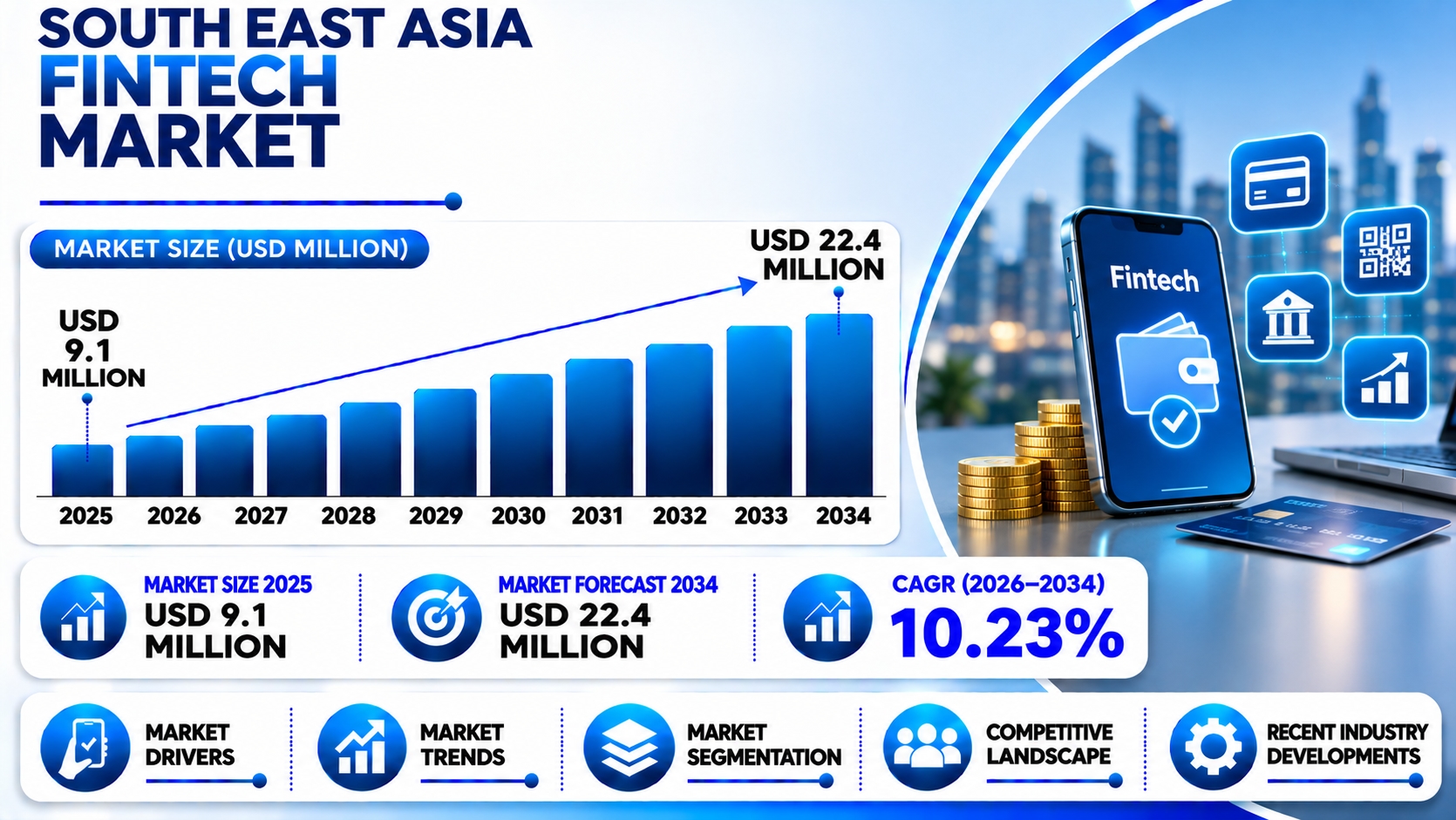
Market Size (2025): USD 9.1 Million
Forecast Market Size (2034): USD 22.4 Million
CAGR (2026-2034): 10.23%
Historical Period: 2020-2025
Segments Covered: Deployment mode, technology, application, end user and country
Countries Covered: Indonesia, Thailand, Singapore, Philippines, Vietnam, Malaysia and Others
Key Growth Drivers: Mobile penetration, regulatory support, financial inclusion, cross-border partnerships
Executive Summary
The Southeast Asia fintech market size stood at USD 9.1 Million in 2025, and IMARC Group expects it to reach USD 22.4 Million by 2034, expanding at a CAGR of 10.23% during 2026-2034. Growth rests on strong mobile penetration, a large unbanked and underbanked population, and a rising appetite for cashless transactions. Startups and financial institutions are innovating across payments, lending and personal finance, while businesses gain faster settlements and reduced paperwork.
The report assesses the market by deployment mode (on-premises and cloud-based), technology (application programming interface, artificial intelligence, blockchain, robotic process automation and data analytics), application (payment and fund transfer, loans, insurance and personal finance, and wealth management) and end user (banking, insurance and securities).
Southeast Asia Fintech Market Key Drivers
Rapid Mobile and Internet Penetration:
A growing number of consumers now reach digital financial services through smartphones, creating conditions that favor fintech innovation. Payments, lending and personal finance apps are becoming everyday tools for individuals and small businesses alike.
Financial Inclusion of Unbanked and Underbanked Populations:
A significant portion of the regional population remains unbanked or underbanked. Mobile wallets and digital payment platforms give these groups a route into the formal financial sector, widening the customer base for fintech providers.
Government Initiatives and Regulatory Frameworks:
Singapore and Malaysia have led with measures that balance innovation and risk. The Monetary Authority of Singapore’s fintech regulatory sandbox lets firms test products under supervision, while Bank Negara Malaysia’s digital bank licensing framework has opened the door to new entrants. Bank Indonesia’s QRIS standard and Thailand’s PromptPay system have standardized domestic digital payments, and ASEAN central banks continue to work on linking payment systems across borders.
Cross-Border Collaborations and Partnerships:
The region’s diverse markets bring both challenges and opportunities. Alliances between local startups, established financial institutions and international players help fintech services expand across borders and create a more interconnected financial landscape.
Youthful Demographics and a Rising Middle Class:
Tech-savvy consumers who expect convenience, efficiency and personalized experiences are accelerating the adoption of modern financial services across the region.
Evaluate Market Opportunity with the Business Sample Report
Southeast Asia Fintech Market Emerging Trends
Open Banking and API-Led Ecosystems:
Open banking encourages banks and fintechs to share data securely through application programming interfaces, allowing partners to assemble comprehensive offerings around payments, credit and wealth products.
AI, Analytics and Process Automation:
Artificial intelligence, data analytics and robotic process automation are being applied to credit assessment, fraud detection, customer service and back-office efficiency, helping lenders and insurers personalize products at scale.
Wallet-Led Digital Payments:
Mobile wallets and QR payments are moving beyond simple cashless convenience and into adjacent services such as lending and savings, deepening engagement among everyday users.
Blockchain and Digital Asset Exploration:
Blockchain is being explored for settlement and cross-border transfers, even as regulators in several countries build clearer rules for digital assets.
Southeast Asia Fintech Market Challenges
Despite strong momentum, the Southeast Asia fintech market faces several structural hurdles:
Regulatory fragmentation across countries raises compliance costs for firms scaling regionally and slows cross-border product launches
Cybersecurity, fraud prevention and data protection requirements are tightening, adding operating costs for fintechs and traditional institutions alike
Uneven digital access and financial literacy in rural areas limit adoption among the very populations fintech aims to include
Rapidly scaling digital lending requires stronger underwriting and disclosure standards to keep credit risk under control
Explore the Full Report with Charts, Table of Contents, and List of Figures
Southeast Asia Fintech Market Segment Insights
By Deployment Mode
On-premises
Cloud-based
By Technology
Application Programming Interface
Artificial Intelligence
Blockchain
Robotic Process Automation
Data Analytics
Others
By Application
Payment and Fund Transfer
Loans
Insurance and Personal Finance
Wealth Management
Others
By End User
Banking
Insurance
Securities
Others
Country Insights
Singapore and Malaysia: Early leaders in regulation that balances innovation and risk
Indonesia, Thailand, Philippines and Vietnam: Mobile-first consumer bases where digital wallets and payment platforms are extending access to financial services
Others: Emerging fintech ecosystems across the wider region
Competitive Landscape
The market blends banks, insurers, securities firms, digital wallet operators and technology startups. Platforms such as GCash, DANA, TrueMoney and TNG Digital connect to regional interoperable payment networks, showing how local wallets are linking into cross-border ecosystems.
IMARC Group’s report covers market structure, key player positioning, top winning strategies, a competitive dashboard and a company evaluation quadrant, with detailed profiles of major companies.
Recent Developments
April 2026: Regulators and industry leaders at the Asia-Pacific Financial Forum Southeast Asia in Taguig City discussed aligning ASEAN and APEC approaches to cross-border payments to reduce fragmentation, delays and costs
March 2026: A new Bank Indonesia regulation covering the payment system industry took effect on 31 March 2026, adding to the region’s evolving rulebook for digital payments
September 2026: Indonesia’s financial regulator OJK brought an implementing regulation for digital asset trading into effect on 1 September 2026, streamlining reporting for operators
Investment Opportunities
Cross-Border and Interoperable Payments: Remittance, trade and tourism payments benefit from linked QR and real-time rails, creating room for platforms that simplify multi-currency transactions.
Cloud-Based and API-Led Platforms: Banks and insurers seeking faster product launches are turning to cloud-based deployment and open APIs, favoring technology providers with scalable infrastructure.
AI, Analytics and Automation Solutions: Credit scoring, fraud detection and robotic process automation tools offer clear efficiency gains for lenders, insurers and wealth managers.
Inclusion-Focused Products: Mobile wallets, micro-lending and digital insurance tailored for underserved users open a wide addressable base.
Discuss Your Requirements With an Analyst and Get Your Customized Market Report
Frequently Asked Questions (FAQ)
What is the Southeast Asia fintech market size in 2025?
The market was valued at USD 9.1 Million in 2025, supported by mobile penetration, underserved banking populations and demand for cashless transactions.
What is the projected market size by 2034?
IMARC Group expects the market to reach USD 22.4 Million by 2034, growing at a CAGR of 10.23% during 2026-2034.
What does the Southeast Asia fintech market report cover?
It covers historical trends from 2020 to 2025 and forecasts for 2026-2034 by deployment mode, technology, application, end user and country, along with drivers, challenges and the competitive landscape.
Which factors drive market growth?
Key factors include mobile and internet penetration, regulatory support and open banking, financial inclusion, cross-border partnerships and a youthful, tech-savvy population.
Which technologies are covered?
The report covers application programming interface, artificial intelligence, blockchain, robotic process automation, data analytics and others.
Conclusion
The Southeast Asia fintech market presents a promising opportunity built on mobile access, supportive regulation and growing demand for convenient digital financial services. Collaboration between startups, banks and international players is creating ecosystems that reach customers conventional banking has struggled to serve.
Organizations that invest in interoperable payments, cloud-based platforms and AI-driven services will be best placed to benefit as the market expands through 2034.
Source: IMARC Group






