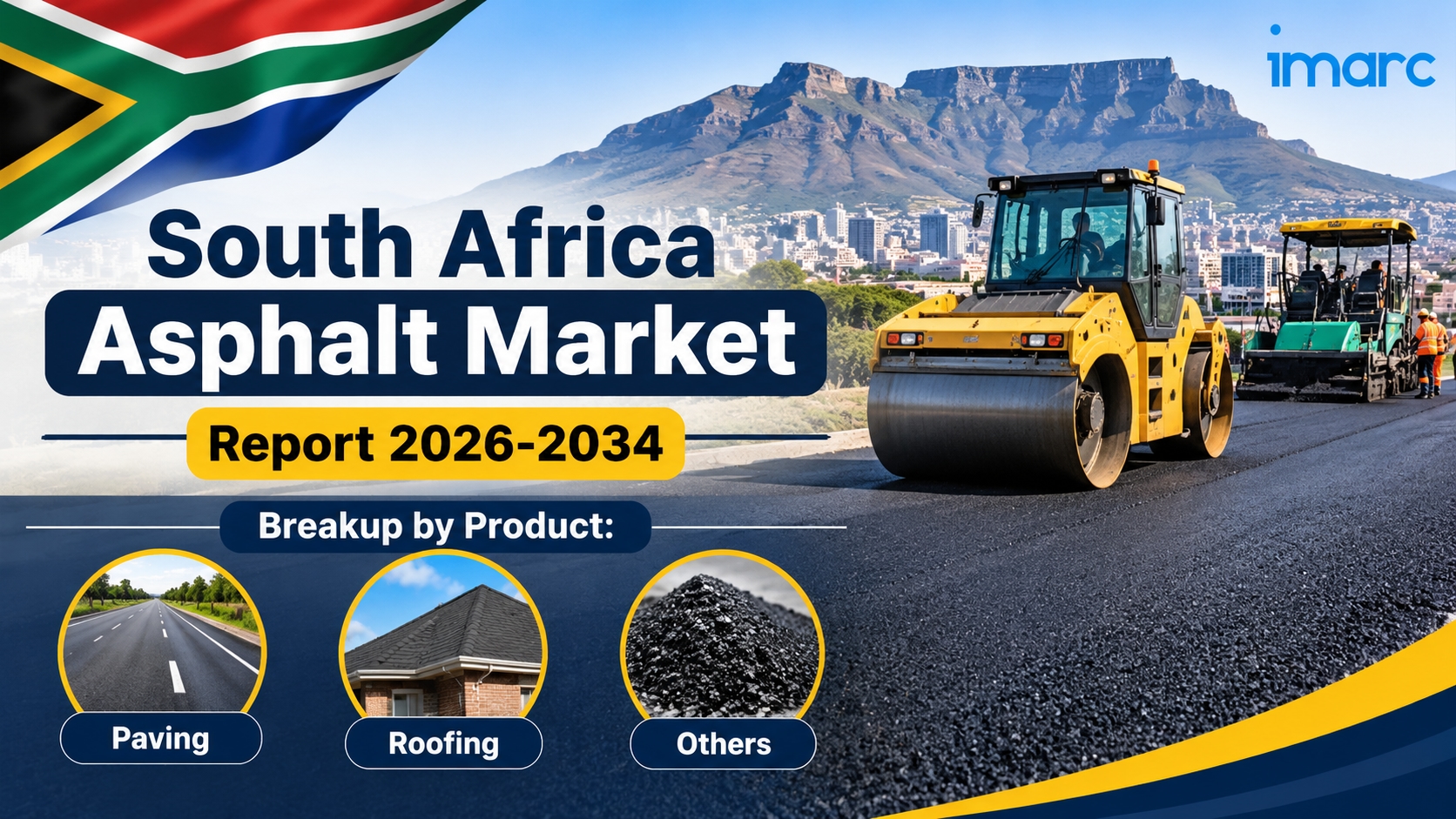
The South Africa asphalt market supported by government spending on road maintenance and rehabilitation, large national highway upgrades, growing demand for polymer modified and emulsified asphalt, and the wider use of asphalt in waterproofing, roofing, and coatings. South Africa asphalt market size reached USD 1,192.3 Million in 2025. Looking forward, IMARC Group expects the market to reach USD 1,881.8 Million by 2034, exhibiting a growth rate (CAGR) of 5.05% during 2026-2034. Road resurfacing programs are scaling up and local suppliers are securing bitumen supply through imports and new storage terminals. Together these trends are strengthening the long-term outlook for the industry.
How AI is Reshaping the Future of South Africa Asphalt Market?
AI-powered pavement condition monitoring, using vehicle-mounted cameras, drones, and sensors, helps road agencies identify cracking, rutting, and potholes early. This lets them prioritize resurfacing across a national network of roughly 27,000 km and direct asphalt and binder volumes to the sections that need them most.
Machine learning tools are optimizing hot mix and cold mix asphalt plant operations. They fine-tune aggregate blending, temperature control, and fuel use, which reduces waste and improves mix consistency. This matters as producers face stricter quality control on imported bitumen and tighter margins.
AI-driven supply chain planning helps asphalt and bitumen suppliers forecast demand and schedule import cargoes into the ports of Durban and Cape Town. It also helps them manage storage levels, an important capability as domestic bitumen refining capacity has dwindled and some contractors hold only about six weeks of storage.
Smart paving and compaction technologies, supported by real-time analytics, improve laydown quality and extend pavement life. They support polymer modified and recycled asphalt pavement mixes that lower lifecycle costs and carbon emissions.
Predictive analytics is helping contractors and government bodies plan multi-year maintenance. Resurfacing activity is rising, with the national road agency targeting about 2,000 km of resurfacing annually, and this improves bid accuracy and project scheduling.
Grab a sample PDF of this report: https://www.imarcgroup.com/south-africa-asphalt-market/requestsample
Market Growth Factors
The South African asphalt market is driven by sustained public investment in road infrastructure. The South African National Roads Agency (SANRAL) is expected to receive almost R31 billion in the current financial year to maintain, rehabilitate, upgrade, and expand the national road network, as part of the Department of Transport's R102 billion budget vote. The national budget also earmarks the resurfacing of 2,000 km of roads annually, more than double the roughly 950 km that was under active resurfacing contracts previously. Provincial road maintenance funding has also grown, with the Provincial Road Maintenance Grant reaching R17.2 billion, a 167% increase over 15 years, and every province allocating more than R1.5 billion.
Flagship projects are generating concentrated demand for paving-grade asphalt and modified binders. These include the R28 billion N2 Wild Coast Road project, the R11.5 billion completion of section 3 of the R573 Moloto Road, and R6.5 billion upgrades to the Huguenot Tunnel. In KwaZulu-Natal, the N2 and N3 upgrade programmes are valued at roughly R52 billion in total, and the 55 km N2 stretch from the Lovu River to uMdloti alone comprises 11 work packages worth about R19 billion. In Gauteng, SANRAL awarded three resurfacing contracts worth R1.43 billion, covering the R21 between Olifantsfontein and Hans Strydom (R499.8 million), the N3 between Heidelberg Road and Geldenhuys (R463 million), and the N17 from Springs to Leandra (R469.5 million). Provincial examples such as the R120 million resurfacing of a 30 km stretch of the R31 in the Northern Cape show how widely spread the maintenance pipeline is.
Product and supply chain shifts are reshaping competition. Penetration grade bitumen currently accounts for the largest type share, while polymer modified and emulsified asphalt are gaining popularity because of their durability and suitability for varied climatic zones. National Asphalt, for example, supplies its certified NATGrip product on the R21 partial reconstruction between Pomona and Olifantsfontein, and AECI Much Asphalt operates 17 static asphalt plants, four mobile plants, and three static emulsion and modified binder facilities. Domestic bitumen availability has tightened, with the last refinery producing bitumen ceasing operations, which has pushed the industry toward imports. In response, companies are investing in storage and import infrastructure, including new bitumen tanks in Durban and a purpose-built import terminal at Maydon Wharf, so that road building can continue without interruption.
Asphalt's role beyond roads also supports demand. Its use as an adhesive, sealant, and waterproofing agent across residential, commercial, and industrial buildings underpins the roofing, waterproofing, and coatings segments. Road safety pressures add to the case for better surfaces, as South Africa recorded more than 11,400 road deaths in a single year, which strengthens the policy emphasis on rehabilitation and maintenance.
Market Segmentation
Product Insights:
Paving
Roofing
Others
Application Insights:
Roadways
Waterproofing
Coatings
Recreation
Others
Type Insights:
Penetration Grade
Cutback
Modified
Emulsions
Paving holds the majority of the market by product, roadways dominate by application, and penetration grade accounts for the largest share by type.
Recent Development & News
September 2026: SANRAL reported progress on its N2 and N3 upgrades in KwaZulu-Natal, valued at about R52 billion in total. Six N2 packages worth R22.8 billion are under construction and three packages worth R6.8 billion are complete, with R4.6 billion spent on participation by 576 small, medium, and micro enterprises.
June 2026: Raubex outlined its measures to secure imported bitumen, including regular cargoes into Cape Town and Durban, storage sufficient for about six weeks of supply, and a three-stage quality assurance process. In the same month, AfriSam highlighted aggregate quality as central to asphalt compliance.
May 2026: Transport Minister Barbara Creecy announced that SANRAL would receive almost R31 billion to maintain, rehabilitate, upgrade, and expand the national road network during the tabling of the R102 billion Transport Budget Vote.
February 2026: The national budget, tabled on 25 February, committed SANRAL to annual maintenance of approximately 27,000 km of road and the resurfacing of 2,000 km, alongside public infrastructure spending led by transport and logistics.
November 2025: A purpose-built bitumen import terminal and pipeline at the Port of Durban's Maydon Wharf was completed in partnership with Continental Bitumen Southern Africa. It is intended to act as the country's primary bitumen import terminal after the last domestic bitumen-producing refinery, Natref, ceased operations in July.
February 2025: Colas moved to operate new bitumen tanks at an expanded Durban site, strengthening import and storage capacity for the southern African road construction industry.
If you require any specific information that is not covered currently within the scope of the report, we will provide the same as a part of the customization.
About Us
IMARC Group is a global management consulting firm that helps the world's most ambitious changemakers to create a lasting impact. The company provides a comprehensive suite of market entry and expansion services. IMARC offerings include thorough market assessment, feasibility studies, company incorporation assistance, factory setup support, regulatory approvals and licensing navigation, branding, marketing and sales strategies, competitive landscape and benchmarking analyses, pricing and cost research, and procurement research.
Contact Us
IMARC Group,
134 N 4th St. Brooklyn, NY 11249, USA,
Email: sales@imarcgroup.com,
Tel No: (D) +91 120 433 0800,
United States: +1-201971-6302