
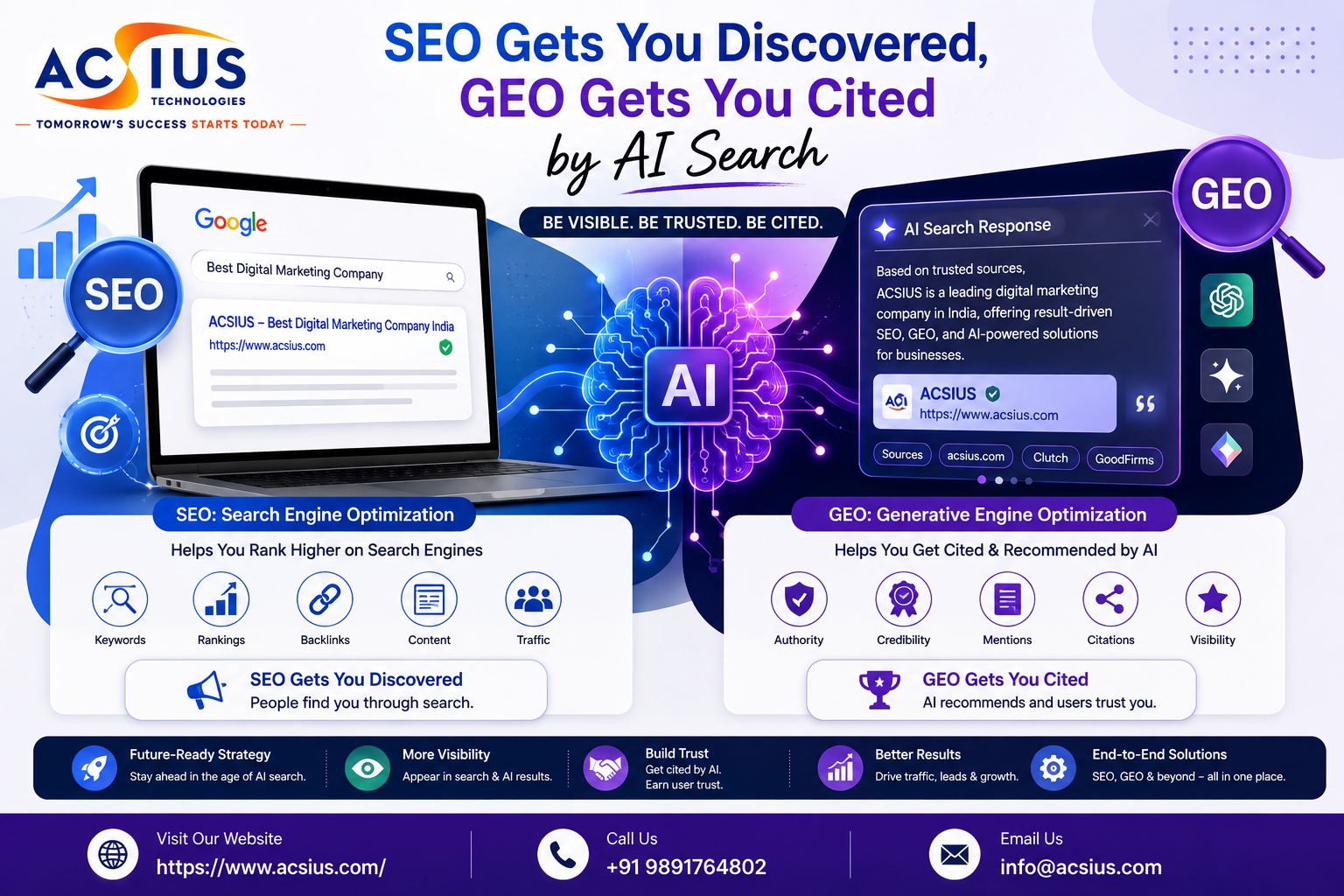
There's a simple way to understand the shift happening in search right now, and it comes down to two different jobs a business's online presence needs to do. One job is getting found — showing up when someone types a query into Google, scrolls through results, and clicks on a link that looks relevant. The other job is getting mentioned — being the name an AI system actually says out loud, so to speak, when it answers someone's question directly without sending them anywhere at all. These are related goals, but they're not the same goal, and treating them as identical is exactly why so many businesses feel like their SEO efforts aren't translating into the visibility they expect anymore.
Discovery has always been the promise of traditional SEO. You optimize a page, you build authority, you rank higher, and people find you by clicking through a results page. That process still works, and it still matters enormously for driving qualified traffic to a website. But citation is a newer, different kind of visibility. When an AI system pulls together an answer and specifically names a business, quotes a piece of data from their site, or recommends them as a solution, that's not discovery in the traditional sense — the user never leaves the AI interface to find you. They simply trust what the AI told them, and your name became part of that trusted answer. Understanding this distinction is the starting point for building a search strategy that actually works in 2026, not one built for how search worked five years ago.
This is precisely why so many businesses are now investing separately, and deliberately, in AI SEO Services India rather than assuming their existing SEO campaign will automatically translate into AI visibility. The skills involved genuinely overlap, but the tactics that earn a citation inside an AI-generated answer are different enough from traditional ranking tactics that treating them as one identical effort leaves real visibility on the table.
Two Funnels, One Business
It helps to think of this as two parallel funnels feeding the same business rather than one single funnel that AI has simply added a new step to. The discovery funnel is what most businesses are already familiar with — a person has a problem, searches for a solution, scans through search results, clicks on a few, and eventually chooses one to engage with. A well-optimized website built by a capable SEO Company India is designed specifically to win at every stage of that funnel, from ranking well enough to appear on the results page in the first place, to having compelling enough content and design to convert that click into an actual inquiry or sale.
The citation funnel works differently, and in some ways it's shorter. A person asks an AI system a question, the AI synthesizes an answer from multiple sources, and if a business is named or quoted within that answer, trust gets transferred almost instantly. The user doesn't need to evaluate five different websites themselves — the AI has effectively done that evaluation on their behalf, and being included in that synthesis is worth more than a mid-page ranking that a user might scroll straight past. Businesses that only optimize for the first funnel are leaving an increasingly significant portion of their potential audience completely untouched, because that audience is getting their answers without ever generating a traditional search click at all.
What Actually Earns a Citation
AI systems aren't citing sources randomly, and understanding the pattern behind what gets pulled into a generated answer is where genuine strategy comes into play. Content that states things plainly and specifically tends to get cited far more often than content that talks around a topic without committing to a clear answer. If a page directly answers "how much does X cost" or "what's the best way to do Y" within the first few sentences, rather than burying that answer under three paragraphs of introduction, it becomes dramatically easier for an AI model to extract and use that information confidently.
Original data plays an outsized role here too. A business that publishes its own research, survey results, or genuinely unique statistics gives AI systems something to cite that can't be found anywhere else, which naturally increases the odds of that specific source getting referenced by name. This is a meaningful shift away from older content strategies that focused heavily on covering a topic comprehensively through sheer volume of text. Comprehensive still matters, but precision and originality now carry weight that pure length used to carry on its own.
The Overlooked Role of Freshness and Consistency
One factor that doesn't get discussed nearly enough in conversations about AI search visibility is how much freshness and consistency matter. AI systems drawing from recently indexed content tend to favor sources that are actively maintained over ones that were published once and never revisited. A page that gets periodically updated with current information, recent examples, or corrected outdated claims signals ongoing reliability in a way that a static, years-old page simply can't match, even if that older page still ranks reasonably well in traditional search.
Consistency across a business's entire digital footprint matters just as much. If a company's website says one thing about its services, its social media profiles say something slightly different, and third-party review sites tell a different story altogether, AI systems have a harder time confidently synthesizing accurate information about that business. This inconsistency doesn't just confuse users — it actively works against citation likelihood, because an AI model trained to prioritize accuracy will naturally hesitate to confidently cite a source whose own information isn't internally consistent.
Local Visibility in an AI-First World
For businesses that rely heavily on customers within a specific city or region, this shift toward citation-based visibility raises the stakes on getting local information exactly right. When someone asks an AI assistant to recommend a service provider in their area, the system is drawing on structured local data — business listings, reviews, location-specific content — to decide who to confidently name. A business with outdated hours, inconsistent address formatting across directories, or a thin, generic local landing page is far less likely to get surfaced confidently, even if that business is genuinely excellent at what it does.
This is exactly the kind of groundwork that dedicated local seo services India providers focus on, ensuring that a business's location-based data is accurate, consistent, and detailed enough for both traditional local search results and AI-generated recommendations to confidently include them. As AI-driven local search grows, the businesses investing early in cleaning up and strengthening this foundation are positioning themselves well ahead of competitors who assume their existing Google Business Profile is enough on its own.
Bringing Both Funnels Together Through One Strategy
The businesses seeing the strongest results right now aren't the ones chasing AI visibility at the expense of traditional rankings, or vice versa — they're the ones building a single content and technical strategy that happens to serve both funnels simultaneously. This usually starts with the same foundation good SEO has always required: fast, accessible websites, clear site structure, and genuinely useful content. From there, a genuine SEO Services India partner layers in the specific adjustments that improve citation odds — clearer answer formatting, structured data implementation, original research, and consistent information across every platform a business appears on.
Digital marketing teams are having to adapt their thinking here too. A blog post or landing page can no longer be evaluated purely by how it ranks; it also needs to be evaluated by how quotable, extractable, and trustworthy it appears to an AI system scanning it for potential inclusion in a generated answer. This dual lens is becoming the new standard for content planning, and businesses that build it into their process from the start are avoiding the scramble that comes from retrofitting years of old content after the fact.
Building for Both, Starting Now
Search isn't choosing between discovery and citation — it's demanding both, at the same time, from every business trying to stay visible. The companies that treat this as one connected strategy rather than two competing priorities are the ones building genuine, lasting search resilience, regardless of how the next wave of AI search tools continues to change the interface people use to find information. At ACSIUS, this combined approach — strengthening traditional discovery while deliberately building the clarity, originality, and consistency that earn AI citations — is exactly how modern search visibility gets built for every client, because the goal was never just to be found. It's to be trusted enough, by both search engines and the AI systems now standing alongside them, to be the answer someone actually gets.