
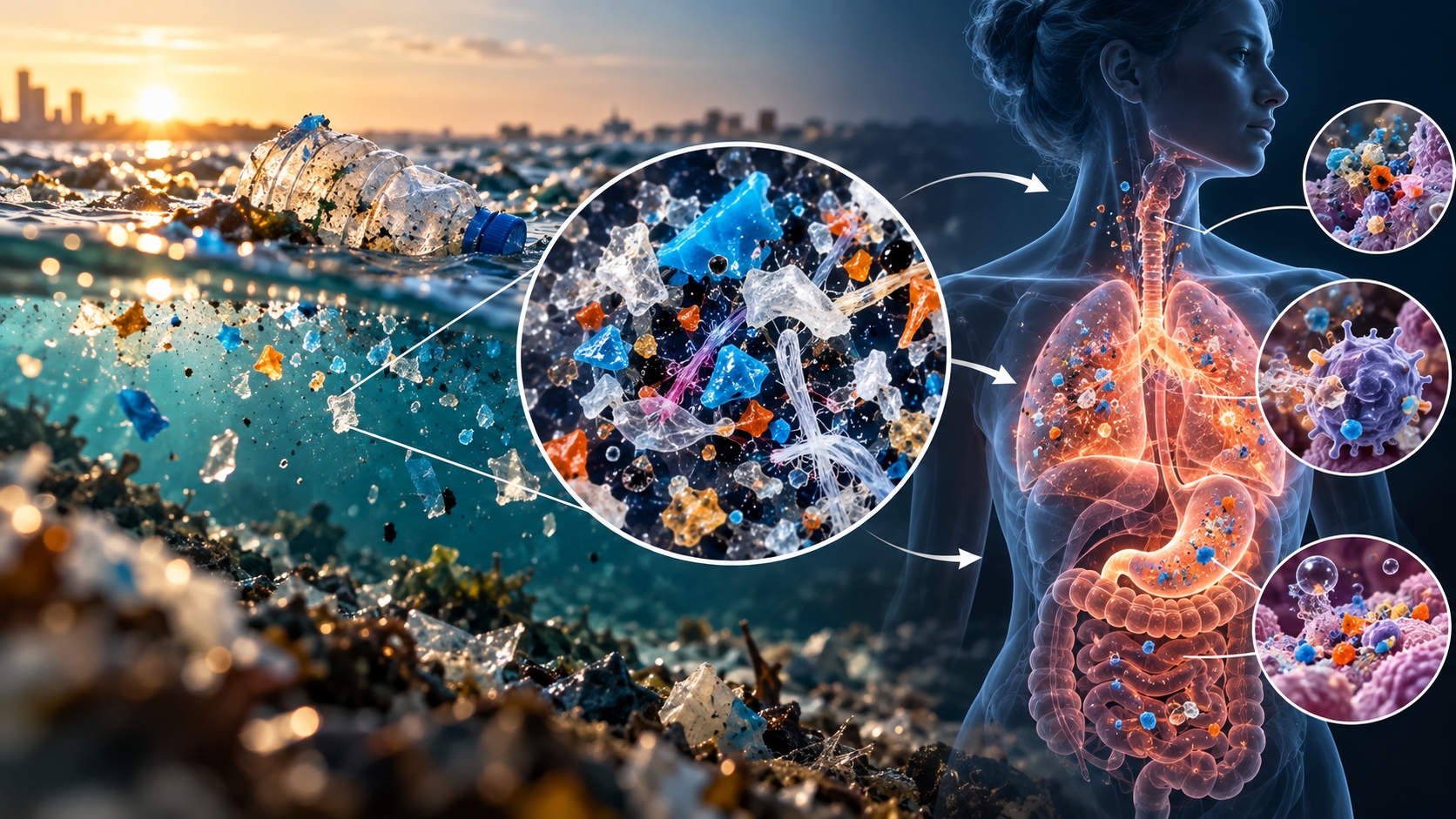
Micro- and nanoplastics change depending on their environment, interact with organic matter, and can vary in size, charge, and shape. Bioengineering professor Shalini Prasad argues that one of the first steps in addressing this problem should be the development of reliable biosensors capable of determining what kinds of particles are present in a sample and in what quantities. But the path from a laboratory sensor to a widely deployable test remains incomplete.
Before attempting to remove micro- and nanoplastics from water, food, or biological environments, researchers must answer what appears to be a simpler question: What exactly is there?
For bioengineering professor Shalini Prasad, that question lies at the heart of the problem.
Prasad, who chairs the Department of Bioengineering at the University of Texas at Dallas and works across bioengineering, nanotechnology, and biosensing, describes the challenge of micro- and nanoplastics primarily as a problem of measurement.
Simply detecting a particle is not enough. Researchers need to determine its size, understand its electrical properties, account for its shape, and distinguish its signal from those produced by the substances surrounding it.
That is where the difficulties begin.
When Size Changes the Rules
For Prasad, one of the fundamental principles of sensing is matching scales.
If an object at the molecular or nanoscale needs to be measured, the measurement system must operate at a comparable scale. This makes it possible to strengthen the useful signal while reducing interference from the surrounding environment.
Prasad traces the development of this principle back to the early 2000s, when researchers were actively developing microscale systems known as “lab-on-a-chip” devices. Their purpose was to transfer laboratory chemical and analytical processes onto compact platforms capable of measuring several parameters simultaneously and producing results rapidly.
She describes portable and noninvasive systems capable of interacting directly with the human body and recording biophysical, biochemical, and other signals as the next stage of that development.
In the case of micro- and nanoparticles, scale has another significance. According to Prasad, size is one of the key characteristics determining how particles interact with biological systems.
But size alone is not enough.
Three Properties of a Particle
Prasad identifies three characteristics that must be considered together: size, charge, and shape.
Charge influences how a particle interacts with its surroundings. Depending on the system, these interactions can be electrostatic, covalent, or involve weaker van der Waals forces.
Shape introduces another layer of complexity.
Prasad uses proteins as an example: their functionality depends not only on their chemical composition but also on their three-dimensional structure. She argues that a similar principle matters for particles. A change in shape means a change in surface area and in the distribution of electrical charge.
Spherical objects are the easiest to characterize. Symmetrical particles are also comparatively straightforward to analyze. The greatest difficulties arise with asymmetrical shapes and particles whose thickness varies along their axes.
Determining that a particle is present in a sample, therefore, is only the beginning of the analysis.
An Electrical “Fingerprint”
One method Prasad considers promising for such measurements is electrochemical impedance spectroscopy.
The technique can be used to study a system’s electrical characteristics across different frequency ranges. The particles are suspended in a liquid — such as a buffer solution or biological fluid — that acts as an electrolyte.
Changes associated with the presence of small particles can be detected through their effects on the electrical properties of the system. Prasad explains that the capacitive component of the resulting signal can be correlated with the charge characteristics of the object being examined.
Importantly, she says, this approach could potentially be used not only for charged particles. Polymers with little apparent surface charge still possess dielectric properties.
Those properties can become part of their measurable electrical “fingerprint.”
A Particle That No Longer Exists in Its Original Form
A real biological sample is far more complicated than a laboratory model.
Once a particle enters a biological fluid, it encounters proteins, lipids, salts, ions, and cellular debris. Prasad describes a process in which chemical interactions occur at the particle’s surface while organic material accumulates around it.
Eventually, researchers are no longer dealing with an isolated particle but with a complex structure in which organic and inorganic components interact.
This creates a measurement paradox.
To examine the polymer accurately, a laboratory can remove the material surrounding the particle. But once the particle has been cleaned, it no longer fully represents the object that existed in the biological environment.
Prasad proposes addressing this problem by creating a library of reference signals.
First, a cleaned particle is analyzed separately to obtain a characteristic signal. Researchers then examine a more complex sample in which organic and inorganic components remain together.
The task is to break the complex signal into its constituent parts.
Prasad describes the use of frequency analysis, signal segmentation, and artificial intelligence methods for this purpose. This process of deconvolution is intended to help separate the polymer signal from that of the organic material.
The method, however, has an important limitation: even for the same material, the signal changes depending on the particle’s morphology.
One reference signal is therefore not enough.
Different forms of the same material must be taken into account, and Prasad acknowledges that the approach still relies heavily on empirical data and has not yet reached the level researchers ultimately hope to achieve.
Why Plastic Is a Special Case
Prasad distinguishes micro- and nanoplastics from other micro- and nanomaterials primarily because of the properties of polymer surfaces.
Plastics consist of repeating chemical chains. At very small scales, she says, surface properties and surface reactivity become particularly significant.
That makes analysis more difficult.
Prasad describes these materials largely as quasi-dielectric systems: they have electrical characteristics, but those characteristics can be substantially masked by interactions with their surroundings.
When the discussion moves from measurement to potential biological effects, Prasad again places size at the center of the issue. She says nanoscale dimensions allow particles to interact with biological structures and links such interactions to inflammatory responses.
The provided transcript, however, does not cite studies, clinical data, or other primary sources that would independently substantiate her statements about specific mechanisms and health consequences. Those claims can therefore be presented only as the researcher’s statements in the interview, rather than as conclusions independently established by the material itself.
Measuring Blood, Water, and Food Using the Same Principle
Prasad sees potential for biosensors to be used across several environments.
She discusses analyzing seawater, food products, and biological materials, including blood and urine. Tissue obtained during medical procedures already being performed for other reasons could provide another possible source of information.
The goal of the first stage would be to establish a baseline: to determine how much micro- and nanoplastic is present and what kinds of particles are involved.
According to Prasad, her team has already developed a sensor capable of determining the quantity of particles and identifying several types of materials, including polypyrrole, polyvinyl chloride, and polymethyl methacrylate.
But there is a critical gap between developing a sensor and producing a reliable, widely deployable test.
From Prototype to Test
For the technology to become a screening tool, Prasad describes a sequential validation process.
First, the test must demonstrate that it can operate across different environments, including water, food matrices, and biological fluids.
A pilot study with sufficient statistical power would then be required.
The next step would be to compare its results with laboratory methods used as reference standards. Prasad mentions gas chromatography–mass spectrometry, liquid chromatography–mass spectrometry, pyrolysis followed by mass spectrometry, and Raman spectroscopy.
Only after such comparisons, she says, would it be possible to describe the platform as technically and scientifically validated.
The provided material, however, does not include results of such validation for the sensor Prasad describes. It does not report its sensitivity, specificity, detection limit, or results from comparisons with laboratory reference methods.
That leaves a central question unresolved: How far has the technology progressed from a laboratory development toward an instrument suitable for widespread practical use?
First, Map the Problem
Prasad describes work on micro- and nanoplastics as a three-stage process.
The first stage is monitoring.
The second is determining where intervention is necessary and what kind of intervention is appropriate.
The third is cleanup or removal.
There is a fundamental logic to this sequence: it is difficult to address a problem in a targeted way before its scale and characteristics can be measured reliably.
Prasad also discusses potential intervention methods, including particle encapsulation, PEGylation, enzymatic degradation, and the development of materials capable of capturing unwanted particles in the environment.
At the same time, she acknowledges that none of the approaches she describes has yet become a scalable, universal solution.
For that reason, in her view, the most immediate task for biosensing is not cleaning the oceans or removing particles from the human body.
It is something more fundamental: learning to reliably detect what remains difficult to measure.
For a laboratory technology, this is also a test of maturity. Prasad’s argument is straightforward: a scientific publication alone does not necessarily translate into public benefit. A technology must move beyond the laboratory, be tested under different conditions, and find partners capable of turning an experimental idea into a practical tool.
For micro- and nanoplastics, that boundary between the laboratory and the real world remains one of the central challenges.
🎥 You can watch it here: “HARD TO DETECT”