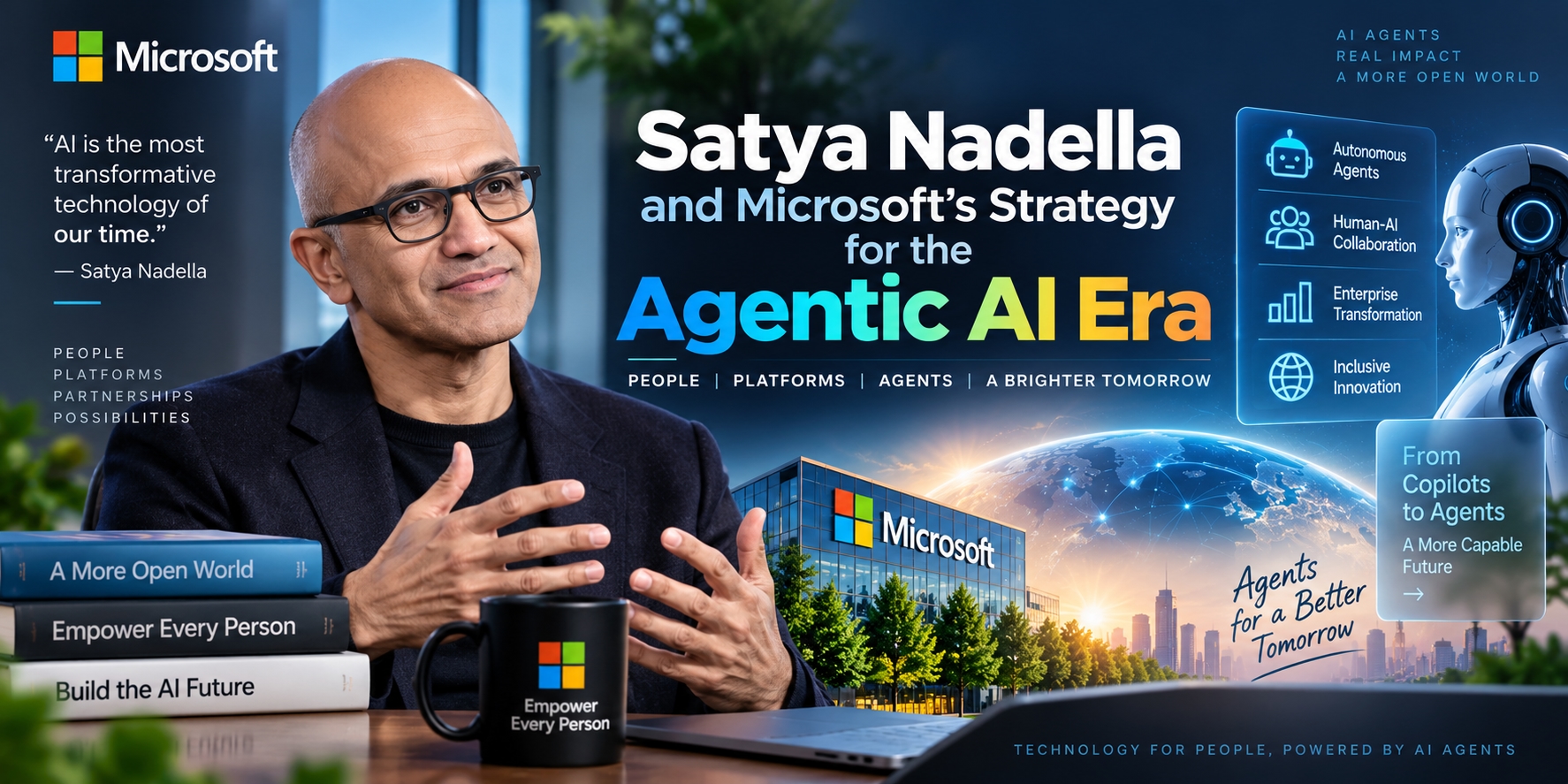
Satya Nadella has spent more than a decade reshaping Microsoft's identity, first around cloud computing, then around AI-infused productivity software. His latest pivot may be his most consequential yet. Under Nadella, Microsoft is now trying to convince the enterprise world that the future of work is not a chatbot sitting beside employees, but a workforce of autonomous AI agents acting alongside, and sometimes instead of, human teammates.
Who Is Satya Nadella?
The Satya Nadella has worked as CEO of Microsoft since 2014, a tenure defined by his early bet on Azure and cloud computing and, more recently, by Microsoft's aggresive push into generative AI following its multibillion-dollar investment in OpenAI.
Under Nadella, Microsoft became the first major technology company to embed large language models across its core productivity suite, launching Microsoft 365 Copilot in February 2023 in what he called a watershed moment for the company.
What Is Satya Nadella's AI Strategy?
Nadella's current AI strategy rests on a simple but significant reframing: rather than treating AI as a feature bolted onto existing software, Microsoft is positioning autonomous AI agents as a new operating model for work itself. At Microsoft's Build 2026 developer conference, Nadella's keynote centered almost entirely on AI agents. As Nadella put it at Microsoft Ignite, the best way to think about these agents is as teammates, not tools.
What Is Agentic AI?
Agentic AI refers to the AI system's ability to carry out multi-step jobs with significant autonomy, taking actions, pulling in outside data, and making decisions across a workflow rather than simply responding to a single prompt. Microsoft's own framing distinguishes agentic systems from earlier chat-based Copilot experiences by their ability to act with initiative inside daily applications, managing complex, multi-step processes rather than just answering questions.
What Are Microsoft AI Agents?
Microsoft's agentic AI push spans several connected products under Nadella's direction. Microsoft 365 Copilot's Wave 3 update introduced Agent Mode, giving Copilot the ability to take autonomous action within Office applications rather than only generating suggested text.
Agent 365 launched as a centralized control plane, letting enterprise IT departments govern, monitor, and secure AI agents across an organization much as they would manage human employee identities, through Microsoft Entra. And a new Microsoft 365 E7 tier, dubbed the Frontier Suite, bundles core productivity licensing with Copilot and Agent 365 into a single enterprise SKU, reflecting how central agentic tools have become to Microsoft's commercial packaging.
How Is Microsoft Using AI Agents?
By mid-2026, Microsoft disclosed more than 40 million Agent 365 registrations and over 30 million paid Copilot seats, with Nadella noting that Copilot's weekly engagement had reached levels comparable to Outlook, historically one of Microsoft's stickiest products.
According to Microsoft's own Work Trend Index, nearly half of Copilot usage now supports difficult cognitive work, like calculations and multi-step decision-making, instead of simple drafting tasks.
What Is Microsoft's Relationship With OpenAI?
Microsoft's agentic AI strategy under Nadella has evolved alongside a changing relationship with OpenAI. For years, OpenAI's models powered the bulk of Copilot's underlying intelligence. That began shifting through 2025 and 2026, as Microsoft renegotiated the terms of its OpenAI partnership to allow greater flexibility in building and deploying its own models through the separate Microsoft AI division, and as Copilot itself became explicitly model-agnostic.
How Is Azure Supporting AI?
Azure is the foundation of Nadella’s agentic AI strategy through Azure AI Foundry. Foundry links Microsoft 365, Fabric, and AI services with shared organizational knowledge. By early 2026, 10,000 customers had used numerous AI models on Foundry. This positions Azure as a neutral, multi-model foundation for enterprise AI. Microsoft’s AI-related business achieved roughly $37 billion in revenue by spring 2026.
How Will Agentic AI Change Enterprise Software?
Nadella's agentic bet implies a fairly significant restructuring of how enterprise software gets used. Rather than employees opening separate applications to complete discrete tasks, the vision Microsoft is building toward involves agents that operate continuously across systems, handling workflows with only periodic human oversight.
Microsoft's Work IQ layer, which aggregates documents, communications, and collaboration patterns into a shared organizational intelligence system, is designed to give these agents the context needed to act appropriately inside a specific company's environment, rather than functioning as generic, context-free assistants.
Satya Nadella's Vision for AI
Underlying all of these product moves is a consistent theme in how Nadella talks about AI's role at Microsoft: he frames the company's advantage not as having the single best model, but as owning the full stack, models, cloud infrastructure, developer tools, and the productivity software hundreds of millions of people already use daily, and being able to assemble those pieces into a coherent agentic ecosystem faster than rivals.
Summary
Satya Nadella's strategy for the agentic AI era represents a genuine shift in how Microsoft thinks about its core business, from selling AI-enhanced software to building an ecosystem where autonomous agents become a standard part of how enterprises operate. With Agent 365, Copilot's Wave 3 agentic capabilities, and an increasingly multi-model Azure AI Foundry all now live and scaling, Nadella has moved this vision well past the announcement stage.
Frequently Asked Questions- FAQs
1. Who is Satya Nadella?
Satya Nadella is the CEO of Microsoft, from the year 2014, known for driving the company's cloud computing growth and, more recently, its agentic AI strategy across Microsoft 365 and Azure.
2. What is Satya Nadella's AI strategy?
Nadella's AI strategy centers on repositioning Microsoft's products around autonomous AI agents rather than simple chat assistants, spanning Microsoft 365 Copilot, Agent 365, and Azure AI Foundry.
3. What is Microsoft's agentic AI strategy?
Microsoft's agentic AI strategy involves deploying AI agents capable of taking autonomous, multi-step action across productivity, coding, and security workflows, governed through tools like Agent 365.
4. What is agentic AI?
Agentic AI refers to AI systems that can carry out complex tasks with meaningful autonomy, taking actions and making decisions across a workflow rather than only responding to individual prompts.
5. What are Microsoft AI agents?
Microsoft AI agents include Copilot's Agent Mode inside Office applications, autonomous agents managed through Agent 365, and developer-built agents created using Copilot Studio and Azure AI Foundry.
6. How is Microsoft using AI agents?
As of mid-2026, Microsoft reported more than 40 million Agent 365 registrations and over 30 million paid Copilot seats, with agents increasingly used for complex, multi-step cognitive tasks.
7. What is Microsoft Copilot?
Microsoft Copilot is the company's AI assistant embedded across Microsoft 365 and other products, now evolving under Nadella's agentic strategy to take autonomous action rather than only generate suggestions.
8. What is Microsoft's relationship with OpenAI?
Microsoft remains a major OpenAI partner and investor, but has renegotiated the terms of that relationship to build its own AI models and make Copilot model-agnostic, now also integrating Anthropic's Claude.
9. How is Azure supporting AI?
Azure AI Foundry underpins Microsoft's agentic AI strategy as a multi-model cloud platform, giving enterprise customers a shared organizational context layer and the infrastructure to build and deploy their own AI agents.
10. How will agentic AI change enterprise software?
Agentic AI is expected to shift enterprise software from discrete, task-based applications toward continuous, context-aware agents that handle multi-step workflows with reduced day-to-day human oversight.