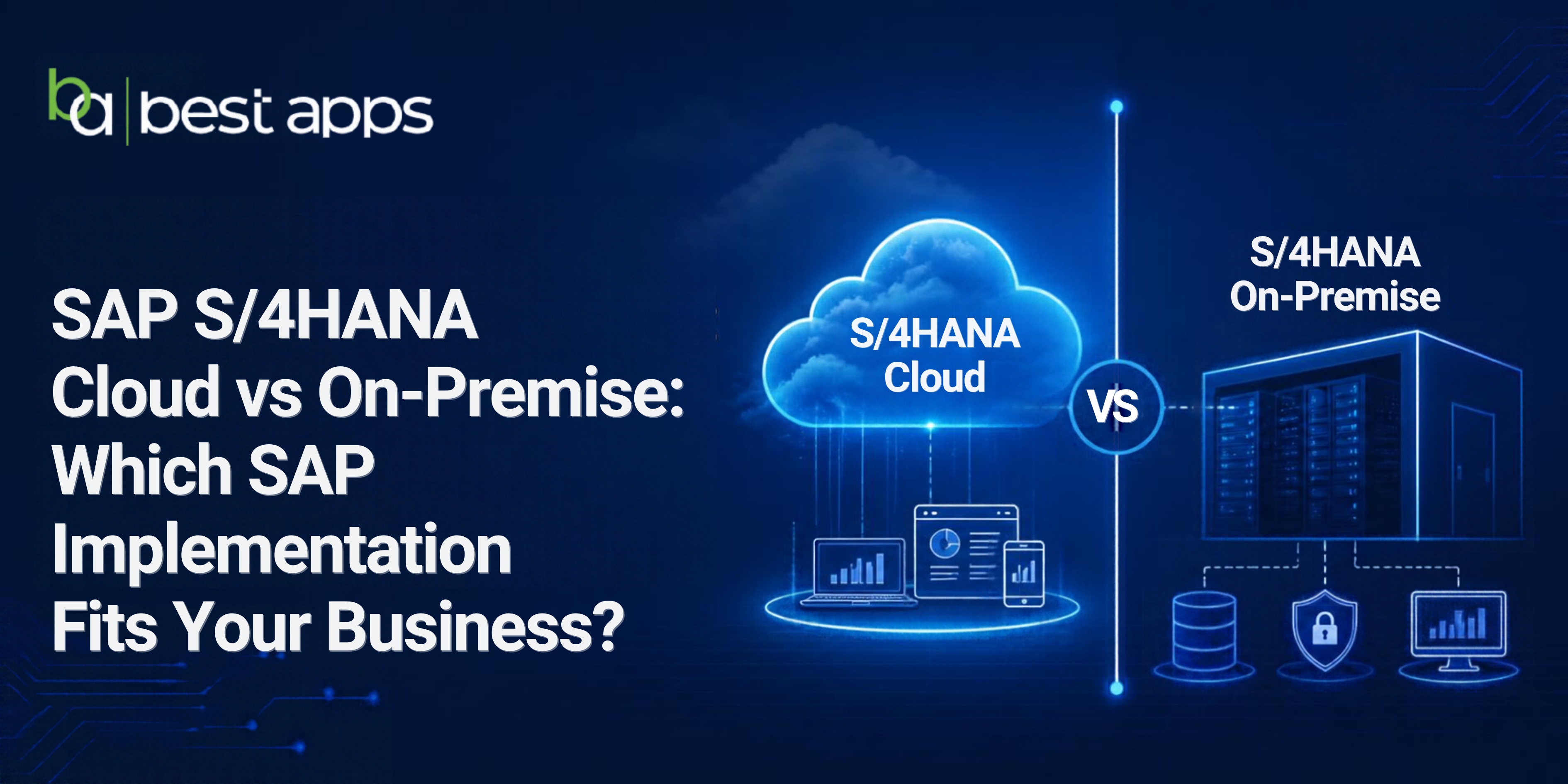
Choosing between SAP S/4HANA Cloud and SAP S/4HANA On-Premise is an important decision for organizations planning an ERP transformation. Both approaches provide a powerful foundation for finance, supply chain, procurement, manufacturing, sales, and other core business processes, but they differ significantly in deployment, infrastructure, customization, maintenance, and cost structure. SAP S/4HANA Cloud can be attractive for organizations looking for a standardized, scalable ERP environment with less responsibility for infrastructure management, while on-premise deployment can provide greater control over infrastructure and highly specific business requirements.
The right choice depends less on which option is universally “better” and more on what your organization actually needs. A growing company looking for faster deployment and reduced infrastructure responsibility may lean toward cloud, while an enterprise with complex processes, extensive existing systems, or strict control requirements may evaluate on-premise more closely. Before making the decision, businesses should assess their processes, integration landscape, customization requirements, IT capabilities, budget, compliance needs, and long-term SAP roadmap.
Understanding SAP S/4HANA Cloud
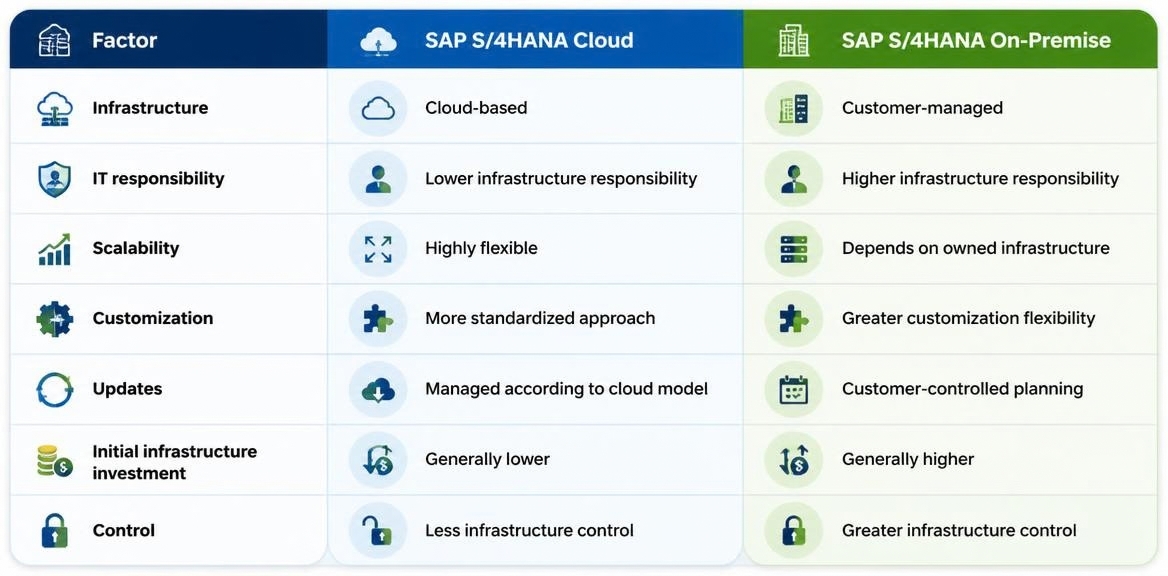
SAP S/4HANA Cloud provides an ERP environment delivered through cloud infrastructure, allowing organizations to access enterprise processes without managing the underlying hardware themselves. This approach can help businesses simplify infrastructure responsibilities and focus more of their IT resources on business transformation. Cloud deployment is particularly appealing to organizations that want a modern ERP platform capable of supporting changing business requirements while avoiding the operational burden associated with maintaining physical servers and related infrastructure.
One of the major advantages is scalability. As business requirements change, organizations can adjust their cloud environment without necessarily following the same infrastructure expansion process required in a traditional data-center environment. Cloud ERP can also support organizations operating across multiple locations by providing centralized access to business processes and data. However, organizations should not assume that cloud automatically means simpler implementation. Successful adoption still requires careful process design, data preparation, integration planning, user training, security planning, and change management.
What Is SAP S/4HANA On-Premise?
SAP S/4HANA On-Premise gives an organization greater responsibility and control over its SAP environment. The company, or its selected infrastructure provider, manages the underlying infrastructure, system administration, upgrades, security controls, and other technical responsibilities. This model can be particularly relevant for organizations with complex business processes that require extensive customization or specific integration requirements.
The greater level of control can be valuable, but it also comes with additional responsibility. Businesses need appropriate technical expertise, infrastructure resources, backup strategies, security controls, system monitoring, and maintenance processes. Therefore, on-premise should not be selected simply because it offers more customization. The organization should determine whether that additional control provides genuine business value that justifies the associated cost and operational responsibility.
Which SAP Implementation Fits Your Business?
For many organizations, the decision comes down to standardization versus control. SAP S/4HANA Cloud may be a strong fit when the business wants a scalable ERP environment, standardized processes, reduced infrastructure management, and a cloud-first strategy. On the other hand, SAP S/4HANA On-Premise may be more appropriate when the organization needs extensive control over its environment, has highly specialized processes, or operates an established IT infrastructure capable of supporting the platform.
The most effective approach is to evaluate the decision from a long-term perspective rather than focusing only on SAP implementation cost. Consider where your organization expects to be five years from now, how quickly processes may change, how much customization is genuinely necessary, and what level of IT responsibility your team can realistically manage. With the right assessment and implementation strategy, both models can support a successful SAP S/4HANA transformation.
Conclusion
There is no single SAP S/4HANA deployment model that works perfectly for every organization. SAP S/4HANA Cloud can offer scalability, reduced infrastructure responsibility, and a standardized approach, while SAP S/4HANA On-Premise can provide greater control and flexibility for organizations with complex requirements. The best decision should be based on business processes, customization needs, IT capabilities, security requirements, integration complexity, budget, and future growth plans. A structured assessment before implementation can help businesses choose an SAP environment that supports both current operations and long-term digital transformation.