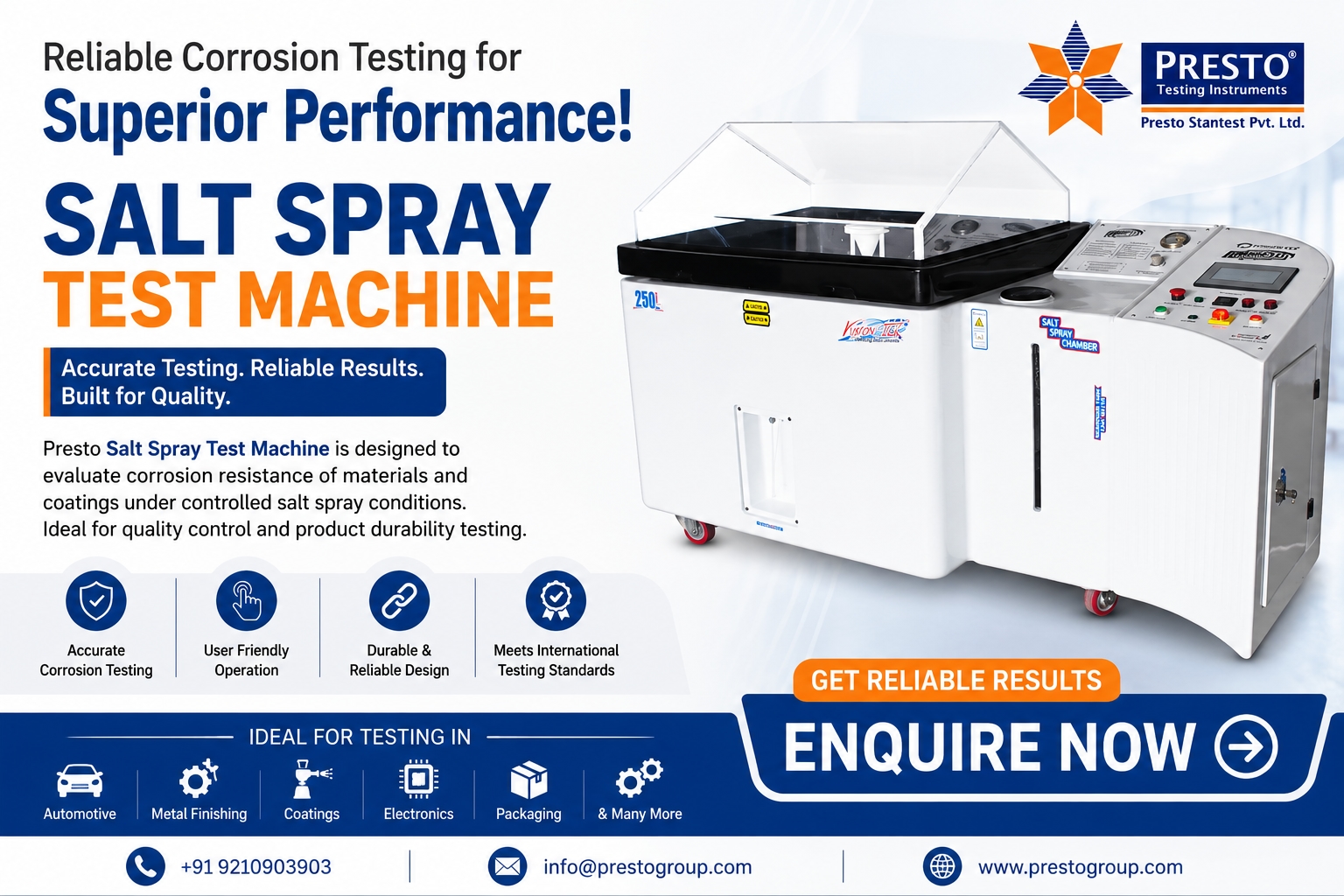
If you manufacture anything that has to survive moisture, coastal air, or harsh industrial environments, you already know corrosion is a slow and expensive problem. A coating that looks perfect on the shop floor can start to fail within months in the field. This is why the salt spray test machine has become a standard piece of equipment in quality labs across the world.
But when you start looking for one, the first question is usually the same: what is the salt spray test machine price, and why do the quotes look so different? Let’s break it down in plain terms.
What Is a Salt Spray Test Machine?
A salt spray test machine, also called a salt spray chamber or salt fog chamber, creates a controlled corrosive atmosphere. Test samples such as painted panels, plated parts, fasteners, or coated metal components are placed inside. A saltwater solution is atomised into a fine fog, and the samples are exposed for a set number of hours.
The idea is simple. The chamber speeds up the corrosion that would normally take months or years in real conditions. By checking when rust, blistering, or white corrosion appears, you can compare coatings, validate a supplier, or catch a process problem before products reach the customer.
Why ASTM B117 Matters
Most buyers look for a chamber that complies with ASTM B117, the most widely referenced standard for neutral salt spray testing. It defines the key conditions your chamber must hold:
A 5% sodium chloride solution
A solution pH between 6.5 and 7.2
A chamber temperature of 35°C
A controlled fog collection rate inside the cabinet
If a chamber cannot hold these conditions steadily, your results will not be repeatable, and repeatability is the whole point of testing. Many customers also need compatibility with related standards like ISO 9227 or IS 9844, depending on their industry and export market. Always confirm this before you finalise a purchase.
What Affects the Salt Spray Test Machine Price?
There is no single fixed price, and anyone who quotes one without asking questions is skipping important details. Here are the main factors that move the number up or down.
1. Chamber size and capacity
A compact tabletop unit for small parts costs far less than a large walk-in chamber. Choose a size based on the volume of samples you test today, plus some room to grow. Buying too small means queues in the lab. Buying too large means paying for space you never use.
2. Construction material
The cabinet and lid are usually made of materials like fibreglass-reinforced plastic or PVC. Better material means better resistance to the very corrosion you are testing for, so the chamber lasts longer.
3. Controller and automation
Basic models use simple analogue controls. Advanced chambers offer digital PID controllers, programmable test cycles, and data logging. If you run audits or need documentation for customers, these features are worth the extra cost.
4. Heating and humidity system
A well-designed air saturator and heating system keeps temperature stable throughout the test. This is where cheaper machines often cut corners, and where drift in your readings begins.
5. Combined corrosion testing
Some chambers go beyond a basic salt fog and support cyclic corrosion testing, with alternating salt spray, drying, and humidity phases. These cost more, but they are closer to real-world conditions.
6. After-sales support and calibration
A low upfront price means little if spare parts take weeks to arrive or nobody can help when the chamber stops holding temperature. Installation, training, and calibration support are part of the real cost.
A Cheap Machine Can Be the Most Expensive Choice
It is tempting to pick the lowest quote and move on. We see this regularly: a lab buys a budget chamber, then struggles with inconsistent fog, nozzle blockages, or readings that no longer match the previous batch. Eventually, test reports get questioned by a customer, and the lab has to repeat the work.
When you compare quotes, look beyond the headline figure. Ask these questions:
Does the chamber meet ASTM B117 requirements out of the box?
What is the warranty, and what does it actually cover?
Are spare parts such as nozzles and heaters easy to get locally?
Will the supplier help with installation and operator training?
Can you see the machine running, or speak to existing customers?
Who Needs a Salt Spray Chamber?
The list is longer than most people expect. Automotive component makers, paint and coating companies, electroplating units, electrical and electronics manufacturers, hardware and fastener producers, and research labs all rely on salt spray testing. If your product contains metal and will face humidity, salt, or chemicals at any point, this test belongs in your quality process.
Choosing the Right Partner
Presto Stantest has been building testing instruments for laboratories and industries for years. Our salt spray test chambers are designed to maintain stable conditions, deliver repeatable results, and keep up with daily lab use without constant maintenance. Just as important, our team takes the time to understand your samples, your standards, and your budget before recommending a model, so you pay only for what you actually need.
Get the Right Salt Spray Test Machine Price for Your Lab
Every lab has different requirements, so the most reliable way to know your cost is to talk to someone who can match a chamber to your testing needs.
Ready to find out the exact salt spray test machine price for your requirements? Contact Presto Stantest today for a detailed quote, technical specifications, and expert guidance. Our team will help you choose an ASTM B117 salt spray chamber that fits your standards and your budget.