
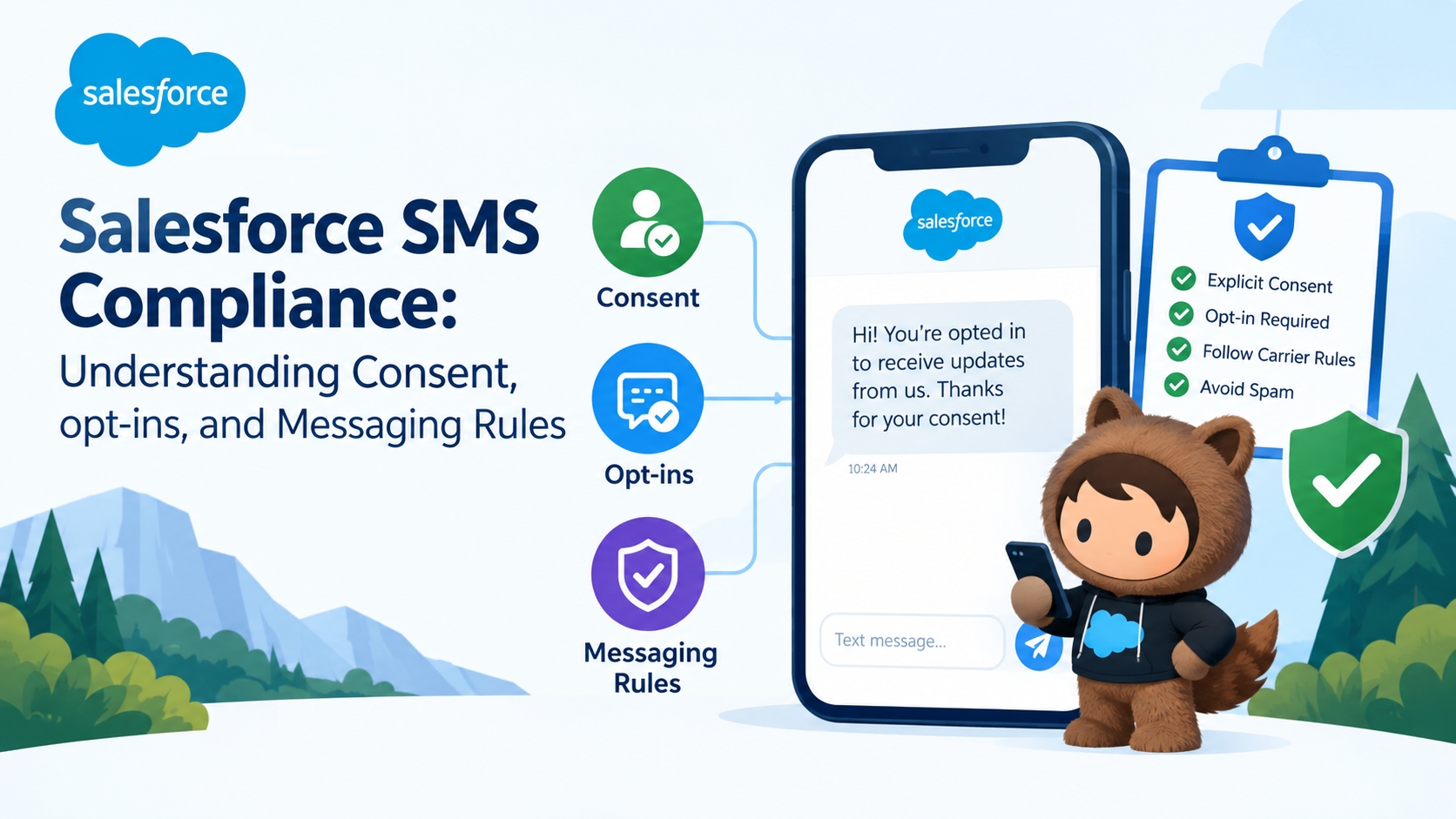
When a customer books a service appointment with an organization, the company sends a confirmation SMS using a Salesforce workflow by default. After some days, another SMS was sent through the same workflow regarding an upcoming festive offer.
Sending these messages via Salesforce automation may have taken just a few seconds, but it raises a more important question: does the customer really want to receive a promotional SMS in the first place?
The appointment confirmation message might be something the client was expecting — but other than that — the client may not have agreed to receive promotional messages.
That's where Salesforce SMS compliance becomes important.
This blog explains what businesses should do to maintain compliance with their Salesforce SMS campaigns without reducing effectiveness.
What Does Salesforce SMS Compliance Really Mean?
Salesforce SMS Compliance is the process of making sure that all the text messages sent via Salesforce adhere to relevant rules relating to consent, privacy, and texting. This goes beyond providing consent to customers.
Companies must understand:
● How consent is provided
● What the customer consents to receive
● How it is documented
● What to do when the customer opts out.
For any company that sends texts to customers for various purposes using SMS, compliance needs to be considered at every stage of the customer's messaging experience. A customer may agree to receive appointment reminders but not necessarily consent to get promotional messages. The assumption that all kinds of messages have the same status creates a compliance problem.
This makes compliance more about having a process than just sending texts.
Top 5 Best Practices for Salesforce SMS Compliance
In order to go through a Salesforce SMS process that is compliant, companies will need to do much more than collect the customer’s phone number.
Here are five key things for a company to consider communicating via Salesforce SMS responsibly:
1. Get Clear and Explicit SMS Opt-ins
All communication initiated through SMS must have prior consent from the customer. The opt-in notice must be clear that the customer has given his/her consent to receive text messages, and the type of messages he/she will receive.
Opt-ins will help customers understand what they are agreeing to and will provide a solid base for businesses.
2. Record and Manage Customer Consent
Consent must be documented, not just collected, and then forgotten. Business must keep track of details, like when and how the consent was obtained, what the telephone number is, and what types of messages the consumer wants to receive.
Maintaining this data in Salesforce may prove to be beneficial for the purposes of managing customer preferences and checking for consent when necessary.
3. Make Opt-Outs Easy and Respect Preferences
It should be easy for customers to withdraw their consent. Provide easy opt-out options like STOP as required and ensure that those requests are handled on time.
Different communication requirements of the customer need to be considered as well. For instance, a customer may require appointment reminders without promotional offers. Salesforce can assist in avoiding unwanted communications through updating preferences in Salesforce.
4. Follow Applicable SMS Messaging Rules
SMS compliance also includes adhering to the regulations that pertain to your business, audience, and message use case. It could include requirements around consent, sender information, promotions, opt-outs, frequency of messages, and message sending practices.
In the U.S., there are regulations like TCPA and 10DLC that might need to be considered by companies when it comes to sending messages. If the messages are sent across different regions, the company also needs to think about local regulations.
5. Build Compliance into Salesforce SMS Workflows
Compliance can be achieved more easily by making it inherent in the Salesforce SMS workflows rather than relying on manual processes. Before sending an SMS, the workflow can automatically check relevant information, such as customer consent and the type of message being sent, to help ensure compliance.
For instance:
Customer profile → Consent check → Preference check → Message sent
This practice helps reduce situations where messages are sent to customers who have opted out.
Common Salesforce SMS Compliance Mistakes to Avoid
Even with a well-articulated compliance procedure, there are mistakes that companies can make and thus expose themselves to unnecessary risks. The common mistakes made by companies include:
● The mistake of assuming that a telephone number equals consent: Just because a consumer has given their number, it does not automatically imply that the person has given consent for business SMS.
● The mistake of using the same consent to send all messages: Considering promotional and transactional messages as similar can make consumers receive texts which they had not consented to.
● The mistake of lack of record of consent: A business will be faced with difficulties in verifying when and how a customer gave their consent.
● The mistake of not complying with opting out: Sending messages to people who have already withdrawn their consent can be very risky and damaging to a company.
● The mistake of complete dependence on manual checking: For instance, as the Salesforce SMS campaigns keep increasing in size, there are chances that checking everyone manually will become more difficult.
Conclusion
Effective SMS communication is all about reaching the right person at the right time while ensuring compliance with authorized guidelines through a Salesforce messaging app.
The use of proper opt-in policies, consent tracking, ease of opting out, regulations, and Salesforce SMS compliance in business practices will make businesses more cautious in their communication.
Finally, Salesforce SMS compliance needs to be regarded as a continuous practice, not something businesses treat as optional.