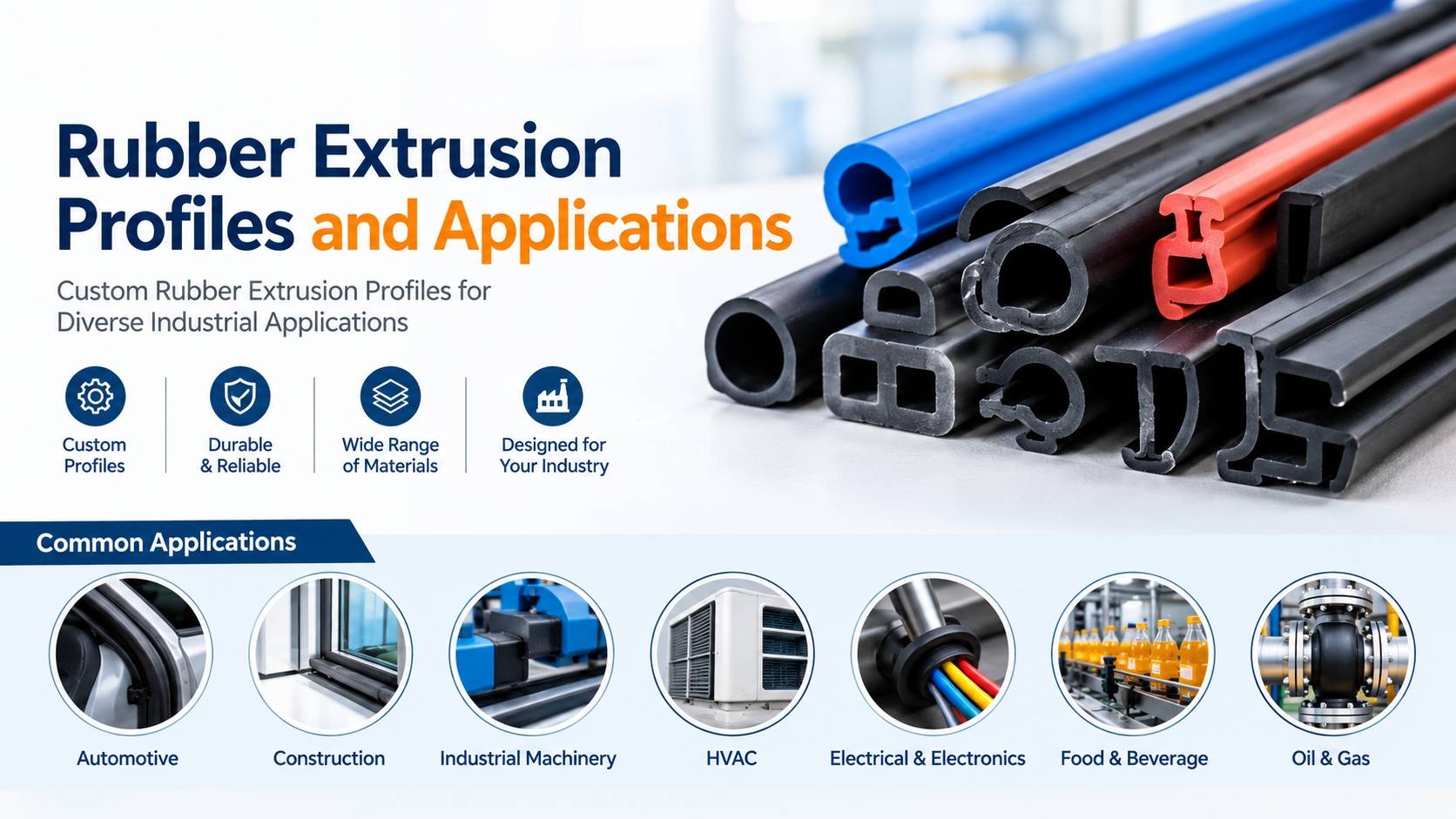
Rubber extrusion profiles are ideal for long, uniform profiles such as seals, gaskets, tubing, and channels. Whereas extruded rubber gaskets are suitable to compress against mating surfaces, and maintain a seal during movement or thermal expansion. This blog explains the exact difference between rubber extrusion profiles and extruded rubber gaskets, and shares industrial applications along with the process to choose the right manufacturer.
What Is The Difference Between Rubber Extrusion Profiles & Extruded Rubber Gaskets?
Rubber Extrusion Profiles are continuous lengths of rubber parts with uniform cross sections manufactured by extruding rubber through a specially shaped die. On the other hand, extruded rubber gaskets are specifically made from EPDM or silicone material to design for flange seals, HVAC seals, or Door/window seals.
Common rubber extrusions profile types include D profiles, U channels, P seals, tubes, cord profiles, edge trims, window seals, and door seals.
What Is the Rubber Extrusion Process?
Material Preparation
First, rubber materials are manufactured based on hardness, flexibility, temperature resistance, chemical resistance, weather resistance, and compression. They are usually made of EPDM, silicone, neoprene, nitrile, natural rubber, and FKM.
Extrusion
Then, the manufacturer forces the prepared rubber compound into the die using pressure because the die shape ensures the desired cross-section of the heated composition.
Curing
Then they cure the extruded profile to achieve the physical characteristics necessary for durability and functionality. Their curing process usually depends on the material used, profile dimensions, and production requirements.
Cooling and Cutting
After that they leave the profile for cooling because it ensures the product retains the required shape after curing. They can make it in continuous forms, cut segments, or specific sizes.
Inspection
Finally, top rated manufacturers profile inspect for delivery. Their quality checks usually include verifying dimensions, surface finish, profile uniformity, hardness, and length. The equipment and techniques used may differ based on materials and manufacturer.
What Types of Rubber Extrusion Profiles & Extruded Rubber Gaskets Are Available?
Under rubber extrusion profiles, there are:
Sealing Profiles
P-profiles, D-profiles, E-profiles, and bulb seals that are engineered to bridge gaps and form seals. This helps reduce the entry of water, dust, air, and sound in applications like doors, windows, automobiles, and machine enclosures.
Channel Profiles
U-profiles and Channel profiles that cover the edges of panels and are used for edge protection, panel fitting, and framing. They also protect against impact.
Tubular Profiles
Tubular sections are ideal for flexible channels, cushioning, sealing, or protection use. Buyers can choose a tubular section based on the application's needs.
Custom Cross-Sections
This is suitable for unusual product shapes that may require special extrusion dies to make the needed shape and size.
Alternatively, common varieties of extruded rubber gaskets include:
Solid Rubber Gaskets
These gaskets are perfect for providing resistance to compression. These can be extruded in rectangles, squares, or triangles.
Sponge Rubber Gaskets
These are suitable for working on uneven surfaces because of a 30% to 60% compression ratio. These are lighter than solid profiles and useful for electrical boxes, and car trunk seals.
Bulb Seals
These seals provide a wide sealing surface with very little closing force. These are typically suitable for car window guides, and electronic enclosures.
Lip & Wiper Seals
Lip seals can help wiping against moving surfaces to prevent fluid leakage and contaminant entry. Whereas wiper seals remove dust, mud, and moisture from moving surfaces to protect internal components.
U-Channels, P-Channels, and Edge Trims
The two flexible legs of U-channels grip the panel edge to give protection, and cushioning while ensuring decreased movement and rattling. In P-channels, the hollow bulb compresses when the panel closes to prevent air, water, dust, noise etc. from passing through. Lastly, the edge trims cover exposed and potentially sharp edges.
Applications Across Different Industries
Automotive
Doors, windows, hoods, and trunks to control water, dust, sound, vibration, and heat. Other areas that require sealing for NVH include edge protection and other sealing applications.
Construction
Sealants for windows and facades, expansion joints, and glazing profiles to provide weatherproofing, joint movement, and thermal and UV protection.
Industrial Equipment
Cabinet seals, machine door seals, protective profiles, and dust seals to protect machinery against dust, fluids, vibrations, and wear.
Electrical and Electronics
The rubber extrusion process can make cable protectors, seal closures, and grommets that provide metal-type protection.
HVAC
Duct, door, and equipment sealing profiles prevent air leakage and protect the enclosed components.
Food and Medical
Specific applications necessitate suitable material choice and adherence to applicable regulations.
How to Choose Rubber Gasket Manufacturers ?
When evaluating rubber gasket manufacturers or rubber extrusion companies, price should not be the only factor to consider. A reliable supplier always shows their extensive years of technical expertise, tooling knowledge, and production capability to match your needs. Here's are the key considerations every buyer should look for:
Material Expertise
Ask whether they can suggest the right elastomers based on factors like temperature, pressure, chemical exposure, and operating conditions. Their material knowledge should include EPDM, NBR, silicone, neoprene, and FKM.
Profile Development
Verify if they can make custom cross-sections using technical drawings, CAD models, prototypes, and sampling. This helps ensure the final cross-section matches the dimensions and sealing requirements.
Tooling Capability
Confirm whether they can design and manage extrusion dies, along with a strong tooling system to meet production needs. Having an in-house tooling system will help control dimensions.
Quality Control
Review how they test dimensions, hardness, material, surface, and batches. Quality documentation and inspection reports may help prove consistent compliance with requirements.
Production Capacity
Make sure the supplier can meet your production needs with consistent quality. Confirm their production capabilities can handle your regular orders and changing production demands.
Application Experience
Industry experience can help you identify potential issues with materials, sealing properties, design, and product performance before production begins. Base your selection of the rubber gasket manufacturer on application expertise, technical support, quality systems, and production capability.
FAQ About Rubber Extrusion Profiles
What Factors Affect the Dimensional Accuracy of Rubber Extrusion Profiles?
Material behavior, die shape, die swell, shrinkage, process parameters, and cooling may also influence the final profile dimensions. Proper control of these factors ensures you meet and maintain tolerance limits.
How Do You Select the Right Rubber Compound for an Extrusion Profile?
The choice of material depends on factors such as temperature, chemical resistance, weather, compression, flexibility, hardness, and the application's operating conditions. Common materials used include EPDM, silicone, neoprene, nitrile, natural rubber, and FKM.
Can Rubber Extrusion Profiles Be Customized?
Yes, custom extrusion dies can be made to create cross sections with the necessary dimensions, tolerances, and functions for specific applications. This lets manufacturers design profiles for sealing, protection, cushioning, and assembly needs.