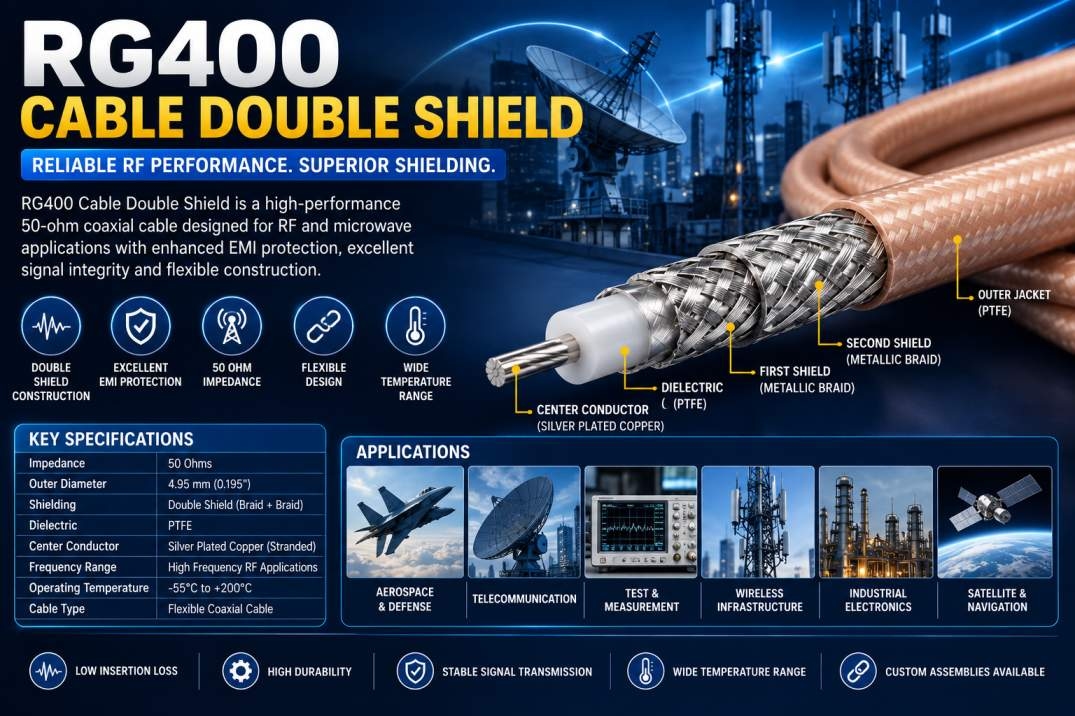
RG400 Cable Double Shield is a high-performance flexible coaxial cable designed for reliable transmission of radio frequency signals in demanding communication, aerospace, defense, instrumentation, and electronic systems. Its double-shield construction provides improved protection against electromagnetic interference (EMI), radio frequency interference (RFI), and unwanted signal leakage compared with many conventional single-shield coaxial cables.
The combination of a stranded center conductor, low-loss dielectric, dual shielding layers, and protective outer jacket allows RG400 Cable Double Shield to provide a useful balance between electrical performance, mechanical flexibility, durability, and shielding effectiveness.
RG400 is commonly selected for applications where the cable needs to withstand movement, vibration, temperature variation, and demanding installation conditions while maintaining a controlled RF transmission path.
This guide explains the construction, performance characteristics, specifications, applications, advantages, connector options, installation considerations, and selection criteria of RG400 Cable Double Shield.
What Is RG400 Cable Double Shield?
RG400 Cable Double Shield is a 50-ohm flexible coaxial RF cable that uses two layers of metallic shielding around the dielectric.
The double-shield construction is designed to reduce electromagnetic interference and improve isolation between the RF signal carried by the cable and the surrounding electrical environment.
A typical RG400 cable construction consists of:
Center conductor
Dielectric insulation
First metallic shield
Second metallic shield
Outer protective jacket
The exact materials and construction details can vary between manufacturers, so the manufacturer's technical datasheet should be checked for final product specifications.
Why Is RG400 Cable Double Shield Important?
RF systems can be affected by external electromagnetic fields generated by motors, power supplies, switching circuits, transmitters, digital electronics, and other communication equipment.
If a cable does not provide adequate shielding, unwanted interference can enter the signal path. Similarly, RF energy carried inside the cable can leak into nearby circuits.
The RG400 Cable Double Shield construction provides additional electromagnetic isolation by using two shield layers.
This makes it useful for systems where:
EMI protection is important
RF signal integrity must be maintained
Cable routing passes near electrical equipment
Multiple RF cables are installed together
Equipment operates in electrically noisy environments
Reliable signal transmission is required
Construction of RG400 Cable Double Shield
The performance of RG400 Cable Double Shield depends on the construction and quality of each individual layer.
Center Conductor
The center conductor carries the RF signal through the cable.
RG400 is commonly manufactured with a stranded copper-based center conductor. Stranded construction provides greater flexibility than a solid conductor and allows the cable to withstand repeated positioning and routing more effectively.
The conductor influences:
Electrical resistance
Signal attenuation
Power handling
Flexibility
Temperature performance
Depending on the product construction, the conductor may use silver-plated materials to improve high-frequency electrical performance and corrosion resistance.
Dielectric
The dielectric surrounds the center conductor and electrically separates it from the shielding system.
PTFE is commonly associated with RG400 constructions because of its low dielectric loss and strong temperature characteristics.
The dielectric affects:
Characteristic impedance
Capacitance
Velocity factor
Signal propagation
Insertion loss
Temperature stability
Maintaining a consistent distance between the center conductor and shielding is essential for controlling the cable's impedance.
First Shield
The first shielding layer surrounds the dielectric.
A metallic braid is commonly used as one of the shielding layers.
Its primary functions include:
Reducing electromagnetic interference
Preventing RF leakage
Providing an electrical return path
Protecting the internal signal conductor
Second Shield
The second metallic shield provides an additional barrier against electromagnetic interference.
The dual-shield configuration is particularly useful in environments where high shielding effectiveness is required.
Compared with a single-shield cable, a double-shield configuration can provide improved isolation when appropriately designed and terminated.
Outer Jacket
The outer jacket protects the internal cable construction against mechanical and environmental conditions.
Typical jacket materials are selected according to the application's:
Temperature requirements
Flexibility requirements
Chemical exposure
Abrasion resistance
Environmental conditions
RG400 Cable Double Shield Specifications
Exact specifications vary between manufacturers, but common RG400 characteristics include the following.
Specification | Typical RG400 Characteristics |
Cable Type | Flexible Coaxial RF Cable |
Characteristic Impedance | 50 Ohms |
Nominal Cable Size | Approximately 0.195 inch |
Shielding | Double Shield |
Center Conductor | Stranded Copper-Based Conductor |
Dielectric | PTFE |
Outer Jacket | Temperature-Resistant Protective Jacket |
Frequency Capability | RF and Microwave Applications |
Construction | Flexible |
Applications | Aerospace, Defense, RF, Instrumentation |
Connector Options | SMA, TNC, N-Type, BNC and others |
Actual electrical and mechanical specifications should always be verified against the specific manufacturer's datasheet.
Characteristic Impedance of RG400 Cable
RG400 is generally designed with a 50-ohm characteristic impedance.
Maintaining 50-ohm impedance is important in RF systems because it helps minimize signal reflections and ensures compatibility with other 50-ohm components.
Typical 50-ohm RF systems include:
Wireless communication
RF test equipment
Radar
Satellite communication
Aerospace electronics
Defense electronics
Antenna systems
Using a 50-ohm RG400 cable in a properly matched RF system helps maintain signal integrity throughout the transmission path.
Frequency Performance
The usable frequency range of RG400 depends on cable construction, connector selection, cable length, installation conditions, and required performance.
RG400 is widely used for RF applications extending into the microwave frequency range.
As frequency increases, cable attenuation generally increases. Therefore, engineers should evaluate attenuation at the actual operating frequency rather than selecting a cable solely by its RG designation.
Important parameters include:
Frequency range
Insertion loss
Return loss
VSWR
Connector performance
Cable length
Temperature
Shielding Performance of RG400 Cable Double Shield
One of the primary advantages of RG400 Cable Double Shield is its dual-layer shielding.
Shielding effectiveness describes how well a cable prevents electromagnetic energy from entering or leaving the cable.
A double-shield construction can provide improved protection against:
External RF interference
Electromagnetic noise
Digital switching noise
Crosstalk
Signal leakage
Electrical interference
However, overall shielding performance also depends on connector design, termination quality, cable construction, frequency, and installation.
RG400 Cable Double Shield Performance
Low Signal Loss
RG400 is designed for efficient RF signal transmission while maintaining a practical balance between flexibility and electrical performance.
Cable loss depends on frequency and length, so shorter cable runs are generally preferred where signal loss is critical.
Excellent EMI Protection
The double-shield configuration provides additional protection against unwanted electromagnetic energy.
Flexible Construction
Unlike semi-rigid cables, RG400 can be routed around equipment and through confined spaces.
Stable Impedance
Its controlled coaxial construction helps maintain a consistent 50-ohm transmission path.
Temperature Resistance
RG400 constructions are commonly selected for applications requiring better temperature performance than ordinary commercial coaxial cables.
Mechanical Reliability
The flexible construction makes RG400 suitable for equipment where cables may experience vibration or installation movement.
Key Features of RG400 Cable Double Shield
Important features include:
50-ohm impedance
Double shielding
Flexible construction
High-frequency capability
Good EMI protection
Reliable signal transmission
PTFE dielectric construction
Stranded center conductor
High-temperature capability
Good mechanical durability
Wide connector compatibility
Suitable for demanding RF environments
Applications of RG400 Cable Double Shield
Aerospace Applications
RG400 Cable Double Shield is widely used in aerospace electronics where reliable RF connectivity, temperature resistance, and mechanical durability are important.
Applications include:
Aircraft communication
Navigation systems
Avionics
RF instrumentation
Radar equipment
Satellite electronics
Defense and Military Electronics
Military systems often operate in electrically complex environments where shielding and reliable signal transmission are important.
RG400 can be used in:
Military communication systems
Radar equipment
Electronic warfare systems
RF receivers
RF transmitters
Tactical communication equipment
RF Test and Measurement
RG400 is useful in test environments where flexible RF connections are needed.
Applications include:
Spectrum analyzers
Signal generators
Network analyzers
RF test fixtures
Laboratory equipment
Calibration systems
Telecommunications
RG400 Cable Double Shield can be used within communication equipment and RF infrastructure.
Applications include:
Wireless communication equipment
RF modules
Cellular systems
Antenna systems
Signal distribution equipment
Industrial Electronics
Industrial environments can contain significant electromagnetic noise generated by motors, switching equipment, power electronics, and automation systems.
Double-shielded RF cables can help provide additional protection for sensitive RF signals.
Medical Electronics
Precision medical and laboratory systems may require controlled RF signal connections with reliable shielding and temperature performance.
Potential applications include:
RF diagnostic equipment
Medical instrumentation
Laboratory systems
Imaging equipment
RG400 Cable Double Shield Connector Options
The cable can be terminated with various RF connectors according to application requirements.
SMA Connector
SMA is one of the most common connectors used with small-diameter RF cables.
It is widely used in:
RF modules
Test equipment
Wireless systems
Microwave assemblies
N-Type Connector
N-Type connectors are widely used in communication and antenna systems.
They provide a robust threaded connection suitable for many outdoor and industrial RF applications.
TNC Connector
TNC connectors use a threaded coupling mechanism and are suitable for RF applications where a secure connection is required.
BNC Connector
BNC connectors are commonly used in laboratory and test equipment because of their convenient bayonet coupling mechanism.
Other RF Connectors
Depending on the application, RG400 can also be terminated with connectors such as:
2.92 mm
2.4 mm
SMB
SMC
MCX
MMCX
7/16 DIN
Connector selection should consider frequency, impedance, power, environmental requirements, and mechanical compatibility.
RG400 Cable Assembly
An RG400 cable assembly combines the RG400 Cable Double Shield with one or more RF connectors.
A customized assembly can be manufactured according to:
Cable length
Connector type
Connector gender
Straight connector
Right-angle connector
Connector orientation
Boot or strain relief
Electrical performance requirements
Custom assemblies reduce installation time and eliminate the need for field termination in many applications.
RG400 Straight Cable Assembly
Straight connectors extend directly along the cable axis.
They are suitable when:
Space is available behind the connector
Straight cable routing is preferred
Equipment has rear-facing RF ports
RG400 Right-Angle Cable Assembly
Right-angle connectors turn the RF connection approximately 90 degrees.
They are useful when:
Installation space is limited
Cable routing needs to turn immediately
Equipment has closely spaced RF ports
Mechanical clearance is restricted
RG400 Cable Double Shield vs Single Shield Cable
Feature | RG400 Double Shield | Single Shield RF Cable |
Shield Layers | Two | One |
EMI Protection | Higher | Application Dependent |
Signal Isolation | Excellent | Good |
Flexibility | High | High |
RF Applications | Wide | Wide |
Noise Protection | Enhanced | Standard |
Installation | Flexible | Flexible |
Actual shielding effectiveness depends on the specific cable construction and termination.
RG400 Cable Double Shield vs RG58
Feature | RG400 | RG58 |
Impedance | Typically 50 Ohms | Typically 50 Ohms |
Shielding | Double Shield | Construction Dependent |
Dielectric | Typically PTFE | Commonly Polyethylene |
Temperature Capability | Generally Higher | Generally Lower |
Flexibility | Flexible | Flexible |
High-Temperature Applications | Suitable | More Limited |
RF Applications | Demanding RF Systems | General RF Applications |
RG400 is commonly selected when higher temperature performance, improved shielding, and demanding RF requirements are important.
Advantages of RG400 Cable Double Shield
Improved Electromagnetic Protection
The dual-shield construction provides additional protection against external interference.
High Temperature Capability
PTFE-based construction allows RG400 to be used in applications where temperature resistance is important.
Flexible Installation
The cable can be routed around equipment and through compact installations.
Reliable RF Transmission
Controlled impedance and coaxial construction support consistent RF signal transmission.
Excellent Mechanical Performance
RG400 can withstand demanding installation and operational environments when correctly specified.
Wide Application Range
The cable can be used across aerospace, defense, telecommunications, instrumentation, industrial, and laboratory applications.
Limitations of RG400 Cable Double Shield
Despite its advantages, RG400 is not suitable for every application.
Potential limitations include:
Higher cost than basic coaxial cables
Greater diameter than some miniature RF cables
Attenuation increases with frequency and length
Improper connector termination can reduce performance
Repeated extreme bending can damage the cable
Not all RG400 products have identical specifications
How to Choose the Right RG400 Cable Double Shield
Selecting the appropriate RG400 Cable Double Shield requires consideration of the complete RF system.
Check Frequency
Confirm that the cable supports the required operating frequency.
Check Impedance
RG400 is generally a 50-ohm cable.
Evaluate Cable Length
Longer cables introduce more attenuation.
Check Shielding Requirements
For electrically noisy environments, verify the manufacturer's shielding effectiveness.
Select the Correct Connector
Ensure the connector is compatible with the equipment and frequency range.
Check Temperature
Confirm the cable's minimum and maximum operating temperatures.
Consider Mechanical Requirements
Evaluate flexibility, installation space, bend radius, vibration, and movement.
Check Power Handling
Verify power capability at the actual operating frequency and environmental conditions.
Installation Guidelines
Correct installation helps preserve the performance of RG400 Cable Double Shield.
Avoid excessive bending.
Do not sharply kink the cable.
Avoid crushing the cable.
Do not pull directly on connectors.
Use suitable connector torque.
Keep mating surfaces clean.
Avoid unnecessary cable length.
Provide proper strain relief.
Follow the manufacturer's minimum bend radius.
Maintenance of RG400 Cable
RG400 Cable Double Shield generally requires limited maintenance, but periodic inspection is useful in mission-critical RF systems.
Check for:
Damaged outer jackets
Connector damage
Loose connections
Corrosion
Excessive bending
Cable deformation
Contamination
Signs of overheating
For precision systems, cable assemblies can also be tested periodically for insertion loss, return loss, and VSWR.
Factors That Affect RG400 Cable Performance
Several factors can influence cable performance.
Frequency
Higher frequencies generally result in greater attenuation.
Cable Length
Longer cables produce greater insertion loss.
Temperature
Temperature changes can influence electrical and mechanical characteristics.
Connector Quality
Poor connector installation can significantly degrade system performance.
Bending
Excessive bending can alter cable geometry and affect impedance.
Shield Termination
The shielding system must be properly terminated to achieve the intended EMI performance.
RG400 Cable Double Shield for High-Frequency Applications
High-frequency RF systems require controlled transmission paths because small impedance variations can create measurable reflections.
RG400 provides a practical combination of:
Flexible construction
Double shielding
Controlled impedance
Temperature resistance
RF compatibility
Mechanical durability
This makes it useful for connecting antennas, RF modules, transmitters, receivers, filters, amplifiers, and test equipment.
RG400 Cable Double Shield for Aerospace and Defense
Aerospace and defense systems often require RF cables capable of operating under demanding environmental and mechanical conditions.
The combination of flexible construction, double shielding, and temperature-resistant materials makes RG400 suitable for various applications where cable reliability and RF isolation are important.
Typical applications include:
Avionics
Radar
Communications
Navigation
RF instrumentation
Defense electronics
Electronic warfare equipment
The exact suitability depends on the required qualification standards and environmental specifications.
RG400 Cable Double Shield for RF Laboratories
RF laboratories frequently require cables that can be connected and disconnected repeatedly while maintaining reliable electrical performance.
RG400 can be used in:
RF test benches
Network analyzer setups
Signal generator connections
Spectrum analyzer connections
Calibration equipment
Prototype development
Connector quality is particularly important in laboratory applications because repeated mating can affect RF performance.
Why Choose RG400 Cable Double Shield?
RG400 Cable Double Shield provides a combination of flexibility, shielding, temperature resistance, and RF performance that makes it suitable for demanding RF environments.
Its double-shield construction is particularly useful where electromagnetic interference and signal isolation are important considerations.
For engineers designing RF equipment, choosing the appropriate RG400 construction and connector combination can help establish a reliable RF transmission path while supporting mechanical and environmental requirements.
Conclusion
RG400 Cable Double Shield is a flexible 50-ohm RF coaxial cable designed for demanding signal transmission applications. Its double-shield construction provides enhanced protection against electromagnetic interference, while its PTFE-based construction and flexible design make it suitable for environments requiring reliable electrical and mechanical performance.
The cable is widely applicable in aerospace, defense, telecommunications, RF test and measurement, industrial electronics, medical instrumentation, and other specialized RF systems.
When selecting RG400 Cable Double Shield, engineers should evaluate frequency, impedance, attenuation, shielding effectiveness, connector type, power handling, temperature rating, cable length, and mechanical requirements. Proper installation and connector termination are equally important for achieving the intended performance.
Frequently Asked Questions About RG400 Cable Double Shield
1. What is RG400 Cable Double Shield?
RG400 Cable Double Shield is a flexible 50-ohm coaxial RF cable featuring two shielding layers around the dielectric. It is designed for reliable RF signal transmission and improved electromagnetic protection.
2. What is RG400 Cable Double Shield used for?
RG400 Cable Double Shield is used in aerospace, defense, telecommunications, RF test equipment, instrumentation, industrial electronics, medical equipment, and communication systems.
3. Is RG400 a 50-ohm cable?
Yes. RG400 is generally designed as a 50-ohm coaxial cable for RF and microwave applications.
4. What is the advantage of double shielding in RG400?
Double shielding provides an additional barrier against electromagnetic interference and can improve signal isolation compared with many single-shield cable constructions.
5. What material is used in RG400 cable?
RG400 constructions commonly use a copper-based center conductor, PTFE dielectric, metallic shielding, and a protective outer jacket. Exact materials can vary by manufacturer.
6. Is RG400 cable flexible?
Yes. RG400 is a flexible coaxial cable and is more suitable for routed installations and equipment connections than semi-rigid cable.
7. Can RG400 Cable Double Shield be used at high temperatures?
RG400 is commonly used in applications requiring higher temperature performance than many general-purpose coaxial cables. The exact temperature range should be confirmed from the product datasheet.
8. What connectors can be used with RG400?
RG400 cable assemblies can be terminated with SMA, N-Type, TNC, BNC, SMB, SMC, MCX, MMCX, and other RF connectors depending on the application.
9. What is the difference between RG400 and RG58?
Both are generally 50-ohm RF cables, but RG400 is commonly associated with PTFE dielectric construction, higher temperature capability, and double-shield configurations, while RG58 is widely used as a general-purpose RF coaxial cable.
10. Is RG400 suitable for aerospace applications?
RG400 can be used in aerospace applications where its electrical, mechanical, temperature, and qualification requirements match the system specifications.