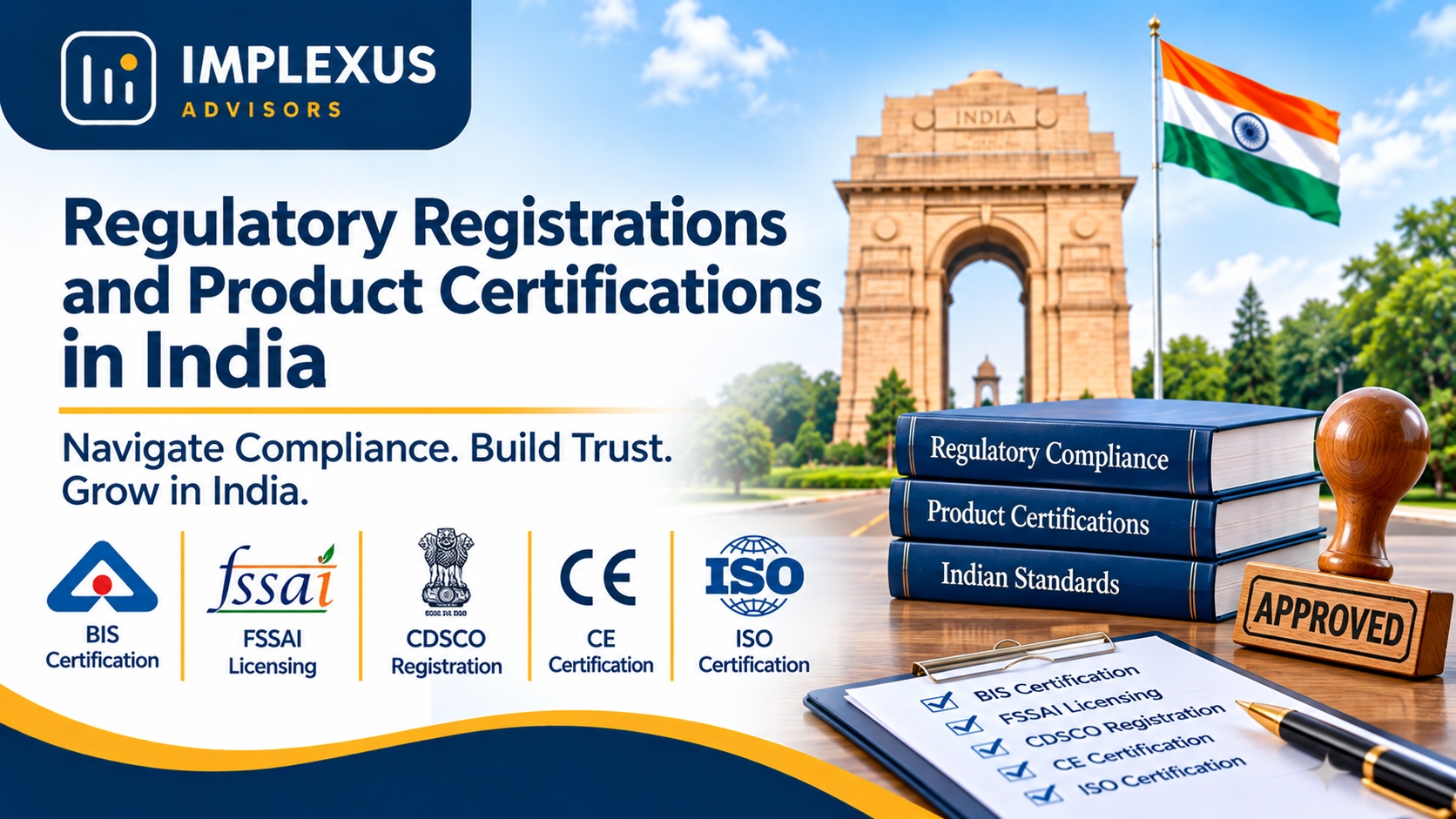
Businesses entering or operating in India must understand the regulatory requirements that apply to their products and industry. Depending on the product category, intended use, manufacturing process and distribution model, companies may need specific registrations, licences, approvals or certifications before they can manufacture, import, market or sell products in the country.
For international businesses, navigating these requirements can be particularly challenging. Different regulatory authorities oversee different product categories, and the documentation and approval processes can vary significantly. Professional Regulatory Registrations & Product Certifications support can help businesses identify applicable requirements and coordinate the necessary regulatory processes.
Understanding Regulatory Registrations in India
Regulatory Registrations in India refer to the formal approvals, licences and registrations required by government authorities for particular business activities or products. These requirements are intended to protect consumers, maintain product quality and safety, and ensure that businesses follow applicable Indian standards.
The regulatory pathway depends on several factors, including:
Product category and intended application.
Whether the product is manufactured domestically or imported.
Applicable Indian standards and quality requirements.
Industry-specific laws and regulatory notifications.
Manufacturing location and business structure.
Labelling, packaging and product documentation requirements.
A product may require one or more approvals depending on its classification. Therefore, businesses should identify the applicable regulatory framework before beginning commercial operations or shipping products to India.
Key Regulatory Registrations and Certifications
Different government authorities oversee different categories of products. Some important regulatory frameworks include:
1. BIS Certification
The Bureau of Indian Standards (BIS) administers product certification schemes to assess conformity with relevant Indian Standards. Depending on the product and applicable notification, businesses may need an ISI Mark licence, registration under the Compulsory Registration Scheme or another applicable conformity assessment approval.
BIS certification is voluntary for many products, but certain products are subject to mandatory certification through Quality Control Orders (QCOs) or other government notifications.
Businesses should verify the applicable Indian Standard, product scope and implementation date before manufacturing or importing regulated products.
2. CDSCO Registration and Licensing
The Central Drugs Standard Control Organisation (CDSCO) regulates specified categories of drugs, cosmetics and medical devices under India's relevant legal framework.
For medical devices, regulatory requirements depend on product classification and risk category. Importers and manufacturers may need appropriate licences or permissions under the Medical Devices Rules, 2017. The applicable licensing authority can differ depending on the activity and device classification.
Businesses dealing with medical devices should review product classification, technical documentation, quality-management requirements and the relevant licensing pathway before entering the Indian market.
3. FSSAI Registration and Licensing
Food businesses must assess their obligations under the Food Safety and Standards Act, 2006. Depending on the nature and scale of the activity, a food business operator may require registration or a State or Central FSSAI licence.
Requirements can apply to manufacturers, processors, importers, distributors, retailers and other food-related businesses. Companies must also consider applicable food safety, hygiene, labelling and documentation requirements.
Applications and relevant licensing activities are managed through FSSAI's Food Safety Compliance System (FoSCoS).
Regulatory Registrations and Certification: Common Business Requirements
The Regulatory Registrations and Certification process generally begins with identifying the product's regulatory classification and the approvals applicable to its intended activities.
Depending on the product, the process may involve:
Reviewing product specifications and intended use.
Identifying applicable Indian standards and regulations.
Determining whether mandatory certification or licensing applies.
Preparing technical files, declarations and supporting documents.
Coordinating product testing through recognised or notified laboratories, where required.
Submitting applications to the relevant authority.
Responding to regulatory queries and coordinating inspections, where applicable.
Tracking approval status and maintaining certification records.
Businesses should also monitor changes to applicable regulations, product standards and government notifications after receiving an approval.
Why Businesses Need Professional Product Certification Services
Obtaining regulatory approvals involves more than completing application forms. Businesses may need to interpret technical standards, coordinate testing, prepare supporting documentation and communicate with multiple authorities.
Professional Product Certification Services can help organisations approach these activities in a structured manner.
Key benefits include:
1. Clearer regulatory planning: Identifying relevant approvals early can help businesses plan product launches, imports and manufacturing activities.
2. Better documentation: Organised technical and corporate records can make application preparation and regulatory reviews more efficient.
3. Coordinated application processes: A structured approach can help manage submissions, queries, testing requirements and follow-ups.
4. Reduced compliance uncertainty: Understanding product-specific obligations can help businesses avoid relying on incorrect assumptions about mandatory approvals.
5. Ongoing regulatory awareness: Monitoring relevant notifications and renewal requirements helps businesses maintain an organised compliance process.
Regulatory Registrations and Product Certification Support by Implexus Advisors
Implexus Advisors supports businesses navigating regulatory registration and product certification requirements in India. Its approach focuses on helping organisations understand applicable approval pathways, coordinate documentation and manage regulatory processes.
Whether a company is introducing a new product, importing goods or expanding its manufacturing operations, identifying the correct regulatory requirements is an important part of market readiness.
With structured regulatory coordination, businesses can approach product approvals more systematically and prepare for their commercial activities in India.
Conclusion
Regulatory registrations and product certifications are important considerations for businesses manufacturing, importing or selling regulated products in India. Requirements under BIS, CDSCO and FSSAI frameworks differ according to product category, activity and applicable regulations.
By identifying the correct approval pathway and preparing the required documentation, businesses can manage regulatory responsibilities more effectively and build a stronger foundation for operating in the Indian market.