PSARA registration is the process through which an eligible private security agency obtains a licence to provide private security services in India. A business that deploys security guards for residential societies, offices, factories, warehouses, hospitals, retail stores, schools, hotels or events should obtain the appropriate PSARA licence before beginning operations.
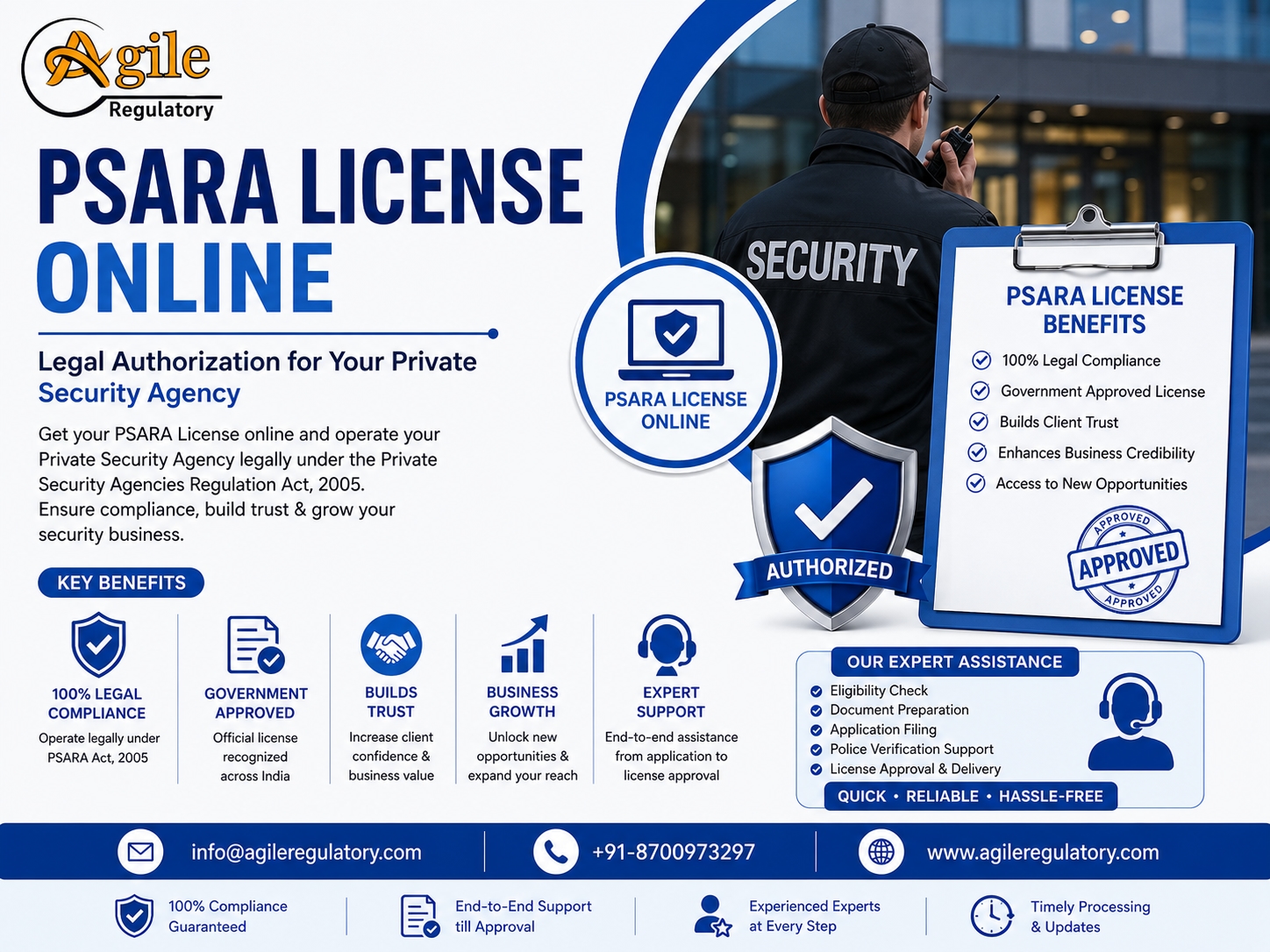
PSARA stands for the Private Security Agencies (Regulation) Act. The licence is issued by the Controlling Authority of the relevant state or Union Territory.
What Is a PSARA Licence?
A PSARA licence is a state-specific legal approval for operating a private security agency.
It may be required for businesses providing:
Security guards.
Security supervisors.
Residential-security services.
Corporate-security services.
Industrial-security services.
Factory-security services.
Warehouse-security services.
Hospital-security services.
Event-security services.
Mall-security services.
Hotel-security services.
Retail-security services.
Guard-deployment services.
Private-security personnel services.
A company-incorporation certificate, GST registration, Shop and Establishment registration or trade licence does not replace PSARA registration.
Who Needs PSARA Registration?
PSARA registration may be relevant for:
Sole proprietorships.
Partnership firms.
Limited Liability Partnerships.
One Person Companies.
Private limited companies.
Public limited companies.
Other eligible Indian business entities.
The applicant, proprietor, directors, partners and principal officers should meet the applicable eligibility requirements under the PSARA Act and the relevant state rules.
PSARA Licence Eligibility
The applicant should generally ensure:
Valid Indian business registration.
Genuine office premises.
Proper business-address proof.
Eligible promoters, directors or partners.
No disqualifying criminal history.
No disqualifying dismissal from government service.
Financial capacity to operate the agency.
Security-training institute arrangement.
Ability to conduct antecedent verification.
Ability to maintain guard and supervisor records.
Ability to comply with applicable state rules.
State-specific eligibility conditions should be checked before submission.
PSARA Licence Scope
A PSARA licence is issued for an approved geographical area.
Licence coverage | Operational scope |
|---|---|
District-level PSARA licence | One district within a state |
Multi-district PSARA licence | More than one and up to five districts within a state |
State-level PSARA licence | Entire state |
Multi-state security business | Separate licence generally required for every additional state |
For example, a licence issued in Delhi does not automatically permit the agency to deploy guards in Uttar Pradesh or Haryana.
PSARA Licence Fees
The central PSARA fee structure is based on the geographical coverage selected by the applicant.
Operational area | Government application fee |
|---|---|
One district | ₹5,000 |
More than one and up to five districts | ₹10,000 |
Entire state | ₹25,000 |
The Private Security Agencies (Regulation) Act, 2005 sets these government fees for the three operational scopes.
The total PSARA registration cost may also include:
Training-institute MoU charges.
Documentation charges.
Affidavit and notarisation charges.
Police-verification expenses.
State-specific processing charges.
Professional-consultant fee.
Office-compliance cost.
Renewal-related cost.
PSARA Licence Online Application
The PSARA licence apply online process varies between states, but the broad process is similar.
Step 1: Set Up the Business Entity
Establish the security agency as an eligible legal entity.
The business should have:
PAN.
Registered office.
Valid business address.
Incorporation or formation documents.
Authorised person.
Business bank account.
GST registration, where applicable.
Step 2: Select the State and Area of Operation
Determine:
State of operation.
District coverage.
Whether a district-level, multi-district or state-level licence is required.
Whether the agency plans to expand to other states.
The selected scope should match the actual service area.
Step 3: Execute Training-Institute MoU
The security agency should enter into a Memorandum of Understanding with a recognised security training institute.
The training arrangement should cover guards and supervisors in areas such as:
Security procedures.
Emergency response.
First aid.
Fire safety.
Access control.
Crowd management.
Communication.
Visitor management.
Basic legal awareness.
Professional conduct.
Step 4: Prepare PSARA Forms and Documents
Prepare the prescribed application, antecedent-verification information, affidavits, declarations and supporting records.
Step 5: File Application Online
Create an account on the designated state PSARA portal and complete the online application.
Step 6: Pay Government Fee
Pay the prescribed fee according to the selected operational area.
Step 7: Complete Police Verification
The competent authority may initiate antecedent verification for the proprietor, partners, directors or principal officers.
Step 8: Respond to Queries
Address document deficiencies, clarification requests or verification queries within the stated timeline.
Step 9: Receive PSARA Certificate
After approval, download and retain the PSARA licence certificate.
Documents Required for PSARA Licence
The document checklist may vary by state, but common records include:
PAN card.
Certificate of incorporation.
Memorandum of Association.
Articles of Association.
Partnership deed.
LLP agreement.
Proprietorship declaration.
GST registration certificate, where applicable.
Registered-office proof.
Rent agreement.
Lease deed.
Ownership proof.
No-objection certificate from premises owner.
Board resolution.
Authorisation letter.
Identity proof of proprietor, partners or directors.
Address proof of proprietor, partners or directors.
Passport-size photographs.
Police-verification information.
Antecedent-verification forms.
Affidavits and declarations.
Training-institute MoU.
Training-institute recognition details.
Employee-management procedure.
Guard-training procedure.
Uniform details, where required.
Agency logo details, where required.
Financial documents, where requested.
Government-fee receipt.
PSARA Certificate
A PSARA certificate is the final licence issued by the relevant state Controlling Authority.
After receiving the certificate, verify:
Agency name.
Legal entity name.
Licence number.
Registered office.
State.
Approved district coverage.
Date of issue.
Validity period.
Licence conditions.
Authorised representative details.
The security agency should retain the certificate at its registered office and provide it during tender submissions, client due diligence, inspections or government enquiries.
PSARA Licence Check Online
A PSARA licence check online can generally be completed through the relevant state portal.
Keep the following available:
Application number.
Registered mobile number.
Registered email address.
Applicant login details.
Payment reference.
State name.
Submission date.
Application-status stages can include:
Draft.
Submitted.
Fee pending.
Document scrutiny.
Police verification pending.
Deficiency raised.
Under process.
Approved.
Rejected.
Licence issued.
The applicant should respond quickly to queries because delayed responses can postpone approval.
PSARA Licence List
The phrase PSARA licence list may refer to the list of approved security agencies or an agency’s internal compliance records.
Every licensed agency should maintain:
PSARA certificate.
Application acknowledgement.
Payment receipt.
Training-institute MoU.
Security-guard records.
Supervisor records.
Guard-training certificates.
Police-verification records.
Guard identity cards.
Client contracts.
Deployment records.
Attendance records.
Complaint records.
Incident records.
Licence-renewal reminders.
Compliance declarations.
The agency should never claim that it is licensed for a district or state outside the territorial scope stated on its certificate.
PSARA Licence in Delhi
A PSARA licence in Delhi is required for an eligible private security agency operating in Delhi.
The applicant should determine whether it needs:
District-level coverage, where applicable.
Multi-district coverage, where applicable.
Delhi-wide operational coverage.
A Delhi licence does not automatically permit guard deployment in Noida, Gurugram, Ghaziabad, Faridabad or other NCR locations outside Delhi.
PSARA Licence Uttar Pradesh
A PSARA licence in Uttar Pradesh is required for agencies operating in Uttar Pradesh.
This may include businesses providing security services in:
Noida.
Greater Noida.
Ghaziabad.
Lucknow.
Kanpur.
Agra.
Meerut.
Varanasi.
Prayagraj.
Aligarh.
Bareilly.
Gorakhpur.
Other Uttar Pradesh districts.
The agency should select its required district or state-level coverage before application.
PSARA Licence Validity and Renewal
PSARA licence validity and renewal requirements should be checked against the relevant state rules and licence conditions.
The PSARA Act provides for a licence validity of five years, subject to applicable state rules and licence conditions.
The security agency should start renewal planning well before expiry and review:
Business address.
Director or partner details.
Training-institute MoU.
Operational coverage.
Guard training.
Supervisor records.
Police verification.
Employee records.
Applicable government fee.
Licence conditions.
PSARA Licence Compliance
After receiving the licence, the agency should maintain ongoing compliance.
Important areas include:
Guard recruitment.
Background verification.
Guard training.
Supervisor appointment.
Guard identity cards.
Uniform standards.
Deployment records.
Client contracts.
Complaint management.
Incident reporting.
Employee-welfare compliance.
EPF compliance, where applicable.
ESIC compliance, where applicable.
Minimum-wage compliance.
Labour-law compliance.
Renewal and amendment compliance.
A PSARA licence is not a one-time registration. The agency should maintain compliance throughout its operations.
PSARA Consultant
A PSARA consultant can help an applicant understand state-specific requirements and prepare a complete application.
Agile Regulatory can assist with:
PSARA registration.
PSARA licence application.
PSARA certificate support.
PSARA licence in Delhi.
PSARA licence in Uttar Pradesh.
State-level licence planning.
District-level licence planning.
Training-institute MoU coordination.
Application-document preparation.
Police-verification documentation.
Online filing support.
Application-status tracking.
Deficiency response.
Licence-renewal planning.
Post-licence compliance support.
Common PSARA Licence Mistakes
Businesses should avoid:
Starting security operations without a PSARA licence.
Applying in the wrong state.
Selecting insufficient territorial coverage.
Operating in another state without a separate licence.
Using incomplete antecedent-verification records.
Submitting an invalid training-institute MoU.
Providing inconsistent business details.
Failing to maintain guard-training records.
Deploying guards without adequate verification.
Missing licence-renewal deadlines.
Failing to update changed directors, partners or office addresses.
Claiming services in unapproved districts.
Treating GST registration as a substitute for PSARA registration.
Conclusion
PSARA registration is essential for a private security agency intending to lawfully deploy guards and provide security services in India. The agency should select the correct state and operating scope, establish a suitable training arrangement, complete police-verification requirements and file accurate online documents.
A valid PSARA licence improves legal compliance, strengthens credibility with clients and supports long-term growth in the private-security sector.
Frequently Asked Questions
1. What is PSARA registration?
PSARA registration is the process through which an eligible private security agency obtains a state-specific licence to provide security guards, supervisors and related private-security services in India.
2. Is a PSARA licence mandatory for a security agency?
Yes. A business intending to operate as a private security agency and deploy guards for clients should obtain the required PSARA licence from the concerned state or Union Territory Controlling Authority before starting operations.
3. What are the government fees for a PSARA licence?
The government application fee is ₹5,000 for one district, ₹10,000 for more than one and up to five districts, and ₹25,000 for the whole state.
4. Can one PSARA licence be used in Delhi and Uttar Pradesh?
No. PSARA licences are state-specific. A licence issued for Delhi does not automatically permit security operations in Uttar Pradesh, Haryana or any other state. The security agency generally needs a separate licence for each additional state where it operates.
5. How can I check PSARA licence status online?
Log in to the relevant state PSARA portal using the application number or registered applicant credentials. The dashboard may show whether the application is under scrutiny, awaiting police verification, has a deficiency, is approved or has resulted in licence issuance.