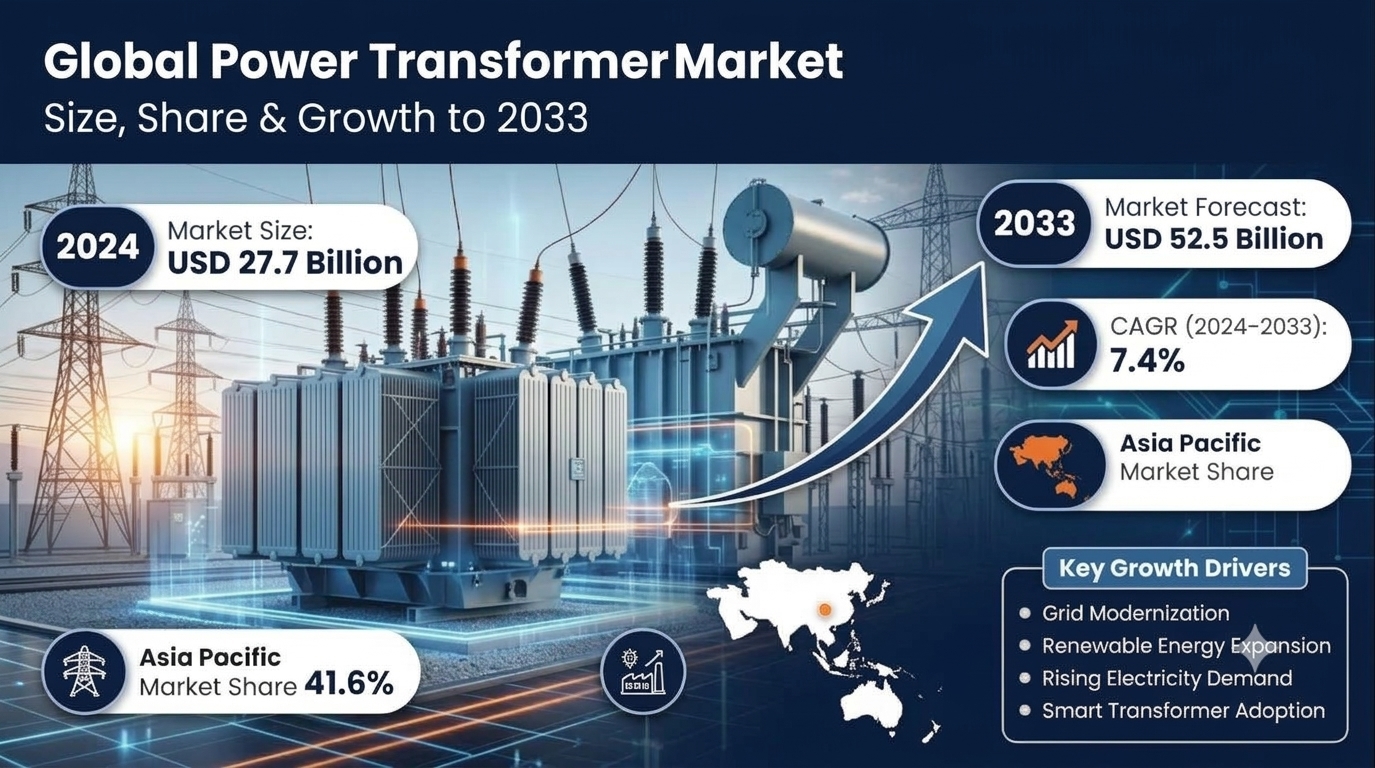
The Global Power Transformer Market is experiencing significant expansion as electricity demand, renewable energy investments, and power infrastructure modernization reshape the global energy landscape. The market was valued at USD 27.7 billion in 2024 and is projected to reach USD 52.5 billion by 2033, expanding at a compound annual growth rate (CAGR) of 7.4%. Increasing industrialization, urban development, and investment in high-voltage transmission networks are creating substantial opportunities for transformer manufacturers worldwide.
Power transformers are essential electrical devices designed to transfer electrical energy between circuits through electromagnetic induction without changing frequency. They enable efficient voltage conversion across generation facilities, transmission networks, and substations, ensuring reliable electricity delivery. Their applications extend across utilities, industrial facilities, renewable energy projects, and large-scale infrastructure developments where stable voltage levels and minimal transmission losses are critical.
The growing integration of solar and wind energy into existing power networks is increasing demand for advanced transformers with improved efficiency, operational reliability, and monitoring capabilities. However, high manufacturing costs, material supply constraints, and extended production timelines remain important concerns. Large customized power transformers often require more than six months to manufacture, making capacity planning and procurement management essential for utilities and industrial operators.
📄 Looking for Specific Data? Get a Free Customized Sample:
https://dimensionmarketresearch.com/request-sample/power-transformer-market/
Global Power Transformer Market Overview
The power transformer industry is undergoing structural transformation as electricity networks transition toward cleaner, smarter, and more interconnected systems. Governments and private utilities are investing in transmission capacity to accommodate growing electricity consumption, renewable energy generation, and industrial expansion.
Traditional electricity networks were primarily designed around centralized power generation. However, increasing adoption of distributed renewable energy and cross-border electricity trading requires more flexible grid infrastructure. Power transformers support these evolving requirements by maintaining voltage compatibility and facilitating efficient electricity transmission across interconnected networks.
Furthermore, aging electrical infrastructure in developed economies is encouraging replacement programs, while emerging economies are prioritizing new substations and transmission corridors. These developments support equipment demand across both replacement and greenfield infrastructure projects.
Key Findings of the Power Transformer Market
2024 Market Size: USD 27.7 billion.
2033 Market Forecast: USD 52.5 billion.
Projected CAGR: 7.4%.
Revenue Growth: USD 24.8 billion between 2024 and 2033.
Leading Region: Asia Pacific, with a 41.6% revenue share.
Leading Core Type: Shell core transformers.
Leading Phase: Three-phase transformers.
Leading Insulation: Oil-insulated transformers.
Leading Rating: 100 MVA to 500 MVA.
Leading End User: Industrial sector.
Power Transformer Market Dynamics
The market is influenced by changing electricity consumption patterns, renewable energy expansion, technological development, and growing infrastructure investment. While the demand outlook remains favorable, manufacturers must manage volatile input costs and demanding technical specifications.
Growth Drivers: What Is Accelerating Market Expansion?
Rising Electricity Demand and Infrastructure Modernization
Growing industrial output, urban populations, and electrification initiatives are increasing electricity consumption across developing and developed economies. Utilities are expanding transmission systems to support rising loads while improving supply reliability.
Countries experiencing rapid industrial development require additional substations, high-capacity transformers, and upgraded transmission corridors. Meanwhile, developed economies are replacing aging equipment to minimize failures and improve operational efficiency.
Major demand catalysts include:
Expansion of high-voltage transmission networks.
Replacement of aging grid infrastructure.
Development of industrial power substations.
Increasing electricity demand from urban centers.
Investments in grid stability and resilience.
Renewable Energy Integration and Grid Expansion
Renewable energy development represents another significant growth driver. Large solar parks, offshore wind farms, and hydroelectric projects frequently require transformers to adjust generated voltage for efficient transmission.
Renewable energy facilities are often located far from major consumption centers, increasing the importance of long-distance electricity transmission. High-capacity transformers enable these power flows while supporting renewable integration into established electricity networks.
The adoption of grid-scale energy storage and hybrid renewable projects also creates opportunities for specialized transformer designs suited to changing operational conditions.
Power Transformer Market Trends
Smart Transformers and Digital Monitoring Technologies
Digital transformation is influencing transformer design, operation, and maintenance. Manufacturers are integrating sensors, connected monitoring systems, and advanced diagnostic technologies that provide better visibility into equipment performance.
Smart monitoring systems can track winding temperatures, insulation conditions, dissolved gases, and operating loads. These capabilities allow utilities to identify potential problems earlier and improve maintenance planning.
Important technology trends include:
IoT-enabled transformer monitoring.
Predictive maintenance and diagnostics.
Remote temperature and load tracking.
Automated fault detection systems.
Digital grid management integration.
Sustainable Insulation and Energy-Efficient Designs
Environmental considerations are encouraging manufacturers to develop transformers that reduce energy losses and environmental risks.
Advanced core materials, improved cooling systems, and alternative insulating fluids are receiving increasing attention. Natural and synthetic ester fluids, for example, offer options for applications seeking improved biodegradability and specific fire-safety characteristics.
Manufacturers are also optimizing transformer designs to reduce lifecycle energy losses, improve durability, and support sustainability objectives.
Power Transformer Market Challenges
Despite favorable demand conditions, transformer manufacturing involves substantial capital expenditure, specialized engineering, and complex procurement processes.
Volatility in prices of electrical steel, copper, and insulating materials can affect production costs. Cold-rolled grain-oriented electrical steel is particularly important for transformer core manufacturing, making supply availability a significant consideration.
Customized equipment requirements create additional complexity because high-capacity transformers must satisfy specific voltage, cooling, insulation, and installation standards.
Major industry challenges include:
High upfront equipment investment.
Volatile electrical steel and copper prices.
Long manufacturing and delivery timelines.
Limited supply of specialized components.
Complex installation and testing procedures.
Shortages of specialized technical expertise.
These constraints encourage utilities to pursue early procurement strategies, supplier diversification, and long-term equipment planning.
Power Transformer Market Segmentation Overview
Market segmentation highlights differences in transformer design, capacity, insulation, and end-user requirements. Understanding these categories helps manufacturers identify demand opportunities and develop equipment suited to specific operating environments.
By Core Type
The market includes shell, closed, and berry core transformers.
Shell core transformers represent the leading segment in the 2024 market assessment, supported by their structural strength, design flexibility, and suitability for demanding electrical applications.
Their winding arrangement can offer mechanical advantages under short-circuit conditions, while optimized configurations support effective magnetic flux management.
By Phase
The industry is divided into single-phase and three-phase transformers.
Three-phase transformers dominate the market because they are extensively used in electricity transmission, generation facilities, and industrial operations.
Their suitability for high-capacity applications makes them essential components of modern electrical infrastructure.
By Insulation
Major insulation categories include oil, gas, air, solid, and other insulating technologies.
Oil-insulated transformers account for the leading segment, supported by their established use in high-voltage equipment and their effective insulation and cooling properties.
The development of alternative insulating fluids is gradually expanding product options for environmentally sensitive applications.
By Power Rating
The market is categorized into:
100 MVA to 500 MVA.
501 MVA to 800 MVA.
801 MVA to 1200 MVA.
The 100 MVA to 500 MVA segment holds the leading position, reflecting its broad application across transmission infrastructure and industrial power networks.
Higher-capacity transformers remain important for bulk electricity transmission and large grid interconnection projects.
By End User
The major end-user categories are industrial, utilities, and residential and commercial applications.
The industrial sector leads the market, driven by electricity-intensive manufacturing activities, infrastructure development, and increasing demand for reliable power supply.
Utilities also represent an essential customer group because transformers are critical assets in transmission substations and interconnected electricity networks.
Power Transformer Market Regional Analysis
Purchase the Report for Comprehensive Details:
https://dimensionmarketresearch.com/checkout/power-transformer-market/
Asia Pacific: Leading Regional Market
Asia Pacific leads the global market with an estimated 41.6% revenue share in 2024. Rapid economic expansion, industrialization, urbanization, and electricity infrastructure investment support this position.
China remains a major contributor, driven by investments in transmission lines, substations, renewable energy connectivity, and industrial power infrastructure.
India also presents substantial opportunities through electricity network expansion, renewable energy deployment, and industrial infrastructure development.
Regional growth is supported by:
Expansion of electricity transmission corridors.
Rapid industrial and urban development.
Increasing renewable energy installations.
Modernization of electrical substations.
Growing demand for reliable power supply.
North America: Grid Replacement and Modernization
North America represents an important market supported by aging grid infrastructure, electricity reliability requirements, and expanding renewable energy integration.
The United States is investing in transformer manufacturing capacity and transmission infrastructure to strengthen domestic supply capabilities.
Increasing electricity requirements from manufacturing facilities and large commercial operations further support equipment demand.
Europe: Energy Transition and Grid Connectivity
Europe's market development is influenced by renewable energy deployment, electrical network modernization, and cross-border power trading.
Wind power expansion, grid interconnection projects, and energy efficiency requirements are encouraging investment in advanced transformer technologies.
Manufacturers are increasingly focusing on equipment reliability, digital monitoring, and environmentally considerate insulation alternatives.
Latin America and Middle East & Africa
Latin America offers opportunities through renewable energy investments, industrial electrification, and transmission infrastructure development, particularly in Brazil and Mexico.
Meanwhile, the Middle East and Africa are expanding power generation and transmission infrastructure to support economic diversification, urban development, and improving electricity access.
Competitive Landscape of the Power Transformer Market
The global market is characterized by competition among established electrical equipment manufacturers offering high-voltage transformers, grid technologies, and associated engineering services.
Competition increasingly centers on manufacturing capacity, equipment efficiency, customization capabilities, technological innovation, and long-term service support.
Leading manufacturers are strengthening production capabilities and developing more efficient transformer designs to meet evolving electricity infrastructure requirements.
Key Companies Operating in the Market
ABB Ltd.
General Electric Company.
Toshiba Corporation.
Siemens AG.
Hitachi Ltd.
Bharat Heavy Electricals Limited.
Crompton Greaves Limited.
SPX Transformer Solutions.
WEG S.A.
Schneider Electric SE.
Strategic priorities include expanding manufacturing facilities, improving supply chain resilience, developing advanced insulation technologies, and strengthening regional distribution networks.
Companies capable of delivering reliable equipment within competitive timelines are well positioned to benefit from expanding electricity infrastructure investments.
Future Market Outlook: Opportunities Through 2033
The Global Power Transformer Market is projected to reach USD 52.5 billion by 2033, reflecting the growing importance of reliable transmission infrastructure in the global energy transition.
Future demand will increasingly depend on electricity network expansion, renewable generation connectivity, industrial electrification, and replacement of aging infrastructure.
Digital technologies are also expected to influence purchasing decisions as utilities seek equipment that supports condition monitoring, operational efficiency, and reduced maintenance disruptions.
Major opportunities through 2033 include:
Expansion of renewable energy transmission networks.
Development of smart grids and digital substations.
Replacement of aging high-voltage transformers.
Adoption of energy-efficient transformer designs.
Expansion of domestic manufacturing capabilities.
Investment in cross-border electricity interconnections.
Manufacturers that combine product innovation with reliable delivery, sustainable materials, and comprehensive technical support may strengthen their competitive positioning.
Frequently Asked Questions (FAQs)
1. What is the global power transformer market size?
The global market was estimated at USD 27.7 billion in 2024 and is forecast to reach USD 52.5 billion by 2033, registering a CAGR of 7.4%. Growth is supported by increasing electricity demand, grid modernization, and renewable energy infrastructure investment.
2. Which region dominates the power transformer market?
Asia Pacific holds the leading position, accounting for approximately 41.6% of global revenue in 2024. China and India contribute significantly through industrial development, transmission infrastructure expansion, and rising electricity requirements.
3. What are the main growth drivers of the market?
Major drivers include rising electricity consumption, renewable energy integration, infrastructure modernization, industrial electrification, and investment in smart grids. These developments increase demand for reliable, high-efficiency transformers.
4. Which transformer segments hold the largest market shares?
Shell core, three-phase, oil-insulated, and 100 MVA to 500 MVA transformers represent leading segments in the 2024 market assessment. The industrial sector holds the leading position among end users.
5. What challenges could affect power transformer market growth?
Major challenges include high manufacturing costs, fluctuating raw material prices, long production lead times, specialized component shortages, and complex equipment installation requirements. Manufacturers are addressing these barriers through production expansion and supply chain improvements.
Summary of Key Insights
The Global Power Transformer Market presents significant opportunities as the world's electricity infrastructure evolves to accommodate rising energy consumption, renewable power generation, and increasing industrial demand.
With the market projected to expand from USD 27.7 billion in 2024 to USD 52.5 billion by 2033, investment in reliable and efficient transformer technologies will remain an important component of electricity infrastructure development.
Asia Pacific's 41.6% market share underscores its importance as a major demand center, while grid modernization initiatives across North America and Europe create additional replacement and technology upgrade opportunities.
The industry's long-term direction will be shaped by smart grid adoption, sustainable insulation technologies, expanded manufacturing capabilities, and high-voltage transmission investments. Companies prioritizing equipment efficiency, supply reliability, and technological innovation are likely to benefit from the ongoing transformation of global electricity networks.
Related Reports:
https://dimensionmarketresearch.com/report/us-transformer-monitoring-market/
https://dimensionmarketresearch.com/report/current-transformer-market/
https://dimensionmarketresearch.com/report/distribution-transformer-market/