Choosing the right engineering specialization after Class 12 can have a major impact on future career opportunities. For students interested in the energy sector, Petroleum Engineering Colleges in India offer specialized programs focused on exploration, drilling, production, reservoir engineering, and other areas related to oil and gas.
Petroleum engineering combines engineering, geology, mathematics, physics, and technology to solve practical problems related to hydrocarbon resources. In 2026, students can explore undergraduate programs such as B.Tech in Petroleum Engineering or related programs such as Applied Petroleum Engineering, depending on the institution.
With energy companies increasingly adopting digital technologies, automation, data analytics, and advanced production techniques, petroleum engineering is also becoming more interdisciplinary. This makes it important for students to compare colleges based on curriculum, laboratories, industry exposure, internships, admission process, and career opportunities.
What Is Petroleum Engineering?
Petroleum Engineering is an engineering discipline concerned with the exploration, extraction, production, and management of oil and natural gas resources. Students learn how reservoirs are evaluated, wells are designed, drilling operations are conducted, and production systems are managed.
A typical petroleum engineering curriculum can include subjects related to drilling engineering, reservoir engineering, production engineering, fluid mechanics, thermodynamics, petroleum geology, well testing, enhanced oil recovery, and petroleum economics.
Modern programs may also introduce students to areas such as automation, artificial intelligence, energy systems, carbon capture, and data-driven decision-making.
Petroleum Engineering Courses in India
Students searching for Petroleum Engineering Colleges in India 2026 can find different types of programs depending on the institution.
The most common undergraduate option is a B.Tech in Petroleum Engineering, generally structured as a four-year degree. Some institutions use related names such as Applied Petroleum Engineering.
For example, IIT (ISM) Dhanbad lists a four-year B.Tech Petroleum Engineering program, while RGIPT's 2026-27 B.Tech admission brochure includes Petroleum Engineering among its four-year engineering programs.
UPES also offers a four-year B.Tech in Applied Petroleum Engineering with areas such as Intelligent Petroleum Systems, Gas Engineering Informatics, and energy systems and storage.
After completing a bachelor's degree, students can pursue postgraduate education such as M.Tech in Petroleum Engineering or related energy disciplines.
Best Petroleum Engineering Colleges in India
When looking for the best petroleum engineering colleges, students should not focus only on rankings. A better approach is to compare the academic curriculum, faculty, laboratories, practical training, industry interaction, internships, placement support, research opportunities, and total cost of education.
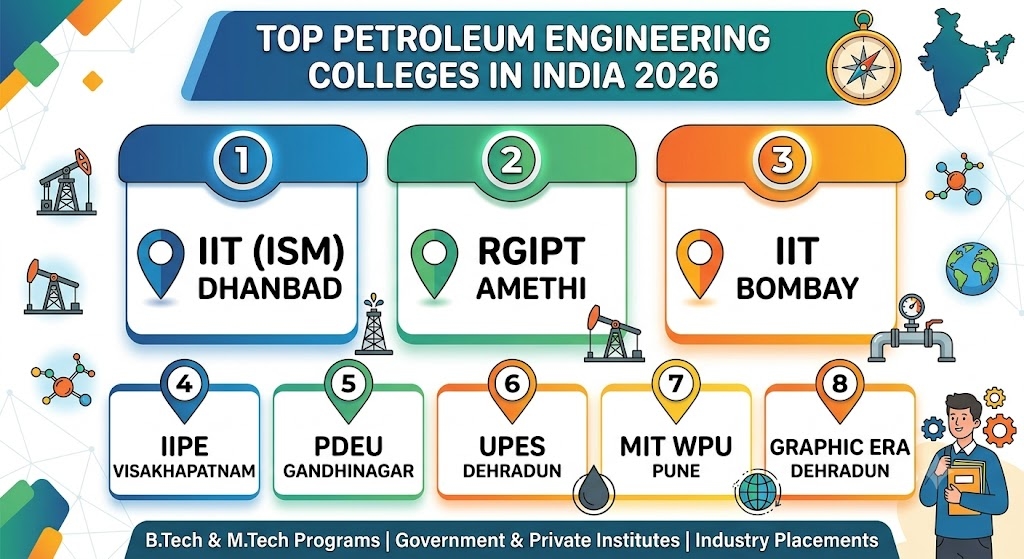
Some recognized institutions offering petroleum-related education include:
IIT (ISM) Dhanbad
IIT (ISM) Dhanbad is one of the prominent institutions associated with petroleum and energy education. Its undergraduate admissions include Petroleum Engineering, and the institute continues to offer postgraduate petroleum engineering pathways as well.
Rajiv Gandhi Institute of Petroleum Technology
RGIPT is a specialized energy-focused institute with a strong emphasis on petroleum engineering and related disciplines. Its current 2026-27 B.Tech information brochure lists Petroleum Engineering as a four-year program. The institute also highlights its petroleum engineering department, laboratories, research activities, and industry interaction.
UPES
UPES offers B.Tech Applied Petroleum Engineering as a four-year undergraduate program. Its current 2026 admissions information lists specializations including Intelligent Petroleum Systems and Gas Engineering Informatics, reflecting the increasing integration of technology with petroleum engineering.
The availability of specific petroleum programs can change, so students should always verify the current admission brochure of each institution before applying.
Petroleum Engineering Eligibility
Eligibility requirements vary between colleges and admission routes. Generally, candidates interested in undergraduate engineering programs should have completed Class 12 with Physics, Chemistry, and Mathematics.
For example, UPES currently specifies a minimum of 50% marks in Classes X and XII, along with at least 50% in PCM for its B.Tech programs, including Applied Petroleum Engineering. Its listed selection routes include UPESEAT, JEE Main, board merit, SAT, and CUET, subject to the applicable program rules.
Government and centrally funded institutions may have different eligibility conditions and entrance requirements. Students targeting IIT (ISM) Dhanbad, for example, should follow the applicable JEE Advanced and JoSAA admission process for undergraduate seats.
Because eligibility and admission rules can change each academic year, applicants should check official institutional and examination authorities for the 2026 admission cycle.
Petroleum Engineering Admission Process 2026
The admission process generally begins with checking eligibility and identifying colleges that offer the desired program.
Students may then need to appear for a national, state, or university-level entrance examination, depending on the institution. After the entrance examination or merit evaluation, qualified candidates participate in counseling, seat allocation, or the university's selection process.
The usual process includes:
Checking eligibility requirements
Selecting suitable colleges and specializations
Appearing for the required entrance examination
Completing the application form
Participating in counseling or selection
Submitting documents
Paying admission and tuition fees
Completing enrollment and reporting formalities
For 2026 admissions, students should rely on current official notifications rather than older admission information found on third-party websites.
Petroleum Engineering Fees in India
The cost of studying petroleum engineering differs significantly based on the institution, location, course structure, hostel requirements, and whether the college is public or private.
Government and centrally funded institutions may have a different fee structure from private universities. Private institutions can also offer different tuition plans, scholarships, and payment schedules.
For this reason, students should compare the complete cost rather than looking only at tuition fees. Expenses such as hostel accommodation, examination charges, laboratory fees, books, transportation, and other institutional charges may also contribute to the total cost.
It is advisable to check the official fee structure for the specific 2026-27 academic session before taking admission.
Career Scope After Petroleum Engineering
Petroleum engineering graduates can explore career opportunities across oil and gas companies, drilling contractors, energy businesses, service providers, engineering consultancies, research organizations, and other industrial sectors.
Common job profiles include:
Petroleum Engineer: Works on planning and improving oil and gas production operations.
Drilling Engineer: Focuses on well planning, drilling systems, and drilling performance.
Reservoir Engineer: Studies reservoir behavior and helps optimize hydrocarbon recovery.
Production Engineer: Works on improving production efficiency and managing well performance.
Well Completion Engineer: Helps design and implement systems for bringing wells into production.
Energy Sector Analyst: Uses engineering and analytical skills to study energy projects, markets, and technical performance.
With additional education or skills, graduates may also move into research, consulting, project management, data analytics, energy technology, or interdisciplinary engineering roles.
Skills Needed for a Petroleum Engineering Career
A successful petroleum engineering career requires more than academic knowledge. Students should develop strong analytical and problem-solving skills along with technical understanding.
Important skills include mathematics, fluid mechanics, engineering software, technical communication, data analysis, teamwork, project management, and knowledge of health and safety practices.
As the energy industry becomes more technology-driven, knowledge of automation, programming, simulation tools, artificial intelligence, and data analytics can also provide an advantage.
Why Choose Petroleum Engineering in 2026?
The energy industry is changing rapidly, and petroleum engineers are increasingly working with advanced technologies and multidisciplinary energy projects. Current petroleum programs are also expanding beyond traditional oil and gas topics into areas such as intelligent petroleum systems, gas engineering, energy storage, and digital technologies. UPES, for example, currently incorporates these themes into its Applied Petroleum Engineering offerings, while RGIPT highlights research areas including enhanced oil recovery, reservoir simulation, CCUS, geomechanics, and AI/ML for process optimization.
This changing environment makes petroleum engineering suitable for students who are interested in engineering, energy systems, technology, field operations, and research.
How to Choose the Right Petroleum Engineering College?
Before selecting a college, compare the curriculum, faculty, infrastructure, laboratories, internships, industry exposure, placement support, alumni network, location, fees, and admission requirements.
Students should also check whether the program offers opportunities for practical training, field visits, industrial projects, research, and exposure to modern technologies.
Most importantly, confirm that the program and institution meet the academic and regulatory requirements relevant to your future plans.
Conclusion
Petroleum Engineering Colleges in India 2026 offer students an opportunity to build specialized engineering knowledge for careers related to energy, oil and gas, and emerging technology-driven energy systems. From B.Tech Petroleum Engineering to Applied Petroleum Engineering and postgraduate options, students have several pathways to explore.
Institutions such as IIT (ISM) Dhanbad, RGIPT, and UPES currently provide petroleum-focused educational opportunities, but the exact programs, eligibility criteria, fees, and admission routes vary.
Before applying, compare colleges carefully and verify the latest 2026 admission information directly from official sources. Choosing a program that combines strong academics, practical exposure, industry interaction, and modern energy technologies can help students build a strong foundation for a long-term engineering career.
https://www.mcmacademy.in//blog/bosse-april-2026-admission-class-10-and-12/
https://www.mcmacademy.in//blog/petroleum-engineering-colleges-in-india/
https://www.mcmacademy.in//one-sitting-degree/