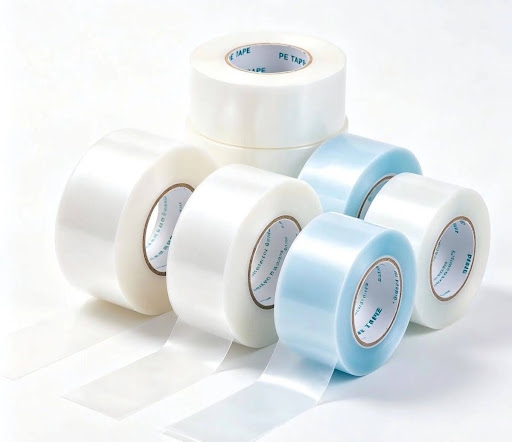
PE tape, duct tape and cloth tape share a shape and a shelf, but they are three different tools built from three different backings. PE tape is a film of polyethylene: smooth, waterproof and slightly stretchy. Duct tape is a sandwich of cloth scrim for strength coated in plastic to keep the weather out. Cloth tape, the gaffer's favourite, is a woven fabric with a matt face and an adhesive tuned to let go politely. Everything each tape is good at, and everything it is bad at, follows from what is on its back and what is on its face.
Chosen rightly, each has clear work. PE tape is the weatherproof one, sealing sheeting, wrapping bundles and patching tarpaulins outdoors. Duct tape is the strong one, gripping hard for temporary repairs where strength matters more than the surface underneath. Cloth tape is the polite professional, holding cables, marking floors and protecting finished surfaces it will later leave cleanly. Chosen wrongly, each fails in its own characteristic way: the strong one takes paint with it, the polite one lets go in the rain, the weatherproof one stretches where rigidity was needed. Tape is not tape, and the drawer is an expensive place to learn it.
PE tape: the weatherproof one
PE tape is built for water and time. Its plastic backing does not soak, rot or go limp in the rain, and it stretches a little instead of tearing when a joint moves. That makes it the natural choice outdoors and anywhere damp: sealing sheeting, joining membranes, wrapping and weatherproofing jobs that must survive weeks of weather rather than hours of handling. It is also smooth, so it sheds dirt instead of collecting it. Its weakness is the mirror of its strength: the slick face that shrugs off water also gives some adhesives less to hold, and it will never tear as obediently by hand as its cloth cousins.
Duct tape: the strong one with a temper
Duct tape earned its fame honestly. The cloth scrim gives it a tensile strength the others cannot match, it tears straight across by hand, and its aggressive adhesive grabs rough, dusty and awkward surfaces that defeat politer tapes. For emergency repairs, rough bundling and holding things that want to escape, it is superb. Its temper shows later. That same adhesive hardens with heat and age into a residue that has ended friendships, and the tape itself goes brittle outdoors as its coating ages. Duct tape is a sprinter with a long memory: brilliant today, regrettable in six months, especially on anything painted, polished or borrowed. It should be sold with its apology included, for use at removal time.
Cloth tape: the polite professional
Cloth tape, sold as gaffer tape, is what the other two would be if they had been raised by stage crews. The woven backing is strong and flexible, the face is matt so it does not shine under lights, and the adhesive is the diplomat of the family: firm for the job, removable afterwards without a solvent bath. It costs more than duct tape, which is the entire explanation for why the two are confused. On floors, cables, scenery and finished surfaces, cloth tape is the professional default. It is not the strongest, the cheapest or the most weatherproof. It is the one that leaves the room as it found it.
Choosing by the job, not the drawer
The working rule is to ask the job three questions. Will it get wet or live outdoors? That is PE tape's country. Must it hold hard, right now, on a rough surface, and is the ending somebody else's problem? Duct tape accepts the mission. Must it come off a finished surface cleanly, in public, without evidence? Cloth tape, every time. Tradespeople who run all three rolls, labelled and separate, are not being extravagant. They are avoiding the small disasters that happen when the nearest roll is asked to be a different tape than it is, disasters that are then blamed on tape in general.
Why the makers keep them separate
Manufacturers could blur these lines and some cheap products do, which is how unlabelled rolls cause trouble. Serious makers keep the families distinct and publish what each is for, because a tape used outside its talent damages the reputation of the whole shelf. This is why a pe tape manufacturer will specify weather resistance and stretch rather than promise the moon, and why cloth tape makers talk about clean removal the way sports cars talk about speed. The honesty is commercial, not poetic: a tape that knows its job gets bought again, and a tape that pretends to do everything gets cursed in three trades at once.
Tape is not tape
The apprentice on the bench learned the lesson the way everyone does, by removing the wrong adhesive from the wrong surface at the end of a long day. The three rolls went back into the drawer labelled, which is where the knowledge actually lives. PE for the weather, duct for the emergency, cloth for the clean exit: a sentence that takes five seconds to say and saves an hour every time it is remembered. Materials are honest about what they are. The failures happen when people ask them to be something else and act surprised. Surprise, in this trade, is just inexperience that has not been invoiced yet.