
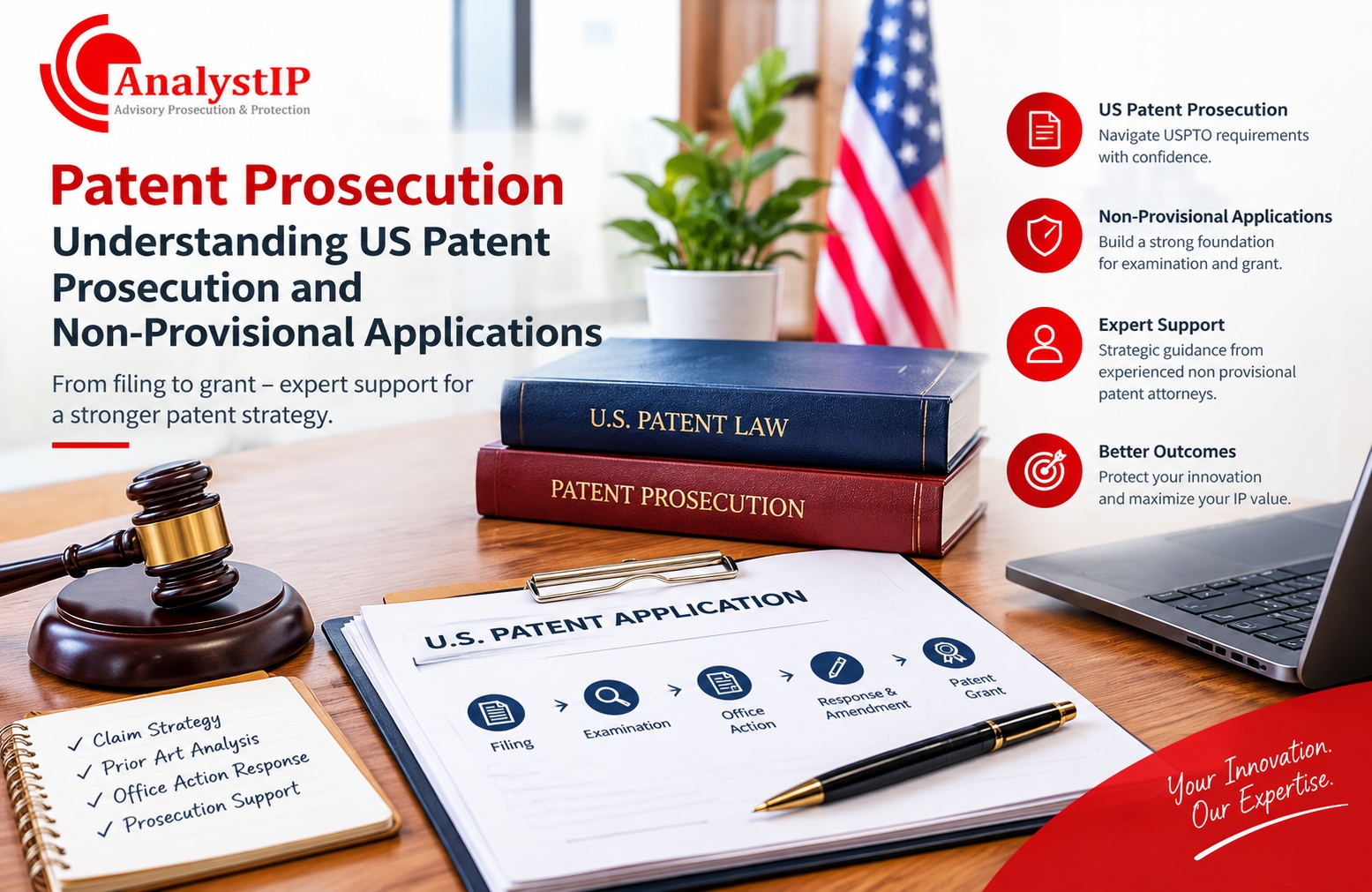
Patent protection does not end after an application is filed. The application must go through examination, responses, amendments, and other procedural stages before a patent can be granted. This entire process is generally referred to as patent prosecution. For inventors and businesses seeking protection in the United States, understanding US patent prosecution is essential for managing applications effectively and responding to USPTO requirements.
A well-planned prosecution strategy can help applicants address examination issues, clarify claim scope, and move an application toward allowance while maintaining appropriate patent protection.
What Is Patent Prosecution?
Patent prosecution refers to the interaction between a patent applicant and a patent office from the filing of a patent application through examination and, where applicable, grant. It can involve office actions, claim amendments, arguments, information disclosures, interviews, and other communications.
In the United States, US patent prosecution is handled before the United States Patent and Trademark Office (USPTO). During examination, a USPTO examiner reviews the application to determine whether the claimed invention satisfies applicable patentability requirements.
The prosecution process can vary considerably depending on the technology, claim structure, prior art identified by the examiner, and responses submitted by the applicant.
Understanding US Patent Prosecution
US patent prosecution typically begins after a patent application has been filed with the USPTO. The application may subsequently be examined by a patent examiner who reviews the specification, claims, drawings, and relevant prior art.
An examiner may issue an Office Action identifying objections or rejections. The applicant then has an opportunity to respond within the applicable deadline. A response may include claim amendments, legal or technical arguments, explanations, or supporting information.
Effective US patent prosecution requires more than simply responding to individual objections. The applicant needs to understand the examiner's reasoning and determine how the claims can be presented clearly while preserving commercially meaningful protection.
What Is a Non-Provisional Patent Application?
A non-provisional patent application is a formal U.S. patent application that can proceed through examination and potentially mature into an issued patent. Unlike a provisional application, a non-provisional application includes the elements required for examination, including claims and the necessary disclosure of the invention.
A provisional application can provide an earlier filing date but does not itself mature directly into a patent. If an applicant wants to pursue patent protection based on the provisional filing, a corresponding non-provisional application generally needs to be filed within the applicable 12-month period.
Because the non-provisional application becomes the foundation for examination, careful preparation is important.
Role of a Non Provisional Patent Attorney
A non provisional patent attorney can assist applicants with preparing, filing, and prosecuting non-provisional patent applications in the United States. Professional support can be particularly valuable when an invention involves complex technology or when the applicant expects detailed examination.
A non provisional patent attorney may assist with reviewing prior art, developing claim strategies, preparing specifications, drafting claims, responding to Office Actions, and communicating with the USPTO.
During US patent prosecution, claim amendments need to be considered carefully. Changing a claim may address an examiner's objection or rejection, but amendments should also be evaluated in relation to the invention's commercial objectives and potential future enforcement.
Importance of Office Action Responses
Office Actions are an important part of US patent prosecution. An Office Action may contain prior-art rejections, objections, or other requirements that need to be addressed.
A strong response should directly address the examiner's concerns rather than simply repeating the original application. Depending on the circumstances, an applicant may amend claims, explain distinctions over cited references, provide technical reasoning, or use other available prosecution strategies.
Timely responses are particularly important because failure to respond appropriately can result in abandonment of the application.
How AnalystIP Supports Patent Prosecution
AnalystIP provides intellectual property research and patent support services for inventors, businesses, technology companies, and organizations. Our team can support US patent prosecution through prior art research, claim analysis, patent documentation, prosecution research, and technical analysis.
For applicants preparing non-provisional applications, AnalystIP can also provide research and analytical support that complements the work of a non provisional patent attorney. This can include technology research, prior art identification, claim mapping, patent landscapes, and competitive patent analysis.
By combining technical research with structured patent analysis, AnalystIP helps clients better understand the patent environment surrounding their innovations.
Conclusion
Patent prosecution is a critical stage in transforming a patent application into enforceable intellectual property. For applicants seeking U.S. protection, US patent prosecution requires careful attention to examination reports, prior art, claim amendments, deadlines, and prosecution strategy.
A well-prepared non-provisional application provides a strong foundation for examination, while experienced professional support can help applicants respond effectively to USPTO requirements. Whether you are preparing a new application or managing an ongoing prosecution matter, AnalystIP provides patent research and IP analysis services to support informed and strategic patent decisions.