Call an open-source CRM free and someone will nod along. Fair enough, the license is free. The rest isn’t. Somebody installs it, shapes it, locks it down, patches it, and keeps it alive, and that somebody costs money. Teams still go this way all the time, mostly because a paid platform wouldn’t stretch to fit how they sell. Below: what customizing one actually gets you, where it hurts, what sort of developer you need, and roughly what that developer charges.
What Is Open-Source CRM Customization?
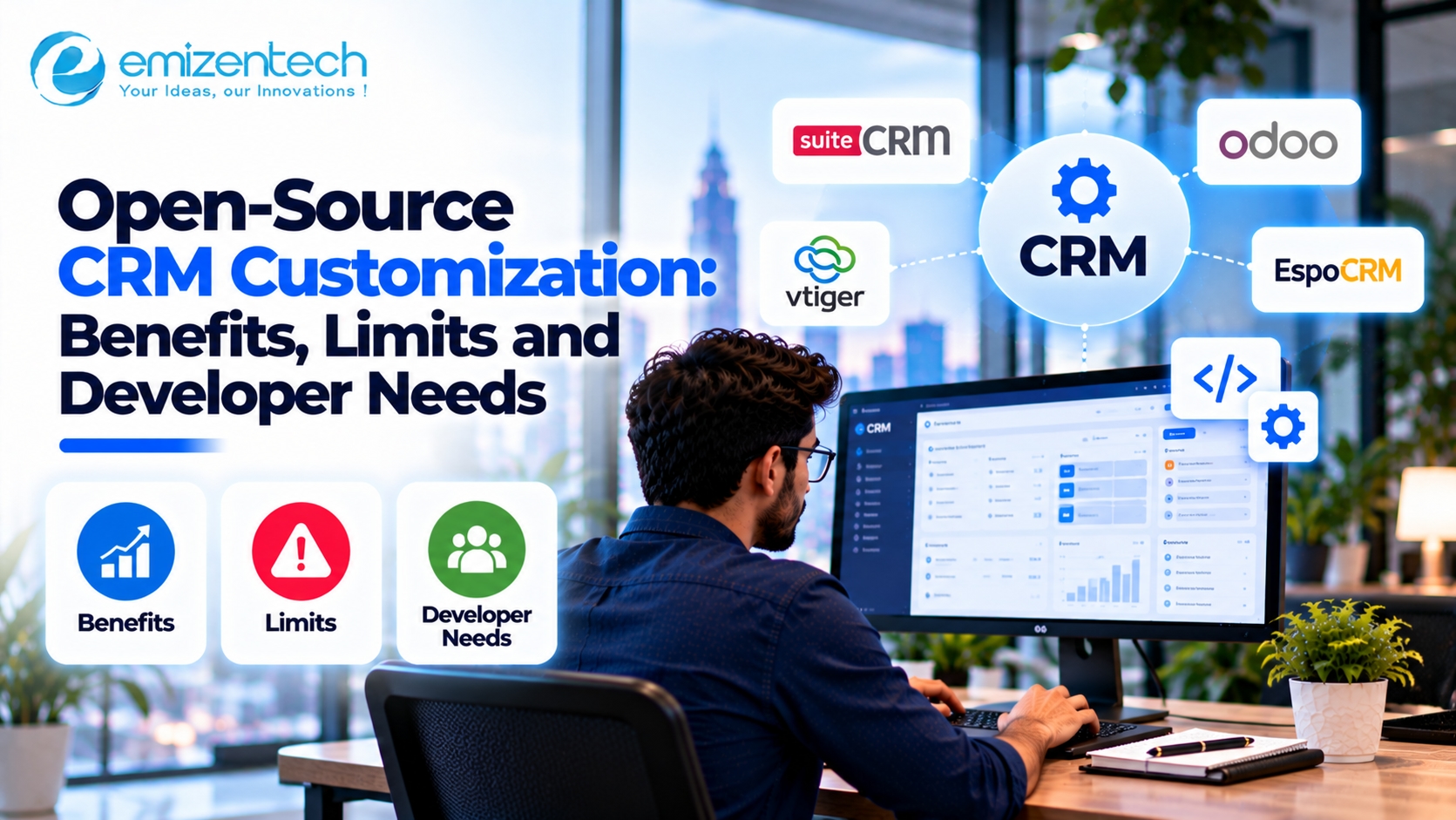
The source code is public. That’s the whole idea. Anyone with the skills can read it, change it, and host it wherever they want. SuiteCRM, EspoCRM, Vtiger, and Odoo’s community edition are the names you’ll run into most. Customizing one means bending it around your sales process: new modules, odd fields, workflows that match what reps really do, links out to your other tools.
On a paid platform you work inside the vendor’s walls. Here the walls aren’t there. Great, until you realize nothing stops you building something nobody can maintain in two years. It’s a workshop, not a showroom. You can make almost anything, and you also sweep the floor.
A small team with a simple process rarely needs any of this. A team with three regional sales flows and a compliance rule nobody else has probably does.
What Are the Benefits of Customizing an Open-Source CRM?
People go open-source for freedom, mostly. Less vendor, more control. A few things come up again and again when teams explain why.
No per-user license fee on the software. Matters more as headcount grows.
You can read and change the code, so if a workflow needs to behave strangely, it can.
Hosting is your call, which helps if your rules say records have to stay in one place.
Leaving is easier. Your data and your custom work come with you.
Odd, specific features a vendor would never build, like a strange approval chain or something only your industry needs.
There’s a community around most of them, sharing plugins and fixes.
What Are the Limits of Open-Source CRM?
Open-source isn’t easy mode. Support first. There’s no vendor hotline, so you’re on forums or paying someone. Documentation can be hit and miss as well. Some projects have thorough guides, others have an old forum thread and a lot of hope.
Security comes next, and that one’s entirely yours: patching, hardening, monitoring. Leave an install alone for a year and you’ve got a problem.
Upgrades catch people out the most. Heavy custom code can fight a new release, and what should be an afternoon’s update becomes a mini project. Integrations and AI features are usually thinner than on the big paid platforms too, so you’ll build more of that yourself. And once you add developer time, hosting, and upkeep, “free” looks a bit silly.
None of that kills the idea. The savings just land in license fees while the work lands everywhere else. Plan for it before anyone writes code.
What Can Developers Customize in an Open-Source CRM?
Pretty much anything. That’s the appeal and the trap. Most projects end up in the same few places, so it’s worth knowing them before you write a brief.
Modules, fields, and page layouts, so the screens look like your sales process and not somebody else’s
Workflows: lead routing, reminders, approvals
Integrations with your store, ERP, or email tools through REST APIs and webhooks
Reports and dashboards (these only work well if the data model underneath makes sense)
AI features, like lead scoring, forecasting, or a drafting assistant, connected to an LLM such as OpenAI, Claude, or Gemini
Roles, permissions, single sign-on
Data migration from spreadsheets or an old CRM
What Skills Do Open-Source CRM Developers Need?
Coding isn’t the whole job. These CRMs run on stacks like PHP or Python, and the developer has to read a huge codebase someone else wrote, then extend it without cracking the core. Database sense matters, because a messy data model slows every report. APIs, obviously. Security too, and on a self-hosted system it’s their problem, not a vendor’s.
Testing and version control sound dull. They’re what stop upgrades becoming disasters.
Experience with the specific CRM matters more than people expect. A strong PHP developer who’s never touched SuiteCRM’s module structure will spend the first weeks just finding their way around.
Two newer skills deserve a mention. AI integration, meaning lead scoring, forecasting, and generative assistants, with guardrails and a person checking the output. And data migration: mapping fields, cleaning records, checking everything afterward. One more thing no job ad lists. Find the developer who asks how your team sells before touching code. That person saves you months of rework.
How Much Does Open-Source CRM Development Cost?
The software’s free. The people aren’t. What you pay depends more on how you hire than on the CRM itself, and offshore dedicated rates typically run 50 to 70 percent below comparable onshore rates in Australia, the Gulf region, or Western Europe. Typical numbers:
Hourly work: $20 to $35 an hour. Suits audits, bug fixes, and small enhancements, and you pay only for reviewed hours
A full-time dedicated developer starts at roughly $2,800 a month for 160 hours, so about $17.50 an hour
Bigger programs can run on a dedicated team with QA, a project manager, and an AI engineer, priced to scope
Seniority and platform shift those numbers, so call it a starting point. If you decide to hire CRM developers for an open-source build, ask about the trial period, replacement terms, and who owns the code. A two-week trial and full IP transfer are fair to expect. For self-hosted work, ownership of the code matters even more than usual.
Is Open-Source the Right Fit for Your Team?
Depends. How much do you want to shape the system, and how much upkeep can you live with? Open-source suits teams with unusual processes, strict data-hosting rules, or a budget that would rather pay for development than license fees. It also suits anyone planning to keep the CRM for years.
A paid platform usually wins when you want it working fast, with vendor support, built-in AI, and not much maintenance. Lots of teams start there and move over later, once the limits start to sting.
A rough test: if you can name three things you need that no paid platform offers, open-source deserves a serious look. If you can’t, the paid route is probably easier. Neither is wrong. Just don’t go open-source because it sounds cheaper. Go because you need the freedom.
Final Thoughts
Open-source CRM customization trades license fees for responsibility. You get control, flexibility, and ownership. You also take on the upkeep, security, and upgrade work a vendor would normally handle. Who does the building matters a lot, so judge developers on their code, their security habits, and how they handle upgrades, not only their rate. EmizenTech is one of several providers you could talk to, and the same questions apply to all of them: how they vet people, how they handle upgrades, and who owns the code. Whoever you pick, settle the “why open-source” question first.
Frequently Asked Questions
Short answers to the questions that come up most.
Is an open-source CRM really free?
The software license usually is. Hosting, development, security, and maintenance still cost money, and developer time is the biggest part of the bill.
Which open-source CRMs can be customized?
Common options include SuiteCRM, EspoCRM, Vtiger, and the community edition of Odoo. Developers can also build a custom CRM from scratch if none of them fits.
How much does an open-source CRM developer cost?
Hourly work typically runs $20 to $35 an hour, and a full-time dedicated developer starts at roughly $2,800 a month for 160 hours. Team setups are priced to scope.
Is an open-source CRM secure?
It can be, but on a self-hosted system security is your job. That means patching, access controls, secure API connections, and regular review.
Can AI features be added to an open-source CRM?
Yes. Developers can connect lead scoring, forecasting, and generative assistants through LLMs like OpenAI, Claude, or Gemini, with guardrails and human review for anything customer-facing.