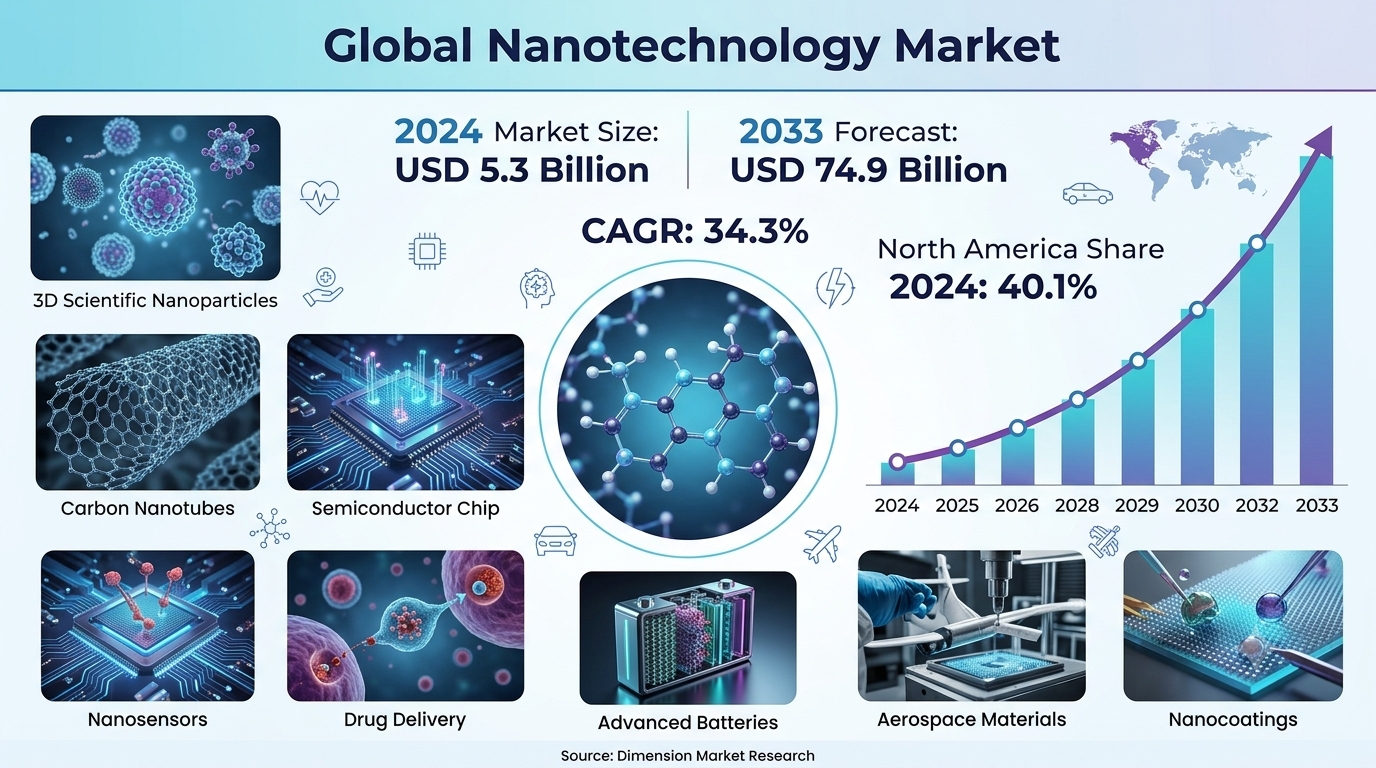
The Global Nanotechnology Market Size is expected to reach USD 5.3 billion by the end of 2024 and expand significantly to USD 74.9 billion by 2033, registering a strong CAGR of 34.3% during the forecast period. Nanotechnology is becoming increasingly important across healthcare, electronics, energy, automotive, aerospace, environmental applications, advanced materials, and industrial manufacturing as organizations seek technologies capable of manipulating matter at the molecular and atomic scale.
Nanotechnology involves the design, production, characterization, and application of materials, structures, and devices with dimensions generally measured in nanometers. At this scale, materials can demonstrate unique electrical, chemical, mechanical, optical, and biological properties that differ considerably from their conventional forms. These characteristics are driving the development of high-performance coatings, nanoparticles, nanosensors, nanocomposites, nanoelectronics, drug-delivery systems, energy-storage materials, and highly specialized industrial components.
Growing investment in advanced materials, precision healthcare, semiconductor miniaturization, sustainable energy technologies, and intelligent sensing solutions is creating significant opportunities for market participants. Universities, technology developers, manufacturers, pharmaceutical companies, and industrial organizations are increasingly integrating nanoscale materials and processes into product development pipelines to improve functionality, reduce material consumption, enhance energy efficiency, and enable applications that were previously technically difficult or economically impractical.
Download a Complimentary PDF Sample Report:
https://dimensionmarketresearch.com/request-sample/nanotechnology-market/
Nanotechnology Market Overview
The nanotechnology market represents one of the fastest-evolving segments within advanced materials and emerging technology ecosystems. Its applications extend from nanoparticles used in medical treatments to nanostructured materials incorporated into batteries, electronics, protective coatings, sensors, filtration systems, and lightweight composites.
The ability to engineer materials at extremely small dimensions provides manufacturers with opportunities to enhance conductivity, strength, durability, surface area, thermal resistance, chemical reactivity, and optical performance. Consequently, nanotechnology is increasingly being incorporated into both established industries and next-generation technologies.
The market's projected growth from USD 5.3 billion in 2024 to USD 74.9 billion by 2033 reflects expanding commercialization alongside continued technological development. The forecast 34.3% CAGR also demonstrates the increasing importance of nanoscale engineering in addressing challenges related to miniaturization, targeted treatment, energy storage, environmental sustainability, and high-performance material development.
Nanotechnology is transitioning from primarily research-oriented applications toward broader commercial deployment. Improved manufacturing processes, advances in characterization techniques, better control of nanoscale properties, and stronger collaboration between research institutions and commercial enterprises are making nanotechnology increasingly accessible for industrial-scale applications.
Key Findings of the Nanotechnology Market
The Global Nanotechnology Market is projected to reach USD 5.3 billion in 2024.
The market is forecast to expand to approximately USD 74.9 billion by 2033.
Global revenue is expected to grow at a 34.3% CAGR during the forecast period.
North America is anticipated to account for 40.1% of market revenue in 2024.
Healthcare, electronics, energy, industrial manufacturing, and advanced materials represent major application areas.
Increasing investments in research and development are accelerating the commercialization of nanotechnology-based products.
Nanomaterials, nanosensors, nanoelectronics, and nanomedicine are emerging as important technology categories.
Demand for lightweight, high-strength, conductive, and multifunctional materials is supporting wider commercial adoption.
Continued semiconductor miniaturization is strengthening opportunities for nanoscale manufacturing technologies.
Sustainable energy and environmental applications are expected to create additional long-term growth opportunities.
Nanotechnology Market Dynamics
The nanotechnology market is influenced by rapid scientific advancement, substantial research investment, evolving industrial requirements, commercialization capabilities, regulatory considerations, and improvements in nanoscale manufacturing.
One of the strongest forces supporting market expansion is increasing demand for materials that deliver multiple advanced properties simultaneously. Manufacturers are increasingly looking for products offering lightweight construction, enhanced mechanical strength, improved conductivity, corrosion resistance, heat tolerance, antimicrobial properties, or specialized optical characteristics.
At the same time, developments in precision medicine and advanced healthcare technologies are increasing interest in nanoscale drug delivery, diagnostics, imaging, biosensors, and therapeutic applications. In electronics, semiconductor companies continue to explore nanoscale architectures as computing devices become smaller, faster, and more energy efficient.
However, commercialization remains technically demanding. Producing nanomaterials with consistent particle size, purity, structural characteristics, and functional properties can require specialized equipment and substantial capital investment. Environmental, health, safety, and regulatory considerations can also influence the pace at which new nanotechnology applications reach commercial markets.
Nanotechnology Market Growth Drivers
Rising Demand for Advanced Materials
Growing demand for high-performance materials is one of the most important factors driving the nanotechnology market. Industries including aerospace, automotive, electronics, renewable energy, construction, and industrial manufacturing increasingly require materials that combine mechanical strength, durability, conductivity, lightweight properties, and resistance to challenging operating environments.
Nanomaterials can substantially modify conventional material performance even when incorporated in relatively small quantities. Nanoparticles, nanocomposites, carbon-based nanomaterials, and advanced coatings are therefore being evaluated for applications requiring higher performance without proportionally increasing component size or weight.
These advantages are particularly valuable in transportation and aerospace applications where lightweight structures contribute to energy efficiency. Similar benefits exist in electronics, where highly conductive nanomaterials can improve device performance while supporting miniaturization.
Expanding Healthcare and Nanomedicine Applications
Healthcare represents an important area of opportunity for nanotechnology because nanoscale materials can interact with biological systems in highly specialized ways. Researchers and healthcare technology companies are increasingly investigating nanotechnology for targeted drug delivery, medical imaging, diagnostics, biosensors, regenerative medicine, antimicrobial coatings, and advanced therapeutic systems.
Targeted delivery technologies can potentially improve the ability to transport therapeutic compounds to specific biological locations while reducing unnecessary exposure to surrounding tissues. Nanoparticles can also be engineered with specialized surface properties that improve interaction with biological molecules.
Growth in precision medicine, personalized treatment, early disease detection, and minimally invasive diagnostics is therefore expected to strengthen long-term adoption of nanotechnology-based healthcare solutions.
Continuous Miniaturization of Electronic Devices
The electronics industry continues to move toward smaller, faster, and more energy-efficient components. Nanotechnology enables the development of extremely compact electronic structures, advanced semiconductor architectures, nanoscale sensors, flexible electronics, and next-generation memory technologies.
As conventional manufacturing approaches face physical limitations at increasingly small dimensions, nanoscale fabrication techniques are becoming more important. Applications involving nanosensors, conductive nanomaterials, quantum structures, and nanoscale transistors are particularly relevant to the future development of computing, telecommunications, artificial intelligence infrastructure, wearable devices, and connected technologies.
Increasing Research and Development Investment
Growing investment in nanotechnology research is accelerating product development across industries. Government organizations, universities, technology companies, manufacturers, pharmaceutical developers, and research institutions are funding programs focused on nanoscale materials, devices, characterization technologies, and manufacturing processes.
Higher R&D spending supports improved understanding of nanoscale properties while helping developers overcome challenges related to production consistency, scalability, performance, safety, and cost.
As more research projects transition toward commercialization, the nanotechnology market is expected to benefit from a growing pipeline of industrial and consumer applications.
Nanotechnology Market Trends
Growing Adoption of Nanotechnology in Energy Storage
Energy storage technologies increasingly require materials capable of providing higher energy density, improved charging performance, better durability, and enhanced thermal management. Nanostructured electrodes, advanced conductive materials, nanoscale coatings, and specialized separators are being investigated for batteries and next-generation energy-storage systems.
Nanotechnology can increase surface area and improve ion transport, potentially enhancing electrochemical performance. These properties are particularly relevant as electric vehicles, renewable energy systems, portable electronics, and grid-scale storage create greater demand for advanced battery technologies.
Expansion of Nanosensors
Nanosensors are emerging as an important nanotechnology application due to their ability to detect extremely small physical, chemical, or biological changes. Potential applications include healthcare diagnostics, industrial automation, environmental monitoring, food safety, automotive systems, defense technologies, and connected devices.
Increasing integration of sensors into smart infrastructure and IoT ecosystems is expected to expand opportunities for highly sensitive nanoscale sensing systems.
Development of Nanostructured Coatings
Nanocoatings are being increasingly developed for surfaces requiring corrosion resistance, scratch resistance, antimicrobial properties, water repellency, thermal protection, or improved durability.
Automotive components, industrial machinery, medical devices, electronics, construction materials, textiles, and aerospace systems represent potential application areas. The ability to deliver enhanced surface performance without fundamentally changing the underlying material makes nanocoatings attractive across multiple industries.
Increasing Focus on Sustainable Nanotechnology
Environmental sustainability is becoming increasingly influential in nanotechnology development. Researchers and manufacturers are exploring nanomaterials for water purification, pollutant removal, renewable energy generation, energy efficiency, lightweight transportation components, and advanced filtration technologies.
At the same time, companies are working to improve manufacturing processes to reduce waste, energy use, and potentially hazardous materials associated with nanomaterial production.
Challenges in the Nanotechnology Market
High Manufacturing and Development Costs
Nanotechnology development often requires specialized laboratories, characterization instruments, clean-room environments, precision manufacturing equipment, and highly qualified scientific personnel. These requirements can significantly increase development and commercialization costs.
Moving from laboratory-scale production to consistent industrial-scale manufacturing is particularly challenging because nanoscale properties can change when production volumes increase.
Regulatory and Safety Concerns
Nanomaterials can behave differently from conventional materials, creating additional requirements for toxicity testing, environmental evaluation, occupational safety, and regulatory assessment.
Understanding how nanoparticles interact with biological systems and ecosystems remains important for responsible commercialization. Stronger regulatory frameworks and standardized testing methodologies may therefore influence product development timelines.
Challenges in Large-Scale Commercialization
Producing nanomaterials with consistent size, purity, morphology, surface properties, and performance characteristics at industrial scale remains technically complex.
Manufacturers must maintain precise process control while ensuring that production remains economically viable. Variability in nanomaterial characteristics can significantly affect downstream product performance.
Nanotechnology Market Segmentation Overview
The nanotechnology market can be analyzed across several major technology, component, application, and end-use categories.
By Nanomaterial Type
The market includes nanoparticles, nanocomposites, nanotubes, nanowires, nanofilms, nanofibers, quantum dots, and other engineered nanostructures.
Nanoparticles remain important because of their widespread applications across healthcare, coatings, cosmetics, electronics, catalysts, energy storage, and industrial processes.
Carbon-based nanomaterials, including carbon nanotubes and graphene-related materials, are gaining attention because of their exceptional electrical conductivity, mechanical strength, lightweight characteristics, and thermal properties.
By Technology
Major nanotechnology approaches include nanofabrication, nanocharacterization, nanolithography, nanopatterning, nanoscale manufacturing, and molecular-scale engineering.
Continuous advancements in fabrication and characterization equipment are supporting greater precision and repeatability in nanoscale product development.
By Application
Important application areas include:
Healthcare and biotechnology
Electronics and semiconductors
Energy and power
Automotive
Aerospace and defense
Chemicals and advanced materials
Environmental applications
Industrial manufacturing
Consumer products
Healthcare applications are supported by growing interest in nanomedicine, while electronics applications benefit from continued device miniaturization. Energy applications are expanding through batteries, solar technologies, fuel cells, and advanced energy-storage materials.
By End-Use Industry
Nanotechnology is increasingly used by pharmaceutical and biotechnology companies, semiconductor manufacturers, automotive companies, aerospace organizations, energy companies, research institutions, industrial manufacturers, and chemical producers.
Each sector applies nanotechnology differently depending on performance requirements, production economics, safety considerations, and regulatory conditions.
Purchase the report for comprehensive details:
https://dimensionmarketresearch.com/checkout/nanotechnology-market/
Nanotechnology Market Regional Analysis
North America
North America is anticipated to account for 40.1% of global nanotechnology market revenue in 2024, positioning the region as the leading market.
The region's strong position is supported by increased government research and development expenditure, established research infrastructure, advanced universities, technology-focused companies, semiconductor manufacturers, biotechnology organizations, and extensive commercialization capabilities.
Nanotechnology adoption across North America is expanding within healthcare, electronics, energy, aerospace, defense, advanced materials, and industrial applications. Growing investments in nanoscale manufacturing, semiconductor technologies, precision medicine, battery materials, and sophisticated sensors are supporting regional market development.
The presence of established technology ecosystems also allows research institutions and commercial organizations to collaborate more efficiently in moving innovations from laboratories toward industrial deployment.
Europe
Europe represents an important nanotechnology market supported by strong capabilities in advanced manufacturing, automotive engineering, healthcare, materials science, renewable energy, and academic research.
Demand for sustainable materials, lightweight components, energy-efficient technologies, advanced coatings, and healthcare innovation is expected to support further adoption.
Environmental regulations and sustainability initiatives are also encouraging research into nanomaterials that can support cleaner energy, water treatment, reduced material consumption, and improved industrial efficiency.
Asia-Pacific
Asia-Pacific is emerging as a major growth region due to rapid expansion in electronics production, semiconductor manufacturing, automotive production, healthcare investment, and renewable energy infrastructure.
Large manufacturing ecosystems are increasing demand for advanced materials, nanoscale electronics, energy-storage components, industrial coatings, and high-performance composites.
Rising investment in research laboratories, semiconductor capacity, electric mobility, battery production, and healthcare technologies is expected to support significant long-term regional expansion.
Latin America
Latin America represents a developing nanotechnology market with growing opportunities in healthcare, agricultural technology, mining, energy, water treatment, advanced materials, and research applications.
Expansion of university research programs and greater collaboration with industrial organizations could support wider commercialization during the forecast period.
Middle East & Africa
The Middle East & Africa market is gradually developing as governments increase investments in scientific research, advanced materials, renewable energy, healthcare, water treatment, and industrial diversification.
Water purification and environmental applications may represent particularly important opportunities because nanotechnology can support highly efficient filtration and contaminant-removal systems.
Competitive Landscape of the Nanotechnology Market
The competitive landscape is characterized by technology companies, nanomaterial manufacturers, semiconductor developers, pharmaceutical companies, advanced-material suppliers, specialized research organizations, and emerging nanotechnology startups.
Competition is increasingly focused on intellectual property, product performance, manufacturing scalability, application development, strategic partnerships, and commercialization capabilities.
Many companies are collaborating with universities and research institutions to accelerate innovation and gain access to specialized expertise. Partnerships between nanomaterial developers and end-use manufacturers are also becoming increasingly important because successful commercialization often requires materials to be customized for specific applications.
Companies capable of combining strong research expertise with reliable large-scale manufacturing are likely to strengthen their position as demand moves beyond experimental applications toward commercial deployment.
Product differentiation will increasingly depend on achieving consistent particle characteristics, improved functional performance, lower production costs, strong safety profiles, and application-specific customization.
Future Market Outlook
The future of the nanotechnology market is expected to be shaped by accelerating commercialization, improved manufacturing processes, expanding healthcare applications, semiconductor innovation, sustainable materials, and energy-storage technologies.
The market's projected increase from USD 5.3 billion in 2024 to USD 74.9 billion by 2033 highlights substantial long-term opportunities for companies involved in nanomaterials, nanosensors, nanoelectronics, nanomedicine, advanced coatings, and nanoscale manufacturing.
Healthcare could become one of the most transformative application areas as research progresses in targeted therapies, diagnostics, biosensors, imaging, and regenerative technologies. At the same time, semiconductor miniaturization will continue to create demand for advanced fabrication technologies capable of operating at increasingly smaller dimensions.
Electric vehicles and renewable energy systems will provide additional opportunities through nanostructured battery materials, catalysts, conductive components, and energy-efficient materials.
Environmental applications could also expand considerably. Nanofiltration membranes, photocatalytic materials, nanoscale adsorbents, and specialized sensors have potential applications in water purification, pollution monitoring, waste treatment, and environmental remediation.
As commercialization improves, nanotechnology is likely to transition from a specialized emerging technology toward a fundamental enabling platform supporting innovation across numerous industries.
Frequently Asked Questions
1. What is the Global Nanotechnology Market Size in 2024?
The Global Nanotechnology Market is forecast to reach approximately USD 5.3 billion by the end of 2024, supported by rising adoption across healthcare, electronics, energy, advanced materials, automotive, and industrial applications.
2. How large will the nanotechnology market become by 2033?
The global market is projected to reach approximately USD 74.9 billion by 2033, reflecting strong commercialization of nanoscale technologies across multiple industries.
3. What is the expected CAGR of the nanotechnology market?
The nanotechnology market is expected to expand at a CAGR of 34.3% during the forecast period, driven by increased research investments, semiconductor miniaturization, nanomedicine development, advanced materials, and energy-storage applications.
4. Which region dominates the nanotechnology market?
North America is anticipated to hold approximately 40.1% of global nanotechnology market revenue in 2024. Strong research infrastructure, government R&D expenditure, advanced technology companies, healthcare innovation, and semiconductor development support the region's leading position.
5. What industries are creating the strongest opportunities for nanotechnology?
Major opportunities are emerging across healthcare, electronics, semiconductors, energy storage, automotive, aerospace, advanced materials, industrial manufacturing, and environmental technologies. Nanomedicine, nanosensors, nanoelectronics, nanocoatings, and battery materials are expected to remain particularly important areas of innovation.
Summary of Key Insights
The Global Nanotechnology Market is entering a period of rapid commercialization as nanoscale engineering becomes increasingly integrated into healthcare, electronics, energy, advanced materials, automotive, aerospace, and industrial manufacturing.
The market is forecast to increase from USD 5.3 billion in 2024 to USD 74.9 billion by 2033, expanding at a substantial 34.3% CAGR. North America is expected to maintain a leading position with approximately 40.1% revenue share in 2024, supported by strong government R&D expenditure and extensive technology development capabilities.
Major growth opportunities are emerging from nanomedicine, nanosensors, nanoelectronics, advanced coatings, semiconductor miniaturization, energy-storage materials, environmental technologies, and high-performance nanocomposites.
Although manufacturing complexity, development costs, regulatory requirements, and nanoscale safety considerations remain challenges, continued advances in production technologies and commercialization capabilities are expected to expand the addressable market significantly.
Over the coming decade, nanotechnology is likely to evolve into an increasingly important foundational technology, enabling manufacturers and technology developers to create smaller, stronger, smarter, more efficient, and highly specialized products across a broad range of global industries.