
A peptide's name only tells you so much. To really know what you're working with, you need its amino acid sequence, what it's made of and how it shows up in lab tests. Those details let you tell one peptide from another, check its quality documents and keep your lab records consistent.
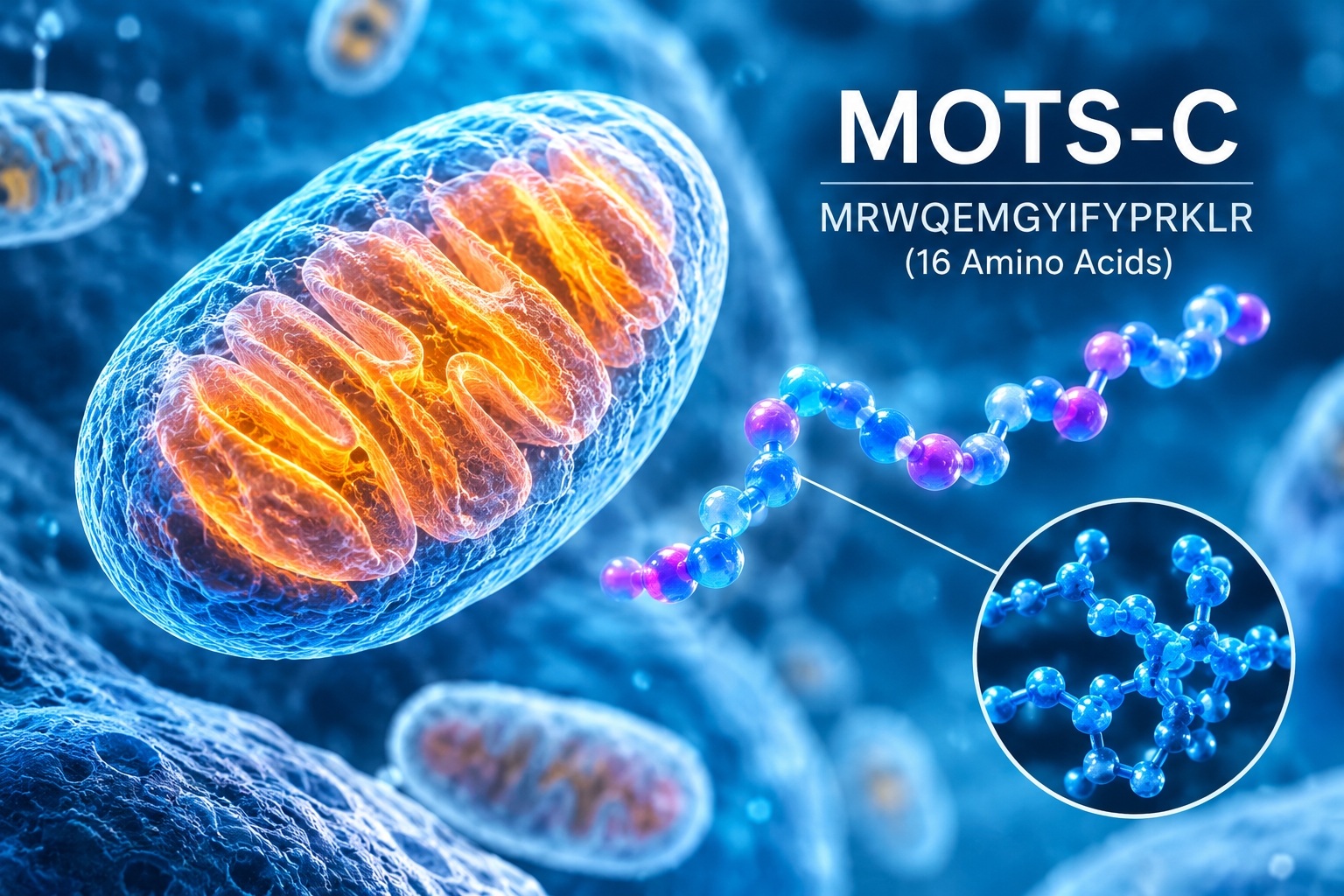
MOTS-C is a good peptide to learn this on. It comes from mitochondria, which is unusual, and it's closely tied to mitochondrial biology. Its structure makes it a clear example of how researchers check a peptide's identity, its chemistry and its test results.
What Is MOTS-C?
MOTS-C is a peptide made of 16 amino acids. Its code sits in the region of mitochondrial DNA that holds the 12S ribosomal RNA gene. That's what makes it stand out, since most peptides are coded by DNA in the nucleus.
Its amino acid sequence is:
MRWQEMGYIFYPRKLR
This is the sequence researchers use to identify MOTS-C in chemical and lab testing.
Because it comes from mitochondria, MOTS-C is often used in studies on how mitochondria connect with the rest of the cell. But it's worth keeping two things apart: what the peptide is, and what it might do. Knowing its sequence and where it comes from doesn't prove how it will behave in every model.
Understanding Peptide Structure and Composition
A peptide is a chain of amino acids held together by peptide bonds. The order of those amino acids is called the primary structure, and it shapes the peptide's chemical properties.
MOTS-C has 16 amino acids in its chain. These include methionine, arginine, tryptophan, glutamine, glutamic acid and a few others.
Why do researchers care so much about the sequence? A few reasons:
To confirm the correct molecular identity.
To tell apart compounds with similar names or structures.
To understand what the molecule is made of.
To compare reference materials with test results.
To keep lab records consistent.
Change even one amino acid and you have a different molecule. That's why getting the sequence right is such a big part of peptide research and checking materials.
MOTS-C and Mitochondrial Biology
Mitochondria are small structures inside the cell. They handle a lot of important chemistry, including energy use and cell signalling.
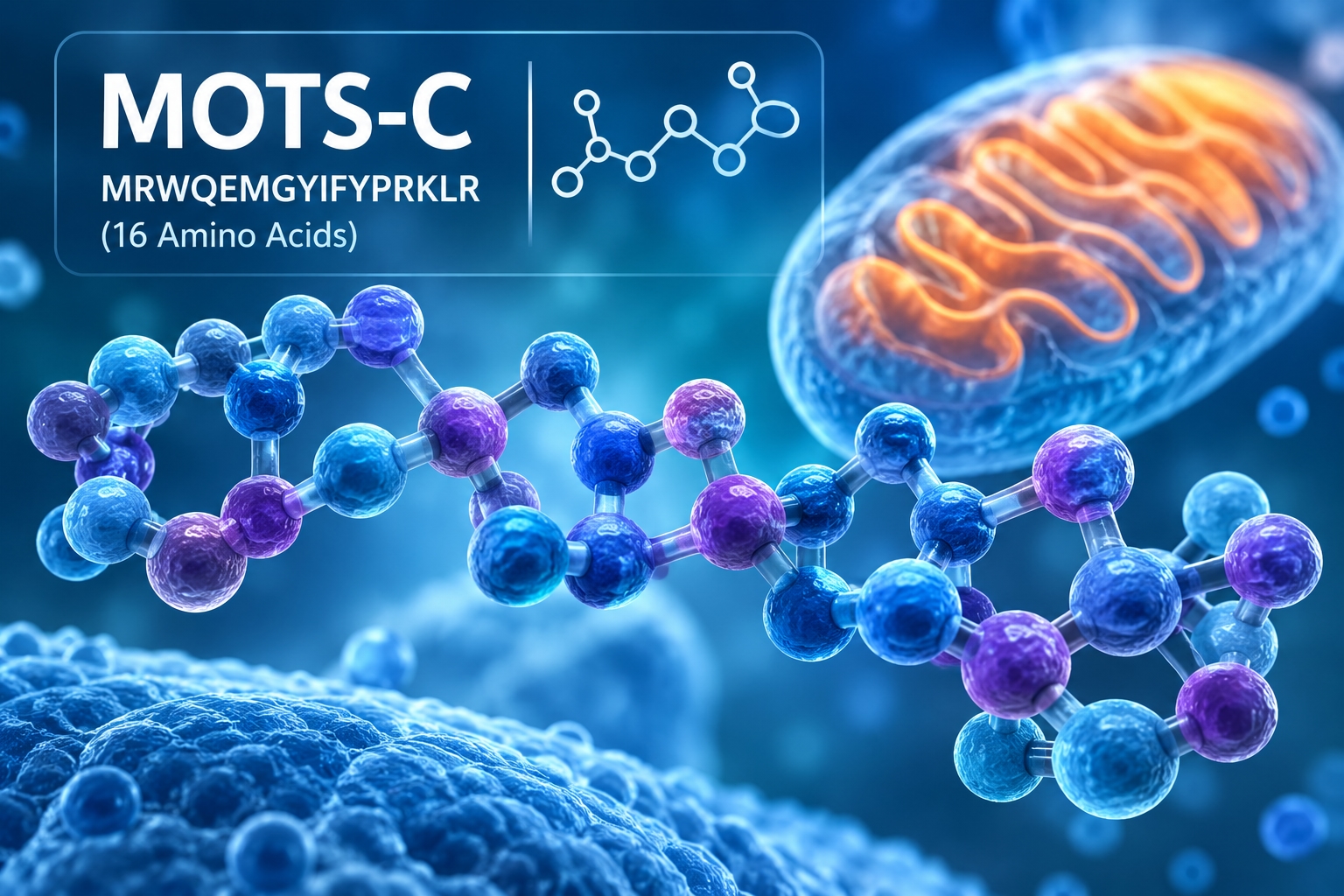
MOTS-C is studied as part of a wider group called mitochondrial-derived peptides, and in research on how mitochondria communicate. Some studies have looked at how it relates to metabolic signalling, including pathways linked to an enzyme called AMP-activated protein kinase (AMPK).
AMPK works as the cell's energy sensor. When energy levels change, it reacts and helps coordinate how the cell makes and uses energy.
There's an important line to draw here. What we know about how AMPK pathways work is well established. How MOTS-C might interact with them is still being studied. Results always need to be read in light of the model and the evidence behind them.
Analytical Characterisation of MOTS-C
Lab testing is a big part of judging any research peptide. It shows whether a material actually matches the identity and specs it's sold with.
The two tests used most often are high-performance liquid chromatography (HPLC) and mass spectrometry (MS).
High-Performance Liquid Chromatography (HPLC)
HPLC splits a sample into its parts. It does this based on how each part interacts with two phases inside the system: a stationary phase and a mobile phase.
For peptides, the results show how much of the sample is the main peptide and how much is something else.
When reading an HPLC report, look at:
The reported purity value.
The test conditions used.
How detection was done.
How the sample was identified.
The batch or lot number.
Any limits noted in the report.
A purity percentage only makes sense alongside the method behind it. It shouldn't be taken as proof of every part of a material's quality.
Mass Spectrometry (MS)
Mass spectrometry measures the mass-to-charge ratio of ions. This tells you the molecular mass, which helps confirm what the compound is.
With peptides, the MS result is compared with the mass you'd expect from the sequence and chemical form.
HPLC and MS tell you different things. Use them together and you get a much clearer picture than either one gives on its own.
Why Batch-Specific Documentation Matters
A product specification describes what a research material should be like. A batch-specific Certificate of Analysis (COA) shows the actual test results for one production batch.
They do different jobs, so read them side by side.
When looking at MOTS-C, it helps to check:
Product identity: Confirm the name, sequence and molecular details.
Quantity and presentation: Make sure the stated amount and form match the current product listing.
Batch traceability: Check that the batch number on the report matches the material you have.
Analytical methods: See whether HPLC, mass spectrometry or other tests are listed.
Testing details: Look at the date, the results and the lab that ran the tests, where this is given.
A COA makes testing open and traceable. It doesn't promise that a material will give a certain result in your experiment.
Experimental Consistency and Research Reproducibility
With research peptides, being able to repeat results is everything. Small differences in the material, how it's handled, how it's tested or the conditions of the experiment can all change what you see.
Good records go a long way. It helps to note:
Compound name and batch number.
Supplier and product specs.
Any test reports.
Sample ID and how it was prepared.
Controls used.
Measuring methods.
Any changes from the written protocol.
With notes like these, it's much easier to compare experiments and find out why results differ.
Using the same test methods each time matters most when you're comparing batches or looking at results from different studies.
Selecting MOTS-C for Laboratory Research
When you look at a MOTS-C listing, don't stop at the product name. Check the technical details too.
The main things to look at are its molecular identity, the stated amount, its batch documents and whether the test methods suit what your research needs.
The MOTS-C 10mg research peptide listing at Essential Peptides includes product information and its quality documents. Read the current specs and the batch-specific Certificate of Analysis before you order.
This way, you choose based on the facts, not just on what the catalogue description says.
Frequently Asked Questions
What is the amino acid sequence of MOTS-C?
It's MRWQEMGYIFYPRKLR, a chain of 16 amino acids.
Where does MOTS-C come from?
Its code sits in mitochondrial DNA, in the region of the 12S ribosomal RNA gene. Most peptides are coded in the nucleus instead.
Why use both HPLC and mass spectrometry?
HPLC shows how pure a sample is, and mass spectrometry confirms its molecular mass. Together, they give a fuller picture.
What is the difference between a product specification and a COA?
A specification says what the product should be like. A COA shows the real test results for one batch.
Is MOTS-C for human use?
No. It's supplied only for lab and in-vitro research. It isn't a medicine.
Conclusion
MOTS-C is a useful example of a peptide that comes from mitochondria. Its structure and origin both matter in chemical research. Its 16-amino-acid sequence gives a clear starting point for checking identity, while HPLC and mass spectrometry help researchers judge the material itself.
Good research comes down to knowing your compound, having open batch records and using methods that can be repeated. When researchers look at molecular details, test reports and the original research side by side, they get a much more organised approach to checking peptides.
Research Use Only: MOTS-C and the compounds discussed are intended strictly for controlled laboratory research and in-vitro applications. They are not intended for human or veterinary use, consumption, diagnosis or treatment.