Running a busy warehouse or regional freight network means your trucks and scanners never truly stop moving and shutting down your dispatch floor for a software upgrade feels like inviting chaos. Many supply chain leaders delay necessary upgrades because they fear losing live tracking data or missing customer delivery windows during a system switch. But how can growing operators replace aging platforms while keeping every loading dock active? Well, partnering with a team experienced in logistics custom software development lets you upgrade your infrastructure piece by piece and reliable logistics software development services keep your daily shipments moving smoothly.
The Hidden Risks of Keeping Outdated Supply Chain Platforms Running
Outdated warehouse and transportation platforms often rely on aging databases and rigid workflows that struggle to handle modern order volumes and your team ends up spending hours fixing avoidable mistakes. Relying on logistics custom software development becomes necessary when patchwork fixes no longer stop your daily bottlenecks, resulting in:
Dispatchers manually retyping shipment details across disconnected spreadsheets and billing portals every single morning.
Warehouse pickers dealing with delayed inventory counts that cause unexpected stockouts and missed carrier pickups.
Operations managers lacking live visibility into delayed loads until an angry customer calls the support desk.
These daily inefficiencies do not just slow down your warehouse floor, they also erode customer trust and squeeze your operating margins, so let's take a look at why sudden replacements rarely solve the problem.
Why Big-Bang System Replacements Fail Active Supply Chains
Attempting to replace an entire enterprise resource planning or transportation platform over a single weekend sounds appealing on paper, yet this all-at-once approach often paralyzes active freight networks. Experienced teams specializing in logistic software development avoid overnight cutovers because high-volume operations cannot absorb sudden downtime, resulting in:
Unresolved data mapping errors freezing automated load tendering and carrier rate calculations during peak shipping hours.
Warehouse scanners failing to sync with new bin locations, which leaves pallets stranded on receiving docks.
Billing and settlement queues backing up for weeks while finance teams reconcile mismatched shipment records.
When an entire network stalls at once, your staff loses confidence in the new platform and reverts back to manual workarounds and the reasons for choosing an incremental path are not hard to see.
Phased Modernization Strategies Through Logistics Custom Software Development
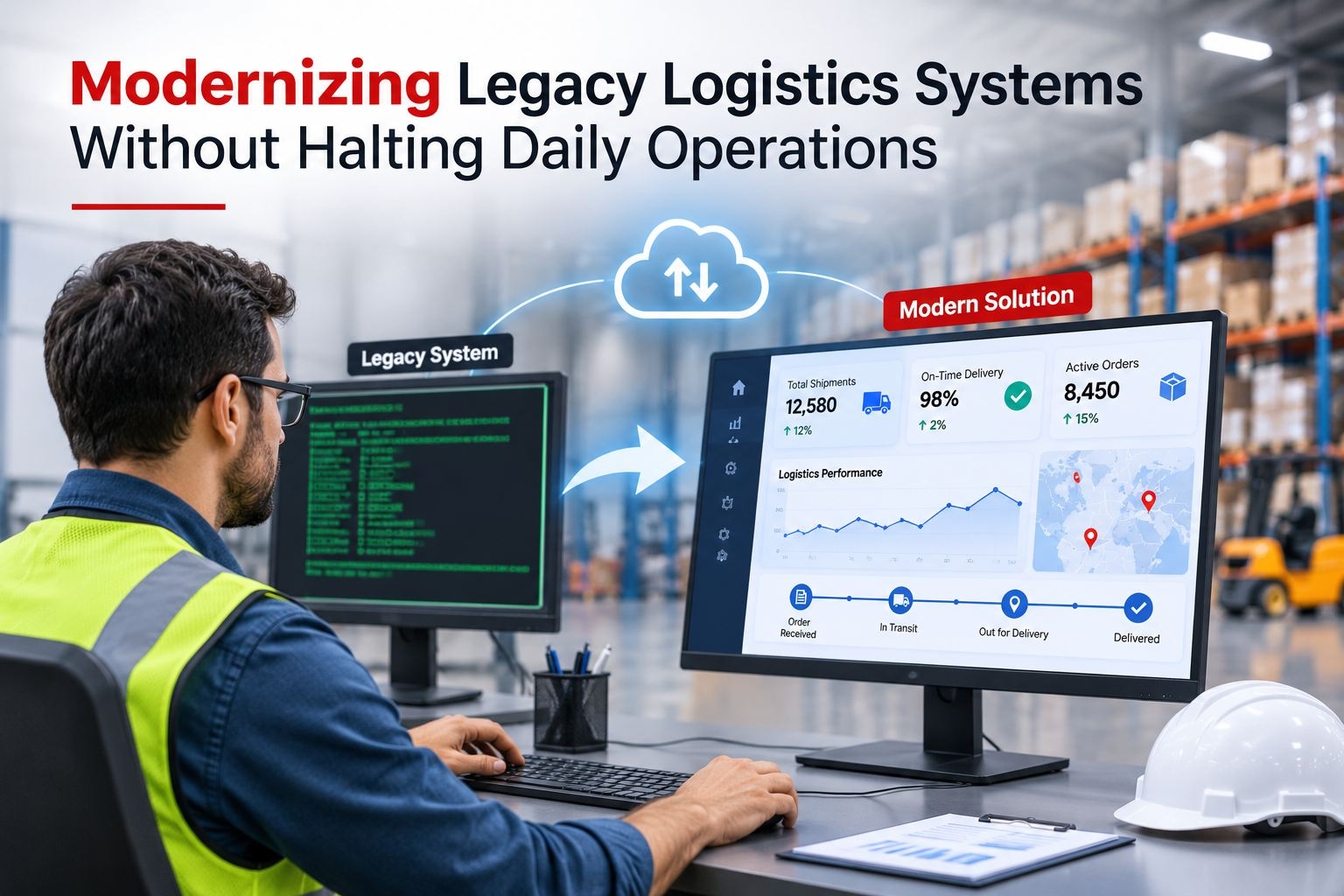
Instead of pulling the plug on your existing tools, smart engineering teams wrap modern modules around your legacy core and gradually shift traffic to the new environment. Investing in logistics custom software development allows you to modernize one workflow at a time while your older system continues processing active orders, resulting in:
Isolating high-pain bottlenecks like load planning or automated invoicing first so your team sees immediate relief.
Running parallel shadow environments where new routing engines process live orders without affecting active driver manifests.
Retiring outdated legacy modules only after the replacement service proves its stability across multiple billing cycles.
This step-by-step approach eliminates operational shock and proves value early and logistics custom software development also gives you complete control over how fast each warehouse or terminal transitions.
Comparing Legacy Infrastructure and Modern Cloud Architecture
Understanding the technical gap between aging on-premise servers and modern cloud platforms helps operations leaders plan realistic upgrade budgets without disrupting current freight contracts. Choosing the right logistics software development service bridges this gap cleanly and the differences across core operational areas are clear:
Feature | Legacy On-Premise Systems | Modern Cloud-Native Systems |
System Updates | Requires scheduled weekend server downtime and manual patches. | Deploys continuous background updates without interrupting active dispatchers. |
Data Visibility | Batch-processed reports updated overnight or every few hours. | Live telematics, scanner events and shipment milestones updated instantly. |
Third-Party Integrations | Rigid custom scripts that break whenever carrier APIs change. | Standardized REST APIs and automated EDI 204, 214 and 210 connections. |
Field Accessibility | Tied to desktop terminals inside the main warehouse office. | Accessible from rugged scanners and cab tablets even in dead zones. |
Moving away from rigid servers through logistics custom software development removes single points of failure across your network, so let's break down how middleware connects your old and new tools safely.
Integrating Real-Time APIs and Middleware Without Breaking Workflows
Your legacy database still holds years of valuable customer contracts, rate cards and historical lane data that your dispatchers rely on every single day. Thoughtful logistics software development introduces a lightweight middleware layer that translates data between your old database and new cloud applications, resulting in:
Two-way synchronization that keeps customer orders, inventory levels and invoices aligned across SAP oracle or NetSuite.
Automated Electronic Data Interchange bridges that normalize carrier tracking updates into a single unified dashboard.
Webhook triggers that alert dispatchers to temperature breaches or dock delays before shipments fall behind schedule.
And that is not all, because building clean integration layers through logistics custom software development ensures your legacy system stays fully operational until the final data table moves over.
Safeguarding Live Fleet Data During Active Database Migrations
Moving millions of active shipment records, compliance logs and carrier profiles without corrupting a single row requires strict validation rules at every stage. When engineers develop logistics software for active fleets, they rely on continuous background replication rather than risky bulk file transfers, resulting in:
Dual-write database pipelines that record every new scan and delivery signature into both old and new tables simultaneously.
Automated reconciliation scripts that flag mismatched weights, addresses or billing rates before invoices go out to clients.
Instant rollback switches that route traffic back to your legacy database if any network anomaly appears during peak hours.
These safeguards protect your financial records and Department of Transportation audit trails from beginning until completion and logistics custom software development keeps every single load accounted for during the transition.
Training Warehouse and Dispatch Teams While Systems Transition
Even the cleanest software architecture will stall on launch day if your dispatchers, dock supervisors and billing clerks feel overwhelmed by unfamiliar screens. Teams that invest in logistics custom software development schedule role-based training around active shift patterns so floor productivity never dips, resulting in:
Interactive sandbox environments loaded with real lane data where dispatchers practice building loads without affecting live trucks.
Floor champions on every warehouse shift who help coworkers troubleshoot scanner prompts and label printers in real time.
Short, task-specific reference guides focused strictly on each employee's daily workflow rather than dense technical manuals.
When your staff sees that the new interface cuts their repetitive data entry in half, adoption happens naturally across every terminal, so let's look at how mobile tools support your drivers on the road.
Equipping Drivers and Field Staff With Offline-First Mobile Tools
Drivers and yard operators spend their shifts moving through rural dead zones, metal warehouses and concrete loading bays where cellular signals drop constantly. Working with an experienced logistic app development company ensures your field applications store every scan locally and sync automatically once connectivity returns, resulting in:
Cab applications that display turn-by-turn navigation, digital manifests and instant route updates when a customer cancels a stop.
Photo proof of delivery and digital signature capture that attach directly to the customer invoice the moment a drop closes.
Yard management tools that log trailer movements against specific dock doors instead of relying on a dusty whiteboard.
Giving field teams dependable mobile tools eliminates missing paperwork and speeds up customer billing cycles and logistics custom software development ties every cab and scanner directly into your central control tower.
Why Choose AppZoro for Logistics Modernization
Modernizing an active supply chain requires an engineering partner that understands real-world freight rules, compliance pressures and tight operational margins. As a trusted mobile app development company atlanta businesses rely on, AppZoro Technologies builds tailored platforms around your exact dispatch workflows without disrupting daily operations, resulting in:
Strict Non-Disclosure Agreements signed before discovery begins, protecting your proprietary rate cards, lane strategies and customer data.
Deep integration experience across Zebra and Honeywell warehouse hardware, telematics sensors, carrier EDI feeds and major ERP platforms.
End-to-end product engineering from our Atlanta Tech Village headquarters, covering cloud architecture, custom web portals and offline driver apps.
Our engineers map your dispatch rules first and deliver incremental upgrades that pay for themselves quickly, making logistics custom software development with AppZoro a practical investment for growing carriers and third-party logistics providers.
Final Thoughts
Upgrading an aging transportation or warehouse platform does not mean shutting down your loading docks or risking missed delivery commitments over a stressful weekend. By breaking the transition into manageable phases, connecting legacy databases through reliable middleware and equipping your drivers with offline-ready mobile tools, your business can modernize smoothly while every truck stays on schedule. Whether you are replacing fragile spreadsheets or unifying multiple regional warehouses under one control tower, incremental engineering keeps your customers happy and your margins protected. If you are ready to map out a zero-downtime upgrade path for your fleet or warehouse, reach out to AppZoro Technologies today and let our Atlanta engineering team help you build a system that fits the way your operation actually works.