The global Industrial Hemp Market is gaining commercial importance as industries explore renewable raw materials, plant-based ingredients, sustainable textiles, and environmentally responsible manufacturing alternatives.
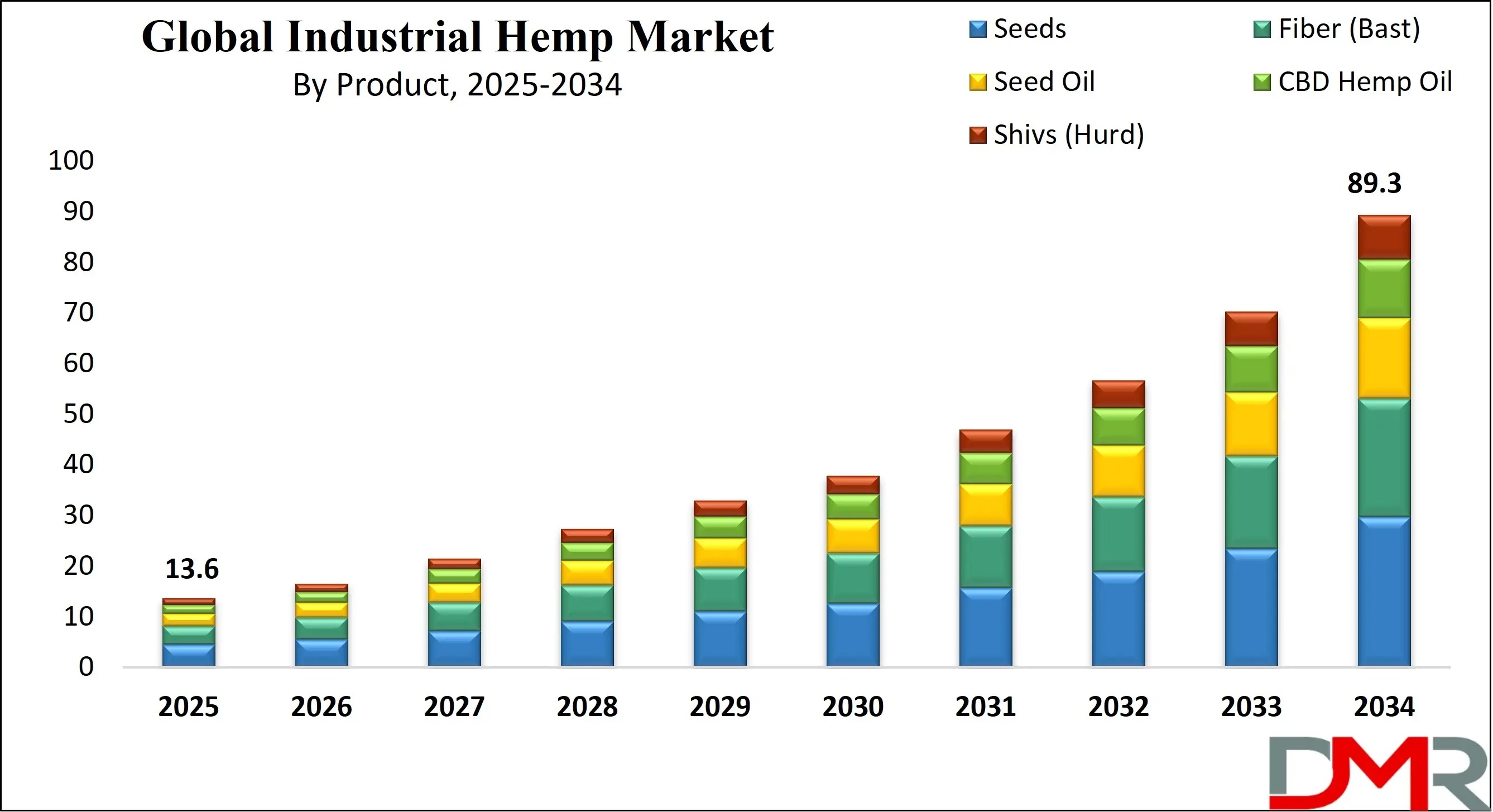
According to Dimension Market Research, the market is projected to grow from USD 13.6 billion in 2025 to USD 89.3 billion by 2034, registering a CAGR of 23.2%.
Growth is supported by industrial applications of hemp fibers, seeds, seed oils, and other plant-derived materials across textiles, construction, food processing, personal care, and related manufacturing industries.
The market also reflects increasing interest in diversified agricultural supply chains and materials capable of serving multiple industrial purposes.
What Is the Industrial Hemp Market?
Industrial hemp is a variety of Cannabis sativa cultivated for industrial and commercial applications under applicable regulatory requirements.
It is generally distinguished from marijuana by its low tetrahydrocannabinol, or THC, content, with legal thresholds depending on the jurisdiction.
Different parts of the hemp plant serve different commercial applications.
Hemp fibers are used in textiles, paper, insulation, and composite materials.
Hemp seeds support food and nutritional ingredient applications, while seed oils are relevant to food processing, personal care, and industrial formulations.
The woody inner portion of hemp stalks, commonly called shivs or hurds, can be processed into construction and other materials.
This diversity of applications makes industrial hemp relevant to agriculture, manufacturing, and materials innovation.
Why Is the Industrial Hemp Market Growing?
Increasing demand for sustainable materials is an important growth driver.
Textile manufacturers are exploring hemp fibers because of their durability and suitability for different fabric applications.
Construction companies are evaluating hemp-based materials, including hemp-lime composites and insulation products, as part of sustainable building initiatives.
Food and beverage manufacturers are also using hemp seeds and related ingredients in nutritional products.
Industrial diversification is another significant factor.
Hemp can supply raw materials for textiles, composites, paper, food, and certain industrial products, creating opportunities across multiple value chains.
Regulatory developments also influence market expansion by determining where hemp can be cultivated, processed, transported, and commercialized.
However, legal requirements differ substantially between countries and product categories, making compliance an important consideration for businesses.
Get a Free Sample of the Industrial Hemp Market Report
Discover market insights covering hemp products, cultivation sources, industrial applications, geographic demand, competitive activity, and emerging commercial opportunities through Dimension Market Research.
https://dimensionmarketresearch.com/request-sample/industrial-hemp-market/
Industrial Hemp Market: Key Statistics
● 2025 Market Size: USD 13.6 Billion
● 2034 Forecast: USD 89.3 Billion
● Forecast CAGR: 23.2%
● Leading Product: Hemp Seeds, 30.4% share in 2025
● Leading Source: Conventional, 54.4% share in 2025
● Leading Application: Textiles, 24.1% share in 2025
● Leading Region: Asia Pacific, 34.5% share in 2025
Industrial Hemp Market Segmentation
Hemp Seeds Lead Product Demand
Hemp seeds are projected to account for 30.4% of global market revenue in 2025.
They are used in food products and as raw materials for different nutritional and industrial applications.
Hemp fiber represents another important category because of its relevance to textiles, composite materials, and manufacturing.
Seed oils and hemp shivs also provide opportunities for specialized applications.
The diversity of hemp-derived materials allows processors to develop multiple commercial products from different parts of the plant.
Conventional Cultivation Holds the Largest Share
Conventional hemp sources are expected to account for 54.4% of market revenue in 2025.
Established cultivation practices, production scalability, and cost considerations support this position.
Organic cultivation represents another segment, particularly where buyers prioritize agricultural certification and specific sustainability requirements.
Cultivation economics depend on farming conditions, crop varieties, processing infrastructure, and market access.
Textiles and Construction Create Industrial Opportunities
The textile industry is projected to lead application demand with a 24.1% share in 2025.
Hemp fibers are relevant to clothing, upholstery, specialty fabrics, and other textile products because of their strength and versatility.
Construction is another important application area.
Hemp-based building materials are being explored for insulation, composite products, and sustainable construction systems.
Hemp-lime composites, sometimes referred to as hempcrete, are used in certain building applications because of their insulating characteristics.
Industrial applications also extend to paper, automotive materials, and selected bio-based products.
As manufacturers investigate alternatives to conventional raw materials, hemp processing and material development offer opportunities for suppliers and product innovators.
Technology and Supply Chain Trends
Improved fiber processing technologies are important to the development of industrial hemp products.
Manufacturers require consistent fiber quality, efficient separation techniques, and reliable raw material supply.
Processing capacity is particularly relevant because hemp cultivation alone does not guarantee access to commercially usable industrial inputs.
Another important trend is the growing integration of agriculture with downstream manufacturing.
Relationships between growers, processors, textile producers, and industrial buyers can support more consistent quality and product availability.
Research into hemp-based composite materials and specialized applications may further expand commercial opportunities.
Nevertheless, cultivation regulations, processing costs, quality consistency, and distribution infrastructure remain important industry challenges.
Regional Outlook: Asia Pacific Leads
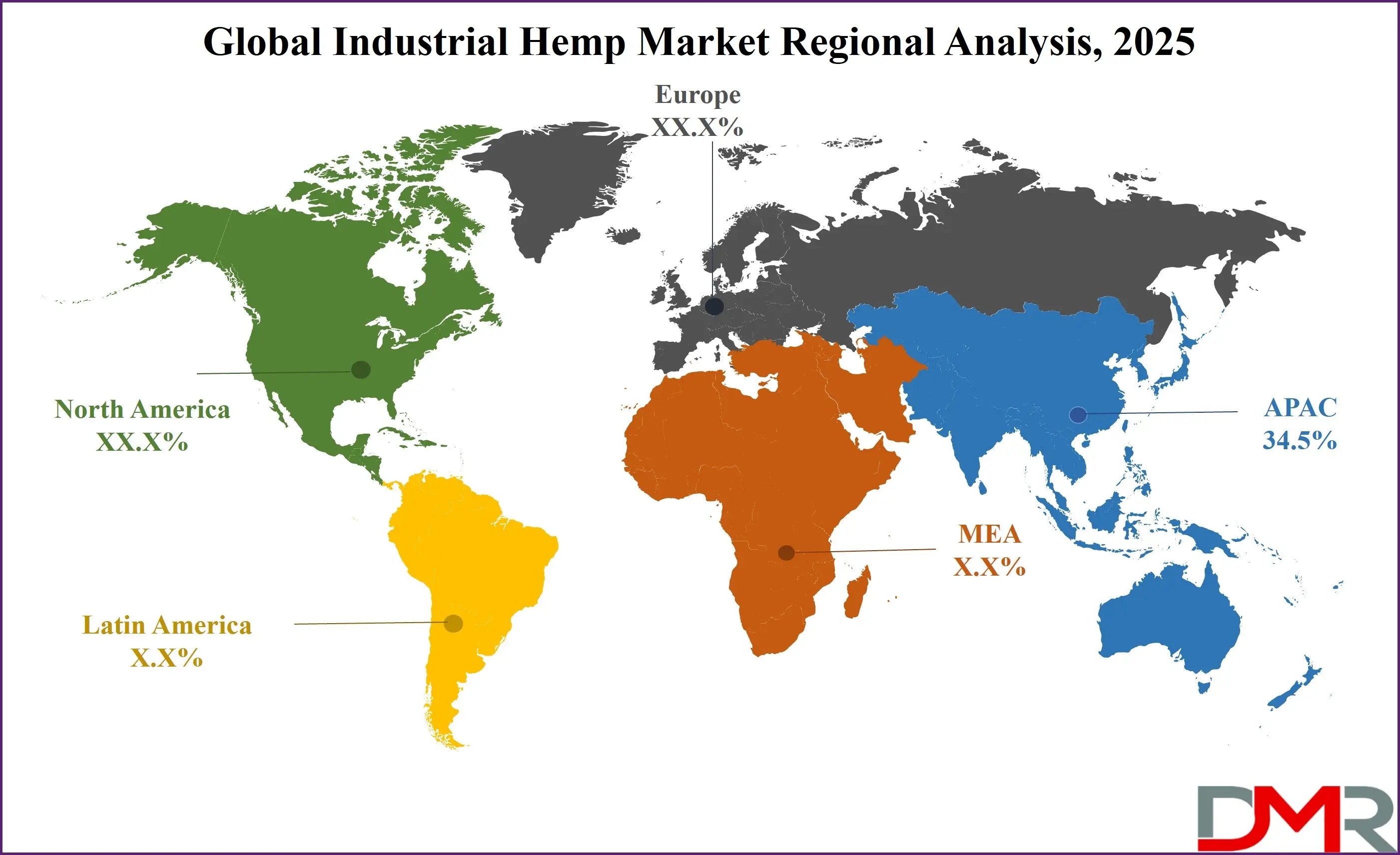
Asia Pacific is projected to hold the largest regional market share at 34.5% in 2025.
The region benefits from hemp cultivation activity, manufacturing capabilities, and demand for industrial materials.
China represents an important market through its established manufacturing and textile activities.
Europe also presents significant opportunities, supported by interest in renewable materials, sustainable textiles, and industrial hemp processing.
North America is another important region where agricultural policies and industrial demand influence hemp production and commercialization.
The United States market is developing across textiles, construction materials, food products, and other commercial applications.
Competitive Landscape
The industrial hemp industry includes agricultural producers, processors, ingredient suppliers, and specialized material manufacturers.
Prominent companies identified in the DMR report include Ecofibre Ltd., HempFlax Group B.V., Dun Agro Hemp Group, Fresh Hemp Foods Ltd., GenCanna, IND HEMP, HemPoland, South Hemp Tecno, and Blue Sky Hemp Ventures Ltd.
Competition involves raw material quality, cultivation efficiency, processing capabilities, product diversification, and access to industrial customers.
Companies with integrated supply chains and reliable processing infrastructure are positioned to address demand across several industrial applications.
Explore the Complete Industrial Hemp Market Analysis
Access detailed market segmentation, regional forecasts, industrial applications, competitive intelligence, and emerging hemp-based material opportunities through the full Dimension Market Research report.
https://dimensionmarketresearch.com/checkout/industrial-hemp-market/
Frequently Asked Questions
1. What is the Industrial Hemp Market size?
The global market is projected to reach USD 13.6 billion in 2025 and USD 89.3 billion by 2034.
2. What is the expected CAGR of the Industrial Hemp Market?
The market is forecast to grow at a CAGR of 23.2% through 2034.
3. Which product segment leads the market?
Hemp seeds lead with a projected 30.4% share in 2025.
4. Which region dominates the Industrial Hemp Market?
Asia Pacific leads with an anticipated 34.5% market share in 2025.
5. What is supporting future industrial hemp demand?
Demand for sustainable textiles, plant-based ingredients, construction materials, and diversified industrial raw materials supports market expansion.
Conclusion
The Industrial Hemp Market is developing into a diversified industry connecting agriculture, food ingredients, textiles, construction, and renewable material manufacturing.
Continued progress in cultivation, processing technology, supply chain development, and industrial applications is expected to create opportunities for producers, processors, and manufacturers.
Related Industrial Hemp Market Insights
U.S. Industrial Hemp Market
The U.S. Industrial Hemp Market Size is projected to increase from USD 2,143.6 million in 2025 to USD 12,713.3 million by 2034, registering a CAGR of 21.9%. Hemp seeds are expected to account for 78.2% of the U.S. market in 2025, while food and beverages lead applications with a 35.3% share.




