Introduction
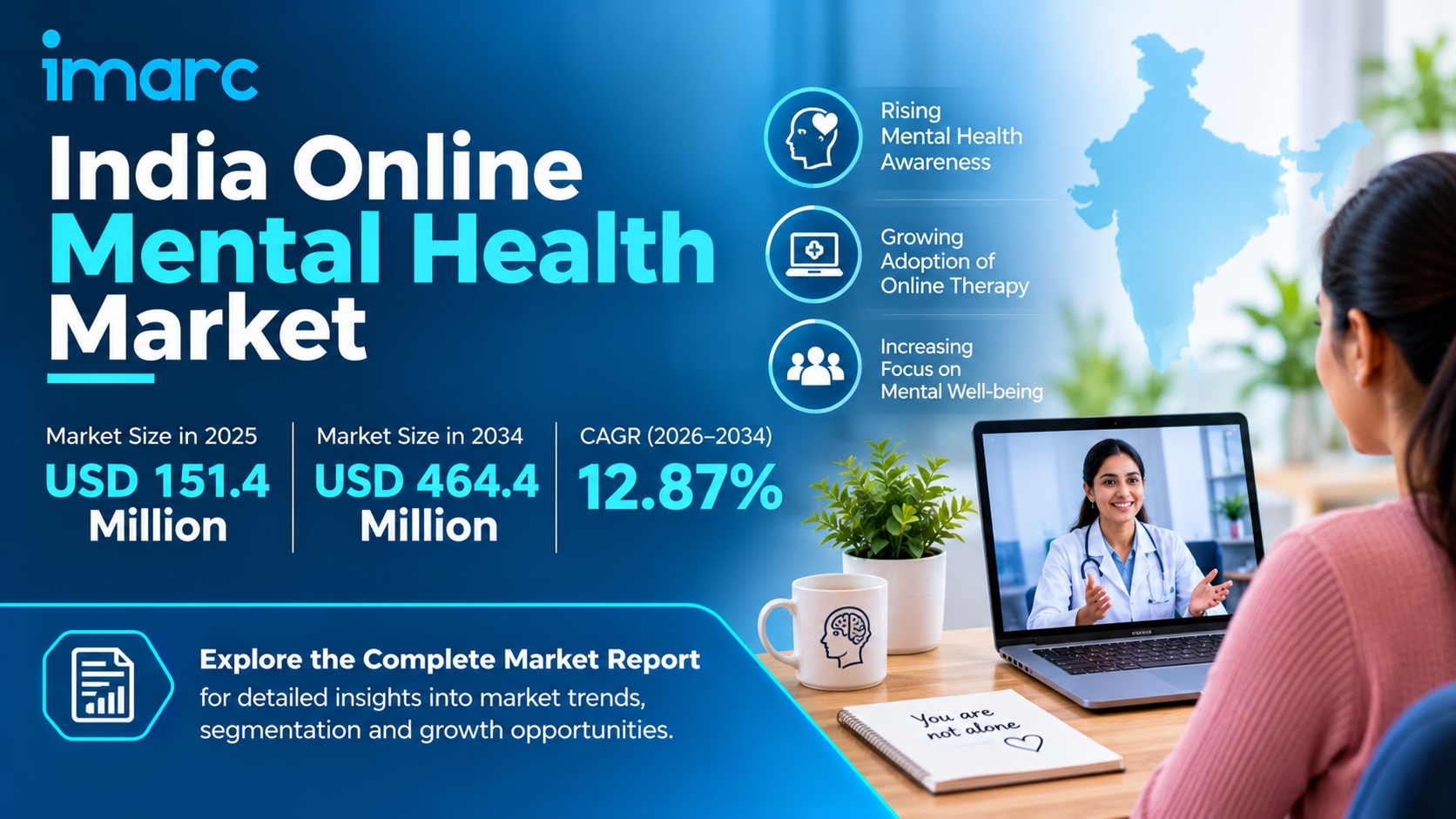
India’s online mental health market stands as one of South Asia’s fastest-emerging digital healthcare segments, encompassing Teletherapy/Online Counseling, Mental Health Apps, Online Self-Help Tools and Resources, Digital Psychiatry Services, and Corporate Mental Health Programs, addressing Anxiety Disorders, Depression, Stress Management, Bipolar Disorder, Substance Abuse Disorders, and other conditions, delivered through Websites, Mobile Applications, and Telehealth Platforms to Individuals, Corporates, Educational Institutions, and Healthcare Providers, spanning North India, South India, East India, and West India. The online mental health market size in India reached USD 151.4 Million in 2025 and is projected to reach USD 464.4 Million by 2034, exhibiting a growth rate (CAGR) of 12.87% during 2026-2034.
The market is growing due to rising awareness and reduced stigma around mental health, expanding internet and smartphone access, demand for convenient and affordable therapy, the rise of subscription and pay-per-session models, AI-driven mood tracking, supportive government initiatives, and growing private investment in digital health platforms. The National Mental Health Survey 2015-16 estimated that around 10.6% of Indian adults live with a mental disorder, and a large treatment gap persists because of limited access to trained professionals, with fewer than one psychiatrist available per 100,000 people. Online platforms are helping bridge this gap by connecting users to counselors, psychiatrists, and self-help tools regardless of location, making care more private, flexible, and accessible.
Market Snapshot
Current Market Size (2025): USD 151.4 Million
Projected Market Size (2034): USD 464.4 Million
CAGR: 12.87%
Teletherapy and online counseling, mental health apps, online self-help resources, digital psychiatry, and corporate wellness programs together form the service landscape, giving users a spectrum of options from low-cost self-guided tools to clinician-led, personalized treatment delivered through secure video, chat, and audio sessions.
Anxiety disorders, depression, and stress management are among the most common concerns addressed by digital platforms, supported by growing awareness among young adults, working professionals, and students who increasingly prefer discreet, on-demand support over in-person clinic visits.
Mobile applications, websites, and telehealth platforms provide the main delivery channels, with smartphone access and improving connectivity in tier-2 and tier-3 cities opening a large and previously underserved population to digital counseling and wellness content.
Individuals, corporates, educational institutions, and healthcare providers make up the end-user base, with employers and universities adopting structured wellbeing programs and healthcare providers integrating digital tools to extend reach and continuity of care.
What Growth Factors Are Driving India Online Mental Health Market?
Rising Awareness and Reduced Stigma:
Conversations around mental health are becoming more open in India, supported by education campaigns, social media discussions, and advocacy from public figures and celebrities. Younger consumers in particular are more willing to seek help for anxiety, depression, and burnout, and are comfortable doing so online where privacy is preserved. Workplaces and educational institutions are also normalizing wellbeing conversations, offering counseling access and mental health days. This shift in attitudes is expanding the pool of people willing to try therapy, mental health apps, and online self-help programs, and it is turning mental wellness from a taboo subject into a mainstream health and lifestyle priority across urban and semi-urban India.
Internet Penetration and Smartphone Accessibility:
Affordable data and inexpensive smartphones are bringing digital services to tier-2 and tier-3 cities, where access to qualified mental health professionals is limited. Users can now book a video session, chat with a counselor, or use a guided meditation app from home. Regional language content, voice-based interfaces, and low-bandwidth options are further widening reach. The rapid rise of the India mental health apps market reflects this accessibility, as consumers adopt mood trackers, cognitive behavioral therapy modules, and sleep and stress management tools that fit seamlessly into daily routines without the cost or scheduling constraints of traditional clinics.
Demand for Affordable, Personalized, and AI-Enabled Care:
Subscription plans, pay-per-session pricing, and bundled corporate packages are making therapy more affordable and predictable. Platforms are using AI-driven mood tracking, personalized recommendations, and symptom screening to match users with the right level of support, from self-help content to clinician-led care. Convenience also plays a major role, since online sessions eliminate travel time and allow flexible scheduling for working professionals and caregivers. Growing private investment in digital health startups is funding product innovation, clinician networks, and marketing, further expanding awareness and adoption of online mental health services among new user groups.
Government Policy Support:
Mental Health Care Act, 2017: Recognizes mental healthcare as a legal right, strengthening patient protections and encouraging wider access, which supports the growth of accessible digital and community-based mental health services.
Tele-MANAS Initiative: The national tele-mental health helpline offers free, round-the-clock counseling support in multiple languages, normalizing remote care and increasing public familiarity with digital mental health services.
Telemedicine Practice Guidelines and eSanjeevani: Formal guidelines and the national telemedicine platform legitimize remote consultations, giving digital mental health providers a clear framework to operate and scale responsibly.
Ayushman Bharat Digital Mission and Data Protection Law: Digital health infrastructure and the Digital Personal Data Protection Act encourage secure, interoperable health records and build user trust in online mental health platforms.
Evaluate Market Opportunity with the Business Sample Report
What Are the Latest Emerging Trends in India Online Mental Health Market?
AI-Driven Personalization and Mood Tracking:
Platforms are increasingly deploying artificial intelligence to analyze user inputs, track mood patterns, and offer personalized exercises, reminders, and content. These tools can flag early warning signs, recommend appropriate care levels, and help therapists monitor progress between sessions. Chat-based support and guided programs powered by AI are making basic mental wellness help available at any hour, while human clinicians focus on complex cases. This blend of technology and professional care is shaping a new model of hybrid mental healthcare that improves engagement, lowers cost per user, and allows providers to serve far larger populations than traditional models.
Subscription and Pay-Per-Session Business Models:
Flexible pricing is changing how consumers pay for mental health support. Monthly and annual subscriptions bundle therapy sessions, self-help content, and community features, while pay-per-session models let first-time users try services with minimal commitment. Corporate packages offer employees confidential access to counseling as part of wellbeing benefits. These models lower the barrier to entry, improve retention, and create predictable revenue for platforms, supporting sustained investment in clinician networks and product development across the ecosystem.
Culturally Relevant, Verified Content for Indian Users:
Providers are tailoring services to Indian languages, family structures, and cultural contexts, recognizing that generic global content does not always resonate with local audiences. In January 2023, Metta Media introduced MyndStories, described as the first platform in India offering verified mental health content tailored specifically to Indians. Such initiatives build trust, counter misinformation, and help users find credible guidance, which is essential for a category where quality and credibility strongly influence adoption and long-term engagement.
How will India Online Mental Health Market Evolve in the Coming Years?
The India online mental health market is poised for a sustained high-growth trajectory through 2034, driven by declining stigma, deepening smartphone and internet access, supportive regulation, and rising demand for affordable, personalized care. The market is projected to grow from USD 151.4 Million in 2025 to USD 464.4 Million by 2034 at a CAGR of 12.87%.
Investment is expected to concentrate on teletherapy networks, AI-enabled screening and mood tracking, regional-language content, corporate wellbeing programs, and integration with broader digital health ecosystems. The steady India online mental health market growth will reward platforms that build clinical credibility, protect user data, and deliver measurable outcomes for individuals, employers, educational institutions, and healthcare providers.
How Is India Online Mental Health Market Segmented?
➤ By Service Type
Teletherapy/Online Counseling
Mental Health Apps
Online Self-Help Tools and Resources
Digital Psychiatry Services
Corporate Mental Health Programs
➤ By Disorder Type
Anxiety Disorders
Depression
Stress Management
Bipolar Disorder
Substance Abuse Disorders
Others
➤ By Platform Type
Websites
Mobile Applications
Telehealth Platforms
➤ By End User
Individuals
Corporates
Educational Institutions
Healthcare Providers
➤ By Region
North India
South India
East India
West India
Request Customized Data Tailored to Your Interest
Note: If you require any specific information not covered within this report’s scope, we will provide it as part of the customization.
Competitive Landscape - By IMARC GROUP
The market research report has also provided a comprehensive analysis of the competitive landscape. Competitive analysis such as market structure, key player positioning, top winning strategies, competitive dashboard, and company evaluation quadrant has been covered in the report. Also, detailed profiles of all major companies have been provided.
The India online mental health market is at an early-stage competitive development phase, featuring a mix of teletherapy platforms, mental health app developers, digital psychiatry providers, corporate wellbeing specialists, and content-led startups. Competition differentiates on clinical quality, therapist availability, regional-language support, data privacy, affordability, and user experience rather than on price alone.
Frequently Asked Questions
How big is the online mental health market in India?
➤ The India online mental health market reached USD 151.4 Million in 2025, underpinned by rising awareness and reduced stigma, wider internet and smartphone access in tier-2 and tier-3 cities, demand for affordable and convenient therapy, and growing private investment in digital health platforms.
What is the projected growth rate of the India online mental health market?
➤ The market is expected to exhibit a CAGR of 12.87% during 2026-2034 to reach USD 464.4 Million by 2034, driven by teletherapy adoption, AI-enabled personalization, subscription-based care models, corporate wellbeing programs, and supportive policies such as the Mental Health Care Act 2017.
What are the key factors driving market growth?
➤ Key drivers include reduced stigma and growing awareness, expanding internet and smartphone penetration, demand for affordable and personalized online therapy, AI-driven mood tracking tools, government policies such as the Mental Health Care Act 2017, and increasing private investment in digital mental health platforms.
About Us:
IMARC Group is a global management consulting firm that helps ambitious changemakers create a lasting impact. The company offers comprehensive market assessment, feasibility studies, incorporation support, regulatory assistance, branding and strategy services, and procurement research.
IMARC Group
134 N 4th St. Brooklyn, NY 11249, USA
Email: sales@imarcgroup.com
Tel: (D) +91 120 433 0800
United States: +1-201-971-6302