The Hyperscale Data Center Market is experiencing significant expansion as businesses, cloud service providers, and technology companies invest in large-scale computing infrastructure. The rapid adoption of artificial intelligence (AI), cloud computing, big data analytics, and digital services is increasing demand for facilities capable of processing enormous volumes of information while maintaining scalability, reliability, and operational efficiency.
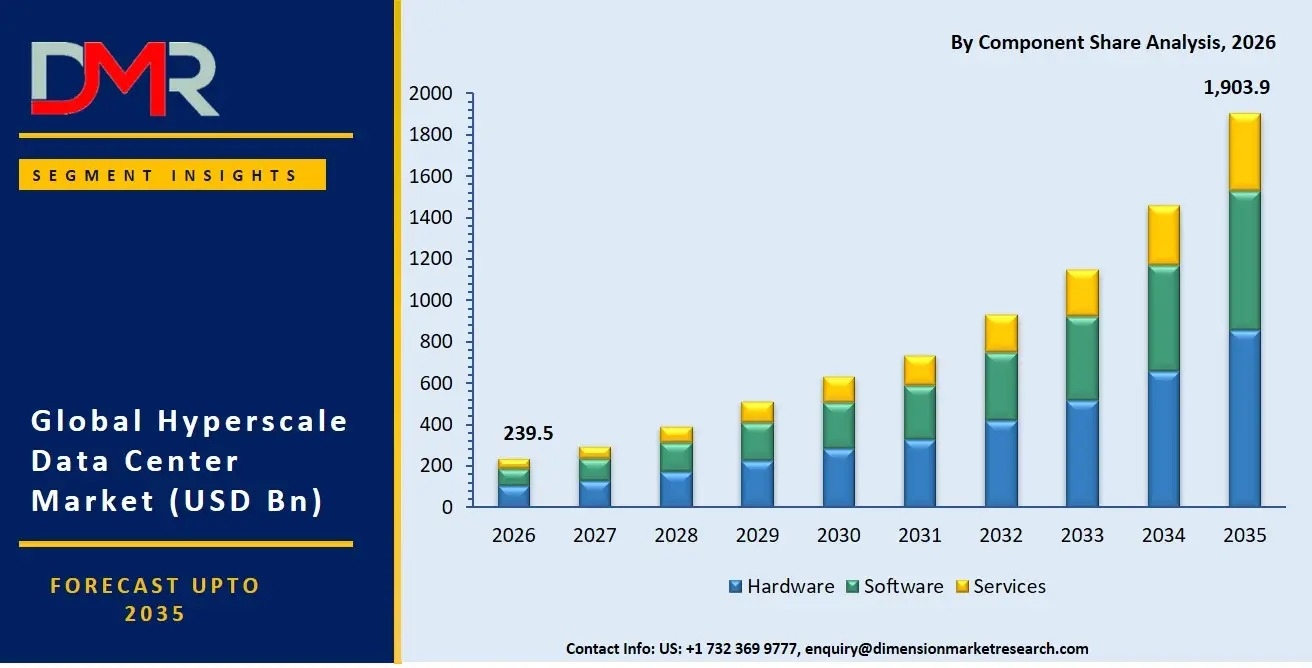
According to Dimension Market Research, the global Hyperscale Data Center Market is projected to reach USD 239.5 billion in 2026 and is expected to increase to USD 1,903.9 billion by 2035, registering a compound annual growth rate (CAGR) of 25.9% during 2026 to 2035. This expansion reflects the growing importance of hyperscale infrastructure in supporting AI workloads, enterprise cloud migration, high-performance computing, and global digital transformation.
As generative AI applications become more computationally demanding, traditional data center architectures are increasingly challenged by requirements for advanced processing capabilities, high-density power infrastructure, and sophisticated cooling technologies. Hyperscale facilities are becoming essential to addressing these requirements while supporting the next generation of digital services.
What Is the Hyperscale Data Center Market?
The Hyperscale Data Center Market includes large-scale data center infrastructure designed to deliver highly scalable computing, storage, and networking capabilities. These facilities are built to support massive workloads through automated operations, advanced hardware, efficient power distribution, and intelligent infrastructure management.
Unlike conventional enterprise data centers, hyperscale facilities are designed to accommodate hundreds of thousands of interconnected servers operating as an integrated computing environment. They generally feature power capacities exceeding 10 MW and are developed to support cloud platforms, AI training, machine learning, streaming services, and enterprise applications.
The market includes hardware, software, and services. Hardware covers servers, storage systems, networking equipment, electrical infrastructure, and cooling systems. Software supports cloud management, monitoring, orchestration, automation, and disaster recovery. Services include installation, deployment, maintenance, consulting, and managed infrastructure support.
Cloud service providers remain central to the market because they require extensive computing capacity to support public cloud, hybrid cloud, and enterprise workloads.
Why Is the Hyperscale Data Center Market Growing?
Increasing Demand for Artificial Intelligence Infrastructure
Artificial intelligence is one of the most important growth drivers for hyperscale data centers. Generative AI models, large language models, and machine learning applications require substantial computing resources for training, inference, and data processing.
These workloads depend heavily on graphics processing units (GPUs), specialized accelerators, high-speed networking, and advanced storage infrastructure.
AI computing also creates greater power and cooling requirements. GPU-based computing clusters can consume significantly more electricity per rack than conventional computing systems. As a result, operators are investing in high-capacity power distribution, advanced UPS systems, and liquid cooling technologies.
This shift is changing how hyperscale facilities are designed, constructed, and managed.
Accelerating Enterprise Cloud Migration
Businesses across BFSI, healthcare, government, manufacturing, and telecommunications are increasingly adopting cloud-based infrastructure.
Migrating workloads from traditional on-premise environments to hyperscale cloud platforms allows organizations to access scalable storage, computing capacity, and enterprise applications without independently building and maintaining extensive infrastructure.
Hybrid cloud deployment is also gaining importance because it allows businesses to combine private infrastructure with public cloud resources.
As enterprise digital transformation continues, cloud service providers are investing in larger facilities to accommodate increasing demand for computing and data management.
Expansion of Digital Services and Data Generation
Online streaming, e-commerce, financial transactions, connected devices, and enterprise applications are generating growing volumes of digital information.
Hyperscale facilities provide the infrastructure needed to process, store, and distribute this information efficiently.
Content delivery networks, high-performance computing, and edge computing are also increasing demand for geographically distributed infrastructure that can deliver reliable services with reduced latency.
Get a Free Sample of the Hyperscale Data Center Market Report
Explore detailed market forecasts, segmentation, regional analysis, competitive intelligence, and emerging technology trends through the Dimension Market Research report.
https://dimensionmarketresearch.com/request-sample/hyperscale-data-center-market/
Hyperscale Data Center Market Segmentation
The market is segmented by component, deployment mode, power capacity, data center type, infrastructure type, organization size, application, and end user.
By Component
The hardware segment is expected to lead the component category. This is supported by increasing investments in servers, storage systems, networking equipment, power generation, and advanced cooling technologies.
Software plays an important role in infrastructure management, cloud orchestration, performance monitoring, security monitoring, and operational automation.
Services include professional and managed services that support installation, maintenance, deployment, and infrastructure optimization.
By Deployment Mode
The market includes on-premise, cloud-based, and hybrid deployment models. Cloud-based deployment remains an important category as businesses increasingly rely on scalable computing and storage services.
Hybrid environments provide flexibility by combining enterprise-controlled infrastructure with hyperscale cloud resources.
By Power Capacity
The report categorizes facilities into:
● 10 to 50 MW
● 51 to 100 MW
● Above 100 MW
The above 100 MW category is expected to account for a significant market share in 2026, supported by investments in large-scale cloud infrastructure, AI training facilities, and high-performance computing.
By Application and End User
Cloud computing is expected to lead the application segment because of increasing adoption of SaaS, PaaS, and IaaS services.
Other important applications include AI and machine learning, big data analytics, content delivery, disaster recovery, high-performance computing, virtualization, and edge computing.
Cloud service providers are projected to dominate the end-user segment because of their substantial investments in large-scale computing infrastructure.
BFSI, IT and telecommunications, government and defense, healthcare, retail, media, manufacturing, and energy are also important end-user industries.
Technology Trends Reshaping Hyperscale Infrastructure
Liquid Cooling and Advanced Thermal Management
As AI workloads increase server power density, conventional air cooling becomes less effective for certain high-performance computing environments.
Direct-to-chip liquid cooling and immersion cooling are gaining importance because they can manage higher thermal loads while supporting energy-efficient infrastructure operations.
These technologies are creating opportunities for specialized cooling equipment manufacturers and infrastructure solution providers.
AI-Driven Data Center Automation
Artificial intelligence is also transforming data center operations.
AI-powered infrastructure management systems can monitor equipment performance, identify potential hardware failures, optimize cooling operations, and distribute workloads more efficiently.
Predictive maintenance can help operators reduce unexpected downtime and improve infrastructure reliability.
Sustainable and Energy-Efficient Infrastructure
Electricity consumption and environmental performance are becoming important considerations in data center development.
Operators are exploring renewable energy integration, energy storage, closed-loop cooling systems, and improved power management technologies.
Sustainable construction materials and water-efficient infrastructure are also becoming increasingly relevant to long-term facility planning.
Regional Outlook of the Hyperscale Data Center Market
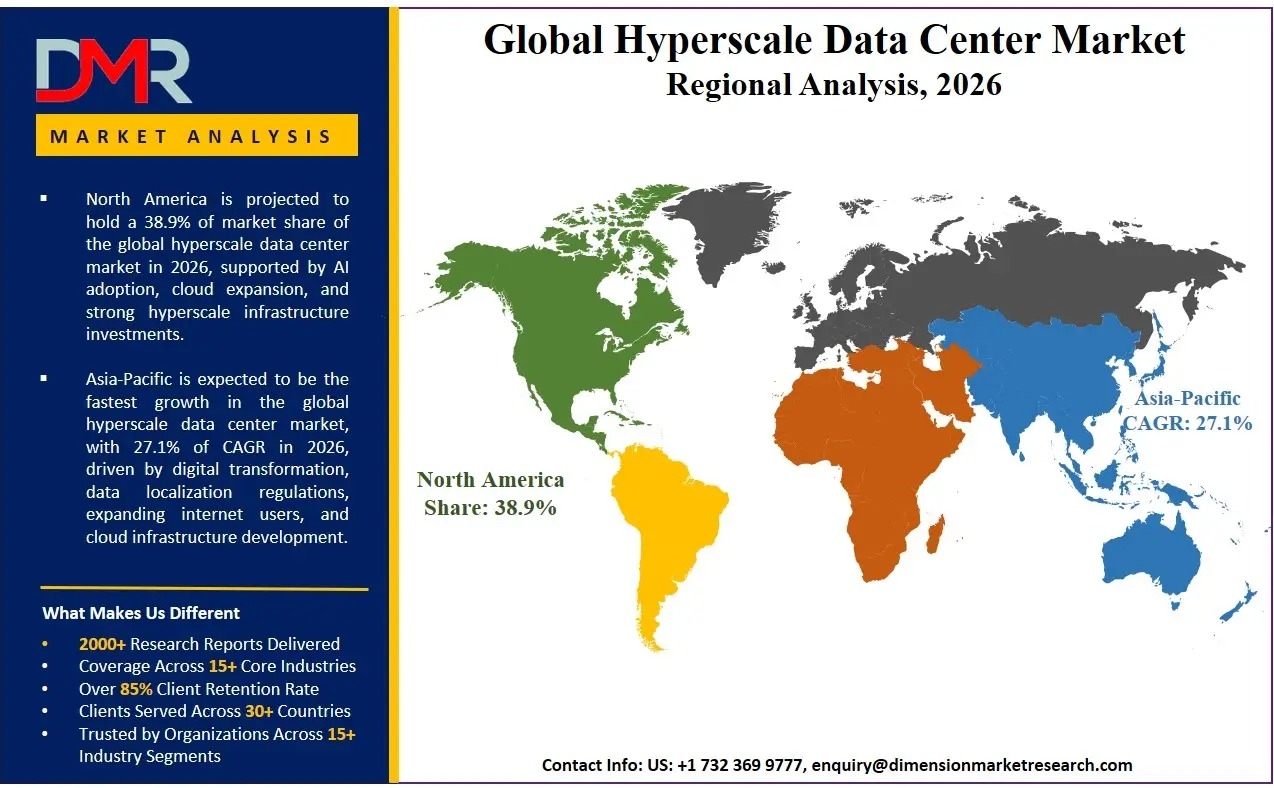
North America is expected to dominate the global Hyperscale Data Center Market, accounting for 38.9% of market share in 2026. The United States remains a major investment destination because of its established cloud infrastructure ecosystem and the presence of leading technology companies.
Europe is also expanding through investments in sovereign cloud infrastructure, regulatory compliance, data management, and energy-efficient facilities.
Asia Pacific is projected to be the fastest-growing regional market. Increasing cloud adoption, digital transformation, expanding internet usage, and investments in AI infrastructure across China, India, Japan, and Southeast Asia are supporting regional development.
Japan represents an important market within this regional expansion. Its growing demand for AI computing, cloud infrastructure, and high-performance processing is encouraging investment in hyperscale facilities.
However, electricity availability, grid connection delays, land constraints, and infrastructure costs remain important challenges across several markets.
Competitive Landscape of the Hyperscale Data Center Market
The competitive environment includes cloud service providers, hyperscale infrastructure operators, colocation companies, and manufacturers of electrical, mechanical, and IT infrastructure.
Prominent companies identified in the Dimension Market Research report include Amazon Web Services, Microsoft Corporation, Alphabet Inc. (Google Cloud), Meta Platforms, Oracle Corporation, Alibaba Group, IBM, Apple, Baidu, Tencent, Equinix, Digital Realty Trust, NTT DATA, QTS Realty Trust, CyrusOne, CoreWeave, GDS Holdings, Schneider Electric, Vertiv, and Eaton.
Competition is increasingly influenced by infrastructure scalability, power efficiency, cooling capabilities, server performance, and operational automation.
Cloud providers are also developing proprietary server, networking, power, and cooling technologies to improve performance and strengthen control over their infrastructure.
Strategic partnerships between cloud providers, colocation operators, and equipment manufacturers are becoming important for supporting large-scale facility development and technological innovation.
Hyperscale Data Center Market Statistics
Market Indicator | Verified Value |
2026 Market Size | USD 239.5 Billion |
2035 Forecast | USD 1,903.9 Billion |
Forecast CAGR | 25.9% |
Leading Region | North America |
North American Share (2026) | 38.9% |
Fastest-Growing Region | Asia Pacific |
Leading Component | Hardware |
Leading Application | Cloud Computing |
Leading End User | Cloud Service Providers |
Challenges and Future Growth Opportunities
Despite strong growth prospects, the industry faces several structural challenges.
Power availability is one of the most important constraints. Large hyperscale facilities require substantial electricity, and limited grid capacity can delay construction and expansion projects.
High capital expenditure is another barrier. Building large-scale facilities requires significant investments in land, servers, networking equipment, electrical systems, and advanced cooling infrastructure.
Supply chain vulnerabilities involving semiconductors, power equipment, and specialized cooling technologies can also affect project timelines.
At the same time, these challenges are creating new opportunities for companies developing liquid cooling systems, modular infrastructure, renewable energy solutions, high-density power equipment, and AI-based facility management platforms.
The expansion of edge computing and distributed hyperscale architecture also creates opportunities to establish infrastructure closer to end users and latency-sensitive applications.
Future Outlook for the Hyperscale Data Center Market
The future of the Hyperscale Data Center Market will be closely connected with the evolution of artificial intelligence, cloud computing, and enterprise digital infrastructure.
Increasing demand for GPU-based computing, generative AI applications, and large-scale data processing will encourage continued investments in high-capacity facilities.
Liquid cooling, intelligent automation, renewable energy integration, and advanced power management are expected to play important roles in the next generation of hyperscale infrastructure.
Asia Pacific is also expected to create significant opportunities as digital economies expand and cloud service providers strengthen their regional presence.
Organizations capable of combining scalable computing infrastructure with energy efficiency, operational resilience, and advanced cooling solutions will be well positioned to participate in the industry's long-term development.
Explore the Complete Hyperscale Data Center Market Analysis
Access the complete Dimension Market Research report for detailed forecasts, market segmentation, regional insights, competitive analysis, and strategic industry intelligence through 2035.
https://dimensionmarketresearch.com/checkout/hyperscale-data-center-market/
Frequently Asked Questions (FAQs)
1. What is the global Hyperscale Data Center Market size?
The global Hyperscale Data Center Market is projected to reach USD 239.5 billion in 2026 and USD 1,903.9 billion by 2035.
2. What is the CAGR of the Hyperscale Data Center Market?
The market is expected to register a CAGR of 25.9% during the 2026 to 2035 forecast period.
3. Which component segment leads the Hyperscale Data Center Market?
Hardware is expected to lead the component segment, supported by demand for servers, storage, networking equipment, power infrastructure, and cooling systems.
4. Which region dominates the Hyperscale Data Center Market?
North America is expected to dominate the market, accounting for 38.9% of the global market share in 2026.
5. What is the future outlook for the Hyperscale Data Center Market?
The market is expected to experience strong growth through 2035, supported by AI adoption, cloud migration, increasing data generation, high-performance computing, and investments in energy-efficient infrastructure.
Conclusion
The Hyperscale Data Center Market is becoming a critical foundation of the global digital economy. Increasing AI workloads, enterprise cloud migration, and expanding digital services are accelerating investments in large-scale computing infrastructure.
Hardware, cloud computing applications, and cloud service providers are expected to remain important market categories, while North America maintains its leading regional position and Asia Pacific offers substantial growth opportunities.
As liquid cooling, AI-driven automation, and sustainable infrastructure technologies advance, hyperscale data centers will play an increasingly important role in supporting the next generation of digital transformation.
Related Data Center Market Insights
1. Japan Hyperscale Data Center Market Size
The Japan Hyperscale Data Center Market is projected to reach USD 15.1 billion in 2026 and USD 105.0 billion by 2035, registering a CAGR of 24.0%. Increasing AI adoption, cloud computing, 5G expansion, and demand for high-performance computing are supporting market development.
2. Data Center Market Share
The global Data Center Market is projected to reach USD 301.8 billion in 2026 and USD 805.3 billion by 2035, growing at a CAGR of 11.5%. Cloud adoption, enterprise digitalization, colocation facilities, and increasing data generation are supporting industry expansion.
3. AI Data Center Market Growth
The global AI Data Center Market is estimated at USD 445.4 billion in 2026 and is forecast to reach USD 4,250.1 billion by 2035, registering a CAGR of 28.5%. Generative AI, GPU-based computing, high-performance processing, and specialized infrastructure investments are driving growth.