Math can sometimes feel like trying to untangle a giant ball of yarn. You pull on one string, and another knot appears somewhere else. Whether you are scaling a baking recipe for a weekend party, figuring out the best price for bulk groceries at the supermarket, or working on high school homework, ratios and proportions pop up everywhere in daily life.
Instead of getting bogged down by complicated cross multiplication and manual fractions, using a digital tool makes the process effortless. This comprehensive guide walks you through everything you need to know about proportions, how online math instruments work, and how they save you time and mental energy.
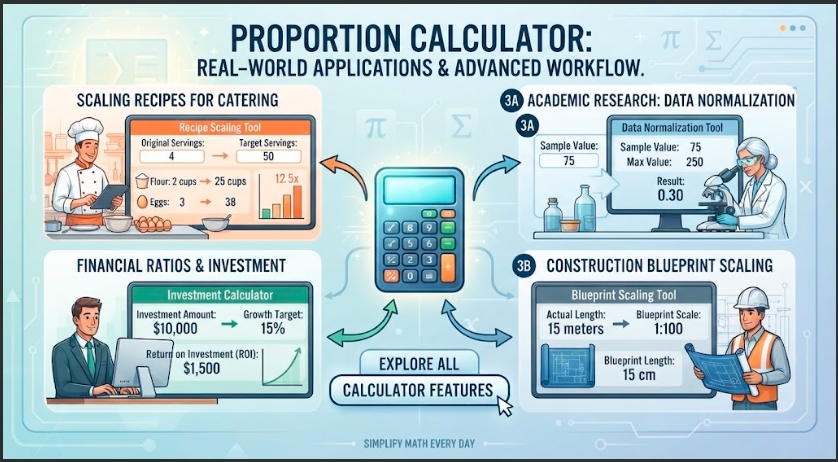
Understanding Ratios and Proportions in Everyday Life
A ratio simply compares two quantities, showing how much of one thing exists compared to another. For example, if a recipe calls for two cups of flour for every one cup of sugar, your ratio is 2 to 1.
A proportion takes that concept one step further. It states that two ratios are equal to each other. When you know three parts of a proportion, you can easily find the missing fourth part. This process is called solving for $x$.
People encounter these mathematical relationships constantly. Artists use them to scale drawings up or down. Carpenters rely on them to cut materials precisely. Financial analysts use them to compare market growth over different periods. Learning how these numbers connect helps build strong problem-solving skills without needing a degree in advanced mathematics.
Direct Versus Inverse Relationships
Before jumping into calculations, it helps to understand the two main types of proportions you will encounter: direct and inverse. Recognizing the difference ensures you apply the correct formula or select the right setting on a digital math tool.
Direct Proportions
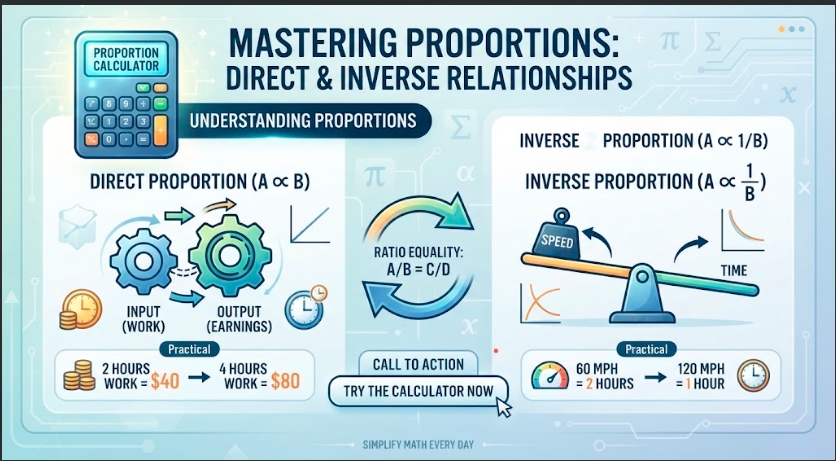
A direct proportion happens when two values increase or decrease together at the same constant rate. If you buy more apples at the grocery store, the total cost goes up by the exact same multiplier.
Example: If 3 kilograms of fruit cost 15 dollars, then 6 kilograms will cost 30 dollars. As the weight doubles, the price doubles right along with it.
Inverse Proportions
An inverse proportion works in the opposite direction. When one value increases, the other value decreases proportionally.
Example: If 2 workers can paint a fence in 6 hours, 4 workers can finish the job in 3 hours. As the number of workers goes up, the time required to complete the task goes down.
Knowing how to handle both scenarios is essential for accurate calculations in physics, chemistry, and practical engineering tasks.
Why Use an Online Tool?
Manual calculations involve cross multiplying and dividing fractions. While this is a great skill to learn in school, it leaves room for human error when dealing with large numbers or decimals.
An inverse proportion calculator or standard ratio solver eliminates guesswork. By inputting your known values into designated fields, the system processes the mathematics instantly.
Key Benefits of Digital Calculators
Speed: Get accurate answers in milliseconds without grabbing scrap paper or a physical handheld device.
Accuracy: Eliminate calculation mistakes caused by misplaced decimal points or arithmetic slips.
Convenience: Access these tools directly from your smartphone, tablet, or laptop wherever you happen to be.
How to Solve Proportions Step by Step
To make the most of any math tool, it helps to understand the mechanics happening behind the screen. Here is how a standard proportion is set up and solved manually or digitally.
Set up the equation: Write your first ratio as a fraction, such as a / b. Set it equal to the second ratio containing your unknown variable, such as c / x.
Cross multiply: Multiply numerator a by denominator x, and set it equal to denominator $b$ multiplied by numerator c. This gives you a \times x = b \times c.
Isolate the variable: Divide both sides by a to find the final value of x.
For more technical definitions and historical background on mathematical ratios, you can explore the Wikipedia entry on the subject.
Practical Applications in Science and Finance
Mathematics is not just something you study in a classroom and forget. According to recent educational technology reports shared by Google News, interactive digital tools and calculators significantly improve student comprehension and data analysis efficiency in modern STEM fields.
Whether you are calculating chemical concentrations in a laboratory or converting currency rates for an upcoming international trip, proportions provide the reliable framework needed to get accurate results. For instance, travelers frequently use ratio formulas to convert foreign money values into local currency smoothly.
Frequently Asked Questions
What is a proportion calculator?
It is a digital utility designed to solve missing values in math equations where two ratios are set equal to each other.
How do I use an inverse proportion calculator?
You input your initial variables into the inverse settings fields, and the tool calculates the opposite scaling relationship automatically.
Can I use these tools for fractions and decimals?
Yes, most modern proportion calculator accept whole numbers, decimals, and fractional inputs without any issues.
Are online math calculators free to use?
Most web-based calculation tools are entirely free and accessible directly through standard web browsers.
Why is cross multiplication important?
Cross multiplication is the primary algebraic method used to solve for an unknown variable in any standard proportion equation.
How do I know if a problem is direct or inverse?
Ask yourself if both values increase together (direct) or if one increases while the other decreases (inverse).
Can proportions help with cooking recipes?
Absolutely. If a recipe serves four people but you need to feed ten, proportions help you scale every ingredient accurately.
Where can I learn more about advanced mathematics?
Educational websites, math forums, and online learning platforms offer extensive guides on ratios, algebra, and geometry.
Conclusion
Mastering ratios and proportions opens the door to smoother problem-solving in everyday life, academics, and professional projects. Whether you are adjusting measurements in the kitchen or analyzing data for a work presentation, understanding these mathematical relationships gives you confidence.
Instead of stressing over manual fractions, take advantage of modern digital tools to simplify your workflow. Try out a reliable calculation tool today to see how fast and easy solving math can truly be!



