Starting a fitness journey can feel overwhelming, especially when you are unsure which exercises to perform, how many days to work out, or how much time to spend exercising. The good news is that getting fit does not require an expensive gym membership, complicated equipment, or hours of intense training.
Following a structured workout plan for beginners can help you build strength, improve endurance, increase flexibility, and develop healthy habits without putting unnecessary pressure on your body.
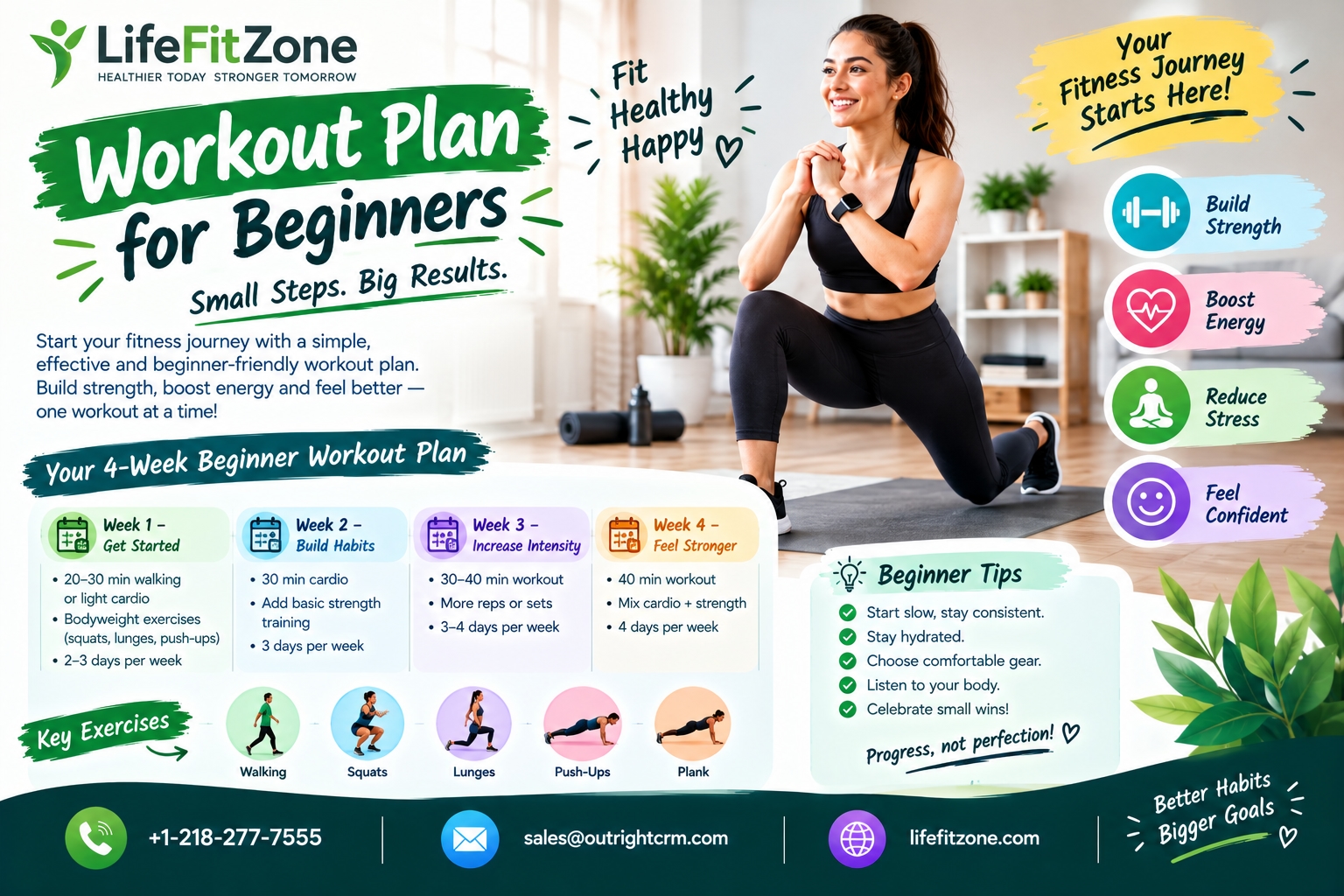
A well-designed beginner workout routine should include simple strength exercises, cardiovascular activities, and flexibility training. Whether you want to lose weight, build muscle, improve stamina, or simply become more active, starting with manageable exercises can make your fitness journey easier.
At LifeFitZone, we believe fitness should fit your lifestyle. With a practical beginner workout plan at home, you can start improving your physical fitness without investing in expensive gym equipment.
In this guide, we will explore a simple 7-day workout plan for beginners, an effective full-body workout for beginners, easy exercises, nutrition tips, and recovery strategies to help you stay consistent.
Let's get started!
Why Do Beginners Need a Structured Workout Plan?
Many people start exercising with enthusiasm but struggle to maintain their routine after a few weeks. One common reason is the lack of a clear workout schedule.
Following a structured fitness plan helps you understand what to do each day and gives your body enough time to recover.
Here are some important benefits:
Builds physical strength: Regular exercise helps strengthen your muscles and supports everyday movements.
Improves cardiovascular health: Walking, cycling, and other aerobic activities help improve heart and lung fitness.
Supports weight management: Physical activity increases energy expenditure and complements healthy eating habits.
Improves flexibility: Stretching and mobility exercises help you move more comfortably.
Develops consistency: A weekly schedule makes exercise easier to incorporate into your daily routine.
Supports mental well-being: Physical activity can help improve mood, reduce stress, and support better sleep.
The best approach is to start slowly, choose exercises that match your fitness level, and gradually increase your activity.
Understanding the Basics of a Beginner Workout Routine
Before following a workout schedule, it is helpful to understand the three main types of exercise.
1. Strength Training
Strength training involves working your muscles against resistance. Beginners can start with bodyweight exercises without purchasing expensive equipment.
Some effective beginner exercises include:
Bodyweight squats
Wall push-ups
Glute bridges
Standing lunges
Bird-dog exercises
These movements help develop strength in different muscle groups while improving coordination and stability.
2. Cardiovascular Exercise
Cardio exercises increase your heart rate and help improve endurance.
Some beginner-friendly options include:
Brisk walking
Cycling
Swimming
Dancing
Marching in place
Start with a comfortable pace and gradually increase your activity time as your stamina improves.
3. Flexibility and Mobility Training
Flexibility and mobility exercises help your body move through comfortable ranges of motion.
You can include:
Shoulder circles
Gentle neck movements
Hamstring stretches
Hip rotations
Calf stretches
Gentle yoga poses
Combining strength training, cardio, and mobility creates a balanced fitness routine.
A Simple 7-Day Workout Plan for Beginners
If you are wondering how to start working out, this 7-day workout plan for beginners provides a practical starting point.
You can perform most of these activities at home without special equipment.
Day | Workout Activity | Duration |
Monday | Full-body strength training | 20–30 minutes |
Tuesday | Walking or cycling | 20–30 minutes |
Wednesday | Stretching and mobility | 15–20 minutes |
Thursday | Full-body strength training | 20–30 minutes |
Friday | Low-impact cardio | 20–30 minutes |
Saturday | Walking, swimming, or dancing | 20–30 minutes |
Sunday | Rest or gentle walking | As comfortable |
If you are completely new to exercise, start with three active days per week and gradually introduce additional sessions.
The schedule is flexible. Listen to your body and allow enough recovery time between challenging workouts.
Best Full-Body Workout for Beginners
A full-body workout for beginners is an excellent way to train different muscle groups without following a complicated exercise routine.
You do not need advanced movements to improve your strength. Basic exercises can help develop your legs, arms, chest, back, and core.
Here are five effective exercises you can include in your weekly routine.
1. Bodyweight Squats
Target muscles: Quadriceps, glutes, and hamstrings.
Bodyweight squats are an excellent lower-body exercise for beginners.
How to perform:
Stand with your feet approximately shoulder-width apart.
Keep your chest lifted and your back comfortable.
Push your hips backward as you bend your knees.
Lower yourself only as far as you can maintain good form.
Push through your feet to return to the starting position.
Beginner target: 2 sets of 8–10 repetitions.
2. Wall Push-Ups
Target muscles: Chest, shoulders, and triceps.
Wall push-ups are an easier alternative to traditional floor push-ups.
How to perform:
Stand facing a wall.
Place both palms against the wall at shoulder height.
Step backward slightly while keeping your body aligned.
Bend your elbows and bring your chest toward the wall.
Push against the wall to return to the starting position.
Beginner target: 2 sets of 8–12 repetitions.
3. Glute Bridges
Target muscles: Glutes, hamstrings, and supporting core muscles.
Glute bridges are useful for strengthening the hips and lower body.
How to perform:
Lie on your back with your knees bent.
Keep your feet flat on the floor.
Place your arms comfortably beside your body.
Tighten your abdominal muscles and squeeze your glutes.
Lift your hips gently without arching your lower back excessively.
Slowly lower your hips.
Beginner target: 2 sets of 10–12 repetitions.
4. Marching in Place
Target: Cardiovascular endurance and lower-body movement.
This simple activity is suitable for people who want to improve their stamina without jumping or running.
How to perform:
Stand upright with your feet comfortably apart.
Lift one knee and then the other.
Swing your arms naturally.
Maintain a comfortable and controlled rhythm.
Beginner target: 2 rounds of 30–60 seconds.
5. Bird-Dog Exercise
Target muscles: Core, back, and supporting stabilizing muscles.
Bird-dog exercises help improve balance and coordination.
How to perform:
Start on your hands and knees.
Keep your hands beneath your shoulders and knees beneath your hips.
Extend your right arm forward while extending your left leg backward.
Keep your hips and shoulders steady.
Return to the starting position.
Repeat with the opposite arm and leg.
Beginner target: 2 sets of 6–8 repetitions per side.
Remember to prioritize correct technique over completing more repetitions.
Beginner Workout Plan at Home: Tips to Get Started
You do not need to visit a gym to develop a consistent exercise routine. A simple beginner workout plan at home can help you become stronger and more active using basic movements.
However, creating the right environment and following a few simple habits can make home workouts more effective.
Choose a Comfortable Workout Space
Find a small area where you can move safely without hitting furniture or other objects.
A yoga mat can provide additional comfort during floor exercises, although it is not essential for every movement.
Wear Comfortable Clothing
Choose breathable clothing that allows you to move freely. Wear supportive footwear when performing standing exercises or cardio activities.
Start With Simple Movements
Avoid attempting advanced exercises immediately.
Focus on learning basic movements and maintaining good posture. Increase your workout difficulty only when you feel comfortable with your current routine.
Set Realistic Fitness Goals
Instead of expecting dramatic changes within a few days, create achievable goals.
For example:
Complete three workouts this week.
Walk for 20 minutes on three days.
Learn five basic strength exercises.
Maintain a consistent bedtime.
Improve your exercise technique.
Small achievements can help you stay motivated.
5 Easy Exercises for Beginners
If you are looking for easy exercises for beginners, start with movements that feel comfortable and allow you to maintain proper technique.
Here are five additional exercises you can try:
1. Standing Calf Raises
Stand upright and slowly lift your heels off the floor. Pause briefly before lowering them.
Beginner target: 2 sets of 10–12 repetitions.
2. Standing Knee Raises
Stand comfortably and lift one knee toward your waist before lowering it. Alternate between both legs.
Beginner target: 2 sets of 10 repetitions per leg.
3. Seated Leg Extensions
Sit on a sturdy chair and slowly straighten one knee. Hold briefly and lower your foot.
Beginner target: 2 sets of 10 repetitions per leg.
4. Side Leg Raises
Stand beside a sturdy support. Lift one leg gently out to the side without leaning your upper body.
Beginner target: 2 sets of 8–10 repetitions per leg.
5. Gentle Wall Sits
Stand with your back against a wall and slide down slightly into a comfortable seated position. Hold briefly before standing up.
Beginner target: 2 rounds of 10–20 seconds.
Choose exercises according to your current ability. You do not need to perform every movement in one session.
Home Workout Without Equipment: Build Fitness Anywhere
A home workout without equipment is a convenient way to start exercising when you have limited time, space, or access to a gym.
Bodyweight exercises use your own body as resistance, making them suitable for developing basic strength and coordination.
Here is a simple workout you can try at home.
Exercise | Duration or Repetitions |
Marching in place | 3 minutes |
Bodyweight squats | 10 repetitions |
Wall push-ups | 10 repetitions |
Glute bridges | 12 repetitions |
Bird-dog | 6 repetitions per side |
Gentle stretching | 3–4 minutes |
Perform the strength exercises at a comfortable pace, taking breaks whenever needed. If necessary, reduce the repetitions or complete only one round initially.
As your fitness improves, you can gradually add repetitions or another round.
The goal is to develop a sustainable routine rather than exhaust yourself during every session.
Nutrition Tips to Support Your Beginner Workout Plan
Exercise is only one part of a healthy lifestyle. Your body also needs proper nutrition to support physical activity and recovery.
You do not need a complicated diet to get started. Focus on balanced meals and consistent eating habits.
Eat Enough Protein
Protein supports muscle repair and growth.
Include foods such as:
Eggs
Milk and yogurt
Paneer
Lentils and beans
Soy products
Chicken and fish
Choose options that suit your dietary preferences.
Include Fruits and Vegetables
Fruits and vegetables provide essential vitamins, minerals, fiber, and other nutrients.
Try including different colors and varieties in your daily meals.
Choose Healthy Sources of Carbohydrates
Carbohydrates provide energy for physical activity.
Good options include oats, whole grains, rice, potatoes, fruits, and other minimally processed carbohydrate sources.
Stay Hydrated
Drink water regularly throughout the day.
Your fluid requirements may increase depending on workout intensity, temperature, and how much you sweat.
Avoid Extreme Dieting
Eating too little can make it difficult to exercise comfortably and recover properly.
Instead of following restrictive diets, focus on balanced meals and sustainable eating habits.
Common Beginner Workout Mistakes to Avoid
Starting a fitness journey is exciting, but some common mistakes can make it difficult to maintain progress.
Here are a few things to avoid.
1. Exercising Too Much Too Soon
Long and intense workouts are not necessary when you are starting. Increase your exercise duration and difficulty gradually.
2. Ignoring Warm-Ups
Begin each workout with approximately five minutes of gentle movement, such as marching, easy walking, or shoulder circles.
3. Forgetting Recovery Days
Your body needs time to recover after challenging workouts. Avoid training the same muscle groups intensely every day.
4. Comparing Your Progress With Others
Everyone starts from a different fitness level. Focus on your own improvements instead of comparing your results with someone else's.
5. Ignoring Exercise Technique
Performing fewer repetitions with good form is generally more useful than rushing through exercises incorrectly.
6. Expecting Immediate Results
Fitness improvements take time. Consistency, nutrition, sleep, and recovery all contribute to long-term progress.
How to Stay Consistent With Your Workout Routine
Motivation can change from day to day. Building habits is a more reliable way to maintain your exercise routine.
Try these practical strategies:
Schedule your workouts at a convenient time.
Begin with shorter sessions.
Track your completed workouts.
Choose activities that you genuinely enjoy.
Find a workout partner if it helps you stay accountable.
Celebrate small improvements.
Allow yourself to rest when necessary.
Remember that missing one workout does not mean you have failed. Simply return to your routine when you are ready.
How Long Does It Take to See Results From a Beginner Workout Plan?
There is no universal timeline for fitness results.
Your progress depends on several factors, including your starting fitness level, workout consistency, exercise intensity, nutrition, sleep, and individual health.
You may notice improvements in stamina, movement, and exercise confidence as you become more active.
Changes in muscle strength and body composition usually require consistent effort over a longer period.
Rather than focusing only on appearance, pay attention to improvements such as:
Walking longer without feeling tired.
Performing more repetitions comfortably.
Improving exercise technique.
Feeling more energetic during everyday activities.
Maintaining a consistent workout schedule.
These improvements are meaningful signs of progress.
Safety Tips for People Starting Exercise
Before beginning a new fitness routine, consider your current health, physical abilities, and previous injuries.
If you have a chronic health condition, significant joint problems, or concerns about exercising safely, consult a qualified healthcare professional for guidance.
Follow these basic precautions:
Start at a comfortable intensity.
Warm up before exercising.
Use controlled movements.
Take breaks when needed.
Stay hydrated.
Avoid exercising through sharp or worsening pain.
Allow enough time for recovery.
Stop exercising and seek appropriate medical attention if you experience concerning symptoms such as chest pain, faintness, or unusual severe breathlessness.
A sustainable workout routine should challenge you appropriately without compromising your well-being.
Conclusion
Starting a fitness journey does not have to be complicated. A practical workout plan for beginners can help you develop strength, improve endurance, support flexibility, and build healthy habits at your own pace.
Begin with simple exercises, follow a realistic weekly schedule, eat balanced meals, and give your body enough time to recover.
Whether you choose a beginner workout routine, a full-body workout for beginners, or a home workout without equipment, the most important thing is to find an approach that fits your lifestyle.
You do not need to complete every workout perfectly. What matters most is creating a routine that you can maintain over time.
At LifeFitZone, we believe that every fitness journey starts with one small step. Start where you are, stay consistent, and give yourself the opportunity to grow stronger every day.
Your fitness journey begins today!
Frequently Asked Questions (FAQs)
1. What is the best workout plan for beginners?
A balanced workout plan for beginners combines strength training, cardiovascular exercise, and flexibility work. Start with approximately three active days per week and gradually increase your activity as your fitness improves.
2. How many days a week should a beginner work out?
Beginners can start with three days of structured exercise each week. As their stamina and recovery improve, they can gradually add more activity.
3. Can I follow a beginner workout plan at home?
Yes. A beginner workout plan at home can include exercises such as squats, wall push-ups, glute bridges, and bird-dog movements. Most of these exercises do not require gym equipment.
4. How long should a beginner workout last?
A beginner session can last approximately 20–30 minutes, including warm-up and cool-down activities. Shorter sessions are also useful when you are developing an exercise habit.
5. Is walking enough exercise for beginners?
Walking is an excellent starting point for improving cardiovascular fitness. However, combining walking with strength training and flexibility exercises provides a more balanced fitness routine.
6. Should beginners exercise every day?
Beginners do not need to perform intense workouts every day. Alternate challenging sessions with lighter activities and recovery days. Gentle walking can be included on many days if comfortable.
7. Can beginners lose weight with home workouts?
Home workouts can support weight management when combined with balanced nutrition and consistent physical activity. Results vary depending on individual circumstances and lifestyle habits.
8. What should I eat before a beginner workout?
If you need food before exercising, consider a light, easily tolerated option such as a banana, yogurt, or toast. The ideal choice and timing depend on your appetite and workout schedule.
9. Do beginners need gym equipment?
No. Many easy exercises for beginners use body weight as resistance. As your fitness develops, you may choose to introduce resistance bands, dumbbells, or other equipment.
10. How can I stay motivated to exercise regularly?
Set realistic goals, choose enjoyable activities, track your progress, and follow a manageable schedule. Focus on building a lasting habit rather than expecting immediate results.
At LifeFitZone, we believe that every fitness journey starts with one small step. Start where you are, stay consistent, and give yourself the opportunity to grow stronger every day