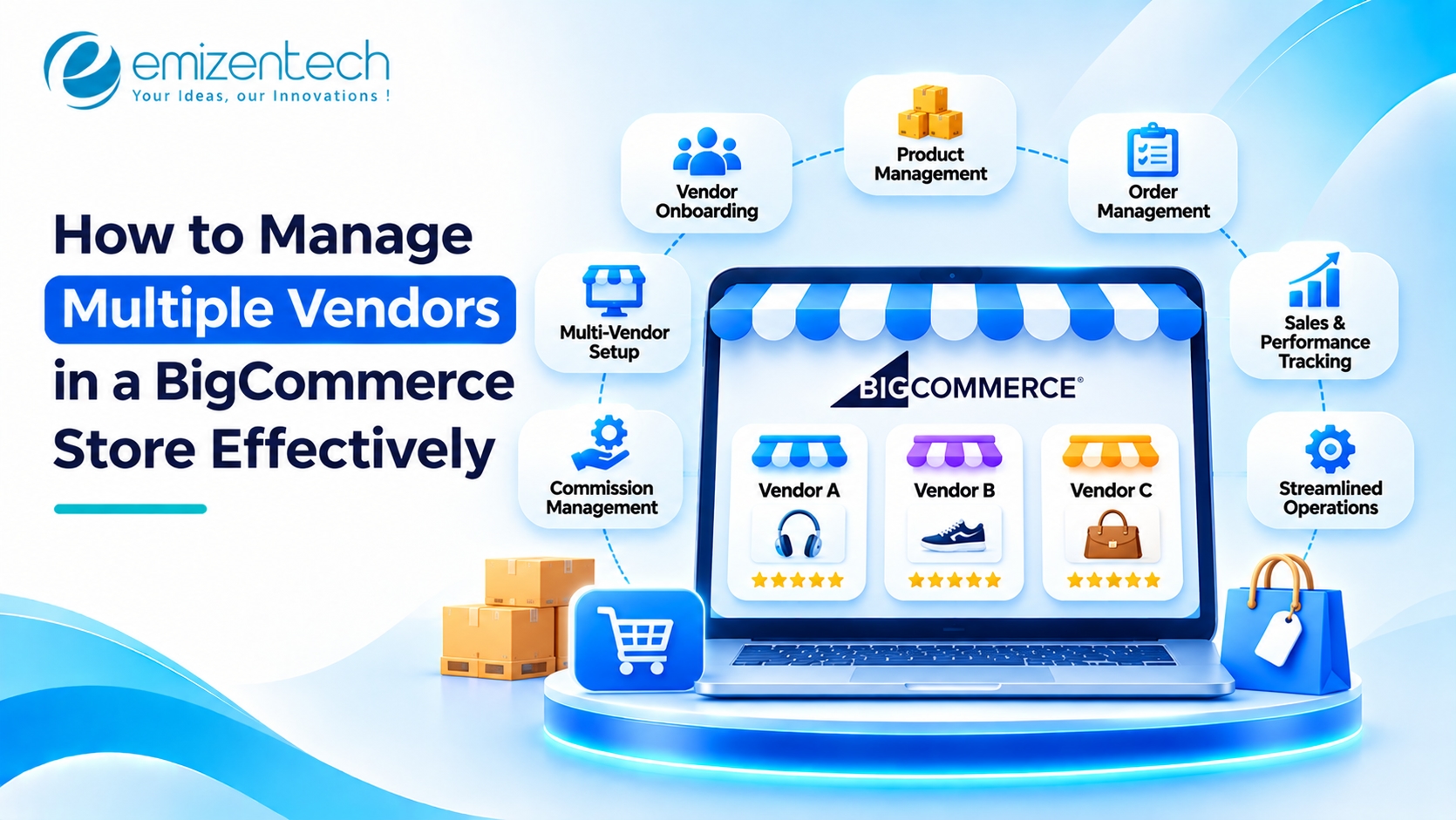
Managing multiple vendors in an eCommerce store becomes challenging as product catalogs expand, order volumes increase, and businesses work with suppliers across different locations. Store owners need to coordinate product listings, inventory updates, order fulfillment, vendor performance, and customer expectations without disrupting daily operations.
BigCommerce provides a flexible eCommerce platform that businesses can extend with suitable integrations, applications, and custom functionality to manage complex store operations. With the right workflows, automation, and AI-powered capabilities, businesses can simplify vendor coordination, improve inventory visibility, and maintain a consistent shopping experience.
Why Managing Multiple Vendors in a BigCommerce Store Is Challenging
As an eCommerce business works with more vendors, managing their activities through manual processes becomes increasingly difficult. Store owners must coordinate product information, stock availability, pricing, order processing, and fulfillment across different suppliers.
Some common challenges include:
Inventory management: Keeping product stock levels updated across multiple vendors is difficult, especially when the same products are sold through different channels.
Product information consistency: Different vendors may provide product descriptions, images, specifications, and pricing in inconsistent formats.
Order distribution: Assigning customer orders to the correct vendors requires clear fulfillment rules and accurate product availability data.
Shipping coordination: Managing different shipping methods, delivery timelines, and tracking information can complicate order fulfillment.
Vendor communication: Delayed updates about stock changes, order status, and product availability can affect customer satisfaction.
Addressing these challenges requires centralized store management, clearly defined vendor workflows, and reliable integrations.
Key Strategies to Manage Multiple Vendors in a BigCommerce Store
Businesses can improve vendor coordination by establishing structured processes and using the right eCommerce technologies. Effective BigCommerce development can help businesses customize store functionality, connect external systems, and streamline vendor-related operations as their product catalogs and order volumes grow.
1. Establish a Structured Vendor Onboarding Process
A standardized onboarding process helps store owners maintain control over the vendors they work with. Collect essential information such as business details, product categories, contact information, pricing structures, shipping capabilities, and inventory management practices during registration.
Include business verification, product quality checks, and agreement approvals where applicable. A structured vendor onboarding workflow also makes it easier to organize supplier information and establish clear responsibilities.
Automation can simplify repetitive onboarding activities, such as collecting documents, reviewing product information, and sending approval notifications. AI can further assist by categorizing vendor catalogs based on product types, attributes, and specifications, helping administrators organize large product inventories.
2. Implement Centralized Product and Order Management
Managing product listings and customer orders across multiple vendors requires accurate and consistent information. Businesses should establish a centralized system to manage product details, pricing, stock availability, and order records.
For example, when a customer purchases products supplied by different vendors, the store should identify the relevant suppliers and organize fulfillment accordingly. Administrators should also have visibility into order status, vendor responsibilities, and pending fulfillment activities.
AI-powered automation can help identify product information inconsistencies, categorize listings, and analyze order patterns. This reduces repetitive administrative work and helps businesses manage larger product catalogs more efficiently.
3. Manage Vendor Inventory and Stock Availability
Accurate inventory management is essential for preventing overselling, stock discrepancies, and order cancellations. Businesses should maintain reliable inventory records and establish processes for vendors to update product availability regularly.
Inventory management systems can synchronize stock information between BigCommerce and connected ERP, warehouse management, or inventory platforms.
The store should support:
Real-time or scheduled inventory synchronization
Vendor-specific stock tracking
Low-stock notifications
Inventory adjustment records
Product availability updates
AI-based demand forecasting can further improve inventory planning by analyzing historical sales, seasonal trends, and purchasing patterns. Businesses can use these insights to estimate future product requirements and coordinate replenishment with vendors.
4. Establish Consistent Product and Service Quality Standards
Working with multiple vendors requires clear quality expectations to maintain a consistent customer experience. Businesses should establish guidelines for product descriptions, images, specifications, packaging, shipping timelines, and return policies.
Administrators should regularly monitor vendor performance using metrics such as order fulfillment rates, product return rates, shipping delays, inventory accuracy, and customer complaints.
AI-powered sentiment analysis can evaluate customer reviews and support feedback to identify recurring product or fulfillment issues. For example, repeated complaints about damaged products or inaccurate descriptions can help administrators identify vendors who need corrective action.
These insights make it easier to maintain product quality and improve vendor accountability.
5. Simplify Communication Between Vendors and Store Administrators
Clear communication helps vendors and store administrators coordinate product updates, order processing, inventory changes, and fulfillment activities.
Businesses can use centralized vendor dashboards, automated notifications, and communication workflows to share important updates. Vendors should be able to access relevant information about their products, assigned orders, stock levels, and fulfillment responsibilities.
Automated notifications can communicate new orders, low-stock alerts, shipment updates, and pending actions.
AI-powered chatbots can also answer common vendor questions about order procedures, product submission requirements, and store policies. This reduces repetitive support requests and allows administrators to focus on more complex operational issues.
6. Monitor Vendor Performance Through Analytics
A centralized administrative dashboard gives businesses visibility into vendor activities and overall store performance. It should display important information such as vendor sales, pending orders, completed shipments, inventory levels, cancellations, and customer feedback.
Administrators can use these insights to identify reliable vendors, recognize fulfillment problems, and evaluate supplier performance.
AI-driven analytics can take performance monitoring further by identifying sales patterns, forecasting product demand, and highlighting potential inventory or fulfillment issues. These insights help businesses make informed decisions about vendor relationships, stock planning, and product assortment.
Essential Features for Managing Multiple Vendors in a BigCommerce Store
A store working with multiple vendors needs specific capabilities to support centralized administration and smooth operations. Depending on the business model, the following features may be implemented through integrations, third-party applications, or custom functionality.
Feature | Purpose |
|---|---|
Vendor registration | Organizes vendor information and onboarding. |
Vendor dashboard | Provides access to relevant products and orders. |
Product management | Helps organize vendor-specific product listings. |
Inventory synchronization | Keeps stock information updated. |
Order management | Tracks orders and vendor fulfillment responsibilities. |
Shipping management | Coordinates delivery and tracking information. |
Vendor performance analytics | Evaluates sales and fulfillment performance. |
Automated notifications | Communicates order and inventory updates. |
Reporting dashboard | Provides visibility into store operations. |
Selecting features according to business requirements helps avoid unnecessary complexity while supporting future store expansion.
Common Mistakes to Avoid When Managing Multiple Vendors
Even with the right eCommerce technology, poor vendor management practices can affect store operations. Businesses should avoid these common mistakes:
Relying on manual inventory updates: This increases the risk of stock discrepancies and overselling.
Ignoring vendor performance: Failing to monitor fulfillment rates and product quality makes recurring issues harder to identify.
Maintaining inconsistent product information: Different product formats and specifications can create confusion for customers.
Overlooking integration requirements: Poor synchronization between BigCommerce and external systems can lead to inaccurate inventory and order records.
Ignoring scalability: Store workflows that work for a small vendor network may become inefficient as product catalogs and order volumes increase.
How to Scale Vendor Management as Your BigCommerce Store Grows
Scaling vendor operations requires more than adding new suppliers to the store. Businesses should establish standardized workflows for product onboarding, inventory synchronization, order distribution, and fulfillment management.
Integrating BigCommerce with ERP, CRM, inventory, and shipping systems can reduce manual coordination and improve operational visibility. Scalable architecture and optimized APIs also help support increasing product catalogs and transaction volumes.
AI-powered demand forecasting and inventory analytics can further help businesses identify purchasing trends, anticipate stock requirements, and improve vendor coordination as the store expands.
Conclusion
Managing multiple vendors requires organized product information, accurate inventory synchronization, efficient order fulfillment, and continuous performance monitoring. Combining these processes with automation, integrations, and AI-driven analytics helps businesses maintain operational efficiency as their eCommerce operations grow.
EmizenTech provides BigCommerce development services to help businesses customize their stores, integrate essential business systems, and implement functionality that supports complex eCommerce operations and future expansion.