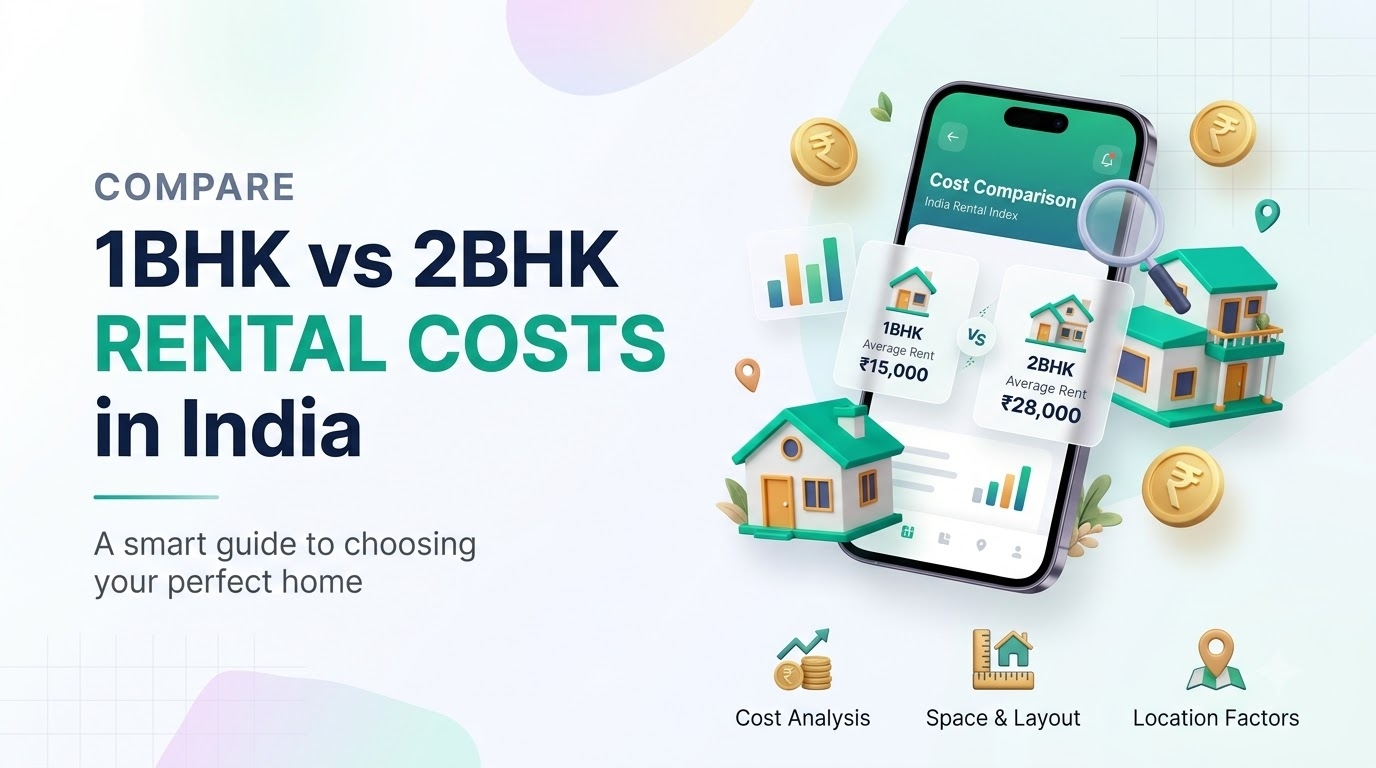
Choosing between a 1BHK and a 2BHK apartment is one of the most common decisions tenants face when searching for a rental home in India.
A 1BHK apartment may offer lower monthly rent and reduced maintenance expenses, while a 2BHK property provides additional living space, privacy, and flexibility.
However, the difference between these two options is not limited to the number of bedrooms.
Rental prices depend on location, property size, furnishing, amenities, and neighbourhood demand. A 2BHK apartment in one locality may even cost less than a 1BHK property in a more expensive neighbourhood.
This makes it important to compare actual housing costs rather than relying only on property configurations.
For tenants evaluating 1BHK vs 2BHK rent in India, understanding rental price differences, total monthly expenses, and long-term housing requirements can help them make a practical decision.
This guide explains how to compare apartment rental costs, evaluate local rent information, calculate affordability, and choose the right property for different household needs.
Understanding the Difference Between 1BHK and 2BHK Apartments
The term BHK stands for bedroom, hall, and kitchen.
A 1BHK apartment generally includes one bedroom, a living area, and a kitchen.
A 2BHK apartment typically includes two bedrooms, a living area, and a kitchen.
However, actual layouts and usable floor areas can vary between properties.
What Is a 1BHK Apartment?
A 1BHK apartment usually suits individuals, couples, or small households that do not require an additional bedroom.
It may also appeal to tenants who want to keep housing expenses manageable.
What Is a 2BHK Apartment?
A 2BHK apartment provides an additional bedroom that can be used for family members, guests, or a home office.
It may be more suitable for households requiring additional privacy and space.
Why Apartment Configuration Matters
The number of bedrooms influences how a home can be used.
However, tenants should also evaluate carpet area, ventilation, storage, bathrooms, and overall layout.
A well-designed 1BHK may sometimes be more practical than a poorly planned 2BHK.
Why 1BHK and 2BHK Rental Prices Differ
Several factors influence the rental price difference between one-bedroom and two-bedroom apartments.
Property Size
A 2BHK apartment generally offers more living space, which may increase its rental value.
Locality
Apartments near employment centres, educational institutions, and major transport routes may command different rents.
Furnishing
A furnished apartment may include appliances, beds, wardrobes, and other household items.
Building Amenities
Parking, security, lifts, and power backup may influence rental prices.
Property Condition
A recently renovated apartment may cost more than an older property requiring maintenance.
Housing Demand
Rental demand can differ between neighbourhoods and property types.
Because these factors vary, tenants should not assume that every 2BHK apartment costs a fixed percentage more than a 1BHK.
How to Compare 1BHK vs 2BHK Rent in India
A useful comparison begins with properties that share similar characteristics.
Step 1: Choose the Same Locality
Start by comparing apartments within the same neighbourhood.
This reduces the influence of location differences.
Step 2: Review Carpet Area
Two properties with the same BHK configuration may have very different usable floor areas.
Step 3: Compare Furnishing
Avoid comparing a fully furnished 1BHK directly with an unfurnished 2BHK without accounting for the difference.
Step 4: Check Maintenance Charges
Larger apartments may have higher maintenance fees, depending on the building's charging structure.
Step 5: Evaluate Utilities
Electricity and other household expenses may vary according to property size, appliances, and usage.
Step 6: Compare Actual Rent Information
Property advertisements show asking prices, which may differ from amounts tenants actually pay.
Reviewing available locality-wise rental price data can help renters understand reported housing costs in different Indian neighbourhoods.
Step 7: Calculate the Total Monthly Expense
Include rent, maintenance, utilities, commuting, and other recurring costs.
This provides a more complete comparison than monthly rent alone.
How Locality Affects Apartment Rental Costs
Location is one of the most important factors in rental affordability.
A 1BHK in a premium neighbourhood may cost more than a 2BHK in an area farther from major employment centres.
Workplace Connectivity
Tenants working in office districts may prefer nearby housing to reduce commuting time.
Public Transportation
Metro stations, bus services, and railway connectivity can influence neighbourhood preferences.
Educational Institutions
Students and families may prioritize properties near schools and colleges.
Local Facilities
Grocery stores, healthcare facilities, and everyday services can improve residential convenience.
Housing Availability
Different neighbourhoods offer different numbers and types of rental properties.
Tenants should compare the cost of living in each locality rather than focusing only on apartment size.
Comparing Total Monthly Housing Expenses
Monthly rent is only one part of the total cost of living in a rental property.
A larger apartment may also involve higher maintenance and utility expenses.
Example: 1BHK Monthly Expenses
Consider a hypothetical 1BHK apartment with the following monthly costs:
Rent: ₹16,000
Maintenance: ₹1,200
Electricity and water: ₹1,800
Internet: ₹800
Transportation: ₹2,500
The estimated total monthly expense is ₹22,300.
Example: 2BHK Monthly Expenses
Now consider a hypothetical 2BHK apartment:
Rent: ₹23,000
Maintenance: ₹2,000
Electricity and water: ₹2,500
Internet: ₹800
Transportation: ₹2,500
The estimated total monthly expense is ₹30,800.
Understanding the Difference
In this example, the 2BHK apartment costs ₹8,500 more per month.
Over twelve months, that difference amounts to ₹1,02,000.
These figures are illustrative rather than actual market averages.
The purpose is to show how a relatively small monthly difference can become significant over time.
Is a 1BHK Apartment Better for Working Professionals?
A 1BHK apartment can be suitable for working professionals who prioritize affordability and manageable living space.
Lower Housing Expenses
A smaller apartment may reduce rent and selected maintenance costs.
Easier Household Management
A compact home may require less time for cleaning and general upkeep.
Suitable for Individual Living
A 1BHK can provide sufficient space for one person, depending on their requirements.
Better Budget Flexibility
Lower housing expenses may leave more money available for savings and other priorities.
Potential Limitations
A 1BHK may feel restrictive when multiple people need separate workspaces or bedrooms.
Working professionals should consider whether their housing needs may change during the rental period.
When Does Renting a 2BHK Make More Sense?
A 2BHK apartment may provide better value when additional space serves a practical purpose.
Families With Children
An extra bedroom may help households manage privacy and sleeping arrangements.
Couples Working From Home
The second bedroom can function as a dedicated workspace.
Shared Rental Arrangements
Two working professionals may share a 2BHK and divide eligible household expenses.
Frequent Guests
An additional room may be useful for visiting family members.
Longer-Term Housing Plans
Tenants expecting changes in household size may prefer a property with additional space.
However, these benefits should be weighed against the higher financial commitment.
How Shared Renting Changes the Cost Comparison
Sharing an apartment can make a larger property more affordable on a per-person basis.
For example, suppose a 1BHK costs ₹16,000 per month, while a 2BHK costs ₹24,000.
If two tenants share the 2BHK equally, each pays ₹12,000 in base rent.
This may be lower than the cost of renting separate 1BHK apartments.
Consider Privacy
Shared accommodation may require compromises regarding common spaces and daily routines.
Divide Expenses Clearly
Roommates should agree on how rent, utilities, maintenance, and other costs will be shared.
Review Agreement Conditions
The rental agreement should clearly identify permitted occupants and relevant responsibilities.
Plan for Roommate Changes
Tenants should understand what happens if one occupant moves out before the agreement ends.
Shared renting can reduce individual costs, but it also introduces additional practical considerations.
Understanding Security Deposit Differences
Security deposits are an important part of the upfront cost of renting an apartment.
The requested amount may vary depending on location, landlord preferences, agreement conditions, and applicable law.
Comparing Deposit Amounts
Suppose a landlord requests a deposit of ₹48,000 for a 1BHK with ₹16,000 monthly rent.
The deposit equals three months of rent.
If another landlord requests ₹75,000 for a 2BHK with ₹25,000 monthly rent, that deposit also equals three months of rent.
Comparing deposits in months of rent can make different offers easier to understand.
Confirm Refund Conditions
Tenants should review when the deposit will be refunded and which deductions may apply.
Check Upfront Affordability
A larger deposit can create a financial burden even when monthly rent is manageable.
Review the Agreement
Deposit arrangements should be documented clearly.
The deposit amount alone does not determine whether a rental offer is fair.
How to Evaluate Rental Affordability
Affordability depends on income, existing expenses, financial responsibilities, and savings goals.
There is no single rent-to-income ratio that suits every household.
Calculate Monthly Take-Home Income
Use the amount available after applicable deductions.
Identify Essential Expenses
Include food, transportation, education, healthcare, and other necessary payments.
Account for Savings
Consider emergency savings and long-term financial priorities.
Estimate Total Housing Costs
Add maintenance, utilities, and other recurring expenses to the monthly rent.
Evaluate Financial Flexibility
A property may technically fit the budget while leaving very little room for unexpected expenses.
A sustainable housing decision should balance comfort with financial stability.
How to Use Actual Rent Data When Choosing an Apartment
Rental listings are helpful for discovering available properties.
However, asking prices do not always represent final agreed rents.
Actual rent information can provide additional context.
Review Comparable Properties
Focus on reports from similar apartment configurations.
Consider Data Freshness
Recent rent reports may be more relevant to current housing decisions.
Check the Number of Observations
A larger collection of comparable reports generally provides more context than a single observation.
Understand Median Rent
Median rent represents the middle amount in an ordered collection of rental payments.
It can help reduce the influence of unusually high or low observations.
Avoid Overinterpreting Limited Data
A small or unrepresentative set of reports cannot establish the exact market value of a property.
Tenant-reported information should support, rather than replace, direct property verification.
Questions to Ask Before Renting a 1BHK or 2BHK
Tenants should ask practical questions before selecting an apartment.
Is Maintenance Included?
Confirm whether the quoted rent includes society maintenance charges.
What Is the Carpet Area?
Ask for the usable floor area rather than relying only on the number of bedrooms.
Are Utilities Separately Metered?
Understand how electricity and water charges are calculated.
Is Parking Available?
Confirm whether parking is included or charged separately.
What Repairs Are Required?
Inspect the property and document existing problems.
What Is the Notice Period?
Understand the conditions for ending the rental arrangement.
How Will Rent Increase?
Review any rent escalation terms mentioned in the agreement.
What Are the Deposit Refund Conditions?
Check the procedure and timing for deposit repayment.
These questions help renters compare the complete rental arrangement rather than only the advertised price.
Common Mistakes When Comparing 1BHK and 2BHK Rentals
Several mistakes can lead to an unsuitable or unnecessarily expensive housing decision.
Comparing Only Monthly Rent
Maintenance and utilities can change the total cost difference.
Ignoring Carpet Area
A property with more bedrooms may not always provide substantially more usable space.
Overlooking Commuting Expenses
A cheaper apartment in a distant locality may increase transportation costs.
Choosing Extra Space Without a Clear Need
Renting a larger apartment may create unnecessary expenses when the additional room is rarely used.
Ignoring Future Household Needs
A smaller apartment may become unsuitable if living arrangements change.
Relying on One Property Listing
One advertised price does not represent the entire local rental market.
Skipping Property Verification
Tenants should inspect the apartment and confirm important details before paying.
Avoiding these mistakes can improve both affordability and living comfort.
How MyBharat Rent Helps Tenants Compare Local Rental Markets
People searching for rental apartments often see multiple asking prices without knowing what other tenants pay nearby.
This information gap can make it difficult to judge whether a property is reasonably priced.
MyBharat Rent focuses on tenant-contributed rental information through an interactive map of Indian localities.
Users can explore available rent reports and compare housing costs across neighbourhoods.
This can provide an additional reference when evaluating 1BHK and 2BHK rental options.
However, reported prices should be interpreted according to property characteristics, data freshness, and the number of available observations.
The platform is most useful as a research resource alongside current listings, property inspections, and direct discussions with owners.
Final Thoughts
Choosing between a 1BHK and a 2BHK rental apartment in India depends on more than the number of bedrooms.
Tenants should compare locality, carpet area, furnishing, monthly rent, maintenance charges, and total household expenses.
A 1BHK may be suitable for individuals and couples who want manageable housing costs.
A 2BHK may provide better value for families, shared accommodation, or households requiring an additional room.
Actual rental information can help renters understand local pricing, but every comparison should account for differences between properties.
Before signing an agreement, tenants should verify the apartment, calculate upfront and recurring costs, and review all important rental terms.
The right rental home is one that meets practical living needs without creating unnecessary financial pressure.