
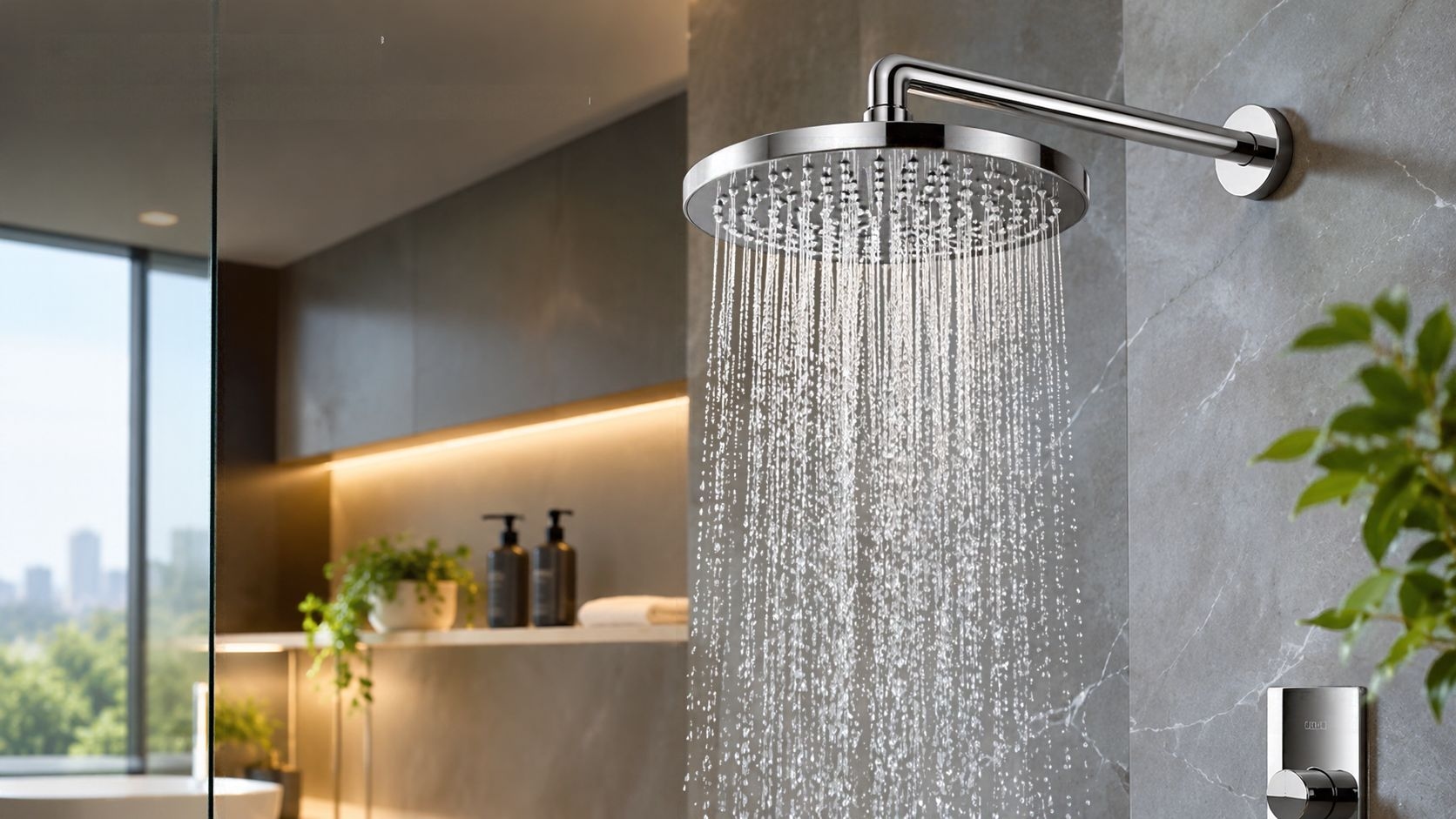
Here's a mistake that repeats on almost every premium project: the client approves a rain shower head from a showroom display, where the water runs at full mains pressure. Then it's installed on a floor fed by a rooftop tank, and it drips. Choosing the best rain shower head isn't a style exercise. It's a pressure, material and supplier-vetting exercise, and the style only works if those three are right.
Rain Shower Head Specifications That Never Make the Brochure
Size and Spray Coverage
Panels run from 200 mm to 400 mm. Bigger doesn't automatically mean better, and most buyers pick size by looks, then blame the supplier when the spray feels thin. A compact 200 mm head often performs better in a small bathroom with modest pressure.
Flow Rate and Pressure
A rain-style head spreads water over many more nozzles than a standard jet head, so it needs more pressure to feel like rain. The US EPA WaterSense label caps showerheads at 2.0 gpm (7.6 L/min), a useful reference when comparing claimed flow rates. Here's the detail buyers skip: ask for flow tested at your building's actual pressure, because a rooftop-tank supply can fall well under 1 bar.
Body and Arm Material
Solid brass holds up, stainless steel suits coastal sites, and ABS is acceptable for budget homes with soft water. Thin ABS panels can sag at the arm joint under prolonged hot water. A ceiling-fixed unit that comes loose means your tiler, plumber and painter all return.
Nozzles and Hard Water
IS 10500 lists 200 mg/L as the acceptable limit for total hardness, and many Indian cities run above it. Silicone nozzles can be rubbed clean. Rigid nozzles scale within months, and a large panel has a lot of them to clog.
Five Questions to Ask Before You Approve a Rain Shower Head Supplier
Put these to any rain shower head supplier, including us.
What's the lowest pressure it works at? Good: tested data at 0.5, 1 and 3 bar. Bad: "works on any pressure." It doesn't.
What does the plating report say? Good: batch-wise salt spray results (EN 248 cites 24 hours for nickel-chromium coatings). Bad: a single certificate dated years ago.
How does the head join the arm? Good: a threaded brass or steel joint with a stated load limit. Bad: a plastic collar no one can describe.
What happens when a unit fails? Good: a written replacement window. Bad: "we'll handle defects case by case." That isn't a policy. It's a negotiation you'll lose after the shipment lands.
Will bulk match the approved sample? Good: tolerance limits in writing. Bad: a flawless sample followed by a different bulk lot.
Choosing on sample appearance alone is how you end up with 400 units that don't resemble the one on your desk.
What the Right Rain Shower Head Protects on Your Margin
The EPA estimates that showers account for roughly 17 percent of indoor household water use, so flow data matters for more than aesthetics.
Fewer plumber revisits. Each callback on a sold flat costs labour and goodwill.
Lower warranty exposure. Sound plating and a solid arm joint cut finish and sagging claims.
Clean handover inspections. Matching finishes across a block keep sign-off on schedule.
Documented water savings. Verified flow gives hotels figures for sustainability reports.
Painless reorders. Same spec, same result, no fresh approval cycle.
Specified look, no failure risk. Architects get the finish they drew, and you don't absorb the fix.
Why Buying Near the Brass Belt Shortens Your Rework Cycle
India's brass component work clusters heavily around Jamnagar in Gujarat, with plating and finishing units spread across Gujarat and Haryana. Buy near that belt and a rejected lot gets reworked in days. Buy through layers of traders and it gets argued about for weeks.
Search for rain shower head manufacturers in India and traders appear first. Many rain shower head suppliers in India outsource casting, plating and assembly, and can't answer a single process question. Uncomfortable, but true. Ask for the factory's name before you discuss price. Nobody tells you how long it takes to trace one SKU to its real production line. Budget a week.
About Us
We build premium bath fittings for luxury homes and for commercial projects that need 400 identical units, not 400 close enough ones. Every rain shower head we ship is leak-tested before packing. [Add one real operational fact here, such as a material or process change made after buyer feedback, with the year.] That's what decades of manufacturing teach you.
Conclusion
The best rain shower head is the one that performs at your building's pressure, not the one that looks best on a render. Treat it as an engineering part with a design finish. Next time, ask for flow data before you ask for finish samples.
FAQs
1. What's the best rain shower head for a low-pressure bathroom?
A compact 200 mm model tested at 0.5 bar. Even then, a booster pump is sometimes the real fix.
2. What should I verify with rain shower head manufacturers first?
Plating test reports and body material grade. If they can't produce both on a call, move on.
3. Do rain shower head suppliers offer custom finishes?
Usually. Matte black and brushed gold take longer to qualify and can raise the MOQ.
4. Is a bigger rain shower head always better?
No. Beyond 300 mm it needs strong supply pressure, or the spray thins out.
5. Can I buy from rain shower head manufacturers in India without a dealer?
Factory-direct works above MOQ. Below it, dealers stock and ship faster, so direct isn't always






