
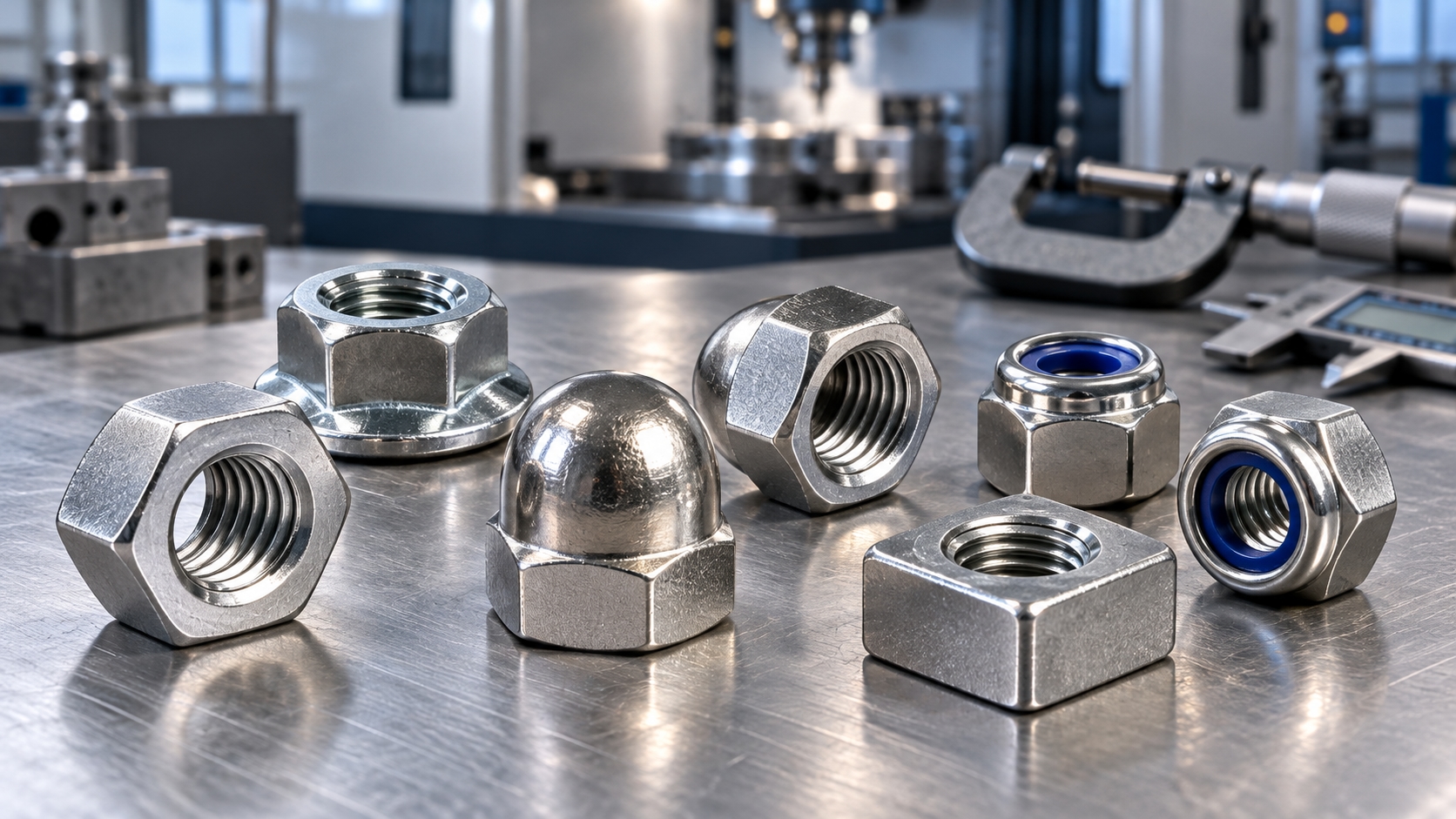
A bolt gets blamed. The nut gets forgotten. Then a joint loosens on a line running sixteen hours a day, and nobody can say which nuts went in. Choosing the best nuts for industrial applications has less to do with price per piece than with what a failure costs after the machine ships. Most buyers spec the bolt carefully and treat the nut as an afterthought.
That's backwards.
Industrial Nuts: Types and the Spec Detail Most Buyers Skip
Hex, Flange and Lock Nuts
Hex nuts (ISO 4032 for metric) cover most jobs. Flange nuts spread the clamp load and take a washer out of your bill of materials. Lock nuts earn their place where vibration never stops, though nylon-insert versions lose grip above roughly 120°C. That rules them out near engines and furnaces.
Property Class and Coating
ISO 898-2 sets the property classes for nuts. Class 8 pairs with 8.8 bolts, class 10 with 10.9, class 12 with 12.9. Here's the detail buyers skip: a class 8 nut on a 10.9 bolt can strip before the bolt reaches its rated load, and nothing on the drawing warned anyone.
Coating is the other trap. Zinc or galvanizing eats into thread tolerance, so a nut that gauged fine bare can refuse to turn on a coated bolt. Getting that allowance right is harder than it looks, and plenty of rejected lots trace back to it.
Five Questions That Expose a Weak Nuts Supplier
Can you show a certificate for this batch? Good: an EN 10204 3.1 certificate tied to the heat number. Bad: a generic certificate with no traceability. A certificate you can't trace to your lot is decoration.
How do you control thread and dimensions? Good: gauge checks per lot, backed by CNC machining and centerless grinding. Bad: "within standard," with no data.
Will you work from my drawing? Good: they question your tolerances before quoting. Bad: an instant "yes" to everything. Real custom manufacturing from drawings starts with questions.
What happens when a lot fails? Good: a written replacement policy. Bad: "we'll handle defects case by case." That isn't a policy. That's a negotiation you'll lose after the shipment lands.
What's the lead time at my volume? Good: separate figures for 5,000 and 500,000 pieces. Bad: one number for every quantity.
What the Right Nuts Do for Your Margin
Correct nuts rarely get credit. Their absence gets noticed.
Class-matched nuts keep the joint at the bolt's rated load, so you stop over-specifying a heavier bolt to compensate. Consistent threads let operators run nuts down by tool instead of forcing them, which protects line speed and coating. Batch-to-batch uniformity lets you cut incoming inspection samples, and every sample you skip is labour back in your margin. Proper lock design reduces warranty callbacks, the most expensive way to discover a spec error. Stainless nuts rated 70 under ISO 3506 carry a 700 MPa proof stress where corrosion rules out plating. And one qualified source for bulk and custom runs means you approve a part once, not three times.
Industrial Nuts Suppliers in India: Why Location Is a Supply Chain Decision
Fastener manufacturing in India clusters around Ludhiana and Rajkot, while demand sits with automotive and machinery belts near Pune, Chennai and the NCR.
That gap matters.
Buyers using industrial nuts suppliers in India's nearest cluster cut transit days on every urgent reorder. They can also walk a sample lot through a plant visit instead of trusting courier photos. Ask each shortlisted supplier which standards they work to. IS 1363 covers hexagon nuts alongside ISO. Industrial nuts manufacturers in India who can't name the standard on a call shouldn't be quoting your drawing.
About Us
We manufacture nuts to customer drawings, using CNC machining and centerless grinding to hold dimensions lot after lot. Our bulk runs are built for repeat orders, not one-off showpieces. Here's what we've learned: a drawing that only says "M12 nut" has caused us more rework than any machine fault. So we ask for the mating bolt's property class and coating before we quote a single piece. As nuts manufacturers, we'd rather lose a quote than ship a nut that won't turn.
The Weakest Part of a Joint Is Usually the Part Nobody Specified
Good nuts never show up in a failure report, and that's the point. Match the class, check the coating allowance, and test the supplier before you test the part. The buyers who'll do best from here are the ones who put nuts on the drawing with the same care as the bolt.
FAQs
What are the best nuts for industrial applications?
Start from the bolt. Match the nut's property class to it (class 8 with 8.8, class 10 with 10.9), then choose the lock design by vibration and temperature.
How do I pick between nuts manufacturers?
Ask for a batch certificate and a gauge report before you ask for a price. Nuts manufacturers who hesitate on those two documents will hesitate again when a lot fails.
What should I confirm with industrial nuts suppliers on custom sizes?
Tolerance, thread class and coating allowance, in writing. Tight tolerances on coated nuts add time, so expect a trial lot first.
Is there a minimum order?
Standard sizes start at 1,000 pieces. Custom drawings usually need more, because tooling setup is a real cost. Smaller trial lots are possible, but the per-piece price will be higher.
Can stainless nuts replace zinc-plated ones?
Often, but not blindly. Stainless threads gall against each other under load, so use anti-seize and slower tightening. Strength classes also differ, so recheck the joint.







