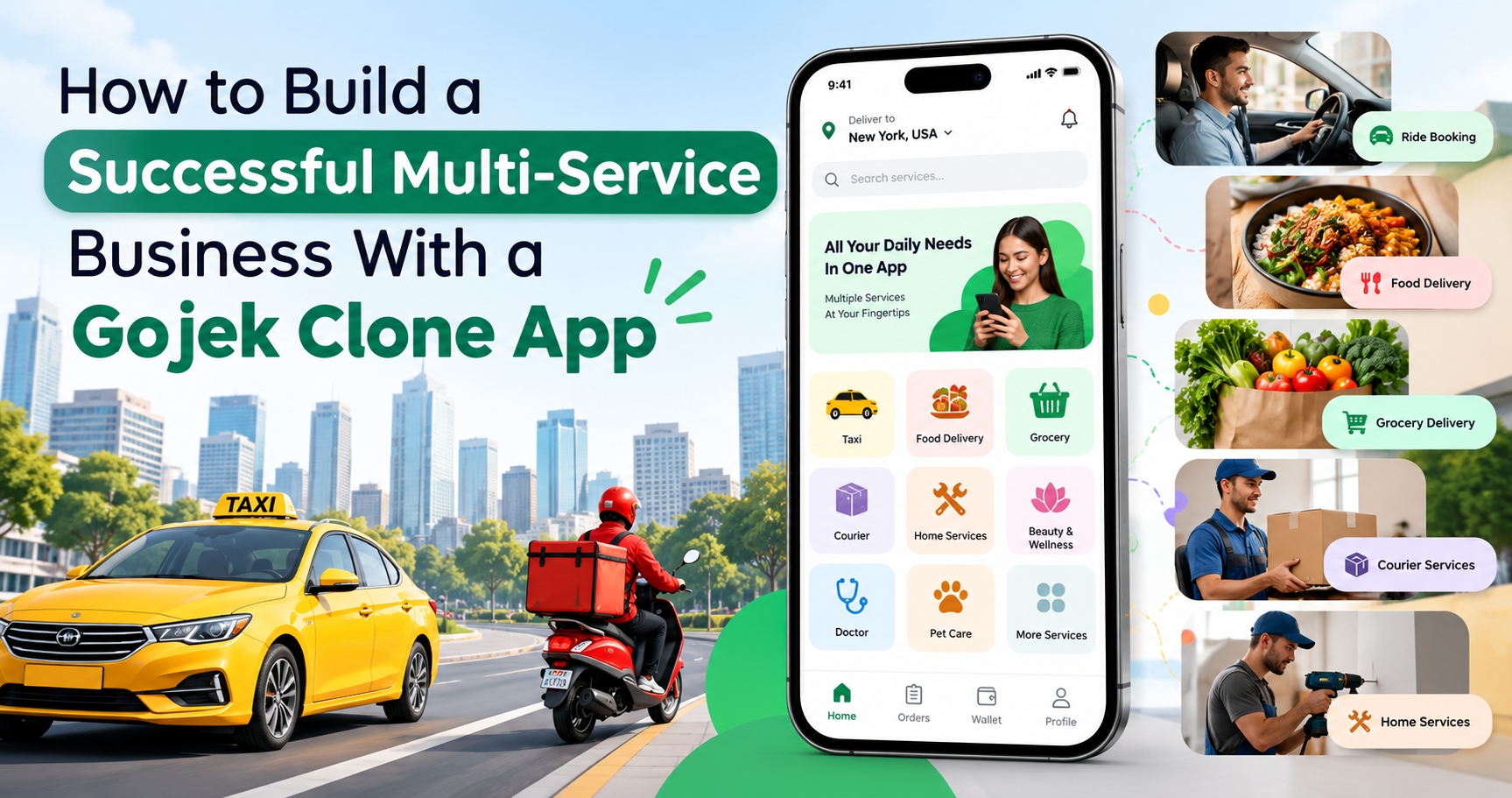
The way people access everyday services has changed significantly. Customers now prefer using digital platforms to book rides, order food, purchase groceries, send packages, and manage other daily needs. Instead of switching between multiple applications, many users appreciate the convenience of accessing several services through one platform.
This shift has created new opportunities for entrepreneurs and established businesses looking to enter the on-demand economy. A multi-service platform can bring different service providers, customers, and delivery partners together within a single digital ecosystem.
However, launching such a business requires more than an attractive application. Business owners need a clear market strategy, reliable technology, effective monetization methods, and a scalable operating model.
A Gojek Clone App offers one possible starting point for entrepreneurs who want to build an all-in-one service platform. With the right planning and customization, businesses can use this approach to introduce multiple services under their own brand and expand as customer demand grows.
What Is a Gojek Clone App?
A Gojek Clone App is a ready-made or customizable software solution designed to help businesses build a multi-service platform similar to the business model popularized by Gojek. It can bring different on-demand services together through a shared digital ecosystem.
Depending on the business requirements, the platform may include ride-hailing, food delivery, grocery shopping, courier services, and home services. Customers can access the available services through a single application, while service providers manage bookings and orders through dedicated interfaces.
A typical platform consists of several components:
Customer app: Allows users to browse services, place orders, make payments, and track bookings.
Service provider app: Helps drivers, delivery partners, restaurants, and other providers manage incoming requests.
Admin panel: Enables business owners to manage users, services, transactions, commissions, and platform operations.
Web interface: Provides additional access to customers, partners, or administrators, depending on the platform's configuration.
The primary advantage of a Gojek Clone App is its flexibility. Instead of developing every component independently, entrepreneurs can start with an existing software foundation and customize it to suit their target audience and business goals.
Why Are Multi-Service Businesses Gaining Attention?
Customers increasingly expect digital services to be convenient, accessible, and reliable. At the same time, businesses are exploring ways to reach more customers without operating completely separate platforms for every service category.
Several developments are making the multi-service business model attractive.
1. Customers Prefer Convenient Digital Experiences
Users often value convenience when choosing a service. A platform that brings transportation, food ordering, grocery shopping, and other relevant services together can reduce the effort required to find and book different providers.
For businesses, this creates an opportunity to build stronger customer relationships by providing multiple reasons for users to return to the same application.
2. Businesses Are Exploring Multiple Revenue Streams
Depending on the services offered, a multi-service platform can generate revenue through delivery fees, booking commissions, subscriptions, convenience fees, and promotional placements.
This diversified approach may reduce dependence on a single service category. However, every service still needs a sustainable cost structure and sufficient local demand.
3. AI Is Creating New Opportunities for Personalization
Artificial intelligence is becoming increasingly relevant to digital marketplaces. Businesses can explore AI-powered recommendations, customer support assistants, demand forecasting, and automated operational insights.
For example, a platform could recommend frequently ordered groceries or suggest relevant services based on a customer's previous activity. These features should be introduced where they provide measurable value rather than added simply to follow a trend.
4. Local Businesses Need Better Digital Access
Restaurants, independent retailers, drivers, and home service professionals may need digital channels to reach more customers. A multi-service platform can provide a shared marketplace where these providers connect with users.
The business opportunity depends on building a balanced network of customers and service providers in the selected market.
How to Build a Successful Multi-Service Business With a Gojek Clone App
Building a successful platform requires a structured approach. Technology is important, but the business model, target market, service quality, and operational strategy determine how effectively the platform serves its customers.
Step 1: Research Your Target Market
Start by identifying the customers you want to serve and the problems your platform will solve.
Research the availability of existing ride-hailing services, food delivery platforms, grocery applications, and other local service providers. Look for gaps such as limited delivery coverage, inconvenient booking processes, inconsistent service quality, or underserved customer segments.
You should also evaluate competitor pricing, service availability, customer expectations, and provider requirements.
For example, a business targeting a suburban market might prioritize grocery delivery, local transportation, and home services rather than introducing every possible category immediately.
Market research helps you choose services based on actual demand instead of assumptions.
Step 2: Select the Right Services for Your Platform
One of the biggest mistakes entrepreneurs make is trying to launch too many services at once. Every additional category introduces new operational requirements, partner relationships, and customer support responsibilities.
Begin with two or three complementary services that address clear customer needs. For example:
Ride-hailing and courier delivery
Food delivery and grocery shopping
Home services and local transportation
Grocery delivery and essential-item delivery
Once the platform develops a stable customer base and reliable provider network, you can introduce additional categories.
A well-planned multi-service app should make expansion possible without making the initial launch unnecessarily complicated.
Step 3: Choose a Suitable Development Approach
Businesses generally consider two approaches when building an on-demand platform: custom development and ready-made software.
Custom development provides greater control over architecture and functionality but usually requires more planning, engineering resources, testing, and ongoing maintenance.
A Gojek Clone App offers an alternative for businesses that want to begin with an existing application structure. The available features can be reviewed, customized, and extended according to the selected business model.
Before choosing a solution, evaluate its source code access, customization options, integration capabilities, security practices, and scalability.
Ask whether the software supports your required service categories and whether additional features can be introduced without major architectural changes.
The goal is not simply to launch quickly. It is to choose a foundation that can support your business as its requirements evolve.
Step 4: Prioritize Essential Features
A successful multi-service platform needs to work reliably for customers, service providers, and administrators.
For customers, essential features may include registration, service discovery, location-based search, booking management, secure payments, order tracking, ratings, and notifications.
Service providers may need availability controls, booking acceptance, service history, earnings reports, and communication tools. The exact requirements depend on whether the provider is a driver, restaurant, courier, retailer, or home service professional.
The admin panel should support user management, service configuration, transaction monitoring, commission settings, promotional campaigns, and operational reporting.
Features such as AI-powered recommendations, loyalty programs, dynamic pricing, and automated support can be considered as the platform matures.
A Gojek Clone App should be evaluated on how well its features support real business operations, not simply on the number of features advertised.
Step 5: Create a Sustainable Revenue Model
A multi-service business needs a clear plan for generating revenue while maintaining competitive pricing.
Common monetization methods include:
Commission-based revenue: The platform earns a percentage of eligible bookings or orders completed through its marketplace.
Delivery and booking fees: Customers may pay fees based on distance, service type, order value, or other disclosed pricing rules.
Subscription plans: Frequent users may receive selected benefits through paid membership plans.
Promotional placements: Restaurants, retailers, and service providers may pay for additional visibility, subject to the platform's policies.
Business partnerships: Selected partners may participate in promotional campaigns or negotiated commercial arrangements.
Not every revenue model will suit every service category. Calculate provider payouts, payment processing fees, customer acquisition costs, support expenses, and operational costs before deciding on commissions or fees.
The objective is to build a model that remains commercially viable for the platform and attractive to its partners.
Step 6: Build a Reliable Service Provider Network
A multi-service application cannot succeed without dependable service providers.
Recruit drivers, restaurants, retailers, delivery partners, or professionals based on the categories you plan to launch. Establish clear onboarding requirements, verification procedures, pricing arrangements, service standards, and payment schedules.
Provider onboarding should be simple enough to encourage participation while maintaining appropriate quality and safety checks.
You should also establish processes for handling cancellations, late deliveries, refunds, customer complaints, and provider disputes.
Consistent service quality helps build customer trust. It also encourages repeat usage, which is essential for a marketplace that depends on regular transactions.
Step 7: Launch Locally and Improve Through Feedback
Instead of expanding across multiple cities immediately, consider launching in a smaller geographic area.
A focused launch allows you to test the booking process, evaluate service availability, identify operational issues, and understand customer behavior before investing in broader expansion.
Track important metrics such as completed bookings, repeat purchase rate, average order value, cancellation rate, provider response time, customer acquisition cost, and contribution margin.
Use customer feedback and operational data to prioritize improvements. Once the platform demonstrates reliable service delivery and sustainable unit economics, you can consider entering additional locations or introducing new categories.
Key Challenges to Consider Before Launching
Although a multi-service business offers several opportunities, it also comes with practical challenges.
Managing different service categories: Each category has distinct workflows, pricing rules, and operational requirements. The software must accommodate these differences without making the customer experience confusing.
Maintaining service quality: Poor provider performance can damage the reputation of the entire platform. Clear standards, monitoring, and complaint resolution processes are essential.
Balancing supply and demand: Customers expect services to be available when needed, while providers want a steady flow of bookings. Demand forecasting and location-based operations can help businesses manage this balance.
Protecting customer information: Payment information, location data, and personal details require appropriate security controls, access restrictions, and privacy practices.
Controlling expansion costs: Adding services and entering new markets can increase support, marketing, technology, and operational expenses. Expansion should follow validated demand rather than ambitious launch targets alone.
Understanding these challenges early helps entrepreneurs prepare realistic budgets and operating plans.
How to Choose the Right Gojek Clone App Development Partner
Your technology partner can influence the platform's reliability, customization options, and long-term maintainability.
Before selecting a provider, review the following factors:
Customization capabilities: Confirm that the solution can accommodate your preferred services, workflows, branding, and monetization model.
Source code ownership: Understand the licensing terms, code access, modification rights, and ownership conditions.
Technical scalability: Evaluate the architecture, performance testing, infrastructure options, and ability to support future growth.
Third-party integrations: Check compatibility with payment gateways, maps, notifications, analytics, and other required services.
Security and maintenance: Review security practices, update policies, bug-fixing support, and technical documentation.
Post-launch assistance: Establish what support is included during deployment and after the platform goes live.
Ask for a product demonstration and clarify delivery timelines, implementation costs, and any recurring charges before making a decision.
A suitable development partner should understand your business requirements and explain the practical trade-offs involved in launching and maintaining the platform.
Conclusion
Building a multi-service business requires a clear understanding of customer needs, a focused launch strategy, reliable service providers, and a sustainable revenue model. A Gojek Clone App can provide a practical starting point for entrepreneurs who want to bring multiple on-demand services together under one brand.
The most effective approach is to begin with services that address proven market demand, prioritize essential features, monitor business performance, and expand gradually. Technology should support this strategy rather than replace proper business planning.
Working with an experienced Clone App Development Company can help businesses evaluate suitable software, customize the platform, and prepare for future expansion. With the right combination of market research, operational discipline, and scalable technology, entrepreneurs can build a multi-service platform designed around their customers and long-term business goals.
Frequently Asked Questions
1. What is a Gojek Clone App?
A Gojek Clone App is a customizable software solution that helps entrepreneurs launch a multi-service platform offering services such as ride-hailing, food delivery, grocery delivery, courier services, and home services through one application.
2. How can a Gojek Clone App help startups launch a multi-service business?
A Gojek Clone App provides a ready-made software foundation that startups can customize with their branding, preferred service categories, and business features. This approach can reduce the need to develop every component from scratch.
3. What features should a multi-service app like Gojek include?
A multi-service app should include user registration, service booking, real-time tracking where applicable, secure payments, order management, push notifications, ratings, and an admin panel. Additional features can be introduced according to business requirements.
4. How does a Gojek Clone App generate revenue?
A Gojek Clone App can generate revenue through booking commissions, delivery fees, subscription plans, promotional listings, and service charges. The suitable revenue model depends on the target market, service categories, and operating costs.
5. How do I choose the right Gojek Clone App development solution?
Evaluate customization options, source code access, scalability, security, third-party integrations, maintenance support, and compatibility with your business model. Choose a solution that meets your current requirements and supports future expansion.