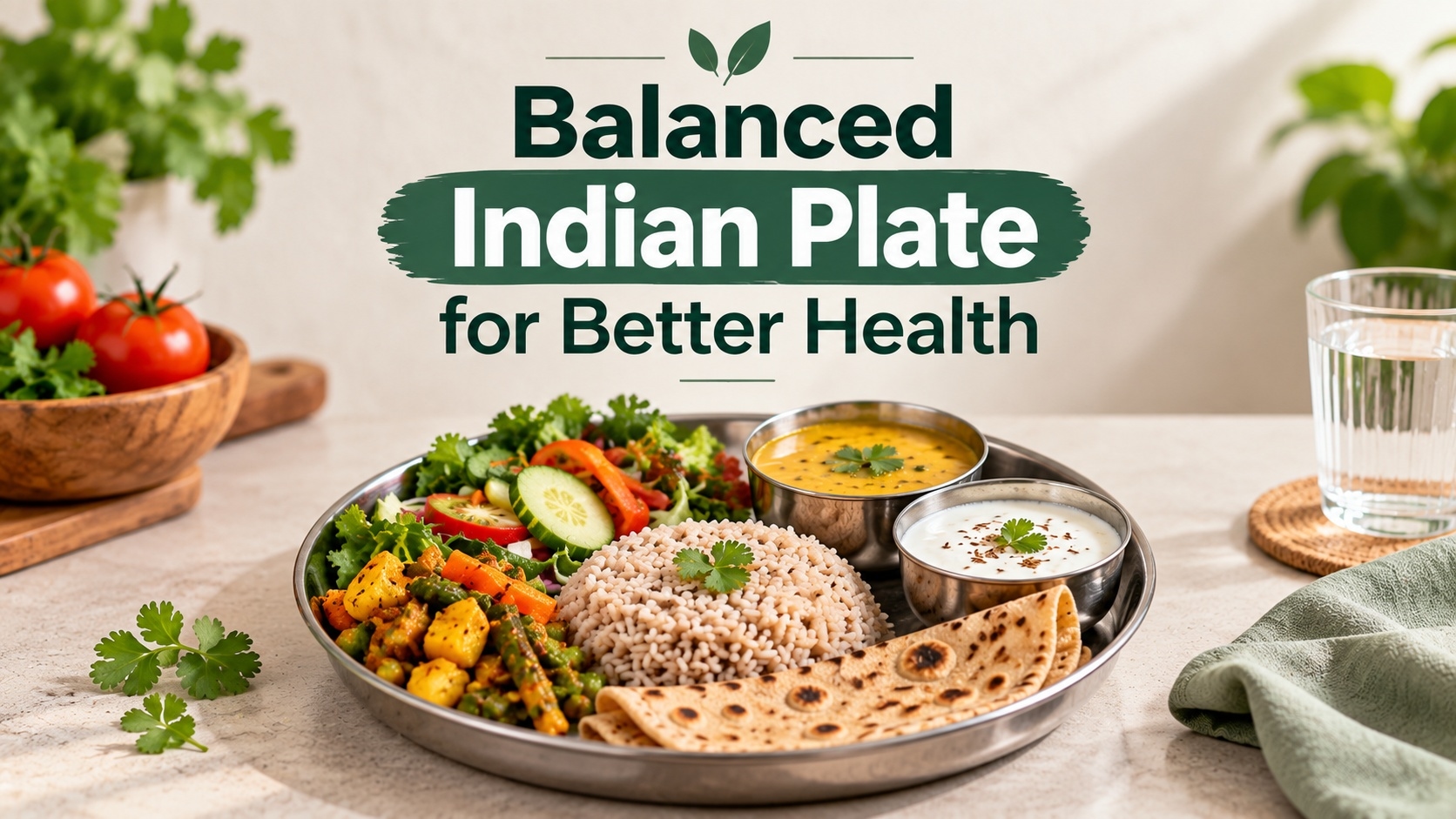
What does a healthy Indian meal actually look like?
For many people, the answer is confusing. Should you eat less rice? Should you stop eating roti? Is dal enough protein? Should you add salad to every meal?
The truth is much simpler.
A balanced Indian plate for better health should include a sensible mix of vegetables, protein-rich foods, whole grains or other carbohydrates, healthy fats, and enough fluids. The exact portions can change based on your age, activity, health goals, and medical needs.
And you don't need to give up the foods you grew up eating.
Dal, roti, rice, sabzi, curd, idli, dosa, poha, chana, paneer and many other Indian foods can all fit into a healthy eating pattern.
Quick Answer
A balanced Indian plate usually includes plenty of vegetables, a good source of protein, a suitable portion of rice, roti, millet, or another carbohydrate, and a small amount of healthy fat. Fruit, curd, nuts, and seeds can be included throughout the day.
The exact portions depend on your individual needs. A person trying to lose weight may need a different plate from someone who is highly active or trying to gain weight.
What Is a Balanced Indian Plate?
A balanced plate is simply a meal where different food groups work together.
Instead of making one food the centre of every meal, you include a combination of foods that provide different nutrients.
For example:
Dal + roti + sabzi + curd
or
Rice + rajma + vegetables + salad
or
Idli + sambar + vegetable side
These are familiar Indian meals. You don't need imported ingredients or expensive health foods to eat well.
A healthy eating pattern should provide a variety of foods, including vegetables, fruits, legumes, whole grains, nuts, seeds, and suitable protein sources. The World Health Organization recommends limiting excess free sugars, salt, saturated fat, and trans fat as part of a healthy diet.
Why Does a Balanced Plate Matter?
Your body needs different nutrients for different jobs.
Protein supports muscles and tissue repair.
Fibre supports digestive health.
Carbohydrates provide energy.
Healthy fats support normal body functions and help with the absorption of certain vitamins.
Vitamins and minerals support many processes in the body.
This is why eating only one type of food is rarely a good long-term strategy.
For example, having only a large bowl of rice may fill you up, but adding dal, vegetables, and curd gives the meal a wider range of nutrients.
It is not about making your plate perfect.
It is about making it more balanced.
What Should Be on Your Indian Plate?
There isn't one exact plate that works for everyone.
Still, you can use a simple structure as a starting point.
Food Group | Indian Food Examples |
Vegetables | Palak, bhindi, beans, lauki, carrot, cabbage |
Protein | Dal, chana, rajma, paneer, tofu, eggs, fish |
Carbohydrates | Roti, rice, oats, millets, poha, potatoes |
Healthy fats | Nuts, seeds, peanuts, suitable cooking oils |
Fermented foods | Curd, buttermilk, other suitable fermented foods |
Fruits | Guava, apple, orange, papaya, pomegranate |
The important part is variety.
You don't have to eat all of these foods in one meal.
Think about your entire day.
1. Fill a Good Portion of Your Plate With Vegetables
Vegetables are often treated as a side dish.
Try giving them a more important place on your plate.
You can use:
Spinach
Methi
Bhindi
Lauki
Beans
Carrot
Cauliflower
Cabbage
Pumpkin
Tomatoes
Mixed vegetables
Cook them as sabzi, add them to dal, make a soup, or include them in a salad.
WHO recommends at least 400 grams of fruits and vegetables each day for adults and children over 10 as part of a healthy diet.
You don't need to weigh your vegetables every day.
Just ask yourself:
"Where are my vegetables in this meal?"
If the answer is "nowhere," add some.
2. Add a Protein Source
Protein is one part of Indian meals that often gets overlooked.
A meal of rice and vegetables may look healthy, but adding dal, beans, curd, paneer, tofu, eggs, fish, or another protein source can make it more filling and nutritionally complete.
Vegetarian protein options
Dal
Rajma
Chana
Lobia
Soy
Tofu
Paneer
Curd
Milk
Nuts and seeds
Non-vegetarian options
Eggs
Fish
Chicken
Other suitable lean protein sources
You don't need to eat chicken or eggs if you are vegetarian.
Indian vegetarian diets already offer plenty of protein-rich foods.
3. Choose Your Carbohydrates Wisely
Carbohydrates are not the enemy.
Rice and roti are common parts of Indian meals, and they can fit into a balanced diet.
The question is more about how much you eat and what you eat with them.
Compare these two meals:
Meal A:
Large bowl of rice + very little protein or vegetables
Meal B:
Moderate rice portion + dal + vegetables + curd
Both contain rice.
But the second meal gives you a wider mix of nutrients.
You can also rotate your carbohydrate sources:
Whole wheat roti
Brown rice
Regular rice
Oats
Millets
Barley
Poha
Upma
You don't have to completely replace rice with millets just because millets are popular.
4. Don't Forget Healthy Fats
Fat is part of a balanced diet too.
You can get fats from:
Nuts
Seeds
Peanuts
Sesame
Flaxseeds
Chia seeds
Suitable plant oils
Avocado
The amount matters.
For example, nuts are nutritious, but eating several handfuls while watching television can turn a small snack into a much larger calorie intake.
A small portion is usually enough.
5. Add Curd When It Suits You
Curd is a common food in many Indian homes.
You can have it with lunch, add it to a meal as raita, or use it as part of a snack.
It also adds protein and calcium.
Try simple combinations such as:
Rice + dal + vegetable + curd
or
Roti + sabzi + paneer + curd
If dairy does not suit you, there are other ways to meet your nutritional needs.
6. Include Fruit Across the Day
Fruit doesn't have to be complicated.
Choose whatever is available and suits you.
Some easy options include:
Guava
Apple
Papaya
Orange
Pomegranate
Banana
Seasonal fruits
You can have fruit with breakfast or as an afternoon snack.
Whole fruit is generally more useful as a regular choice than relying heavily on packaged fruit drinks.
How Much Should You Eat?
This is where many people want a fixed answer.
But there isn't one portion size that works for everyone.
Your needs can depend on:
Age
Sex
Height and body size
Physical activity
Weight goals
Health conditions
Medication
Daily routine
For example, a person who works at a desk all day may need a different energy intake from someone doing physical work or training regularly.
This is why copying another person's diet chart can be misleading.
Instead of asking, "How many rotis should everyone eat?"
A better question is:
"How much food is appropriate for me?"
How to Build a Balanced Indian Plate for Weight Management
If weight management is your goal, you don't automatically need to remove rice or roti.
Start by looking at your overall plate.
Try:
Adding more vegetables
Including a protein source
Keeping carbohydrate portions sensible
Limiting frequent sugary drinks
Reducing deep-fried snacks
Choosing fruit instead of frequent sweets
Paying attention to cooking oil and portion sizes
For example, if you normally eat four rotis with a small amount of sabzi, you might first increase the vegetable portion and include a protein source.
You don't have to make drastic changes overnight.
What Does a Balanced Indian Breakfast Look Like?
Breakfast is often rushed.
You wake up late, have tea, grab biscuits, and leave for work.
Then you are hungry again by 11 a.m.
Try building breakfast around at least two or three food groups.
Options
Poha + peanuts + fruit
Besan chilla + curd
Idli + sambar
Eggs + roti + vegetables
Oats + fruit + nuts
Vegetable upma + curd
These are not complicated meals.
They are simply more balanced than tea and biscuits alone.
What About Lunch?
Lunch can be very simple.
Option 1
Dal + roti + sabzi + curd
Option 2
Rajma + rice + salad
Option 3
Roti + paneer + vegetables
Option 4
Fish + rice + vegetables
Option 5
Vegetable khichdi + curd
If you eat at work, look for meals that contain some combination of vegetables, protein, and carbohydrates.
You don't need to order a "diet meal" every day.
What About Dinner?
Dinner does not need to be extremely light just because it is dinner.
What matters is your total food intake and your individual needs.
You can have:
Dal and vegetables with roti
Paneer or tofu with vegetables
Fish with vegetables and rice
Khichdi with curd
Vegetable soup with a suitable protein source
If you eat late because of work, try planning instead of going the whole evening without food.
Common Mistakes When Building a Healthy Plate
Making the Plate Mostly Carbohydrates
A large portion of rice or several rotis with very little protein and vegetables may not keep you satisfied for long.
Try balancing the meal instead of simply cutting carbohydrates.
Treating Salad as a Complete Meal
A bowl of cucumber and tomato may be refreshing, but it may not provide enough protein or energy for a complete meal.
Add dal, paneer, beans, eggs, tofu, or another suitable protein source.
Adding Too Much Oil
Healthy oils still contain calories.
Measure cooking oil when possible, especially if weight management is your goal.
Drinking Calories Without Realising It
Soft drinks, sweetened coffee, packaged juices, and other sugary drinks can add a lot of sugar.
Water, unsweetened beverages, and suitable alternatives are often better everyday choices.
Copying Someone Else's Plate
Your friend's portion may not be your portion.
Your mother, partner, colleague, or gym friend may have completely different nutritional needs.
How Can a Nutritionist in Bangalore Help?
A Nutritionist in Bangalore can help you understand how to build meals around your individual needs.
This can be especially useful if you:
Want to manage your weight
Have PCOS
Have diabetes or prediabetes
Have digestive concerns
Have a nutrient deficiency
Follow a vegetarian or vegan diet
Have a busy work schedule
Want help planning family meals
A good consultation should look beyond your weight.
Your food habits, health history, lifestyle, activity, preferences, and goals all matter.
For someone working long hours in Bangalore, a nutrition plan may need to include office lunches, restaurant meals, food delivery, travel, and quick breakfast options.
That is much more realistic than expecting you to cook a completely separate meal every day.
A Simple Plate-Building Formula
When you're unsure what to eat, remember this:
Step 1: Add vegetables.
Step 2: Add a protein source.
Step 3: Add a suitable carbohydrate portion.
Step 4: Add a small amount of healthy fat when needed.
Step 5: Drink water.
That's it.
You can use this formula for Indian meals without changing your entire diet.
Frequently Asked Questions
What is a balanced Indian plate?
A balanced Indian plate contains a mix of vegetables, protein-rich foods, carbohydrates, and suitable sources of healthy fat. Examples include dal, vegetables, roti, rice, curd, paneer, beans, eggs, fish, nuts, and seeds. The portions should be adjusted based on your individual health needs, activity level, age, and goals.
How much rice should I eat for a balanced meal?
There is no single rice portion that works for everyone. Your needs depend on factors such as activity level, health goals, and overall diet. Instead of removing rice, combine a suitable portion with protein such as dal or rajma and plenty of vegetables. This creates a more balanced meal than eating a large portion of rice alone.
Is roti healthier than rice?
Neither is automatically better for everyone. Both can fit into a healthy diet. What matters is the type, portion, preparation, and what you eat with them. Whole-grain roti can provide fibre, while rice can also be part of a balanced meal. Your personal health needs should guide the choice.
Can I eat Indian food and still lose weight?
Yes. Indian food can fit into a weight-management plan. Dal, vegetables, roti, rice, curd, paneer, beans, eggs, fish, and other familiar foods can all be included. The main areas to watch are portions, cooking oil, frequent fried foods, sugary drinks, sweets, and your overall daily intake.
What should a healthy Indian breakfast include?
A healthy breakfast can combine protein, fibre, and carbohydrates. Examples include besan chilla with curd, idli with sambar, poha with peanuts and fruit, eggs with roti and vegetables, or oats with fruit and nuts. Choose foods that fit your preferences and keep you satisfied through the morning.
How can a nutritionist in Bangalore help with meal planning?
A nutritionist can help you create meals based on your health goals, food preferences, daily routine, activity level, and medical needs. This can be useful if you work long hours, eat outside often, follow a vegetarian diet, or have a condition that requires specific dietary care. A personalized approach can make healthy eating easier to follow.
Final Thoughts
A balanced plate does not need to look perfect.
Some days you may have dal, rice, sabzi, and curd.
On another day, it might be dosa and sambar.
You may eat out on the weekend.
That's normal.
What matters is what you do most of the time.
Start by looking at your plate before you look at another diet chart.
Ask yourself:
Where are my vegetables?
Where is my protein?
Is my carbohydrate portion suitable for me?
Am I eating because I'm hungry or simply because it is available?
These small questions can change the way you approach food.
And if you are unsure about your portions or have a specific