Introduction
Pursuing a Doctor of Philosophy (PhD) is an important academic step for students and professionals who want to develop specialised knowledge, conduct independent research, and contribute to their chosen field. A doctoral degree provides an opportunity to investigate complex subjects, explore new ideas, and develop expertise in areas such as science, commerce, management, engineering, education, and humanities.
However, applying for a doctoral programme requires careful planning. Candidates need to understand eligibility requirements, entrance examinations, research proposals, university selection, and admission procedures before beginning their applications.
What Is PhD Admission in India?
PhD admission is the process through which eligible candidates secure enrolment in a recognised university or higher education institution to undertake doctoral research.
Unlike undergraduate and postgraduate programmes, a PhD focuses primarily on research, academic investigation, and the development of original contributions to a specific subject area.
Students may pursue doctoral research in several disciplines, including:
PhD in Management
PhD in Commerce
PhD in Computer Science
PhD in Engineering
PhD in Education
PhD in Economics
PhD in English
PhD in Science
PhD in Social Sciences
The availability of research areas depends on the university, its recognised research departments, and the availability of research supervisors.
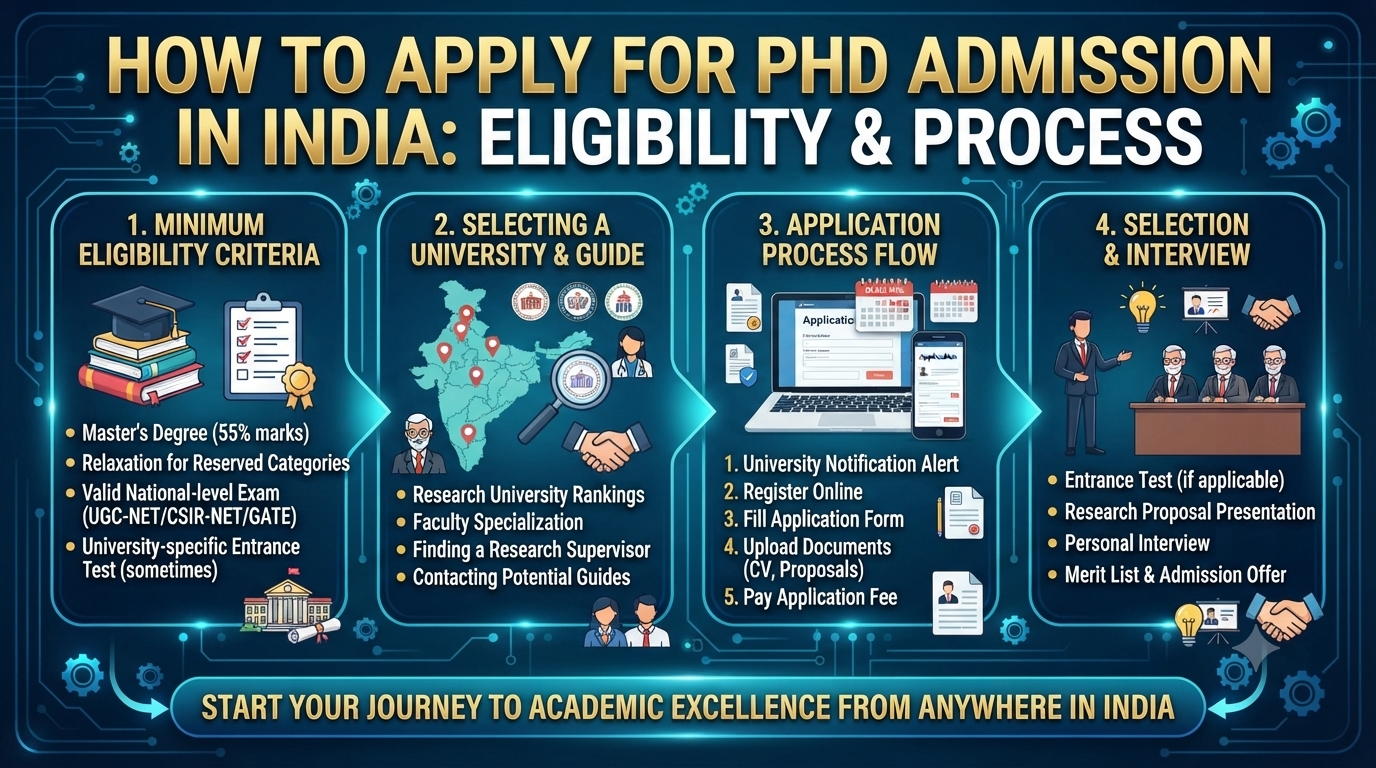
Step 1: Check PhD Eligibility Criteria
The first step towards PhD Admission in India is understanding the minimum educational qualifications required by the university.
Under the UGC PhD Regulations 2022, the general eligibility routes include:
A relevant master's degree with at least 55% marks or an equivalent grade.
Candidates belonging to eligible reserved categories may receive the applicable 5% relaxation.
A four-year bachelor's degree with research or an equivalent qualification with at least 75% marks, subject to applicable conditions.
Candidates with qualifications from recognised institutions must satisfy the relevant admission requirements.
Some universities may have additional subject-specific conditions. Therefore, applicants should review the official PhD admission notification before applying.
Step 2: Select Your Research Subject
Choosing the right research area is one of the most important parts of doctoral admission. Your selected subject should match your academic background, interests, and long-term professional objectives.
For example:
MBA graduates may explore research in marketing, finance, human resources, or business management.
MCom graduates may consider accounting, taxation, banking, or financial management.
MTech graduates may investigate engineering, artificial intelligence, technology, or innovation.
MA graduates may explore literature, economics, sociology, political science, or education.
MSc graduates may pursue research in mathematics, physics, chemistry, computer science, or related sciences.
A well-selected research area can make the doctoral journey more focused and meaningful.
Step 3: Choose a Recognised University
After selecting your research subject, identify universities that offer PhD programmes in your preferred discipline.
Consider the following points before selecting an institution:
UGC recognition and eligibility to offer PhD programmes.
Availability of your preferred research specialisation.
Faculty members and research supervisors.
Research facilities, laboratories, and academic resources.
Admission notifications and available research seats.
University guidelines for coursework and research submission.
It is also useful to review the research work and academic publications of potential supervisors. Choosing a university with suitable research facilities and academic guidance can make your doctoral journey more productive.
Step 4: Understand the PhD Entrance Examination
Many universities use national-level examination scores or their own entrance examinations for PhD selection.
Some important examinations include:
UGC-NET: Used for PhD admission in eligible subjects and for determining JRF and Assistant Professor eligibility.
CSIR-UGC NET: Relevant to eligible science and research disciplines.
GATE: May be considered by institutions for relevant engineering and technology research admissions.
University PhD Entrance Test: Conducted by individual universities according to their admission rules.
Since June 2024, UGC-NET has included three categories for doctoral admission:
Category 1 – Eligible for PhD admission with JRF and Assistant Professor eligibility.
Category 2 – Eligible for PhD admission and Assistant Professor eligibility, without JRF.
Category 3 – Eligible for PhD admission only.
For Category 2 and Category 3 candidates, NET marks carry 70% weightage and the university interview carries 30% weightage. The NET marks are valid for PhD admission for one year from the result declaration date.
Applicants should check the latest examination bulletin and university admission notification to understand which qualification is accepted for their subject.
Step 5: Prepare a Research Proposal
A research proposal is an important document in the PhD admission process. It explains what you intend to study, why the topic is important, and how you plan to conduct the research.
A well-organised research proposal generally includes:
Research Title: A clear description of your proposed research topic.
Introduction: Background information about the selected subject.
Research Problem: The issue or knowledge gap you want to investigate.
Research Objectives: The main goals of your proposed study.
Literature Review: An overview of existing research and relevant studies.
Research Methodology: The methods and approaches you plan to use.
Expected Outcomes: The potential contribution of your research.
The proposal should be relevant to your chosen discipline and follow the university's prescribed format.
Step 6: Complete the Online PhD Application
Once the university releases its PhD admission notification, candidates can proceed with the application.
Follow these steps:
Visit the official university admission website.
Open the PhD admission notification and prospectus.
Register using your email address and mobile number.
Enter personal, academic, and research-related information.
Select your preferred research subject or department.
Upload the required documents.
Pay the application fee through the available payment method.
Submit the form and save the confirmation receipt.
Always check the application deadline and ensure that all information matches your academic documents.
Step 7: Attend the Interview or Research Presentation
After reviewing applications and entrance examination scores, universities shortlist eligible candidates for interviews or research presentations.
During this stage, the selection committee may ask questions about:
Your educational background.
Why you want to pursue a PhD.
Your proposed research topic.
Knowledge of your chosen subject.
Research methodology.
Expected academic contribution.
Your understanding of existing research.
Candidates should prepare their research proposals carefully and be ready to explain their research objectives clearly.
Step 8: Complete Document Verification and Admission
Candidates who successfully qualify through the university's selection process may receive provisional admission or an offer of enrolment.
The next steps generally include:
Verification of academic qualifications.
Submission of original certificates, where required.
Payment of prescribed admission fees.
Completion of university registration.
Allocation or confirmation of a research supervisor.
Participation in the mandatory coursework.
Admission is subject to the university's selection process, available research seats, and applicable regulations.
Documents Required for PhD Admission in India
Keep the following documents ready before applying:
Class 10th and 12th mark sheets.
Bachelor's degree certificate and mark sheets.
Master's degree certificate and mark sheets.
UGC-NET, CSIR-NET, GATE, or other relevant scorecard, if applicable.
Research proposal or synopsis.
Government-issued identity proof.
Recent passport-size photographs.
Category certificate, if applicable.
Experience certificate or employer NOC, where required.
Migration certificate, if requested by the university.
The exact document list may differ between universities and research disciplines.
PhD Admission for Working Professionals
Working professionals who want to continue their careers while pursuing research can explore part-time PhD programmes, provided they meet the university's eligibility and regulatory requirements.
A part-time PhD may be suitable for:
College lecturers and teaching professionals.
Corporate employees interested in academic research.
Engineers and technology professionals.
Banking and finance professionals.
Industry experts interested in specialised research.
Candidates employed in an organisation generally need to submit a No Objection Certificate (NOC) from their employer, confirming that they can fulfil the requirements of the research programme.
Important: A PhD cannot be pursued through distance or fully online mode under UGC PhD Regulations 2022. Part-time PhD is permitted subject to the applicable requirements.
How Long Does It Take to Complete a PhD?
The minimum and maximum duration depend on UGC regulations and the university's academic rules.
Generally, a PhD has a minimum duration of three years, including coursework, and a maximum duration of six years. Applicable extensions and other provisions may be available under university regulations.
Students should understand the research milestones, coursework requirements, progress reviews, thesis submission, and evaluation procedures before enrolling.
Conclusion
Applying for a PhD in India requires careful preparation, from selecting a research subject and checking eligibility to preparing a research proposal and attending the selection interview.
Whether you are a recent postgraduate, lecturer, researcher, or working professional, a doctoral programme can provide an opportunity to develop specialised knowledge and contribute to academic research.
Before applying, verify the university's recognition, admission guidelines, research facilities, entrance examination requirements, and available research seats. A well-planned application can help you take the next step towards your academic and research ambitions.
https://justpaste.it/distance-bca-course
https://janjaonline.mn.co/posts/ma-distance-education-admission-specializations-and-career-scope
https://penposh.com/blogs/28870/MCom-Distance-Education-Course-Benefits-Eligibility-Career-Scope
https://chodilinh.com/threads/msc-distance-education-admission-2027-eligibility-fees-process.692839/