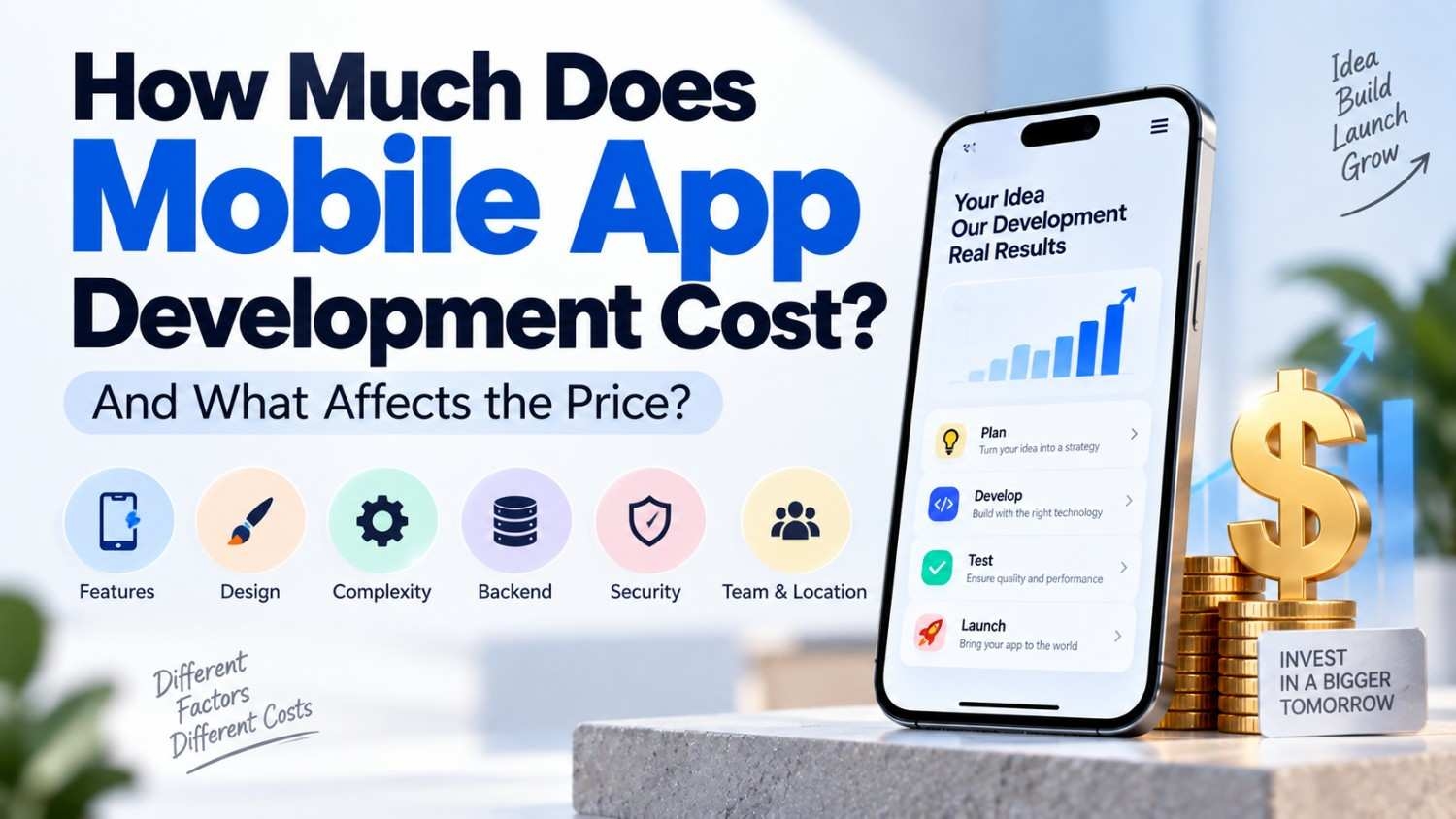
Mobile App Development can range from a relatively straightforward project to a complex digital product requiring multiple integrations, custom backend systems, advanced security, and ongoing maintenance. There is no single development price that applies to every business because the final cost depends on what the application needs to accomplish.
For businesses planning an app, understanding the factors behind development costs is more useful than focusing on one fixed number.
What Is the Typical Cost of Mobile App Development?
Mobile app development costs can vary significantly based on project requirements.
A simple application with a limited number of screens and basic functionality may require considerably less development work than a marketplace, financial application, healthcare platform, or enterprise system.
A practical way to think about the cost is by project complexity:
Basic apps: Limited features, straightforward screens, basic backend requirements, and standard integrations.
Mid-level apps: User accounts, payments, APIs, notifications, dashboards, and more complex workflows.
Complex apps: Advanced integrations, real-time functionality, custom backend architecture, AI features, sophisticated security, or multiple user roles.
These categories provide a starting point, but an accurate estimate requires a detailed feature and technical assessment.
Which Features Have the Biggest Impact on Cost?
The number and complexity of features are among the most important cost factors.
A basic registration and login system requires much less development than an application containing real-time chat, location tracking, payment processing, video streaming, or complex administrative workflows.
Features that can increase development effort include:
User authentication and verification
Social login
Payment gateways
Push notifications
Real-time messaging
GPS and location services
Camera and media processing
AI-powered functionality
Booking systems
Subscription management
Multi-vendor functionality
Advanced search and filtering
Admin and management dashboards
Each feature adds development, testing, integration, and maintenance requirements.
How Does App Design Affect Development Cost?
Design is another factor that can influence the project budget.
A simple application with standard layouts requires fewer custom interface components than a highly customised product with animations, complex interactions, personalised dashboards, and multiple user journeys.
The design process can include:
User research and requirements analysis
User flow planning
Wireframes
UI design
Interactive prototypes
Design system creation
Developer handoff
A well-planned design can also reduce development problems because the required screens, states, and interactions are identified before implementation.
Does Choosing iOS, Android, or Both Change the Cost?
Yes.
Businesses need to determine which platforms their target users require.
Developing separate native applications for iOS and Android can require platform-specific development work. Cross-platform frameworks can allow teams to share portions of the codebase across platforms, although the final approach depends on the application's requirements.
The decision should consider:
Target audience
Required device capabilities
Performance requirements
Development budget
Maintenance expectations
Platform-specific functionality
The cheapest technical option is not automatically the most appropriate one. The technology should match the product requirements.
How Do Backend Requirements Affect Mobile App Costs?
The mobile application is often only one part of the system.
Many apps require a backend responsible for user accounts, data storage, authentication, business logic, APIs, payments, notifications, and administrative operations.
For example, an ecommerce application may require product management, inventory, orders, payments, shipping information, customer accounts, and an admin panel.
A marketplace may require additional seller management, commissions, product approvals, messaging, and transaction workflows.
As backend complexity increases, development and testing requirements also increase.
What Role Do Third-Party Integrations Play?
Mobile applications frequently depend on external services.
Examples include:
Payment gateways
Maps and location APIs
Social login providers
Analytics platforms
Cloud storage
SMS services
Email services
Shipping APIs
CRM systems
AI APIs
Each integration requires configuration, API development, testing, error handling, and sometimes ongoing maintenance.
An application with several external dependencies can therefore require substantially more development work than a standalone application.
How Does Security Affect Mobile App Development Cost?
Security requirements become particularly important when an app handles sensitive information.
Applications dealing with payments, personal information, business records, healthcare information, or financial data may require additional security controls.
Development teams may need to consider:
Secure authentication
Role-based access
Data encryption
API security
Secure storage
Session management
Input validation
Monitoring and logging
Secure payment integration
Security should be considered during architecture and development rather than added only before launch.
Does the Number of User Roles Affect Cost?
Yes.
An application designed for one type of user may have a relatively straightforward workflow.
A platform with customers, vendors, delivery staff, administrators, and managers can require separate dashboards, permissions, workflows, and business rules.
For example, a marketplace may include:
Customer app: Product discovery, ordering, payment, and order tracking.
Seller panel: Product management, inventory, order handling, and sales information.
Admin panel: User management, product approvals, transactions, reports, and platform configuration.
Every additional role can introduce new screens, permissions, APIs, and testing scenarios.
How Much Does Maintenance Add to the Overall Cost?
The cost of mobile app development does not end at launch.
Applications require maintenance as operating systems change, devices evolve, third-party APIs are updated, and users report new issues.
Ongoing work can include:
Bug fixes
Security updates
Performance improvements
OS compatibility updates
Server maintenance
API updates
New feature development
Monitoring and analytics
Businesses should therefore consider the long-term maintenance requirement when calculating the total cost of ownership.
Can an MVP Reduce Initial Development Costs?
An MVP can help businesses control initial development investment by focusing on the core functionality required to validate the product.
Instead of launching with every possible feature, the first version can concentrate on the essential user journey.
For example, a delivery platform might initially focus on registration, order placement, payment, delivery tracking, and basic administration. Advanced loyalty programs, complex analytics, and additional automation could be introduced later.
This approach can reduce initial scope while creating an opportunity to collect real user feedback before expanding the product.
What Should Businesses Ask Before Getting a Development Estimate?
A useful development estimate should be based on clearly defined requirements.
Businesses should prepare information about:
Target users
Platforms
Core features
User roles
Design requirements
Backend requirements
Third-party integrations
Security requirements
Admin functionality
Expected launch scope
Future expansion plans
A development team can then break the project into features and technical components before estimating the effort.
A detailed scope usually produces a more meaningful estimate than a request for a single fixed price.
Why Can Two Similar Apps Have Different Development Costs?
Two applications may appear similar to users while having very different technical requirements.
One may use standard APIs and a simple backend. Another may require custom infrastructure, real-time communication, advanced security, multiple integrations, or complex business rules.
Development cost is therefore influenced by what happens behind the interface as much as what users see on the screen.
The quality of the existing backend, design assets, APIs, documentation, and technical architecture can also affect development effort.
Conclusion
Mobile app development cost depends on the product's features, design, platforms, backend architecture, integrations, security requirements, user roles, and long-term maintenance needs. Businesses can control initial investment by defining a focused MVP, prioritising essential functionality, and planning future features in phases. Working with an experienced mobile app development company can help turn the requirements into a structured development plan with clearer technical scope and cost expectations.
FAQ
How much does mobile app development cost?
There is no universal price because development costs depend on the application's complexity, features, platforms, integrations, design, backend requirements, and maintenance needs.
What is the biggest factor affecting mobile app development cost?
Application complexity is one of the major factors. Features such as real-time communication, payments, AI, location tracking, multiple user roles, and advanced backend workflows can increase development effort.
Is developing for both iOS and Android more expensive?
It can be, depending on the development approach. Separate native applications generally require platform-specific work, while cross-platform technologies can allow code sharing for suitable projects.
Can an MVP reduce mobile app development costs?
Yes. An MVP focuses development on essential features and can reduce the initial scope. Additional functionality can be introduced after the product has been tested with users.
Does mobile app development include backend development?
It can. Many applications require backend APIs, databases, authentication, business logic, notifications, and administrative systems. These requirements should be included when estimating the overall project scope.
Are maintenance costs included in the initial development cost?
Not always. Maintenance is often treated as an ongoing cost covering bug fixes, security updates, OS compatibility, server management, API changes, and future improvements.