The cost to hire an IoT application development company can range from $20,000 to $250,000+, depending on the complexity of the solution, connected devices, software architecture, integrations, security requirements, and development team location.
That wide range can make IoT budgeting difficult. A basic connected-device application may require a relatively modest investment, while an enterprise IoT platform involving thousands of devices, real-time analytics, cloud infrastructure, mobile applications, and AI can become a significant technology project.
For business owners and technology leaders, the important question is not simply “How much does IoT development cost?” It is “What will drive the cost of my specific IoT solution?”
This guide breaks down the major cost factors, development stages, pricing models, ongoing expenses, and practical considerations you should understand before hiring an IoT development partner.
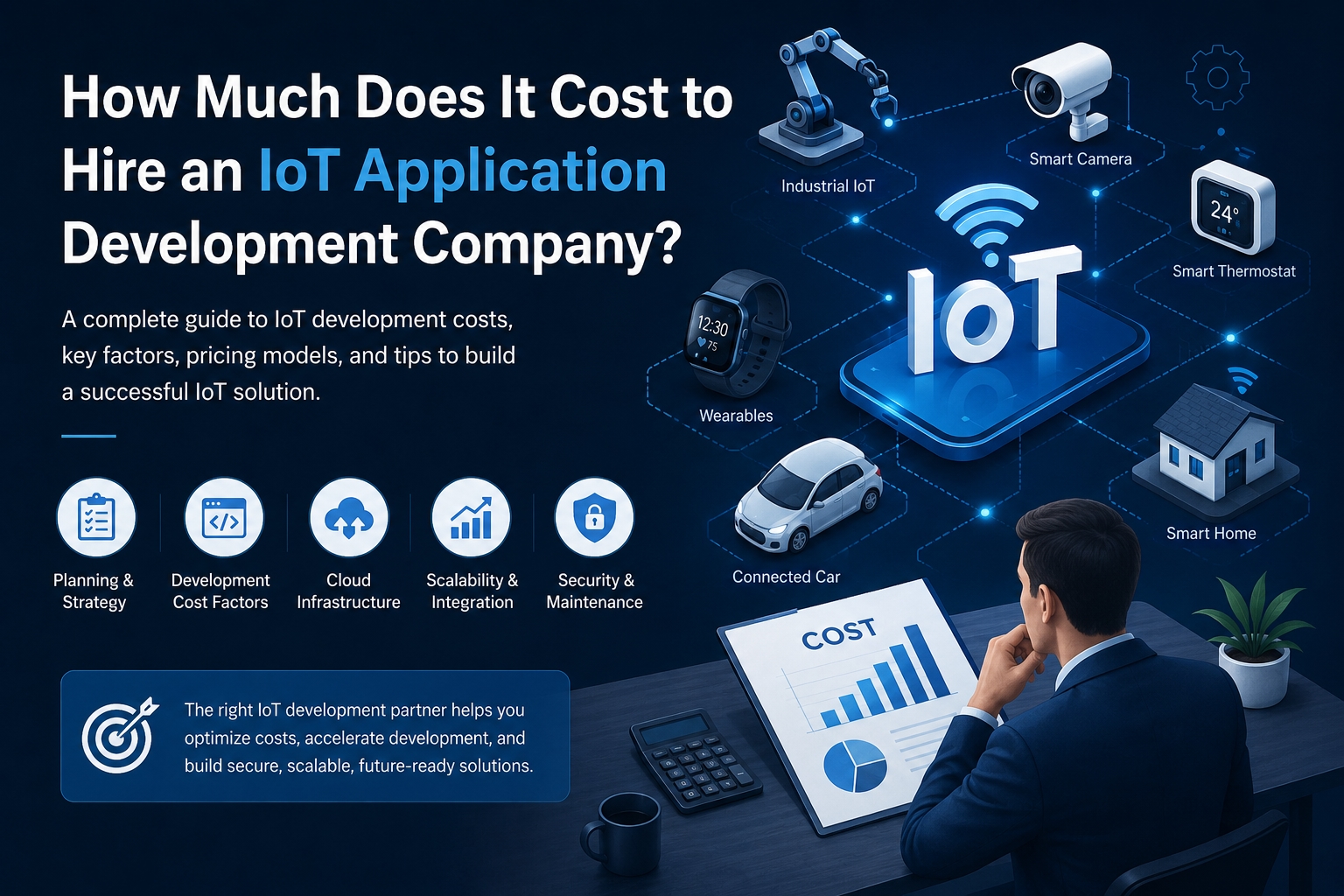
Average Cost to Hire an IoT Application Development Company
There is no universal price for IoT application development. However, a general estimate can help with early-stage planning.
IoT Project Type | Estimated Development Cost |
|---|---|
Basic IoT application | $20,000–$50,000 |
Medium-complexity IoT platform | $50,000–$120,000 |
Advanced IoT solution | $120,000–$250,000+ |
Enterprise IoT ecosystem | $250,000+ |
These figures are planning ranges rather than fixed quotes. The actual cost depends on the application's features, hardware, integrations, cloud architecture, security requirements, development location, and long-term scalability.
For example, a startup building an app that receives temperature data from a few hundred sensors will have very different requirements from a manufacturer monitoring thousands of machines across multiple facilities.
What Determines IoT Application Development Cost?
Several technical and business factors influence the final budget.
1. IoT Application Complexity
The complexity of your application is one of the biggest cost drivers.
A simple IoT application may include:
Device connectivity
User authentication
Basic dashboards
Sensor data visualization
Push notifications
Basic reporting
A more advanced platform might require:
Real-time data processing
Device provisioning
Remote device management
Predictive analytics
AI or machine learning
Automated alerts
Multiple user roles
Advanced dashboards
Third-party integrations
Edge computing
High-volume data processing
The more functionality your platform needs, the more development, testing, and infrastructure planning will be required.
2. Number and Type of Connected Devices
IoT development is not limited to the application itself. Your software must communicate reliably with physical devices.
A project involving 50 devices is considerably different from one supporting 50,000 devices.
Developers may need to account for:
Sensors
Smart appliances
Industrial equipment
Wearables
Gateways
Cameras
GPS devices
Embedded systems
Different devices can also use different communication protocols, which may require additional engineering work.
3. IoT Hardware and Communication Protocols
Hardware compatibility can have a major effect on project cost.
Depending on the use case, an IoT application may communicate using technologies such as:
MQTT
HTTP/HTTPS
Bluetooth Low Energy
Wi-Fi
Zigbee
LoRaWAN
Cellular networks
For instance, a logistics company tracking refrigerated shipments may need GPS, cellular connectivity, temperature sensors, and battery optimization. A smart-home application may rely heavily on Bluetooth, Wi-Fi, or Zigbee.
The development team needs to understand the hardware environment before estimating the software accurately.
4. Cloud Infrastructure and Backend Development
IoT applications generate large amounts of data. That information needs to be collected, processed, stored, and made available to users.
A typical IoT backend may include:
API services
Device management
Databases
Message brokers
Data processing systems
Authentication
Monitoring
Cloud storage
Analytics services
Cloud platforms can provide the infrastructure required for this architecture, but cloud usage also creates ongoing costs.
If your project requires substantial infrastructure optimization or migration from an existing environment, you may also need specialized cloud migration services.
For businesses operating IoT systems at scale, cloud management services can also help monitor infrastructure, optimize resources, and maintain application reliability.
5. Mobile and Web Applications
Many IoT products require more than a backend system.
For example, a smart-building solution might provide:
Mobile app:
Building managers receive alerts and monitor equipment remotely.
Web dashboard:
Administrators analyze energy consumption and device performance.
Backend:
The system receives and processes data from connected devices.
Developing multiple interfaces increases the project scope. However, a well-designed interface can make complex IoT data much easier for non-technical users to understand.
6. Data Analytics and AI
IoT becomes particularly valuable when raw device data is converted into useful business information.
Consider a manufacturing company monitoring industrial equipment.
A basic system may simply report:
Machine temperature: 82°C
An advanced platform could analyze historical readings and identify patterns that suggest potential equipment problems.
This can support:
Predictive maintenance
Anomaly detection
Demand forecasting
Operational optimization
Energy management
Automated decision-making
AI and machine learning capabilities increase development costs, but they can also create measurable business value when applied to the right problem.
7. Security Requirements
Security should be considered from the beginning of an IoT project rather than added after development.
An IoT ecosystem may have multiple potential attack surfaces, including devices, APIs, mobile applications, networks, and cloud infrastructure.
Security requirements may include:
Secure device authentication
Data encryption
API security
Role-based access control
Secure firmware updates
Network protection
Vulnerability testing
Audit logging
Data privacy controls
For an enterprise handling sensitive operational or customer information, security engineering can represent a significant part of the overall budget.
IoT Development Cost by Development Stage
Understanding where your budget goes can make vendor proposals easier to evaluate.
1. Discovery and Planning
During the discovery stage, the development team defines:
Business objectives
User requirements
Device requirements
Technical architecture
Integrations
Security considerations
MVP scope
Skipping proper planning can create expensive changes later.
2. UI/UX Design
Designers create the interfaces users will interact with, including dashboards, mobile screens, device controls, and reporting interfaces.
IoT interfaces require particular attention because users may need to understand large volumes of technical information quickly.
3. Backend and IoT Infrastructure
This stage usually involves building APIs, databases, device communication systems, authentication, data processing, and cloud infrastructure.
For many IoT projects, backend engineering represents a substantial portion of the development effort.
4. Application Development
Developers build the web or mobile applications that allow users to interact with the IoT ecosystem.
The exact cost depends on the number of platforms and required functionality.
5. Testing
IoT testing can be more complicated than conventional software testing because developers need to evaluate interactions between hardware, software, networks, and cloud systems.
Testing may cover:
Device connectivity
API performance
Security
Data accuracy
Network interruptions
Scalability
Mobile compatibility
Hardware compatibility
6. Deployment and Maintenance
Launching an IoT application is not the end of the project.
After deployment, businesses may need:
Security updates
Bug fixes
Infrastructure monitoring
Device support
Performance optimization
New integrations
Application updates
These ongoing requirements should be included in your long-term budget.
Common IoT Development Pricing Models
An IoT application development company may use different pricing models depending on the project.
Fixed-Price Development
A fixed-price model works well when requirements are clearly defined.
You agree on a scope and estimated budget before development begins.
Suitable for: Well-defined MVPs and smaller projects.
Time and Materials
Under this model, you pay based on the actual development time and resources used.
Suitable for: Complex IoT platforms where requirements may evolve.
Dedicated Development Team
You hire a team that works continuously on your product.
The team might include:
IoT developers
Backend engineers
Mobile developers
Cloud engineers
QA specialists
UI/UX designers
Project managers
Suitable for: Long-term IoT products requiring continuous development.
Hidden Costs to Consider
The initial development quote does not always represent the complete cost of owning an IoT platform.
Businesses should also budget for:
Cloud hosting and infrastructure
Device management
Data storage
Third-party APIs
Security monitoring
Software maintenance
Hardware replacement
Connectivity charges
Technical support
Future feature development
For example, an application may initially support 1,000 devices. If the business grows to 100,000 devices, infrastructure and data-processing costs can change substantially.
Scalability should therefore be considered during architecture planning rather than after growth creates performance problems.
How to Reduce IoT Development Costs Without Cutting Quality
Reducing the initial budget does not necessarily mean removing important features. A better approach is to prioritize the right functionality.
Start With an MVP
Build the smallest version that proves the business concept.
For example, instead of developing a complete smart-factory platform immediately, an MVP could focus on:
Device connectivity
Real-time monitoring
Basic alerts
A simple dashboard
Once customers validate the product, additional analytics and automation can be introduced.
Use Existing Cloud Services
Building every infrastructure component from scratch can increase development time. Established cloud services can provide building blocks for storage, authentication, messaging, monitoring, and data processing.
Plan for Scalability Early
A low-cost architecture that cannot handle growth may become expensive to replace later.
Your development partner should consider future device volume, data growth, security requirements, and integration needs during the architecture stage.
Choose a Development Partner Based on Technical Fit
Price should not be the only consideration when selecting an IoT development company.
Evaluate:
IoT development experience
Cloud expertise
Security practices
Backend architecture capabilities
Mobile and web development skills
Testing processes
Post-launch support
Communication and project management
A technically suitable partner can help identify unnecessary complexity before development begins.
How to Choose an IoT Application Development Company
Before signing a contract, ask potential development partners specific questions.
Technical Questions
Which IoT platforms and protocols have you worked with?
How will you handle device authentication?
What cloud architecture do you recommend?
How will the platform scale as devices increase?
How will data be stored and processed?
What security measures will be implemented?
Business Questions
What will be included in the initial scope?
How will change requests be handled?
What are the estimated ongoing infrastructure costs?
What support is available after launch?
How will project progress be reported?
A company with capabilities across custom software development, cloud engineering, mobile applications, AI, and technical consulting can be particularly useful when your IoT product requires several technologies working together.
When Does IoT Development Deliver Business Value?
IoT development makes sense when connected devices can solve a measurable business problem.
For example:
Manufacturing:
Sensors can provide equipment data that supports predictive maintenance and reduces unexpected downtime.
Logistics:
Connected tracking devices can provide information about location, temperature, and shipment conditions.
Healthcare:
Connected devices can collect relevant patient or equipment data for approved monitoring workflows.
Retail:
IoT systems can help monitor inventory, equipment, and store conditions.
Energy:
Connected meters and sensors can provide information that helps organizations identify consumption patterns.
The business case should come before the technology. If the IoT system does not address a clear operational or customer problem, adding more devices and features will not automatically create value.
Final Thoughts
The cost to hire an IoT application development company depends heavily on the scope of the project. A straightforward IoT application may cost tens of thousands of dollars, while a large enterprise platform can require a significantly larger investment.
The biggest cost factors include device complexity, application features, cloud architecture, integrations, security, analytics, scalability, and ongoing maintenance.
The most practical approach is to define the business problem first, identify the minimum viable product, estimate the technical architecture, and then work with an experienced development partner to create a realistic budget.
For companies building connected products, Bitrupt combines custom software development, IoT solutions, cloud engineering, mobile and web application development, AI, and technical consulting. This broader technical capability can help businesses approach IoT as an end-to-end product rather than treating the connected application as an isolated piece of software.
FAQs
1. How much does it cost to develop an IoT application?
A basic IoT application can start around $20,000, while medium and advanced solutions can range from $50,000 to $250,000 or more. The final cost depends on device count, features, integrations, security, cloud infrastructure, and development requirements.
2. What is the biggest factor affecting IoT development cost?
Application complexity is one of the major factors. However, device integration, cloud infrastructure, security, data processing, and scalability can also have a significant impact on the total budget.
3. How long does it take to build an IoT application?
A basic MVP may take several months, while complex enterprise IoT platforms can require significantly longer development cycles. Hardware integration, testing, security, and third-party systems can affect the timeline.
4. Does IoT software require cloud infrastructure?
Not always, but cloud infrastructure is commonly used for scalable IoT applications because it can support device management, data storage, processing, analytics, APIs, and monitoring. Some solutions also combine cloud infrastructure with edge computing.
5. Should a startup build a complete IoT platform from the beginning?
Usually, it is more practical to start with a focused MVP that validates the core business case. Once the concept is proven, additional devices, analytics, automation, and integrations can be introduced based on actual user and business requirements.