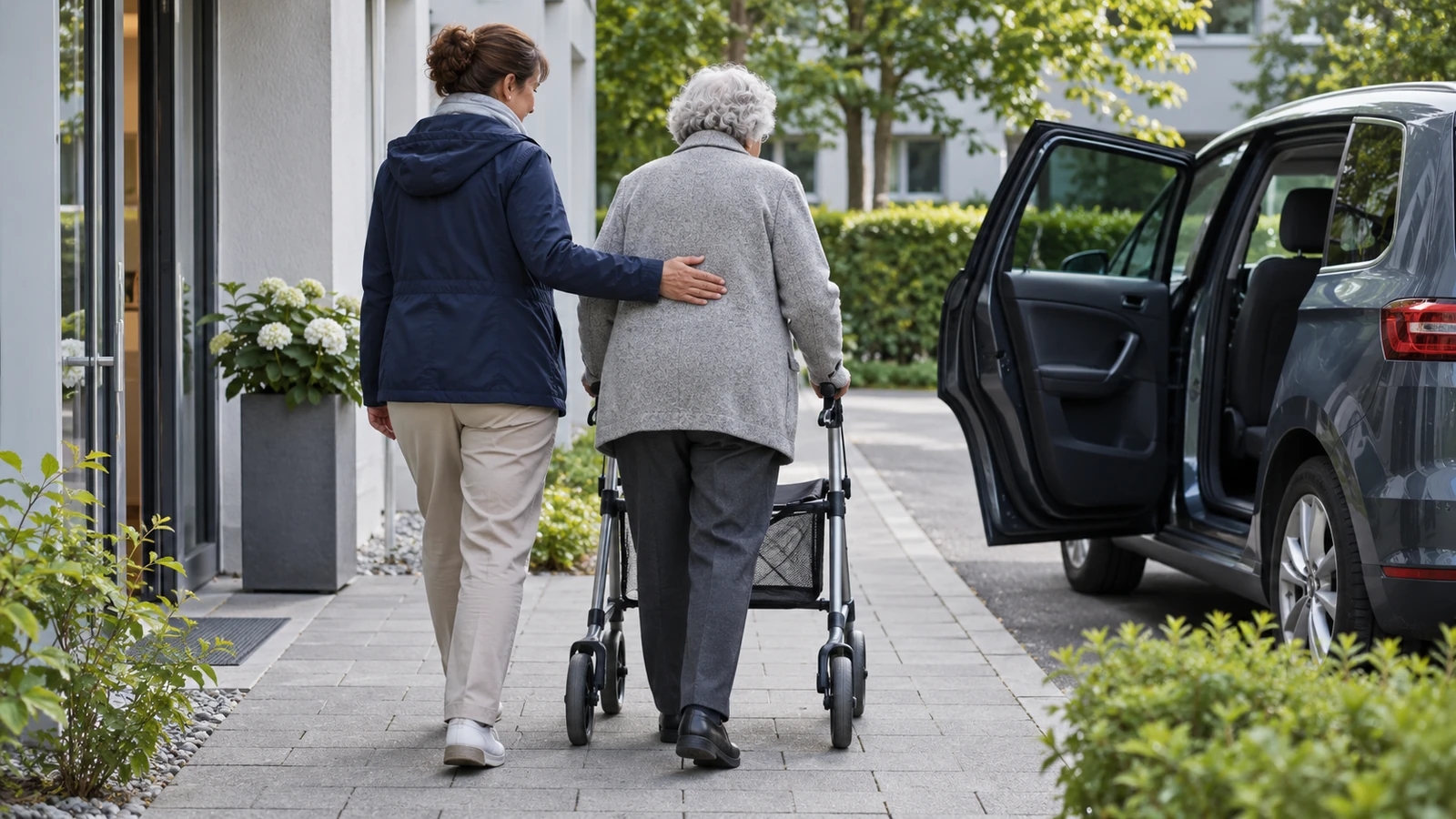
Door-to-door assistance helps an older passenger complete the short walks and transitions at either end of a trip. For someone with walking difficulties, reaching the car, crossing a kerb and getting from the drop-off bay to the building may require more help than the ride itself. Agree where assistance starts and ends before booking.
What door-to-door assistance covers
Depending on the provider, door-to-door help can include meeting the passenger at an agreed entrance, walking alongside them and helping with boarding and alighting. Ask whether the agreed door is the apartment door, the building lobby or the outside entrance. A guide to transport options for older and disabled passengers can help families compare which type of support fits the trip.
Break the trip into short sections: from the home door to the lobby, from the lobby to the car, and from the drop-off bay to reception. For each, say whether the passenger can manage alone or needs someone with them. This gives the provider a clearer request than “needs a little help.”
How walking difficulty changes boarding needs
A passenger may walk independently on a level corridor and still need help over a curb, when turning at a car door or when stepping down. Explain how far they can comfortably walk, whether they use a cane or walker, and which parts of boarding typically require another person.
Someone may walk through a lobby with a frame but need time to rest before boarding. Ask where the passenger can sit while the car pulls up, who will move the frame after boarding, and who will bring it back to the open door at drop-off.
Why entrances, kerbs and stopping points matter
Map the route from the meeting point to the vehicle at each end. Steps at a building entrance, a broken kerb ramp or a vehicle stop across a busy lane can change the amount of help required. A step-free side entrance can be a better meeting point when the provider can stop nearby.
In an apartment complex, the closest gate on the map may lead to steps, while another gate has a level approach. Confirm that the alternative is open at the appointment time and that a driver can stop there. Give the entrance name and a landmark a driver can see from the road.
What assistance needs prior agreement
Confirm whether the provider can meet the passenger inside the lobby, accompany them to reception or carry a folded walking aid. Share any stairs or transfer needs in advance. Arrange clinical or personal care separately according to the passenger’s needs.
Agree on the handover at each end. For example, a relative could meet the driver in the building lobby, while the clinic confirms where staff can receive the passenger. Name the person responsible for each stretch that requires help. This matters particularly when the passenger travels without a companion.
When is door-to-door assistance valuable for elderly passengers?
Door-to-door help is useful when a passenger can make the trip but needs support to reach the vehicle or continue from it to the destination. When arranging door-to-door transport for older passengers, give the precise meeting points and ask what help the assigned driver can provide at each end.
A useful booking note is “Please meet us at the lift lobby. The passenger walks with a frame and needs help at the vehicle step. Can someone accompany them to the clinic reception?” Ask the provider to confirm the tasks they can cover so the family can arrange the rest.
Can older passengers need help even when they can walk?
Yes. A passenger who can walk may still need help on steps, at kerbs or when moving into a vehicle seat.
Does boarding assistance automatically include nursing care?
No. Boarding assistance covers agreed mobility tasks. Confirm any nursing or clinical care separately.
Should the pickup entrance be checked ahead of travel?
Yes. Check the entrance ahead of time for steps, door access, distance to the vehicle and a suitable place to stop.