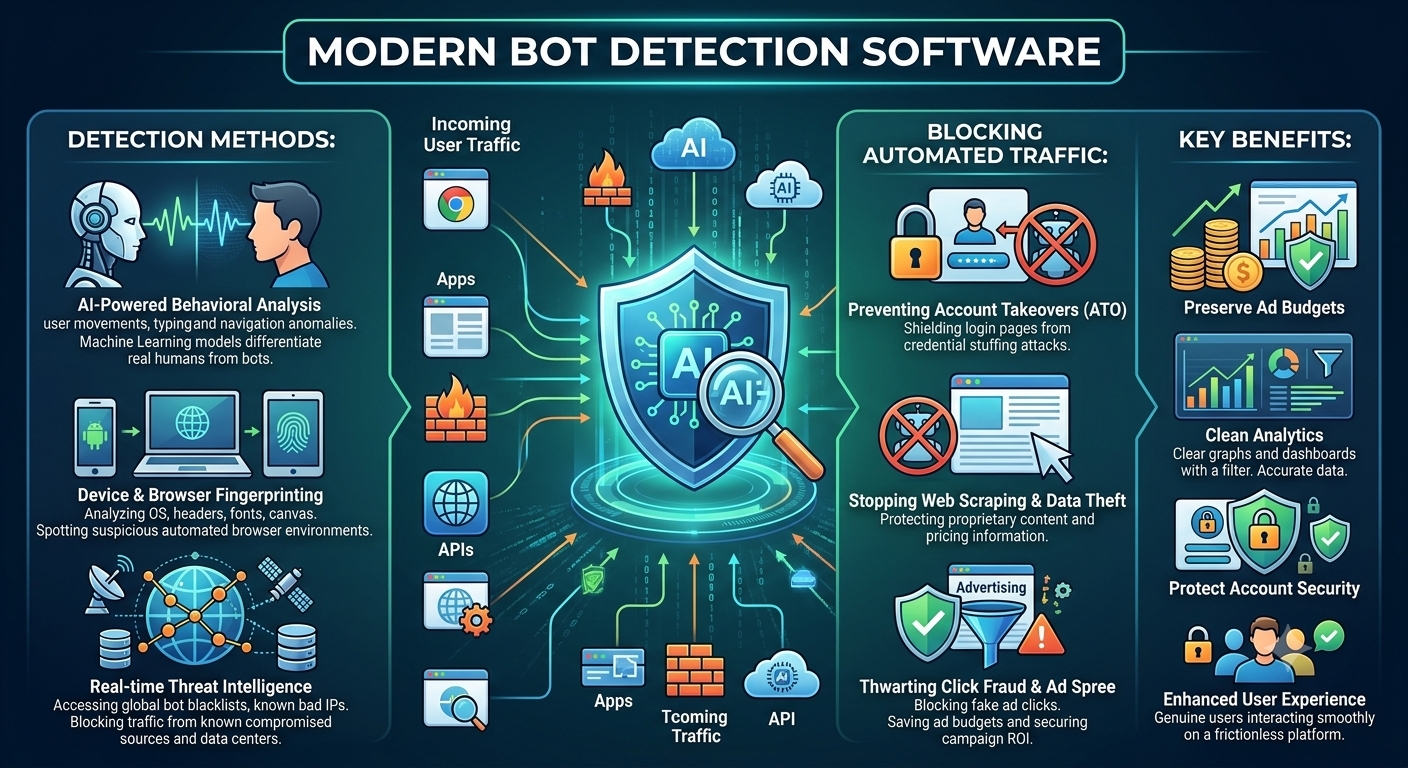
Digital assets, ad spends, and servers experience constant attacks through automated bots. Contemporary scrapers, click bots, and intelligence bots are not anymore based on basic cURL commands because they employ headless browsers that simulate human behaviour.
Selecting the best bot detection software requires insight into how traffic validation works. The most advanced bot detection software is able to detect, classify, and block automated traffic from damaging web assets or skewing analytical data.
The Core Mechanisms of Bot Detection Software
To prevent malicious scraping and invalid automated clicks, modern security solutions employ multi-layered analysis. Rather than relying on a single data point, traffic validation engines analyse hundreds of request parameters in parallel.
Incoming Request
Layer 1: Network & IP Check ──(Data Center / Proxy Subnets)──► [ Block / Challenge ]
Layer 2: Fingerprint Analysis ──(Headless Browser / Canvas)────► [ Block / Challenge ]
Layer 3: Behavioral Biometrics ──(Non-Human Timing / Motions)───► [ Redirect / Honeypot ]
[ Genuine Human Visitor ]
1. Network & IP Reputation Analysis
The initial filter evaluates the originating IP address and network characteristics:
Subnet intelligence: Detects connections made from commercial data centers, commercial Virtual Private Networks (VPNs), or Tor Exit Nodes – connections that are rarely linked to legitimate human activity.
Rate limiting: Measures speed of requests within certain IP address blocks and identifies connections characterised by frequent queries, which is typical for web crawlers.
Network Protocol Fingerprinting: Analyses TLS/SSL handshake parameters and verifies that the connection fingerprint corresponds to a regular browser rather than an automation library.
2. Browser & Device Fingerprinting
Even when scrapers route requests through residential proxies, client-side fingerprinting uncovers execution anomalies:
Automation Variables: Checks for internal properties like navigator.webdriver that are often exposed by browser automation frameworks such as Puppeteer or Selenium.
Canvas & WebGL Rendering: Solves background rendering tasks to analyse GPU signatures and system fonts, identifying emulated browser instances.
Header Consistency: Cross-references the User-Agent string against real-world browser capabilities, headers, and OS profiles.
3. Behavioural Biometrics
A good bot detection tool system uses behaviour tracking in real time to differentiate between user navigation and robot programming.
Interaction Path: The actions of real users involve inconsistent mouse movements, touch and scrolling. Linear movements or instantaneous jumps point to automated systems.
Event Timing: Tracks the time between keyboard and other interactions. Sub-millisecond submissions of forms or consistent intervals point to machine processing.
Visit here: HideClick
Comparison of Detection Techniques
Different defence mechanisms offer varying levels of efficacy and user friction:
Detection Layer | Primary Target | Strengths | Execution Latency |
IP & Network Rate Limiting | Basic Scrapers, Volumetric Attacks | Low resource overhead, fast mitigation | Sub-1ms |
TLS & Header Fingerprinting | Python Scripts, HTTP Client Libraries | Identifies script-based connections | Sub-2ms |
JS Environment Probing | Headless Browsers, Selenium, Puppeteer | High accuracy against automated browsers | Sub-5 ms |
Behavioral Biometrics | Advanced Human-Emulating Bots | Catches sophisticated residential bots | Continuous Analysis |
Real-Time Automated Mitigation Strategies
When an invalid or automated request is detected, modern bot detection software applies tailored mitigation actions depending on the site's security configuration:
┌──► Real-Time Traffic Routing (Safe Page / Compliant View)
│
Mitigation Options ────┼──► Silent Honeypot Redirection (Feed Stale / Mock Data)
│
└──► Direct Connection Termination (HTTP 403 / Rate Limit)
Traffic Diversion: Potential adversaries or ad reviewers are diverted to a different landing page that complies with all regulations, ensuring that no one gains access to the main funnels or offers.
Honeypot Bait: Scrape bots are diverted to other pages where data is modified, confusing the bots and protecting database sources.
Automated Block List: IP ranges or signatures that pose high risks are automatically blocked.
Evaluating Solutions for Web Assets
The choice of best bot detection tools will depend on several factors including campaign needs, architecture, and latency requirements. Features to be considered are:
Low Latency of Execution: Execution must occur in milliseconds to avoid delays to valid human traffic.
Cross-Platform Support: Easy implementation through server-side scripts (PHP, Node.js) or through edge rules (Cloudflare, Web Application Firewalls).
Low False Positives: Scoring engines in place to avoid unnecessary friction for human users.
By deploying multi-tiered bot detection software, organisations can safeguard ad budgets, protect proprietary site data, and ensure infrastructure resources serve actual human users.