
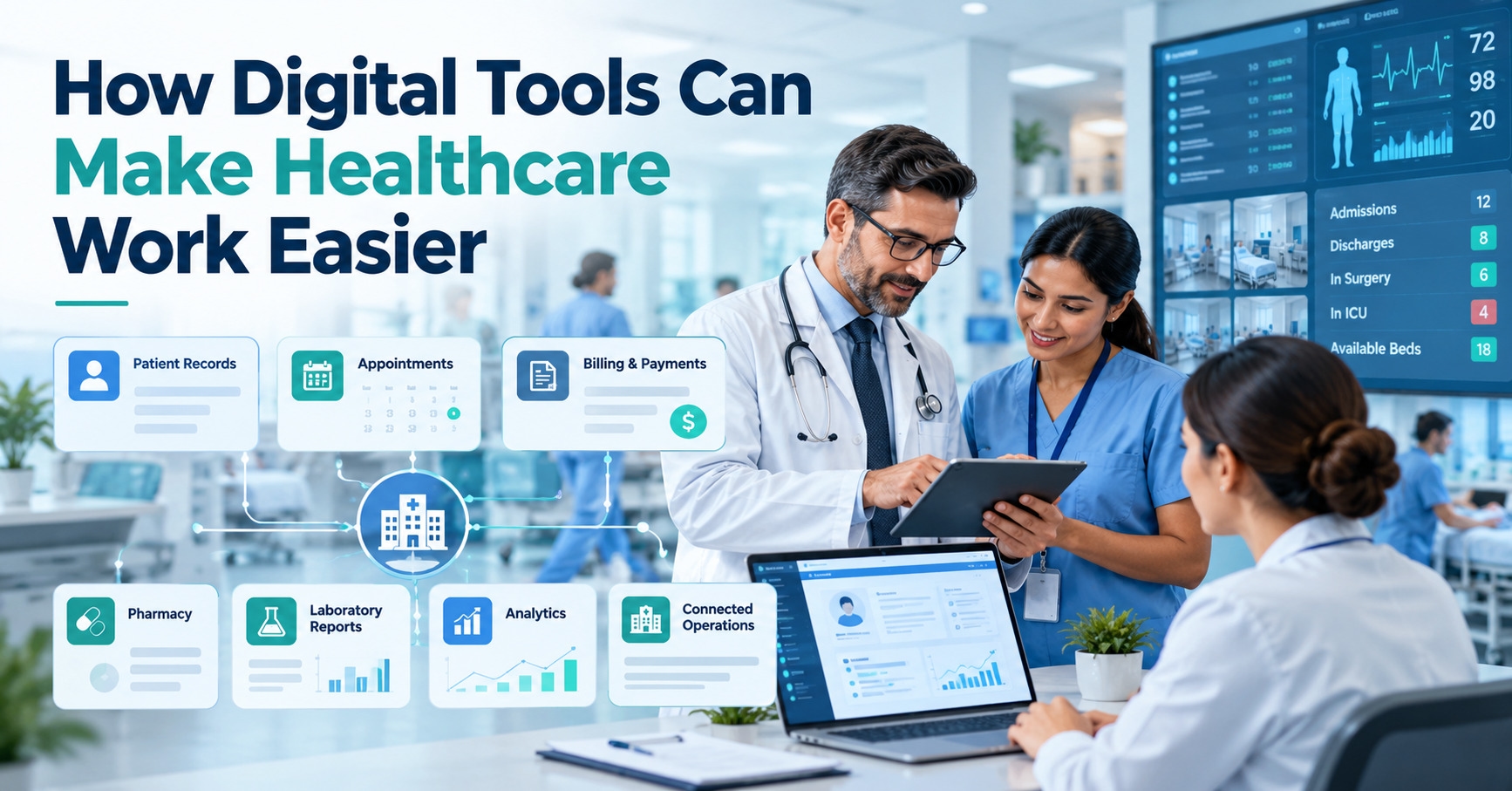
Running a hospital, clinic, diagnostic center, or healthcare facility involves far more than treating patients. Every day, healthcare teams manage appointments, patient records, billing, medicines, laboratory reports, staff schedules, admissions, discharges, and many other operational tasks.
When these activities are handled through separate systems, spreadsheets, paper files, or manual processes, everyday work can become unnecessarily complicated. Information may need to be entered several times, staff can spend longer searching for records, and departments may struggle to stay coordinated.
Modern digital healthcare platforms can help bring these activities together. A well-implemented Health Management System can provide healthcare organizations with a more organized way to manage administrative, clinical, and operational information from one connected environment.
The objective is not simply to replace paper with software. The real value comes from making information easier to access, reducing repetitive work, and helping healthcare teams manage daily responsibilities more efficiently.
Why Healthcare Organizations Need Better Digital Systems
Healthcare organizations handle a significant amount of information every day.
A single patient visit may involve:
Registration
Appointment management
Medical history
Doctor consultation
Laboratory testing
Pharmacy services
Billing
Payment processing
Follow-up appointments
Medical reports
If each department uses a different process, information can quickly become fragmented.
For example, the reception desk may maintain appointment information separately from the billing department. The laboratory may use another system for reports, while doctors may rely on different patient records.
This separation can increase administrative work and make coordination more difficult.
Digital healthcare management systems attempt to solve this problem by connecting important operational activities within a centralized platform.
Centralized Patient Records
Patient information is one of the most important parts of healthcare operations.
Traditional paper records can be difficult to manage as the number of patients increases. Files may need physical storage, retrieving historical records can take time, and updating information manually may create unnecessary administrative work.
Digital patient records allow authorized healthcare staff to access important information more efficiently.
Depending on the healthcare system being used, patient information may include:
Personal details
Previous consultations
Medical history
Prescriptions
Diagnostic reports
Laboratory results
Treatment information
Follow-up records
Having this information available within one system can make it easier for healthcare teams to understand previous interactions and continue patient care without repeatedly searching through different records.
Easier Appointment Management
Appointments may appear simple from a patient's perspective, but healthcare organizations often manage hundreds or even thousands of bookings.
Staff need to coordinate:
Doctor availability
Patient schedules
Consultation times
Cancellations
Rescheduling
Follow-up visits
Department availability
Manual appointment systems can become difficult to maintain when patient volumes increase.
Digital appointment management allows staff to view schedules more clearly and update bookings from a centralized interface.
This can help reduce scheduling conflicts and make it easier for reception teams to manage daily patient flow.
Some healthcare platforms may also support appointment notifications or reminders, which can provide patients with useful information before their visit.
Improving Communication Between Departments
Healthcare facilities consist of multiple departments that depend on each other.
A patient may first visit reception, then meet a doctor, complete laboratory testing, collect medication from the pharmacy, and finally visit billing.
If every department operates independently, staff may need to manually transfer information between systems.
Connected digital tools can create a more organized workflow.
For example, when a doctor requests a laboratory test, the information may become available to the laboratory department through the same digital environment. When results are completed, authorized healthcare professionals may be able to access them without relying on printed reports.
The same principle can apply to pharmacy requests, billing information, admissions, and other operational processes.
Simplifying Billing and Payment Management
Healthcare billing can involve many different activities.
These may include:
Consultation fees
Laboratory charges
Pharmacy purchases
Procedures
Room charges
Insurance information
Payment records
Outstanding balances
Managing these transactions manually can become complicated, especially in larger healthcare facilities.
A digital billing system can help maintain financial information in a structured format.
Healthcare staff can view patient charges, record payments, create invoices, and track billing information from one system.
This can make administrative processes more organized and may also reduce the need to maintain multiple financial records across different departments.
Better Pharmacy Management
Pharmacies within hospitals and clinics need accurate information about medicines and stock levels.
Healthcare staff may need to track:
Available medicines
Stock quantity
Medicine categories
Purchase information
Expiry dates
Prescriptions
Dispensed medicines
Manual inventory tracking can become difficult when the pharmacy handles a large number of products.
Digital pharmacy management tools can provide a clearer view of available inventory.
Staff can identify which medicines are available, which items may need to be reordered, and which products require attention.
When pharmacy information is connected with the wider healthcare system, prescription and patient information can also be managed more efficiently.
Laboratory and Diagnostic Management
Laboratories generate important patient information every day.
Tests may be requested by doctors, processed by laboratory teams, reviewed, and then shared with patients or healthcare professionals.
Without an organized digital workflow, managing large numbers of test requests and reports can become challenging.
Laboratory management features can help organize:
Test requests
Patient information
Sample information
Test status
Results
Reports
Digital access to reports can also make it easier for authorized healthcare professionals to review results without relying entirely on printed documentation.
Managing Hospital Admissions and Beds
Hospitals have additional operational requirements compared with smaller clinics.
Staff may need to continuously monitor:
Admissions
Discharges
Available beds
Occupied beds
Ward information
Patient transfers
Intensive care availability
Procedures and surgeries
When this information is maintained manually, it can be difficult to understand the hospital's current capacity.
A centralized digital dashboard can provide staff with a clearer operational overview.
For example, administrators may be able to see the number of available beds, current admissions, discharges, and patient locations from one system.
This type of visibility can support better day-to-day coordination.
Using Healthcare Data More Effectively
Healthcare organizations generate large volumes of operational data.
However, information provides limited value when it remains scattered across different spreadsheets, files, or software platforms.
Modern healthcare systems can organize information into reports and dashboards that help administrators understand operational activity.
Depending on the platform, healthcare managers may be able to review information related to:
Patient volume
Appointments
Revenue
Billing
Pharmacy activity
Laboratory activity
Admissions
Department performance
These insights can help decision-makers identify patterns and better understand how different areas of the organization are functioning.
Reducing Repetitive Administrative Work
Many healthcare employees spend a considerable amount of time completing administrative tasks.
The same patient information may sometimes be entered into several systems.
For example, reception staff may collect patient details during registration. Similar information may later be required by billing, laboratory, pharmacy, or clinical departments.
Connected healthcare software can reduce unnecessary duplication by allowing authorized departments to work with information already stored within the system.
This allows staff to spend less time repeatedly entering the same data and more time completing other important responsibilities.
Improving Access to Important Information
Healthcare professionals often need information quickly.
A doctor may need to review previous reports before making a clinical decision. Reception staff may need appointment history. Billing teams may need payment details.
If this information is stored in separate locations, employees may spend additional time finding the correct record.
Centralized digital systems can make important information easier to locate.
Instead of searching through several tools or physical files, staff can access relevant information through one organized platform, depending on their permissions and responsibilities.
Supporting Multi-Department Healthcare Organizations
Small clinics may only need basic appointment, patient, and billing features.
Larger healthcare organizations may require a much broader system covering multiple departments.
A scalable healthcare platform can support areas such as:
Reception
Doctors
Nursing
Pharmacy
Laboratory
Billing
Accounting
Hospital administration
Patient records
Inventory
Reporting
This becomes particularly important when healthcare organizations expand.
Adding new doctors, departments, services, or locations becomes more difficult when every area operates through separate processes.
An integrated system provides a stronger operational foundation for growth.
Digital Tools Should Be Easy for Staff to Use
Technology is only useful when people can use it effectively.
Healthcare employees have different responsibilities and different levels of technical experience.
Doctors need quick access to relevant patient information.
Reception teams need simple appointment and registration workflows.
Administrators need reporting and operational visibility.
Pharmacy and laboratory teams need tools designed around their specific processes.
For this reason, healthcare software should provide a clear interface and logical workflow rather than introducing additional complexity.
Platforms such as ehealthmatrix are designed around the concept of bringing healthcare activities into a more connected digital environment.
The effectiveness of any healthcare platform, however, ultimately depends on how well it matches the organization's actual operational requirements.
Choosing the Right Healthcare Management Platform
Not every healthcare organization needs the same software.
Before selecting a platform, healthcare providers should first understand their operational needs.
Important questions may include:
Which departments need digital management?
Identify whether the organization needs support for appointments, billing, laboratory operations, pharmacy management, patient records, hospital management, or several areas together.
How many users will use the system?
A small clinic may have only a few staff members, while a hospital may require access for multiple departments and many employees.
Can the system grow with the organization?
Healthcare businesses often expand over time. The selected platform should be capable of supporting additional users, services, departments, or locations when required.
Is important information easy to access?
Staff should be able to find relevant information without navigating through unnecessary complexity.
Does the platform support reporting?
Operational reports can help healthcare managers understand activity and identify areas that may require attention.
How will existing information be handled?
Organizations moving from paper records or another platform should consider how existing information will be transferred and organized.
Implementation Is Just as Important as the Software
Purchasing healthcare software is only one part of digital transformation.
Successful implementation requires planning.
Healthcare organizations should clearly define:
Which processes will move into the new system.
Which departments will use each feature.
What access permissions different employees require.
How existing information will be migrated.
How employees will be trained.
Who will manage the platform internally.
Introducing everything at once may not always be the best approach.
Some organizations may benefit from implementing essential modules first, such as patient registration, appointments, and billing, before gradually expanding into laboratory, pharmacy, analytics, or additional administrative functions.
A structured rollout can make adoption easier for staff.
The Role of Automation in Healthcare Administration
Automation does not mean removing healthcare professionals from important decisions.
Instead, automation can help with routine administrative processes that do not require continuous manual work.
Examples may include:
Updating appointment records
Generating invoices
Organizing reports
Maintaining transaction records
Tracking inventory
Producing operational summaries
Reducing repetitive administrative tasks can allow healthcare employees to concentrate on responsibilities that require human attention and professional judgment.
Digital Transformation Is an Ongoing Process
Healthcare technology continues to develop.
Organizations that once relied almost entirely on paper records are increasingly using digital systems for everyday operations.
However, digital transformation should not be treated as a one-time project.
Healthcare organizations should regularly review:
Staff requirements
Patient workflows
Reporting needs
Department processes
Data management practices
System performance
As the organization grows, its software requirements may change as well.
A flexible system can help healthcare providers adapt without continuously replacing their entire operational infrastructure.
Final Thoughts
Healthcare organizations manage many interconnected activities every day.
Patient registration, appointments, medical records, billing, laboratory testing, pharmacy management, admissions, reporting, and administration all need to work together.
When these processes are separated across multiple systems or handled manually, everyday operations can become more complicated.
Digital healthcare management platforms provide an opportunity to connect these activities within a more organized environment.
The main advantage is not simply using newer technology. It is creating a system where information can move more efficiently between authorized teams, repetitive work can be reduced, and healthcare staff can manage daily responsibilities with greater clarity.
For hospitals and clinics considering digital transformation, the best approach is to first understand existing operational challenges and then select technology that genuinely supports those workflows.
Frequently Asked Questions
What is a Health Management System?
A Health Management System is a digital platform designed to help hospitals, clinics, and healthcare organizations manage daily operations such as patient records, appointments, billing, pharmacy, laboratory reports, admissions, and administrative tasks from one connected system.
How can digital tools improve healthcare operations?
Digital tools can reduce repetitive administrative work, improve access to information, organize patient records, simplify scheduling, support billing processes, and help different departments work together more efficiently.
Can small clinics use healthcare management software?
Yes. Small clinics can use healthcare management software for essential functions such as patient registration, appointment scheduling, medical records, billing, and reporting. The system can later be expanded as the clinic grows.
What features should a healthcare management platform include?
Common features include patient management, appointment scheduling, billing, pharmacy management, laboratory management, reporting, inventory tracking, admissions, discharge management, and role-based staff access.
How does a digital healthcare system help hospital staff?
It can give staff faster access to relevant information, reduce duplicate data entry, improve coordination between departments, and provide a clearer view of day-to-day hospital operations.
Is healthcare software useful for managing multiple departments?
Yes. An integrated healthcare platform can connect departments such as reception, billing, pharmacy, laboratory, doctors, nursing, administration, and reporting within one centralized environment.
What should healthcare organizations consider before choosing software?
Organizations should consider their size, number of users, required modules, ease of use, reporting needs, scalability, data migration requirements, staff training, and how well the platform fits their existing workflows.


